Key Takeaways
- Existing-mold customized thermos orders usually start at 1,000 units per color, with 30-45 days production after approval
- A 500 ml double-wall 304 stainless thermos often quotes from USD 3.20-6.80 FOB China depending on lid, coating, and packaging
- Laser logo samples can be ready in 5-7 days; new mold development normally adds 25-40 days
- Freight, duty, testing, inserts, and retail cartons can add 18-45% above the FOB unit price
Search thermos manufacturer near me and the map is only half the job. Most buyers we talk to want a shorter quote loop, fewer packing surprises, and someone who can show why a 500 ml flask is USD 3.10 on one BOM and USD 7.80 before freight on another. Last Tuesday, QC pulled two 304 stainless samples from the line; the cheaper one had a 0.35 mm thinner outer wall and a lid gasket that failed after 6 drop tests.
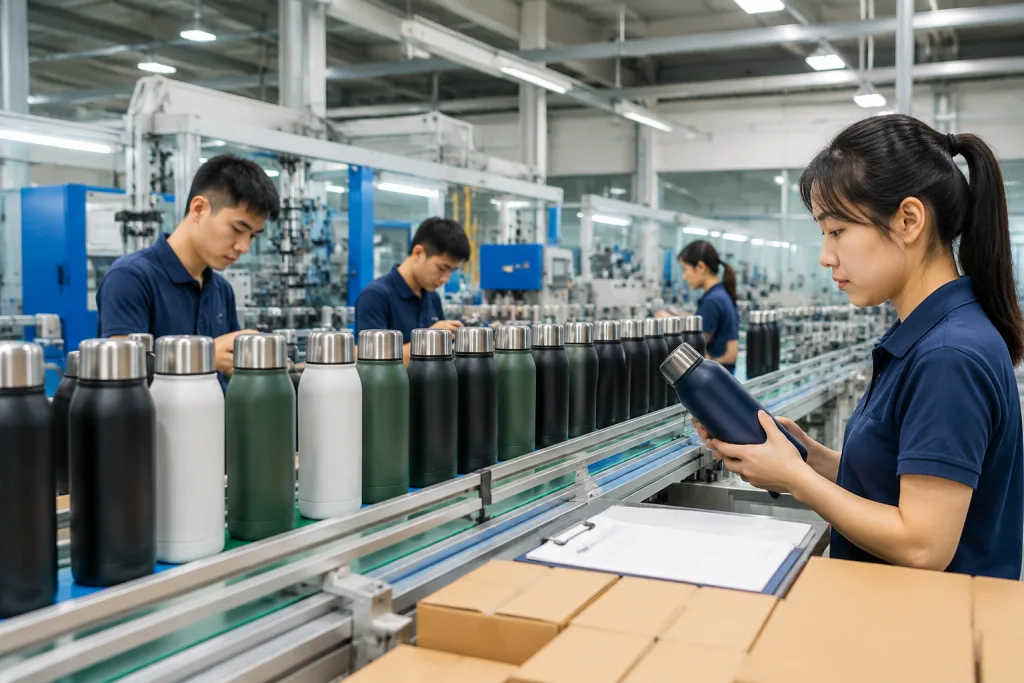
For outdoor retailers and promotional brands, stainless thermos sourcing comes down to cost and ship date. The wrong question is “who is closest?” Ask who can hold spec when the PO says matte black but the artwork file says PMS Black 6 C. BottleForge Industrial manufactures in Hangzhou, Zhejiang, China, with monthly stainless capacity around 450,000 units and practical custom thermos MOQs starting at 1,000 units per color for existing molds. We run existing mold jobs faster because tooling is already on the rack; a new lid shape means CNC sampling, seal testing, and usually 12 days vs 18 days before the buyer sees the first pre-production sample.
Near Me Usually Means Lower Risk
A local thermos vendor makes sense for 48-hour stock delivery. For a customized thermos with logo, Pantone color, gift box, barcode, and retailer compliance, thermos manufacturer near me is the wrong question to ask. You need a manufacturer thermos partner who replies before your buyer chases you, controls the line, and sends real numbers before the PO. Last month QC pulled a 500 ml sample because the logo sat 2 mm too low against the handle line; that is the kind of issue a trading desk misses.
Most stainless thermos manufacturing still sits in China because the parts are close: stainless coil, vacuum forming, powder coating, injection lids, silicone seals, cartons, and test labs. In Zhejiang, we source 304 stainless sheet, PP lid components, food-grade silicone, and coating powder within 3 hours of Hangzhou. The line moves faster when the lid mold shop is 18 km away, not across an ocean. A sales office address does not fix a late gasket.
For outdoor retailers, the risk is not whether a thermos factory can make a bottle. Almost 40 factories can show you a nice sample. The risk is whether your 12 oz, 16 oz, and 24 oz range lands with the same color, no vacuum failure, retail labels that scan, and packaging that survives container loading. We run carton drop tests at 76 cm; one buyer flagged crushed corner protectors after the first pallet stack. For promotional thermos orders, the pain is different: the logo must match the AI file, the event date cannot slip, and the carton mark has to match your distributor thermos packing plan.
A serious thermos supplier should give you a cost sheet with material grade, wall thickness, lid type, decoration method, carton quantity, gross weight, sample time, production lead time, and FOB port. Ask for the dull details: 0.5 mm inner wall, 24 pcs per carton, 13.8 kg gross weight, 7 days for logo samples, 28 days for bulk after deposit. If the quote only says “best price, high quality,” keep moving. We have seen this go sideways.
Unit Price Starts With Construction
Body construction sets the base cost before any logo, color, or gift box gets quoted. For a standard double-wall vacuum flask, we usually run 0.4-0.5 mm inner and outer walls in 304 stainless steel; QC checks the sheet with a digital thickness gauge before stamping. Outdoor models often move to a 0.5-0.6 mm outer wall, which helps when a bottle gets dropped on concrete, but the math doesn't work if the buyer wants a lightweight commuter item. A 500 ml factory thermos with 304 inner and 201 outer will price lower. For Europe and North America, 304 inside and outside is still the safer sell; 7 out of 10 importers we quote ask for it after their retail team reviews the spec sheet.
For FOB China pricing, a simple 350 ml stainless thermos is usually around USD 2.60-4.80 at a normal MOQ of 3,000 pcs. A 500 ml custom thermos usually lands around USD 3.20-6.80. A 750 ml or 1 L outdoor bottle can move from USD 5.20 to above USD 9.50 once you add a rugged carry handle, cup lid, powder coating, and a 350 gsm individual retail box with barcode sticker. These numbers are not fixed. Last month one buyer flagged a USD 0.38 jump after steel moved and their PO had “matte black” typed as “mate black,” which delayed artwork confirmation by 2 days.
Lids need a harder look than most buyers give them. A basic screw cap is cheap and reliable, and on the line we can leak-test it fast with a 45-degree tilt check plus vacuum tester. A push-button stopper feels better in hand, but QC pulled the sample twice on one 500 ml order because coffee seeped around the spring seat after 8 hours. A cup lid with stainless liner suits a premium thermos promotional set; it also adds tooling parts, assembly steps, and one more gasket size for the warehouse to control. Silicone gaskets should be food-grade and removable for cleaning. For children’s or outdoor retail ranges, we normally recommend PP or Tritan-contact components with LFGB or FDA documentation available.
Do not buy only by milliliter capacity. Two 500 ml flasks can differ by USD 1.20 because of steel grade, coating, lid tooling, vacuum performance, and packaging.
MOQ Tiers Change The Math
MOQ is where bulk thermos projects get priced wrong. For existing molds, we usually run 1,000 units per color, and mixed capacity sizes are workable if the body shape is already on our rack. Below 1,000 units, the line still pays for color change, fixture setup, logo screen preparation, carton printing, and QC paperwork. A 300-unit inquiry does not get 30% of the setup cost. QC still pulls pre-production samples with the same 0.02 mm logo-position tolerance, so the math doesn’t work.
At 1,000-2,999 units, you are close to project-entry pricing. Laser engraving, one-color silkscreen, or a simple pad print is realistic, and we can usually finish the sample check with a 3M tape test before bulk. At 3,000-5,000 units, powder coating and custom gift box costs are easier to spread across the order. At 10,000 units and above, a thermos manufacturer has more room on coating line scheduling, carton board purchasing, and lid component buying. We have seen the gap between 1,000 and 10,000 units land at 8-18% on the FOB unit price, depending on model.
For distributors thermos programs, MOQ should be planned by SKU, not only by total order. A 6,000-unit PO split into six colors is not the same as 6,000 units in one color. Each color needs its own powder coating setup, color chip approval, and line cleaning; last month the buyer flagged a matte green that drifted 1 Pantone shade after baking. If your outdoor retailer wants three capacities in four colors, you are managing 12 SKUs. Count it that way from day one.
New molds are a different discussion. A new lid mold can start around USD 1,500-4,000. A new stainless body mold may run USD 3,000-8,000 or more depending on shape and tooling. For a private product family, we usually advise new tooling only when the first confirmed volume is at least 5,000-10,000 units, or when the design gives enough shelf difference to justify the payback. We have seen this go sideways when a PO says “custom lid” but the drawing only shows a 1.5 mm change to the carry loop.
Branding Costs Are Not Equal
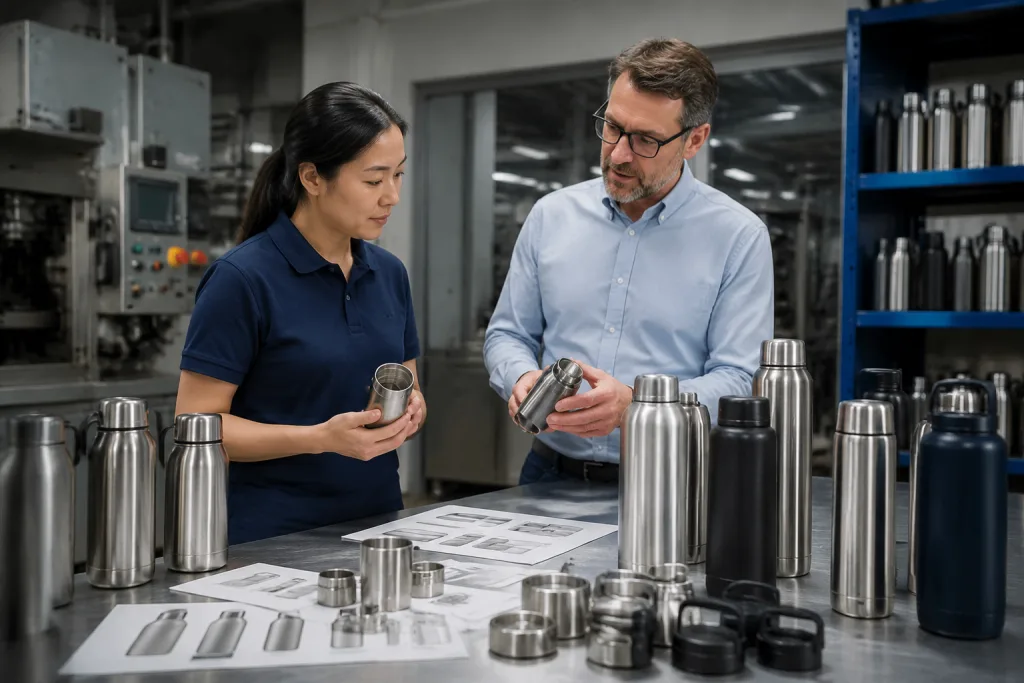
A customizable thermos can be decorated 4 main ways, and the lowest line item is sometimes the wrong question to ask. Laser engraving is durable and clean on stainless or coated surfaces. For a logo area under 40 x 60 mm, laser marking often adds around USD 0.15-0.45 per unit depending on size and speed. On our 30W fiber laser, a simple 28 mm logo runs fast; a dense badge slows the line and the math changes. We like laser for outdoor retailers because it does not peel, and QC can check it with a quick tape rub after marking.
Silkscreen printing still makes sense for sharp, high-contrast logos and promotional thermos campaigns. A one-color logo may add USD 0.08-0.25 per unit after screen setup, but multi-color registration needs care on curved bodies. Last month QC pulled the sample because the second color shifted 1.2 mm near the seam. Heat transfer or water transfer printing can create larger graphics and full-wrap effects, but cost can climb by USD 0.50-1.50 per unit. If you need a thermos customized with retail-grade artwork, ask for a pre-production sample, not just a digital mockup.
Coating drives cost more than some buyers expect. Standard powder coating is common for stainless thermos custom orders and gives a good grip. Gloss paint looks bright but shows scratches faster. Rubberized coating feels nice in hand, but we have seen it go sideways when the inner tray is too loose and the bottles rub during a 12 kg carton drop test. Color matching to Pantone is possible, but allow a practical tolerance. On coated metal, a small visual difference under D65 light can still pass production if it stays within the approved sample range.
Cost packaging early. A plain white box may add USD 0.18-0.35. A printed retail box can add USD 0.35-0.90. Inserts, instruction sheets, FNSKU labels, suffocation warnings, and master carton drop-test requirements all affect price. One buyer flagged a PO typo where the FNSKU label was listed on the polybag instead of the color box, and fixing that after packing would have cost 2 extra days. For North American ecommerce or distributor thermos shipments, poor packaging can wipe out the savings from a cheap unit quote.
Lead Time From Sample To Vessel
A realistic calendar beats an optimistic promise. For an existing stainless thermos factory model, a blank sample usually ships in 3-5 days if our sample room has stock on the shelf. A logo sample takes 5-7 days for laser marking or a 1-color pad print; QC pulled one last month because the buyer’s PO showed “matte balck” while the artwork file said matte black. A coating color sample takes 7-12 days because the powder line needs a small-batch slot, and the oven still has to hold the right cure curve, not just “close enough.”
After sample approval and deposit, normal mass production runs 30-45 days for 1,000-10,000 units. For 20,000 units or more, plan 45-60 days, especially before summer outdoor launches or Q4 promotional campaigns. China holiday periods matter. Around Chinese New Year, a safe buyer locks artwork, deposit, and material purchasing 60-75 days earlier than usual; we have seen 304 stainless sheet deliveries stretch from 12 days to 18 days in late January. Zhejiang factories do not escape that labor and logistics cycle.
New tooling changes the timeline. A new cap or stopper mold usually needs 20-30 days for tooling and first shots. A new body shape can require 30-45 days before vacuum and leak performance can be checked on the line with the water bath tester and vacuum gauge. If the first sample fails leak testing or the lid thread feels rough, another 7-14 days disappears fast. The wrong question is “Can you rush it?” The better question is whether the mold shop, polishing room, and assembly line all have open capacity.
Shipping also belongs in the schedule. Air freight may take 5-10 days airport to airport, but the math often does not work for stainless bottles because weight and carton volume both bite; a 500 ml thermos in a color box can push freight cost past the product margin. Sea freight to Europe or North America usually takes 25-45 days port to port, plus domestic trucking and customs clearance. If your launch date is fixed, work backward from shelf date, not factory completion date, and leave room for the buyer’s inspection under AQL 2.5.
Compliance And QC Add Real Value
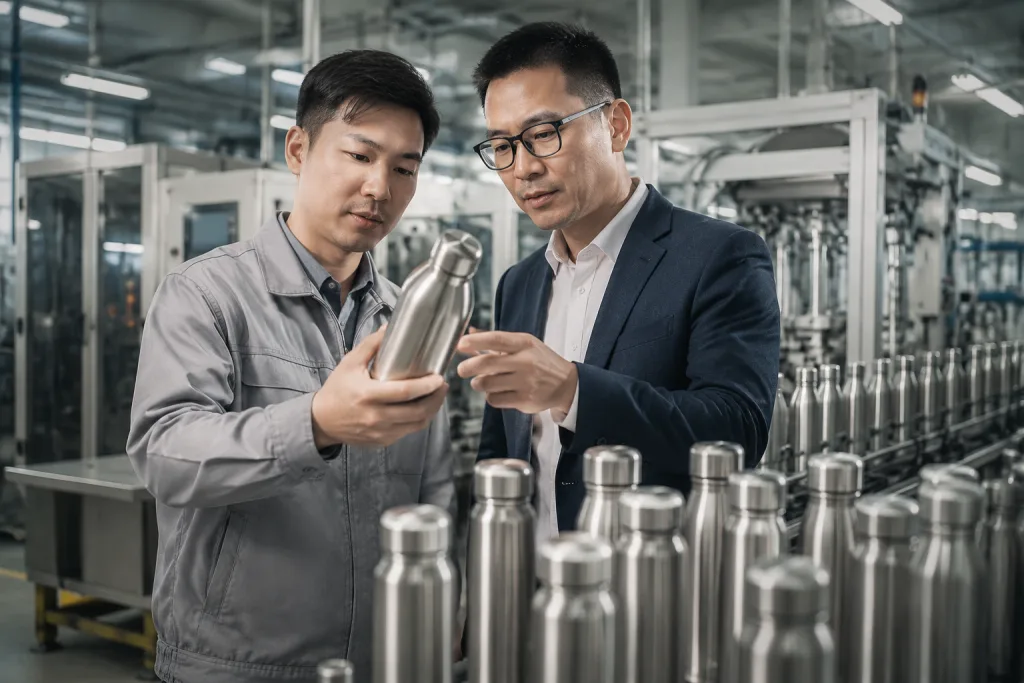
Good thermos suppliers price QC into the quote, not as a “service” after the first complaint. For stainless drinkware, we run incoming 304 stainless checks with a 0.01 mm caliper, then vacuum insulation testing, leak testing, coating adhesion, logo position, capacity check, carton drop review, and final AQL inspection. Common final inspection levels are AQL 2.5 for major defects and AQL 4.0 for minor defects, though premium retail programs sometimes push us to AQL 1.5. QC pulled 32 samples last week because one laser logo sat 3 mm off-center. Small miss. Big retailer headache.
For Europe, buyers usually ask for LFGB, REACH, and food-contact documentation before they approve the golden sample. For the United States, FDA food-contact expectations apply, and ASTM-related physical safety checks may be needed depending on channel and age group. If the product is for kids, this is the wrong question to ask: “Is it just a small thermos?” Ask about small parts, straw components, bite valves, CPSIA-related concerns, and coating heavy metals. We have seen a PO typo change “kids straw lid” to “sport lid,” and QC caught it only because the BOM listed a silicone bite valve at 18 mm.
Vacuum performance should be written in numbers, not sales words. A common 500 ml double-wall thermos may be tested with 95°C water and checked after 6 hours or 12 hours. On our line, the inspector logs temperature with a probe thermometer after the lid torque is set around 8–10 kgf·cm. Your retail claim must match the actual construction. If you print “keeps hot 24 hours” on packaging but buy a lightweight body and low-cost stopper, the math doesn't work; you create a customer service problem before the container leaves China.
At BottleForge Industrial, our export QC team in Hangzhou, Zhejiang, uses line patrol checks and final inspection before carton sealing. For larger manufacturers thermos programs, we can support third-party inspection from SGS, Intertek, Bureau Veritas, or your nominated agency. We ship only after carton marks, barcode scans, and inner polybag counts match the PO, because one buyer flagged a 12 pcs master carton packed as 24 pcs and the warehouse lost half a day sorting it. A factory that resists inspection is not saving you money; it is asking you to accept unknown risk.
Landed Cost Beats FOB Price
FOB price is just the first line on the quote sheet. A thermos distributor should run landed cost before picking a supplier. Start with FOB Ningbo or Shanghai, then add inland trucking if the quote leaves it out, export handling, sea or air freight, insurance, destination port charges, customs brokerage, duty, local delivery, testing, inspection, and retailer chargebacks you can already see coming. We had one buyer choose a USD 0.18 cheaper bottle, then QC pulled the pre-shipment file and found the carton CBM pushed freight up by USD 0.31 per unit. The math did not work.
For stainless vacuum bottles, freight can add 8-25% in normal sea freight conditions and far more by air. Gift boxes look good on a shelf, but a 92 mm wide bottle in a rigid color box can turn a 24 pcs master carton into 18 pcs, which means more cartons per 40HQ. We run this check with carton size, gross weight, and drop-test results before the buyer signs the PO. If the goods ship to Amazon-style warehouses, FNSKU labels, carton labels, polybag rules, and appointment delivery add labor and admin time. For outdoor retail, master carton strength matters. Warehouse handling is not gentle.
Payment terms hit working capital too. A common China factory thermos term is 30% deposit and 70% balance before shipment, especially for customized thermos orders. After 3 clean shipments, some repeat buyers ask for softer terms, but first orders normally stay standard because we buy 304 stainless, order powder coating, and print packaging under your logo. One PO came in with “matte black” in the item line and “gloss black” in the artwork note; production stopped for 2 days while the buyer confirmed the finish.
If you are choosing between a local wholesaler and a direct thermos manufacturer, compare the same scope. A local stock item is usually faster for 200 units, especially if you need delivery this week. A direct thermos factory in China usually wins at 1,000+ units when you need controlled branding, custom packaging, and repeatable supply. This is the wrong question to ask if you only compare unit price. Ask whether your calendar, cash flow, MOQ, artwork approval, and product control can handle a factory order from the line to final AQL 2.5 inspection.
Send Your Thermos Brief For A Costed Quote
Share capacity, quantity, logo method, packaging, and target market. We will return MOQ, FOB pricing, sample timing, and production lead time.
Frequently asked questions
Can a thermos manufacturer near me produce faster than a China factory?
For stock items, yes. A local warehouse can often ship 100-500 blank or lightly branded units within 2-7 days. For a true custom thermos with powder coating, logo, retail box, and carton marks, production still usually takes 30-45 days after sample approval whether the sales office is nearby or not. A China thermos manufacturer can be faster on custom work because coating, lids, gaskets, cartons, and inspection are close to the factory. If your deadline is under 3 weeks, use stock. If you have 8-12 weeks including sea freight, direct manufacturing is usually more economical.
What MOQ should outdoor retailers expect for bulk thermos orders?
For existing molds, a practical MOQ is 1,000 units per color and per design. Some suppliers thermos programs can accept 500 units with a surcharge, but the unit price may increase by 10-25% because setup costs do not shrink much. For outdoor retail ranges, plan SKU counts carefully. A 4,000-unit order split into two sizes and four colors is only 500 units per SKU, which may be inefficient. If you can start with two core colors and one proven capacity, you will usually get better pricing, easier QC, and faster production.
How much does a customized thermos cost with logo and box?
A typical 500 ml stainless customized thermos with 304 stainless, vacuum insulation, powder coating, laser logo, and printed retail box often falls around USD 4.20-7.50 FOB China at 1,000-3,000 units. A simpler promotional thermos with plain box and one-color print may be closer to USD 3.20-5.20. Premium lids, copper lining, handle caps, full-wrap graphics, or heavy retail packaging can push the price higher. Always ask the thermos supplier to separate body, decoration, packaging, and testing costs so you know what is driving the quote.
What files are needed for thermos custom logo samples?
For laser engraving or silkscreen printing, send vector artwork in AI, EPS, or editable PDF format. PNG and JPG files are useful for reference but not ideal for production. Include logo size in millimeters, position from the bottom or top edge, Pantone color if printing, and whether the logo should face the drinking side or opposite side. For a sample, allow 5-7 days for laser and 7-10 days for printed or coated samples. If you need retail packaging, provide dieline artwork and barcode files before the pre-production sample stage.
How do I compare thermos manufacturers without choosing the cheapest quote?
Ask every thermos vendor for the same specification: capacity, 304 or 316 stainless grade, wall thickness, lid material, gasket material, insulation test method, logo method, packaging, MOQ, lead time, FOB port, and AQL standard. Then compare landed cost, not only FOB. A USD 0.40 cheaper bottle can become expensive if it has weak coating, poor cartons, or unclear compliance. For Europe and North America, request food-contact documents such as LFGB, REACH, or FDA-related support. A good manufacturer thermos partner answers with numbers, not slogans.