Key Takeaways
- Typical MOQ for a customized thermos is 1,000 pcs per color, with 25-35 day mass production after sample approval
- 304 inner stainless is normal for food contact; 316 inner steel adds cost but helps for salty or acidic drinks
- Laser engraving usually survives 500+ dishwasher cycles better than standard one-color silkscreen
- A 0.45-0.50 mm inner wall and copper-coated vacuum layer are worth checking on every thermos factory quote
If you are buying thermos in bulk, finding a stainless bottle is the easy part. The hard part is locking the construction, lid seal, capacity, finish, carton pack, and AQL level before 5,000 units land with a 42 mm mouth when your spec sheet said 48 mm, or a logo that fails the 3M tape test after one week.
Outdoor retailers and promo brands often compare samples too loosely. We’ve seen this go sideways. A 500 ml custom thermos for a winter gift campaign is not the same job as a 1,000 ml hiking flask for retail shelves; the line runs different lids, different vacuum test timing, and a heavier inner carton. From our factory network in Zhejiang, China, the buyer pushback is familiar: “Can you lower the FOB price by 8%?” That is the wrong question to ask before the spec is tight.
Start With The Use Case
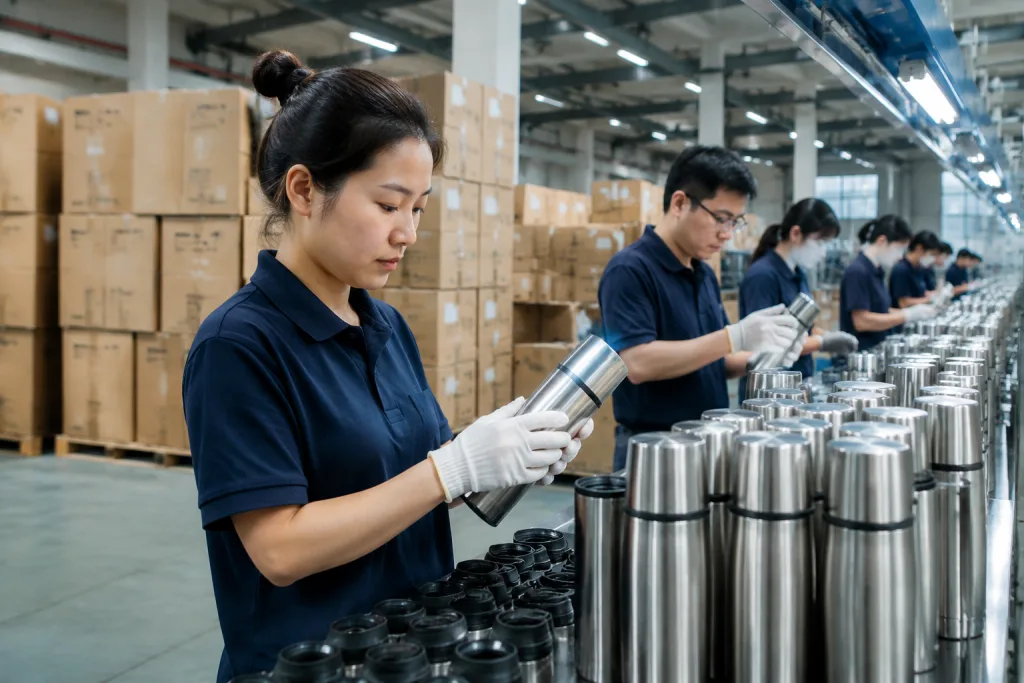
A buyer asking for a bulk thermos usually has two jobs sitting on the same RFQ: retail sell-through and brand promotion. Retail wants insulation that passes the same 6-hour heat test every batch, fewer returns, shelf-ready boxes, and a product that feels worth the ticket price. Promo orders care about logo approval in 24–48 hours, Delta E color control under 1.5 when possible, and a unit price that still fits the campaign budget after freight. We see this on the line when QC pulls 12 random samples and the buyer has written “matte black” on the PO but attached a glossy black reference photo.
For outdoor retailers, I would not start below 500 ml unless you sell commuter accessories. The stronger range is 600 ml, 750 ml, and 1,000 ml, but each size needs a job. A 600 ml stainless thermos fits day hikes and office use. A 750 ml model feels more serious without becoming heavy; we usually keep the filled weight under 1.1 kg for this size. A 1,000 ml model belongs with camping, fishing, road crews, and winter sports. One SKU for every user sounds tidy on a spreadsheet. The math doesn't work after the buyer starts asking for both cup-holder fit and all-day hot water.
For promotional brands, 500 ml and 600 ml are easier. They fit gift boxes without wasting carton space, keep sea freight closer to the quoted CBM, and leave enough logo area for a clean mark. At BottleForge Industrial in Hangzhou, Zhejiang, we usually quote 1,000 pcs MOQ per color for powder-coated custom thermos projects, and 3,000 pcs if you need a molded private lid or custom silicone part. Our monthly stainless thermos output is about 420,000 units across standard and customized thermos lines, so capacity is rarely the issue. Lock the spec early. We’ve seen this go sideways when a buyer changes from laser logo to 2-color silk screen after the first PP sample, which adds screens, tape tests, and usually 5–7 days.
You should decide who complains if the product fails. A distributor thermos sold into outdoor shops must survive colder use, rougher handling, and retail reviews where one leaking lid becomes 8 bad comments in a week. A promotional thermos used for an event may only need a clean finish, safe materials, and reliable insulation for normal coffee use. Same category, different risk profile. On our side, QC checks this with a leak test fixture, a 100°C fill test, and carton drop checks before we ship; the buyer flagged it once because the sample passed insulation but the powder coat chipped at the bottom rim.
Spec Table: Retail Versus Promo
We use this comparison when a buyer asks for thermos custom pricing but the use case is still blank on the RFQ. Retail shelf? Staff gift? Event giveaway? Different job. The FOB ranges below are normal China export numbers for standard double-wall stainless construction, based on quotes we run out of Ningbo/Shanghai, not bait prices that disappear after the first sample. Final cost moves with exchange rate, powder coating, lid structure, carton weight, and testing scope; last month QC pulled one 1,000 ml sample with a 0.38 mm outer wall after the PO said 0.50 mm.
| Spec Point | Outdoor Retail Thermos | Promotional Thermos |
|---|---|---|
| Common capacity | 750 ml or 1,000 ml | 500 ml or 600 ml |
| Typical FOB Ningbo/Shanghai | USD 4.20-7.80 | USD 2.85-5.20 |
| Inner steel | 304 standard, 316 optional | 304 standard |
| Wall thickness | 0.45-0.50 mm inner, 0.50 mm outer | 0.40-0.45 mm inner, 0.45 mm outer |
| Insulation target | Hot 12 hours, cold 24 hours | Hot 8-10 hours, cold 18-24 hours |
| Logo method | Laser mark, debossed sleeve, or print tested by 3M tape | Silkscreen, UV print, or laser mark |
| Packaging | Color box, hang tag, retail barcode | White box, kraft box, gift sleeve |
| Inspection | AQL 2.5 major / 4.0 minor | AQL 2.5 major / 4.0 minor or tighter for gift sets |
A manufacturer thermos quote without these details is half a quote. If a supplier thermos price is USD 0.60 lower, do not just ask for a discount match; this is the wrong question to ask. Ask where the USD 0.60 disappeared. We have seen it come from 0.05 mm thinner steel, weak powder paint, a low-grade silicone gasket, skipped copper coating, loose vacuum testing, or a 5-ply carton changed to 3-ply after approval. The math does not work if the buyer still expects the same shelf life and carton strength.
For outdoor retail, the thermos factory should run 100% vacuum testing on the line and random thermal retention testing per batch, with water filled to the neck and checked by thermometer after the agreed hours. For promotion, we still run leak testing and adhesion checks, often at 2,000 pcs MOQ per color, but the insulation target can be softer. That is not cutting corners. It is matching the bottle to the buyer's real use case before we ship 80 cartons and someone flags the first drop test.
Steel Grades And Vacuum Build
Most thermos factories we compete with in China run 304 stainless steel for the inner liner because it passes food-contact checks, handles coffee and tea without pitting, and does not scare EU or North American buyers during compliance review. The outer wall is usually 201 or 304, based on the target FOB and the PO spec. For a real outdoor SKU, I push for 304 inner with 304 outer if the price band has room. For a promotional thermos, 304 inner with 201 outer can work, but only if the polishing and powder coating are controlled; QC pulled a black 500 ml sample last month with two pinholes near the shoulder after the cross-cut tape test.
316 stainless is the wrong question to ask if the buyer only wants a coffee bottle. It adds roughly USD 0.25-0.70 per unit depending on capacity and steel price, and the math does not work on a 3,000 pcs budget order unless the retail story supports it. We use it when the product is sold for marine use, electrolyte drinks, salty soups, or premium outdoor retail. If the use case is coffee, tea, and water, 304 inner steel is usually the better commercial choice; one German buyer flagged this exact point after their PO had “316” in one line and “304 stainless” in the artwork file.
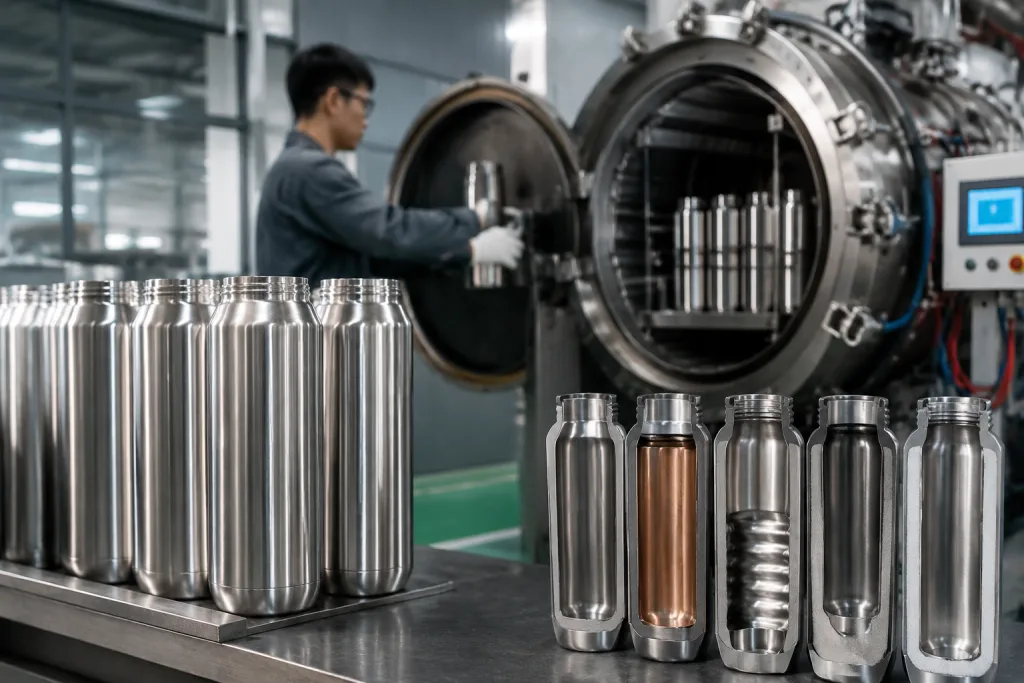
The vacuum build decides more complaints than the steel grade. A good stainless thermos has an evacuated double wall, a sealed base plug, and often a copper-coated inner surface to cut radiant heat loss. On our line, the vacuum station checks the base with a helium leak detector before the bottom cap is pressed. For a 750 ml model, you should expect hot retention near 60°C after 12 hours when starting with 95°C water at 20°C ambient temperature. Some factories quote 24 hours hot retention, but they count 40°C as a pass. Ask for the test method, not just the claim.
Wall thickness needs a blunt talk. Thicker steel feels better and dents less, but it raises material cost and shipping weight. For a 1,000 ml thermos in bulk, 0.50 mm outer wall is a solid target. Dropping to 0.40 mm may save money, but we have seen this go sideways when cartons take a corner hit during LCL distribution; the buyer sees flat spots before the bottle reaches the shelf. If you are building a distributor thermos line for repeat sales, that saving is usually not worth it.
Logo Methods Compared Directly
A customizable thermos only earns its keep when the logo survives daily handling. Buyers ask for a bigger logo; this is often the wrong question to ask. We check adhesion, surface roughness, and contrast first, because powder coating, glossy paint, matte paint, and raw stainless do not print the same on the line. Last month QC pulled 12 samples after a buyer flagged a 0.6 mm gap in small lettering on a curved 500 ml body.
Laser engraving is our safest pick for outdoor retail and premium corporate gifts. It burns through the coating or marks the stainless surface, so there is no ink film to peel off in a backpack pocket. Clean and simple. The trade-off is color: the mark usually comes out silver, dark grey, or close to the base material, depending on finish. On a 600 ml powder-coated model, laser engraving often adds USD 0.08-0.18 per unit after setup; we run a 20 pcs pre-production check with the rotary jig before mass production.
Silkscreen printing works best for one or two solid colors on smooth coated bodies. The math is good for campaign orders, not for tiny artwork with 1.2 mm text wrapped around a curve. Rough powder coat is where we’ve seen this go sideways: the ink skips over the orange-peel texture, then the buyer asks why the PMS red looks broken. Standard logo setup may cost USD 40-80 per color, and unit cost can be USD 0.04-0.12 depending on print area. We normally ask for vector artwork, not a 72 dpi JPG pasted into the PO.
UV printing handles full-color artwork, gradients, and illustrated designs better than silkscreen. It costs more and needs scratch testing before approval. For thermos promotional stock at a trade show, UV can look sharp on the table; for outdoor retail, the math doesn’t work unless it passes abrasion. Our QC team usually runs a 3M tape pull and 200-cycle rub test on the first printed sample, because a nice-looking logo is useless if it scuffs before the carton leaves Hangzhou.
Debossed or molded elements cost more, but they make a thermos customized program feel proprietary instead of catalog-stock with a logo slapped on. A custom silicone band or molded lid detail may require USD 800-2,500 tooling and 3,000-5,000 pcs MOQ. Not for every order. For distributors, though, this protects the program against lookalike items; we’ve had buyers reject cheaper copies after measuring a 0.4 mm difference in the lid groove with calipers.
Lids, Leaks, And Drinking Comfort
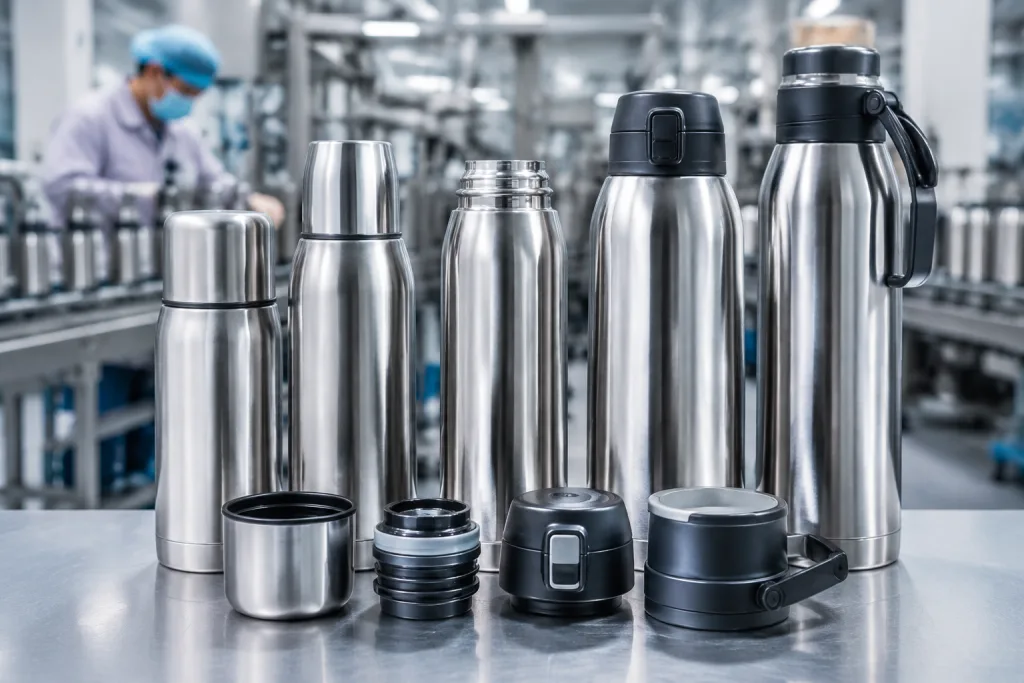
The lid is where 6 out of 10 thermos suppliers quietly win or lose the order. Stainless bodies are easier to compare; lids bring gaskets, threads, springs, buttons, and customer habits into the same 42 mm space. For hiking and camping, we still run a screw cup lid with an inner stopper because it survives drop tests better. For commuting, a push-button or flip lid sells faster on the shelf, but the math does not work if the silicone gasket is off by 0.3 mm and QC finds seepage after the carton is sealed.
For a thermos bulk order, ask what plastic is used in the lid, not just whether it is “food grade.” PP is common for hot drink contact, and Tritan may be used for clear parts. Silicone gaskets should be food-grade and should not carry that sharp rubber smell when QC opens the PE bag. We reject it. For EU buyers, REACH and LFGB-related requirements may apply depending on the contact component. For US buyers, FDA food-contact expectations and California Proposition 65 screening may be relevant. Kids or family-oriented SKUs may also need ASTM or CPSIA review if marketed to children; one buyer flagged this after the PO had “adult gift bottle” typed in the item name, which was the wrong wording for their retail channel.
Thread fit deserves real inspection. A lid that feels fine on five samples may fail at 10,000 pcs if the mold tolerance is loose or the assembly team mixes gasket batches from two suppliers. We normally run an inverted leak test for at least 30 minutes, then shake 20 random bottles by hand and on the vibration table for sport and outdoor lids. QC pulled the sample last month after water marks showed under the cap rim at 18 minutes. For AQL inspection, classify leakage as a critical or major defect, not a minor cosmetic issue.
Drinking comfort is not just design taste. A narrow mouth around 38-45 mm keeps heat better and pours neatly. A wide mouth around 55-65 mm is easier for ice cubes, cleaning, and soup. Outdoor buyers often choose wide mouth because gloved hands and soup spoons are part of the use case. Promotional buyers often choose narrow mouth because it looks slimmer and fits more cup holders; the buyer usually asks for a 72 mm body after checking their car holder sample. A thermos vendor should explain these trade-offs before quoting, not after the mold is chosen. We have seen this go sideways.
Compliance And Inspection Reality
Compliance is not a logo on a PDF. Start with the sales market, then list every food-contact part: inner wall, lid insert, straw, silicone gasket, powder coating, and any claim printed on the gift box. For Europe, 7 out of 10 buyers we quote ask for LFGB food-contact testing, REACH screening for coatings and plastics, plus BSCI or Sedex files when the order goes to chain retail. For North America, we prepare FDA food-contact declarations, Prop 65 risk review, and the retailer protocol before artwork release. QC pulled one lid sample last month because the PO said “BPA fee” instead of “BPA free.” Small typo. Big delay.
Our Zhejiang team splits testing into 3 layers. First, material confirmation before production: steel grade, plastic resin, silicone gasket, and coating system, checked against the BOM and incoming labels on 25 kg resin bags. Second, production control: vacuum testing, leak testing, coating adhesion, print adhesion, torque checks, and carton drop checks; on the line we run the lid torque meter at 1.2-1.5 N·m for common screw lids. Third, pre-shipment inspection under AQL, often 2.5 for major defects and 4.0 for minor defects. For premium retail orders, some buyers use AQL 1.5 major.
Do not rely only on the thermos manufacturer internal QC report. It has value, but this is the wrong place to save USD 300 when the order value is real. On a 5,000 pcs order at USD 5.20 FOB, a USD 280-380 inspection is cheap insurance. The inspector should check product dimensions with a caliper, logo placement against the approved 1:1 artwork, barcode scan, carton marks, gross weight, leakage, coating defects, and a sample thermal test. We have seen this go sideways when a buyer skipped inspection and 42 cartons arrived with the side mark printed one digit short.
If you sell on Amazon or another marketplace, packaging accuracy matters as much as the bottle. FNSKU labels, suffocation warnings for polybags, carton dimensions, and master carton weight need confirmation before shipment; the buyer flagged one 18.6 kg carton because the routing guide capped it at 18 kg. A good thermos supplier in China will ask about channel requirements before mass packing. If they do not ask, raise it yourself before the first carton is sealed with the tape gun.
Choosing The Right Buying Path
For thermos in bulk from China, we usually quote three buying paths: a standard factory model with your logo printed by screen plate or laser jig, a modified stock model using existing body tooling, or a full private mold with new stainless body and lid parts. Each one fits a different risk level, and the wrong choice can burn 3 weeks before the first PPS sample even leaves Hangzhou.
A standard factory thermos with logo is the fastest route and usually ships in 25-35 days after sample approval. Pick this for promotional brands, seasonal campaigns, or distributors testing 1 new channel. You still choose color, finish, logo, packaging, and sometimes lid type; our line checks logo position with a 0.5 mm film ruler before mass printing. The trade-off is simple. Other buyers can use the same shape.
A modified existing model sits in the middle. You might change the lid color to match Pantone 186C, add a 2 mm silicone boot, adjust powder coating texture, switch to a custom box, or pair an existing body with a different cap already in our tool room. MOQ is often 1,000-3,000 pcs, and lead time can be 35-45 days if components are already tooled. This works for outdoor retailers that need a recognizable line without paying for full tooling, but we have seen this go sideways when the buyer approves the body first and flags the cap fit after QC pulled the sample.
A private mold is for brands with volume and patience. Tooling can run from USD 3,000 to USD 15,000 depending on body shape, lid complexity, and plastic parts. Lead time before production may be 45-75 days for design, mold, sampling, and adjustment. The math usually works when annual demand is above 20,000-50,000 pcs and the buyer wants stronger control over design; our mold shop will still ask for a 2D drawing with mouth diameter, thread height, and lid gasket section before cutting steel.
Be careful with any manufacturers thermos quote promising private design, low MOQ, low tooling, and 20-day delivery in the same email. One promise usually breaks. The better sourcing talk is direct: target retail price, FOB ceiling, annual volume, compliance market, preferred capacity, lid style, and launch date. We once had a PO typo showing 500 pcs instead of 5,000 pcs, and the buyer still expected private-color lids at stock MOQ; the math does not work. With clean specs, a factory thermos team in Zhejiang, China can tell you what is realistic before you spend money on samples.
Send Your Thermos Brief For A Practical Quote
Share capacity, quantity, logo method, market, and launch date. We will return a spec-based FOB quote, not a vague catalog price.
Frequently asked questions
What MOQ should I expect for a custom thermos order?
For most custom thermos projects, expect 1,000 pcs per color for standard models with logo printing or laser engraving. If you need a special powder-coated color, some suppliers thermos programs may ask for 2,000 pcs because coating lines need minimum batch efficiency. Custom lids, silicone boots, or molded parts usually push MOQ to 3,000-5,000 pcs. For first orders, we suggest keeping the body shape standard and investing in better logo, packaging, and inspection. That keeps lead time around 25-35 days after sample approval and avoids tooling delays.
How much does a stainless thermos in bulk cost from China?
A realistic FOB China range is USD 2.85-5.20 for 500-600 ml promotional thermos models and USD 4.20-7.80 for 750-1,000 ml outdoor retail models. The price depends on steel grade, wall thickness, lid design, coating, logo process, packaging, and testing requirements. A very low thermos supplier quote may use thinner steel, cheaper paint, or a basic lid gasket. Always compare by full specification, not just by capacity and FOB price. Freight, duty, inspection, and packaging also affect your landed cost.
Is laser engraving better than printing for a customized thermos?
Laser engraving is usually better for durability, especially on powder-coated stainless thermos products used outdoors. It does not rely on ink adhesion, so it handles abrasion and washing better. Silkscreen printing is cheaper and works well for simple one-color promotional logos, usually adding around USD 0.04-0.12 per unit. UV printing is useful for full-color graphics but needs scratch testing before approval. If the thermos customized order is for retail shelves, laser or tested high-adhesion print is safer. If it is for a one-time event, silkscreen may be enough.
What tests should I require before shipment?
At minimum, require 100% factory vacuum testing, random leak testing, coating adhesion testing, logo adhesion testing, and pre-shipment AQL inspection. For AQL, many buyers use 2.5 major and 4.0 minor, with leakage treated as major or critical. Food-contact testing should match your market: LFGB and REACH are common for Europe, while FDA-related documentation and Prop 65 screening may matter for the US. For a 5,000 pcs order, a third-party inspection costing about USD 280-380 is usually worth it.
Which thermos size is best for outdoor retailers?
For outdoor retail, 750 ml is often the best balanced size. It has enough capacity for hiking, winter commuting, and day trips without feeling too bulky. A 1,000 ml thermos is better for camping, fishing, jobsite use, and colder regions, but it raises FOB cost and carton weight. A 600 ml model works well as an entry SKU or giftable item. If you are building a distributor thermos range, start with 600 ml and 1,000 ml as two clear use cases rather than forcing one size to serve everyone.