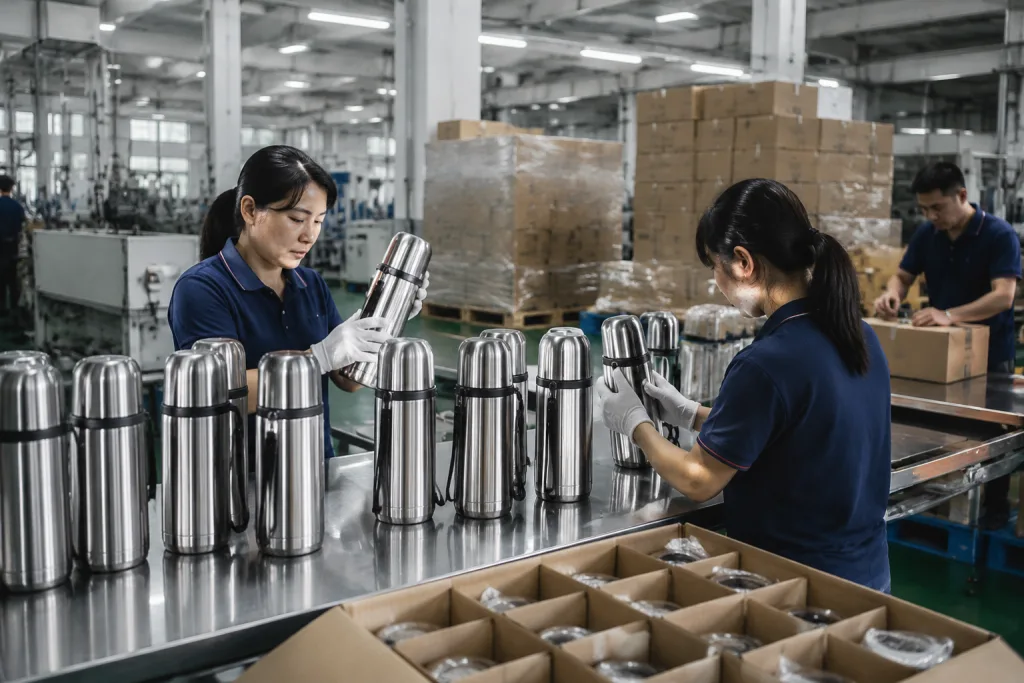
Key Takeaways
- A practical custom stainless thermos MOQ starts at 1,000 units per color for most promotional orders
- 304 stainless steel with 0.45-0.55 mm inner wall is the safe default for drink-contact parts
- Laser engraving is slower than silkscreen but gives lower logo failure risk on powder coating
- Use AQL 2.5 for major defects and AQL 4.0 for minor defects before paying the balance
Your outdoor retail client wants a thermos for promotional gifts, not a cheap giveaway that leaks in a backpack after 3 weeks. The brief looks simple: 750 ml stainless bottle, matte green finish, laser logo, retail box, delivery before the autumn campaign. Small choices bite. Steel grade, powder thickness, cap gasket, carton drop test, and barcode position all change the price, the lead time, the insulation result, and the chance that customs or the final buyer rejects the shipment. Last month QC pulled 32 samples from a 3,000 pcs run because the silicone ring sat 0.8 mm too high and the lid failed the upside-down leak test.
At BottleForge Industrial in Hangzhou, Zhejiang, we run this type of project every month for promotional brands and outdoor distributors. A normal custom thermos order in China is not hard, but asking “how cheap can you make it?” is the wrong question to ask. The math does not work if the buyer wants 304 stainless, 12-hour heat retention, a clean laser logo, and a gift box that survives courier handling. We need fixed decisions on steel grade, wall thickness, cap design, MOQ, decoration, packing, and QC standard before the line opens. On one PO, the buyer typed matte “greeen” and our merchandiser caught it before the Pantone card went to the spray room. Here is how I would walk through one real order from RFQ to shipment.
Start With The Real Order Brief
Say the buyer is an outdoor retailer planning a winter loyalty campaign. The brief says 5,000 units, 750 ml capacity, one body color, one logo position, and delivery to Rotterdam. Good enough for a first price. Not good enough for a safe order. Last month QC pulled a 750 ml sample from the line and the actual brimful capacity was 724 ml on the measuring cylinder, which is exactly the kind of gap that turns into a claim after goods arrive.
A proper RFQ for a custom thermos should start with the use case. Hiking pack and car cup holder are not the same job. Ski lodge resale and corporate gifting are not the same buyer expectation. A tall 750 ml bottle looks strong in photos, but our caliper check often shows 78-82 mm body diameter, and that misses plenty of standard car cup holders. A 500 ml unit works better for event giveaways because cartons stay lighter. A 1,000 ml thermos suits outdoor clubs, but the math changes on steel weight, carton CBM, and ocean freight.
For this buyer scenario, I would quote a double-wall vacuum insulated bottle with 304 stainless steel inside, 201 stainless steel outside, 750 ml nominal capacity, powder-coated finish, silicone anti-slip base, and leak-resistant screw lid. If the brand sits at premium retail, use 304 stainless steel for both inner and outer walls. It adds USD 0.20-0.45 per unit depending on size and China steel pricing. On our floor, the powder line checks coating thickness with a film gauge, and anything around the logo area that chips during tape testing gets flagged before packing.
Do not ask ten thermos suppliers to quote from a photo only. We have seen this go sideways. You will get ten different products and think one thermos vendor is cheaper, while the real difference is wall thickness, cap material, gasket quality, or coating process. A basic specification sheet should lock capacity, dimensions, weight tolerance, steel grade, insulation target, decoration method, packaging, compliance documents, Incoterm, destination port, and inspection level. One buyer once sent a PO with “mat black” instead of “matte black”; our merchandiser caught it before the Pantone card went to the spray room.
For BottleForge Industrial, our current stainless thermos capacity is about 420,000 units/month across standard vacuum bottle lines in Zhejiang. For promotional projects, the workable MOQ is 1,000 units per color for existing molds and 3,000-5,000 units if you need a new lid or body mold. We run standard mold samples in about 7 days, while new tooling samples take closer to 18 days after the 2D drawing is signed. The line can move fast, but mold approval is where buyers lose time.
Price The Thermos Before Artwork
About 8 out of 10 buyers send logo artwork first. I start with product cost. A good-looking customized thermos that blows the campaign budget is just wasted sampling time. For a 750 ml stainless steel factory thermos with powder coating and laser logo, a realistic FOB Ningbo or Shanghai range is often USD 4.20-6.80 per unit at 5,000 units. The spread usually comes from 304 stainless wall thickness checked by micrometer, lid parts counted on the assembly bench, powder coat pass rate after tape test, box printing, and AQL 2.5 inspection scope.
At RFQ stage, ask your thermos manufacturer to split the cost lines. We run quotes with base bottle and surface finish as one block, then logo method, packaging, insert card, master carton, and testing fee as separate lines. This makes negotiation cleaner. If a supplier thermos quote is only one lump number, the math does not work; you cannot see whether USD 0.18 disappeared because the steel got thinner or because the line packed 24 pcs per carton instead of 20 pcs.
For promotional brands, the pricing traps look small on the PO and ugly on the final invoice. A second body color may trigger another 1,000-unit MOQ because the coating line needs a separate powder change and purge. A full-color retail box may add USD 0.25-0.60 per unit versus a brown kraft box with sticker. A metal tea infuser can add USD 0.18-0.35. A molded gift insert may need a tooling fee around USD 250-600. Air shipping a thermos bulk order hurts because vacuum bottles cube out fast; last month QC pulled a 750 ml sample and the export carton measured 56 x 38 x 31 cm for only 24 pcs, so sea freight or rail to Europe made more sense unless the campaign date was already on fire.
FOB pricing is usually the cleanest way to compare thermos manufacturers in China. If you need DDP delivery to Amazon, a warehouse, or a distributor, price that as a second line. Mixing product price and door delivery in the first quote makes it harder to compare suppliers thermos options fairly. We have seen this go sideways when a buyer flagged a “cheaper” quote, then found the supplier had used a Ningbo local truck charge only, not the Amazon appointment delivery cost.
For this order, I would lock the commercial target before sampling: 5,000 units, FOB Ningbo, 30% deposit, 70% after passed final inspection, production lead time 35-45 days after sample approval, and cartons marked for the distributor thermos warehouse. Simple frame. On our side, the merchandiser copies those terms into the PI and checks the carton mark against the buyer’s PO; one typo in a warehouse code can cost 2 extra days at the forwarder.
Choose Steel, Lid, And Coating
The buyer usually asks, “Is it real stainless steel?” Wrong question. For drink-contact parts, write 304 stainless steel, also called 18/8, on the spec sheet and PO. For the outer shell, 201 stainless steel is common in promotional thermos programs because it cuts cost and never touches the drink. If the item is positioned as premium outdoor gear, use 304 inner and 304 outer; QC pulled one sample last month where the PO said “304 body” but the approved sample had 201 outer, and the buyer flagged it before mass production.
Wall thickness matters. We run inner walls at 0.45-0.55 mm on most straight bottles, while the outer wall may be 0.50-0.60 mm depending on size and the stretch-forming die. Too thin saves maybe USD 0.12 per piece, then dents show up after carton drop testing. Too thick pushes weight and freight. For a 750 ml outdoor bottle, a finished weight around 380-480 g is normal depending on lid design; our line checks it with a 0.1 g digital scale before vacuum testing.
The lid is where 7 out of 10 promotional gift complaints start. A low-grade PP lid with a soft gasket can pass a quick office test, then leak after 20 dishwasher cycles or a week in a sales rep’s car. Ask for food-grade PP or Tritan contact parts, silicone gasket, and a lid torque that normal users can open with wet hands. For an outdoor retailer, I would skip complicated flip mechanisms unless the schedule allows at least 12 days of extra leak and fatigue testing. A simple screw lid has fewer failure points, and the line can check it faster with a torque meter.
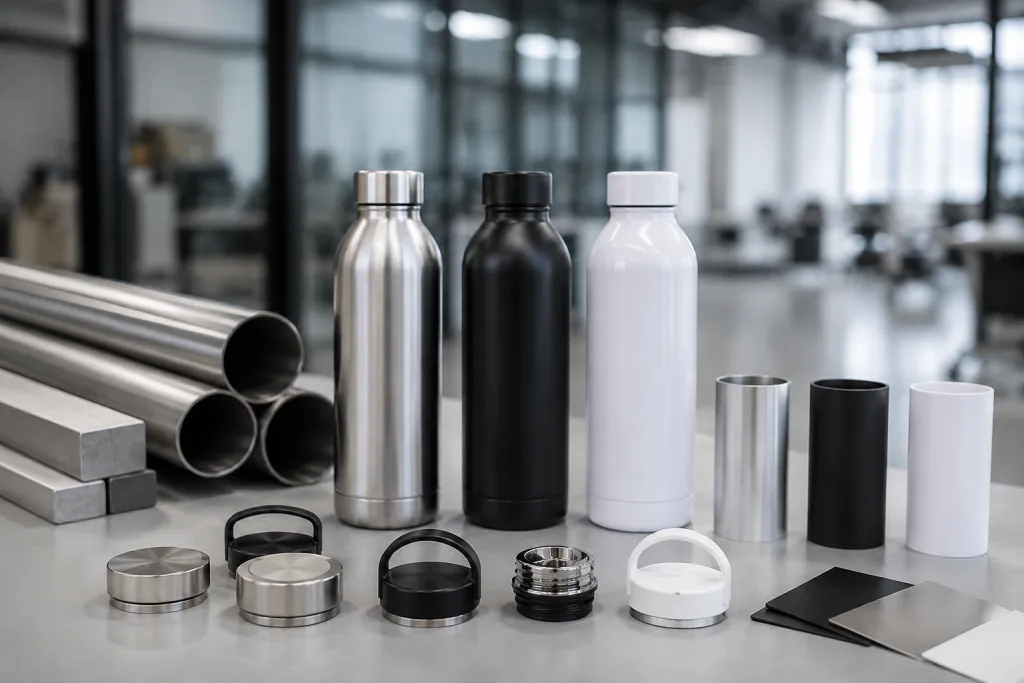
Surface finish is a practical choice, not just a color choice. Powder coating feels better and sells better than basic spray paint, but it needs proper curing and adhesion control. Matte black and olive still move well for outdoor campaigns; navy and sand work when the logo has enough contrast. Glossy finishes show scratches after a few rounds in a display bin. Brushed stainless is durable but gives less brand color impact, and our coating room usually rejects any powder coat panel that fails the 3M tape adhesion pull after curing.
If your client wants a thermos customizable across several campaigns, build the design around one stable bottle body and change only color, logo, sleeve, or box. That keeps reorders faster and cuts mistakes. We ship repeat bodies in about 18 days after artwork approval, while a new mold or new lid structure can stretch to 35-45 days before pre-production samples are even settled. A stable manufacturer thermos platform beats chasing a new shape every season; we’ve seen that go sideways when one tiny lid thread change made 3,000 boxes of printed inserts wrong.
Approve Logo And Packaging Carefully
For this order, the outdoor retailer wants a 45 mm wide logo on the front. We run three decoration routes on this kind of bottle: laser engraving for one-color outdoor logos, silkscreen when the artwork is flat and the color count is low, heat-transfer printing when the buyer insists on gradients or full-color badges. Laser is the safer pick for a powder-coated custom thermos if the brand cares about scuff resistance. It cuts through the coating and shows the stainless layer or undercoat. On our line, the operator checks the 45 mm width with a digital caliper before locking the rotary jig. Unit cost usually lands at USD 0.08-0.18 depending on logo size and order quantity.
Silkscreen is cheaper for simple logos, often USD 0.05-0.12 per position, but we still do an ink adhesion test on the coating. QC pulled one black sample last month where the white ink lifted after a 3M tape test, so the buyer flagged it before mass production. Good catch. Heat transfer handles complex graphics, though it costs more and can look too much like souvenir merch for a serious outdoor brand. Be careful with dishwasher claims. In our experience, 8 out of 10 powder-coated bottle projects are still marked hand-wash recommended because the decoration and coating fail before the steel body does.
Ask the thermos factory for an artwork proof showing exact logo size, Pantone color if printed, position from bottle base, and tolerance. Do not approve a “close enough” mockup. A logo placed 8 mm too high can look wrong once the bottle sits behind a retail box window or shows up in a product photo. We usually set the position with a 0.5 mm tolerance on the print fixture, then QC checks the first 20 pcs before the line keeps running. For laser, approve a physical sample, not only a digital mockup, because laser contrast changes by coating color.
Packaging should match the sales channel. For a pure promotional thermos giveaway, a white tuck box or kraft box is enough. For outdoor retail, use a 350 gsm printed color box or corrugated gift box, with care instructions and barcode printed cleanly enough for scanner testing. If the customer is a distributor thermos buyer serving multiple stores, carton labels should show SKU, color, quantity, gross weight, net weight, carton size, and PO number. We have seen this go sideways from one PO typo: “navy” on the carton label, “royal blue” on the packing list, 86 cartons held at the warehouse.
For North America, confirm whether you need UPC, retail warning text, country of origin, and California Proposition 65 review. For Europe, check food-contact declaration, LFGB if requested, and REACH for coatings and packaging inks. This is the wrong place to save USD 120 on paperwork if the order is going to retail shelves. A good thermos supplier should show which documents are already on file, which test reports match the exact coating and gasket material, and which items need paid lab testing before shipment.
Sample Like You Mean It
A pre-production sample is not a souvenir. It is the order agreement you can hold in your hand. For this customized thermos order, we would ask for 1 blank sample first if the mold is new to the buyer, then 2 pre-production samples with the same powder coating, logo process, lid set, and retail box planned for bulk. The blank unit checks grip, mouth feel, lid fit, and weld finish. The decorated unit checks whether the brand actually lands. We had a PO last month where “mat olive” was typed instead of “matte olive”; the sample caught it before the coating line mixed 80 kg of the wrong powder.
Sample lead time for existing stainless thermos models in Zhejiang is usually 5-7 days for blank samples and 10-14 days for decorated samples. If you need a new mold, expect 25-35 days before a meaningful sample. Do not approve mass production from a 3D rendering or from a sample in the wrong material. This is the wrong place to save 12 days. We run existing 750 ml bodies through the sample room fast, but a new lid tool still needs CNC trial cutting and at least 1 leak check after the silicone ring groove is adjusted by 0.2 mm.
Your sample checklist should be written, not left to memory. Measure capacity by filling to the practical drinking level, not to the absolute rim. Check bottle height and diameter against the specification with a digital caliper. Weigh the unit on a bench scale. Fill with boiling water, close the lid, invert for 10 minutes, and check leakage on white tissue. Then leave hot water inside for 6 hours and record the temperature drop. A reasonable 750 ml double-wall vacuum thermos should keep water above 65°C after 6 hours when starting near 95°C, though exact performance depends on room temperature and lid structure. QC pulled one sample for us that passed the leak test cold but showed 3 wet threads after hot inversion. That one did not go to the buyer.
For logo checks, rub the printed or lasered area with a wet cloth, then repeat with a dry cloth for 30 strokes. For coating checks, ask for cross-hatch adhesion testing on production samples or retained test panels. If the thermos is promotional but still represents an outdoor brand, visible scratches and dust spots are not “minor” to the end customer. We’ve seen this go sideways: the buyer flagged 6 black specks on a white bottle under normal office light, and the carton photos looked worse than the AQL 2.5 report sounded.
Once approved, sign and photograph the golden sample from all sides. The factory keeps 1 piece, you keep 1 piece, and the QC inspector uses it during final inspection. Simple habit. It stops arguments about what “matte olive” or “centered logo” means when the line is packing 3,000 pieces a day and the inspector is checking logo position with a 20 mm clear ruler.
Control Production And Inspection
After deposit and sample approval, the job moves from sales desk to production board. For 5,000 units, we usually book 3-5 days for material preparation, 7-10 days for forming and welding, 5-7 days for vacuum processing and testing, 5-7 days for coating, 3-5 days for logo and packing, plus buffer. A clean lead time is 35-45 days. If a thermos vendor promises 18 days during peak season, ask which station they plan to squeeze: vacuum oven time, coating curing, or final packing. The math doesn’t work. On our line, QC pulled 32 cups last May because the laser logo jig was 1.5 mm off center, and that alone cost half a day.
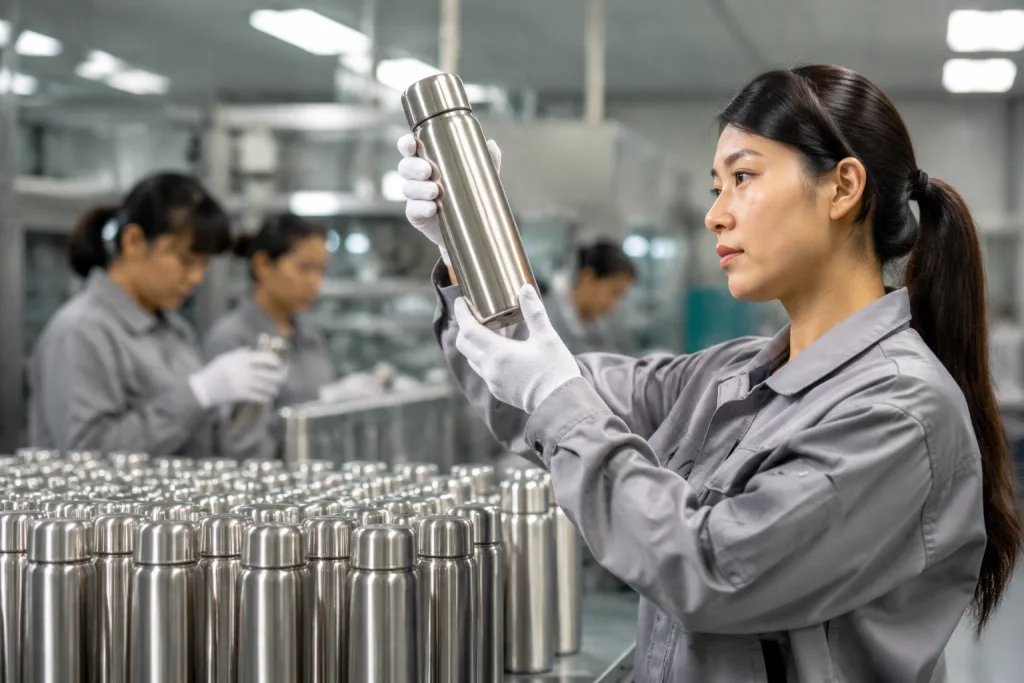
Vacuum insulation cannot be signed off by looking at a shiny bottle. The factory should run vacuum performance checks during production, not after all cartons are sealed. We run visual weld checks under a 600-lumen inspection lamp, vacuum leak detection, hot water retention sampling at 95°C, lid fit checks with a thread gauge, and coating inspection after curing. For larger orders, we recommend an inline inspection when 20-30% of goods are completed, especially if the design is new. This is where we’ve seen projects go sideways: the buyer approved a slim lid drawing, then flagged hand-feel after 1,200 pieces were already welded.
Final inspection should use AQL, not casual carton opening with a cutter knife and a camera phone. For promotional stainless thermos orders, a practical setting is General Inspection Level II, AQL 2.5 for major defects, and AQL 4.0 for minor defects. Critical defects, such as sharp edges, unsafe odor, severe leakage, or wrong material, should be zero tolerance. For a 5,000-unit order, the inspector will typically sample 200 units under standard AQL tables, depending on lot structure. We ask the inspector to record carton numbers, gross weight, and at least 5 temperature-retention readings, because one vague “pass” report is useless when a distributor pushes back two weeks later.
Define defects before inspection day. Major defects include leakage, wrong logo, wrong color, serious dent, failed insulation, broken lid, missing gasket, and incorrect barcode. Minor defects include tiny coating specks, slight carton scuffs, or small alignment variation within approved tolerance. If you wait until inspection to define defects, the argument starts when time is already gone. We once had a PO where “matte black” was typed as “matt black”; small typo, big debate, and QC had to compare the production cup against the signed Pantone swatch under D65 light.
For BottleForge Industrial in Hangzhou, Zhejiang, we keep production records by PO, color batch, and carton run. That matters when you sell through thermos distributors, because one warehouse complaint must be traced to a batch, not guessed across the whole shipment. We ship cartons with batch stickers on the outer box and keep the packing line scan file for 24 months. When a buyer says 14 cartons arrived with scuffed lids, we can check the carton run, the coating date, and the operator record instead of blaming the whole 5,000-unit order.
Ship Without Creating Warehouse Problems
A bulk thermos order can pass production QC and still get rejected at receiving if carton marks, pallet height, or shipping papers are off. We run a common pack at 24 units per export carton, usually 58 x 40 x 32 cm, with gross weight around 12-15 kg depending on bottle weight and insert box. For 5,000 units, plan on roughly 209 cartons and 8-10 cubic meters. Do not guess CBM from the catalog. QC should measure the sealed master carton with a tape measure after the first packed carton comes off the line.
If the goods go to a distributor warehouse, carton labels need to match their receiving system line by line. We have seen a buyer flag one PO because “Matte Black” was printed as “Matt Black” on 209 cartons. If the shipment goes to Amazon FBA, check FNSKU labels, carton labels, and pallet rules before production packing starts. Re-labeling 5,000 thermos custom units after packing is slow, and the math doesn't work. Every extra touch on the line raises the chance of scuffed color boxes.
For Europe, FOB Ningbo or Shanghai plus buyer-arranged freight is common. For North America, 7 out of 10 promotional brands we quote ask for DDP because they do not have import staff. DDP can work, but ask for HS code before shipment, material declaration before booking, packing list with carton count, commercial invoice with unit value, and country-of-origin marking on the product or box. Stainless vacuum flasks are usually classified differently from plastic drink bottles. Your broker should confirm the final HS code, not the salesperson on WeChat.
Payment timing should follow risk. A normal structure is 30% deposit and 70% balance after passed inspection but before vessel release. If you are working with a new thermos manufacturer, do not pay 100% before QC. We usually book the AQL 2.5 inspection slot when packing is 60% finished, then hold balance payment until QC pulls the sample and signs off. If the order is urgent, book vessel space early. Before Chinese New Year, a three-day packing delay can turn ETD from January 12 to January 26.
The best promotional thermos programs are repeatable. Keep the approved specification, test reports, carton layout, and inspection checklist in one project folder. On our side, we keep the Pantone card, laser logo file, and 304 stainless BOM with the mold number, because buyers come back 6 months later asking for “the same bottle, just in navy.” Next time your outdoor retailer asks for a new campaign color, you can reorder from the same manufacturers thermos platform instead of rebuilding the project from zero.
Send your thermos brief for a factory quote
Share capacity, quantity, logo, packaging, and destination. We will return a practical FOB quote and production timeline within 2 working days.
Frequently asked questions
What is the best MOQ for a thermos for promotional gifts?
For an existing stainless thermos mold, 1,000 units per color is the practical starting MOQ in most China factories. At 500 units, the unit price rises because coating, logo setup, packing setup, and export handling are spread over fewer pieces. For a fully customized thermos with a new lid, new shape, or private mold, expect 3,000-5,000 units minimum and tooling fees from about USD 800 to USD 4,000 depending on complexity. If you are testing a new outdoor retail account, start with a standard body, one color, and laser logo. That keeps cost controlled while still delivering a professional promotional thermos.
How long does a custom stainless thermos order take?
For an existing model, plan 5-7 days for blank samples, 10-14 days for decorated samples, and 35-45 days for mass production after sample approval and deposit. Add sea freight time separately: roughly 30-40 days to many European ports and 25-35 days to West Coast North America, depending on routing and season. New molds add about 25-35 days before sample approval. The biggest avoidable delays come from late artwork, unclear packaging files, and changing carton labels after production starts. A good thermos supplier should give you a dated schedule, not just say “soon.”
Which logo method is best for an outdoor promotional thermos?
For powder-coated stainless bottles, laser engraving is usually the safest choice for outdoor promotional brands. It is durable, clean, and avoids ink adhesion issues. Typical cost is about USD 0.08-0.18 per unit for one position. Silkscreen printing can be cheaper at around USD 0.05-0.12, but it needs rub testing and adhesion checks, especially on matte coating. Heat transfer is better for multi-color artwork, but it costs more and may not match a rugged outdoor look. If the thermos will be handled heavily in stores or backpacks, choose logo durability over saving three cents.
What tests should I require before shipping thermos bulk orders?
At minimum, require leakage testing, insulation testing, coating appearance checks, lid fit checks, barcode verification, carton drop review, and AQL final inspection. For food-contact compliance, European buyers often request LFGB or EU food-contact documentation plus REACH review for coating and packaging. North American buyers may request FDA food-contact suitability and Proposition 65 review, depending on the sales channel. For QC, use General Inspection Level II with AQL 2.5 for major defects and AQL 4.0 for minor defects. Critical issues such as sharp metal, severe leakage, wrong material, or unsafe odor should have zero acceptance.
Can one thermos manufacturer serve both promotional brands and distributors?
Yes, but the packing and documentation need to be planned differently. A promotional brand may need gift boxes, event cartons, and simple SKU control. A thermos distributor serving outdoor retailers may need UPC labels, retailer carton marks, pallet configuration, product photos, compliance files, and reorder consistency. The product can be the same 750 ml stainless bottle, but the back-end requirements are not the same. Ask your thermos factory to confirm carton quantity, CBM, barcode placement, spare parts policy, and retained samples before mass packing. This prevents warehouse chargebacks and makes repeat orders much easier.