Key Takeaways
- A realistic 500 ml thermos flask wholesale price is usually USD 3.10-5.80 FOB China depending on lid, finish, and packaging
- MOQ normally starts at 1,000 pcs/color for custom thermos colors and 3,000 pcs for molded lid changes
- AQL 2.5/4.0 inspection should be written into the PO before deposit, not argued after production
- Sampling takes 7-12 days; bulk production from Zhejiang usually takes 30-45 days after artwork approval
If you buy for an outdoor retail line or a promo campaign, the thermos flask wholesale price in a fast email is not the real landed risk. A 500 ml stainless flask at USD 3.20 FOB China looks fine on a spreadsheet, but the math does not work if QC pulls 32 leaking lids from a 200-piece pre-shipment sample, the powder coat chips at the handle area, or the master carton splits during a 76 cm drop test before peak season.
From our factory in Hangzhou, Zhejiang, we quote bulk thermos programs every week for Europe and North America. The clean projects usually start with a tight RFQ, move to a paid sample, then locked artwork, pilot check, and bulk PO; skip one step and we have seen this go sideways. We run about 480,000 units/month on the stainless thermos line, with typical MOQ from 1,000 pieces per color, and the buyer often flags the same thing first: “Can you hold the logo within 0.5 mm on curved powder coating?”
Start With a Real RFQ
A useful RFQ is not “send your best thermos flask wholesale price.” That line makes every thermos supplier fill in the blanks, then the first quote gets torn apart after the buyer sees the sample. We see this weekly. Last month QC pulled a 500 ml sample built from a loose RFQ; the cup height was 238 mm, but the buyer’s shelf tray allowed 225 mm. The price was useless.
For a stainless vacuum flask, start with the working spec: capacity, steel grade, insulation target, lid type, color, logo method, packaging, and delivery term. Write it like a line can run it: 500 ml, inner 304 stainless steel, outer 201 or 304 stainless steel, copper-coated vacuum, 12 hours above 55°C after filling with 95°C water, screw lid with PP inner plug, powder coating, one-color silkscreen logo, individual kraft box, FOB Ningbo. If the powder color is matte black, say matte black. A 0.3 mm coating thickness difference can change both scratch results and carton rub marks.
Then give commercial numbers. A serious factory thermos quote needs target quantity by SKU, launch date, destination country, and whether the order is for retail shelves or corporate gifts. Online fulfillment needs another check because drop-test complaints come back fast. Outdoor retailers usually push us on coating abrasion, retail carton corners, and barcode placement; promotional thermos buyers push logo position, exact PMS color, and delivery date. The wrong question is “what is your cheapest price?” The better question is “what spec can you hold at 6,000 pcs without rework?”
Your RFQ line items should look like this:
- Item: 500 ml stainless vacuum thermos, straight body
- Quantity: 3,000 pcs black, 3,000 pcs forest green
- Customization: front logo 45 mm wide, silkscreen, white ink
- Packaging: individual color box, 24 pcs/export carton
- Compliance: LFGB or FDA food contact, REACH coating declaration if sold in EU
- Trade term: FOB Ningbo or CIF Rotterdam
Send this to thermos suppliers and you compare real quotes, not sales talk. At BottleForge Industrial in Zhejiang, China, a complete RFQ usually gets a structured quote within 24-48 hours on standard models. If the PO later says “CIF Rottedam” instead of CIF Rotterdam, we flag it before PI because one typo can hold a booking for 2 days.
Read the Price Like an Engineer
The first quote should split unit price from tooling, sample, packaging, and freight assumptions. If your thermos vendor sends only “USD 3.68” with no breakdown, send it back. We see this on POs every month, sometimes with the logo line typed as “inclued.” Cheap quotes usually hide one of four cuts: 0.32 mm outer wall instead of 0.4 mm, softer paint, a lighter cap, or no spare gasket in the carton.
For a common 500 ml custom thermos, FOB China pricing often falls into these ranges: USD 3.10-3.80 for a standard stock shape with one-color logo, USD 3.80-4.80 for upgraded coating and gift box, and USD 4.80-6.50 for 304/304 steel with handle lid, full-wrap print, or retail packaging. On our Hangzhou line, QC pulled a 500 ml sample last week and the cap alone changed the cost by USD 0.22. A 750 ml or 1,000 ml outdoor bottle will usually add USD 0.60-1.80 depending on steel weight and cap structure.
Steel is not a marketing detail. A 0.4 mm inner wall with 304 stainless is common. Outer walls can be 201 stainless on price-sensitive promotional thermos orders, but 304 outer gives better corrosion resistance near saltwater, snow, or trail use. For retail, I would cut the EVA box insert before downgrading the drinking surface or gasket material. We have seen this go sideways: the buyer flagged black specks on a silicone gasket during AQL 2.5 inspection, and the rework took 2 extra days.
Ask your manufacturer thermos contact to confirm these PO cost lines before you approve artwork. Do it in writing. Our merchandiser marks them in red on the PI because “same as last order” caused a 12-carton freight dispute in 2023.
- Unit price by quantity tier: 1,000 / 3,000 / 5,000 / 10,000 pcs, with the exact bottle body and lid named
- Logo cost: included, or USD 0.05-0.25/pc for extra positions, laser and silk print priced separately
- Sample charge: often USD 80-180 for logo samples, plus 5-7 days after artwork approval
- New mold cost: commonly USD 1,500-6,000 for lid or body tooling, with ownership written on the PO
- Carton dimensions and gross weight for freight planning, checked against the packed master carton
That is how you control thermos bulk pricing. Chasing the cheapest supplier thermos number is the wrong question to ask. The math only works when you know what was included, what was changed, and what the line must actually ship.
Approve Samples Before You Negotiate
Samples are not desk ornaments. They are the first contract you can hold. For a custom thermos run, we ask buyers to approve a blank sample first when the shape is new, then approve the logo sample after artwork is locked. One buyer pushed us to skip the blank to save 7 days; QC pulled the first logo sample, and the drinking angle felt wrong at 45°. That saving would have turned into a rejected 1×40HQ.
A usable sample PO should name the item code, sample quantity, finish, logo file name, packaging mockup, sample deadline, courier account, and charge payer. Short list, no guessing. Standard blank samples from a Zhejiang factory are often ready in 2-4 days; custom logo samples normally need 7-12 days after vector artwork and PMS color approval. If a customized thermos needs a new molded lid, add 15-25 days for prototype tooling, because the CNC shop still has to cut the lid cavity and test the silicone ring fit in mm, not by eye.
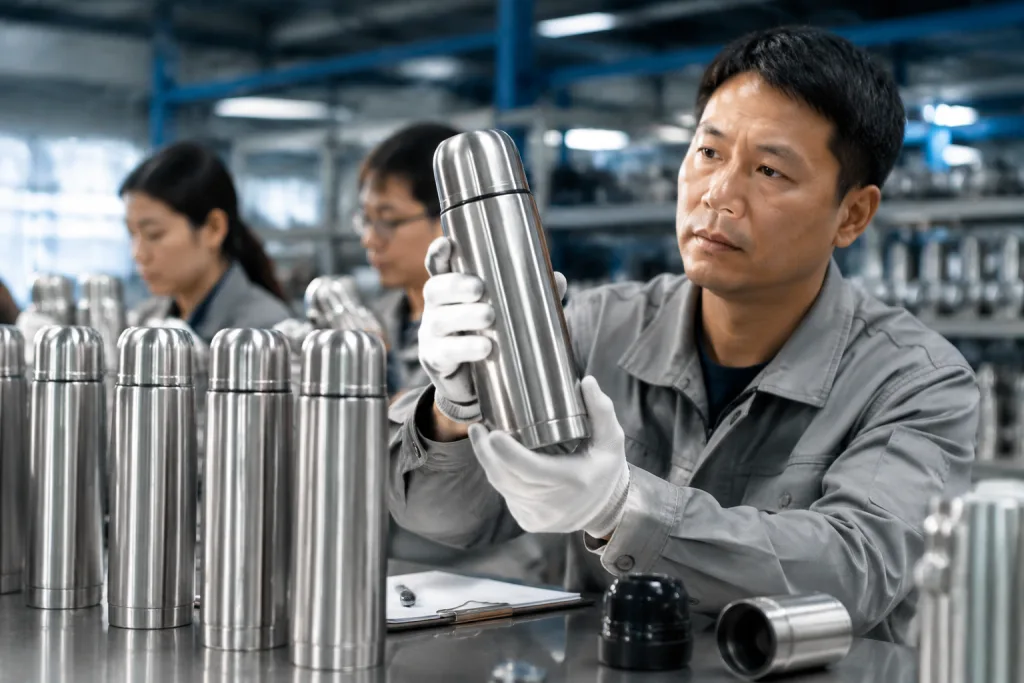
Check samples hard. Fill with boiling water, close the lid, lay it on white tissue for 30 minutes, then invert it. Measure temperature after 6 and 12 hours with a probe thermometer, and write the room temperature on the check sheet. Rub the logo with 3M tape or a wet cloth depending on the decoration method. For powder coating, ask for cross-cut adhesion testing to ISO 2409 or an agreed internal equivalent; we run the blade across a 1 mm grid, then tape-pull it before QC signs. If your product is for kids or family retail, check small parts risk, sharp edges, and the cap tether.
For the sample approval email, avoid vague language. Write: “Approved for bulk, except logo to move 8 mm lower and carton barcode to change to final EAN.” That sentence protects both sides. It tells the thermos factory which sample details are locked and which are still open. We have seen this go sideways when the buyer only wrote “looks good,” then flagged the carton barcode after mass packing.
Do not use the sample stage to keep redesigning the product for free. Use it to confirm whether the factory can repeatedly make what you already specified.
Lock the Bulk PO Details
The purchase order is where 6 out of 10 decent sourcing projects start to wobble. A bulk PO for a thermos distributor or outdoor brand should read like a production sheet the line leader can follow, not a file for accounting only. If the PO only says “custom stainless thermos, 5,000 pcs,” the math doesn't work. Last month QC pulled a pre-production sample with the right logo but the wrong lid finish because the PO never named “matte black PP lid.”
Write line items by SKU. Each SKU should include capacity, body color, lid color, logo method, logo size, packaging, barcode, carton mark, quantity, unit price, subtotal, and delivery date. Mixed colors need a hard split on the PO, not a WeChat note that gets buried: 2,000 pcs matte black, 1,500 pcs navy, 1,500 pcs white. For distributors thermos programs, include country-specific labeling, importer address, and any required language stickers. We run barcode checks with a Honeywell scanner at packing, and one PO typo in an EAN code can stop 38 cartons at final inspection.
Payment terms are usually 30% deposit and 70% balance before shipment for new buyers. Established accounts may move to 30/70 against copy BL or negotiated credit terms, but first order credit is the wrong question to ask before we have shipped together once. FOB Ningbo or Shanghai is clean for most North American and European importers. CIF works for some first-time buyers, but destination port charges still land on your desk. We ship through Ningbo more often because the truck from our Hangzhou plant is about 2.5 hours, and missed SI cut-off can push sailing from 12 days to 18 days.
Quality terms belong in the PO. Use AQL General Inspection Level II, critical 0, major 2.5, minor 4.0 unless you have another standard. Define critical defects: leakage, rust inside the drinking surface, wrong material, food-contact odor, unsafe sharp edge, and unreadable barcode. For a promotional thermos order with event deadlines, add late delivery terms before deposit. After production starts, your leverage drops fast. We have seen this go sideways when a buyer flagged 0.3 mm laser logo drift after 4,800 pcs were already packed.
A clean PO also states what happens if artwork, barcode, or packaging approval is late. The factory can control production days; it cannot control a buyer who takes 11 days to approve a carton proof. Put the approval clock in writing, such as “production lead time starts after signed PP sample and carton artwork approval.” Simple. On the floor, the carton proof sits beside the digital caliper and color chip, and the line waits until somebody signs it.
Control Production, Not Just Delivery
After the deposit hits our account, the factory should send a production schedule, not a loose promise like “ship soon.” For standard stainless flasks, our Hangzhou, Zhejiang team normally books 30-45 days for bulk after final approval, based on coating line slots and order quantity. During peak Q3, we add 7-10 days. Chinese New Year is the big trap: if the PO lands after early January, the line can sit blocked for 2-4 weeks because tube cutting, polishing, and packing crews leave at different times.
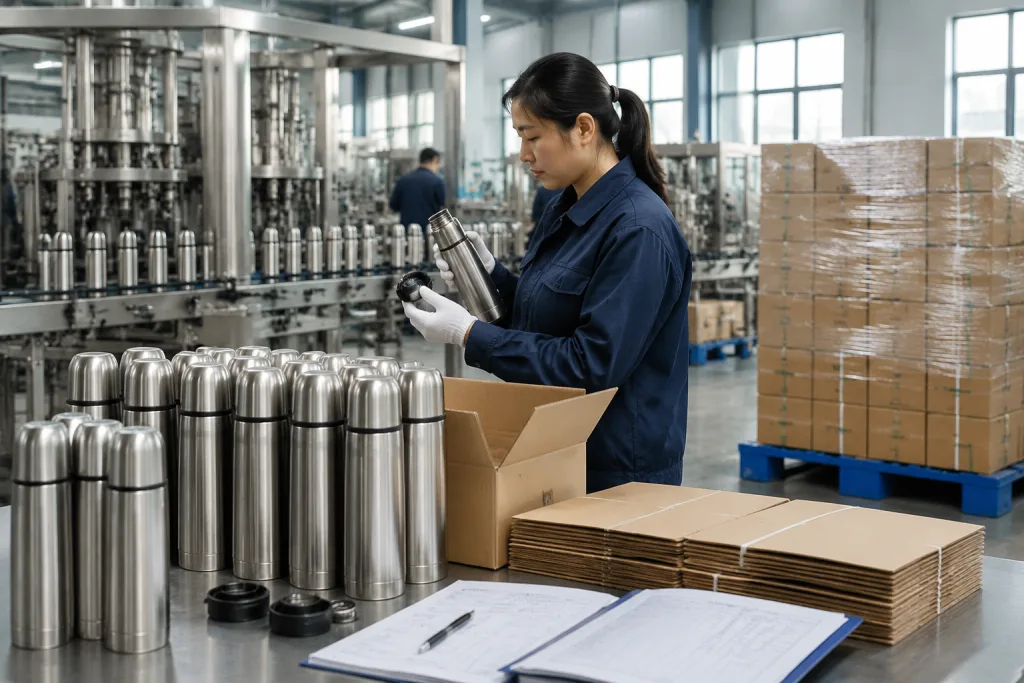
The line runs through tube cutting, welding, water expansion or stretching, vacuuming, copper coating if specified, polishing, powder coating or painting, logo application, assembly, leak testing, packing, and final inspection. The weak points repeat on almost every thermos flask wholesale order: vacuum loss, lid gasket fit, color drift between coating batches, logo adhesion, and carton crush strength. QC pulled one 1,000 ml sample last month where the silicone gasket sat 0.6 mm proud, and that was enough to create a slow leak after the shake test.
Ask for three updates. Not daily photos. Daily photos sound safe, but we’ve seen this go sideways because the merchandiser spends more time taking pictures than checking the order. First, get a pre-production confirmation with approved sample photos, material spec, and packaging proof from the color box file. Second, ask for an inline production report when 10-20% is complete, including a few caliper readings on mouth diameter and height. Third, request packing status before booking final inspection. For large thermos custom orders over 20,000 pcs, a mid-production inspection is worth the extra USD 250-400 inspection fee.
For outdoor retail, request coating abrasion checks and confirm the flask still fits standard cup holders if that is a selling point. We run a quick rub test with 3M tape after logo curing because weak ink can look fine in a photo and fail in the buyer’s warehouse. For promotional brands, verify logo placement using a simple tolerance, such as ±2 mm from the approved position. If you sell online, carton drop testing matters. A 24-piece export carton should normally use 5-ply corrugated board for heavier 750 ml or 1,000 ml flasks, or the math does not work once courier handling starts.
The goal is not to micromanage the thermos factory. The goal is to catch problems while correction is still cheap. Once 300 cartons are sealed with the wrong barcode sticker, nobody wants to hear that the PO had a typo in the item code.
Inspect and Ship Without Drama
Final inspection should run when at least 80% of the order is packed and 100% is produced. If your supplier thermos partner wants inspection at 50% packing, ask what they are trying to avoid. We have seen this go sideways: QC pulled 20 cartons with a barcode scanner after sealing and found 6 cartons using the old EAN sticker from the buyer’s first PO. Early checks miss packing defects, barcode mix-ups, and wrong carton marks.
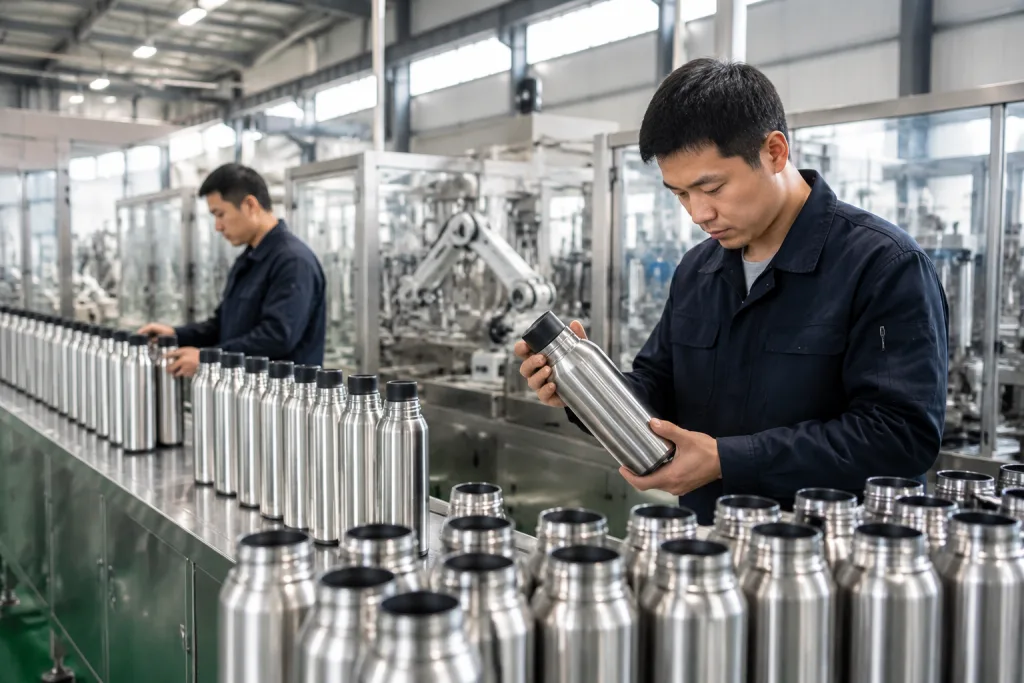
A normal pre-shipment inspection checks quantity, workmanship, function, dimensions, capacity, coating, logo, packaging, carton marks, plus basic on-site tests with a caliper, scale, torque tester, and leak tester. For stainless thermos orders, leakage and insulation are the two tests we never skip. No debate. We run hot water at 95°C, close the lid, then record temperature after a fixed period on the QC sheet. A lab-grade 12-hour test works better for formal claims, but a 2-hour field check still catches obvious vacuum failure before the line loads cartons onto pallets.
For compliance, keep documents in one folder before booking space: commercial invoice, packing list, bill of lading, food-contact test report, material declaration, plus any BSCI or social audit file your customer requires. EU buyers may ask for LFGB, REACH, and packaging waste data. US buyers may ask for FDA food-contact suitability and Prop 65 review depending on materials and state exposure. Your thermos suppliers should say clearly what they already hold and what needs new testing; “we can provide later” is not a document. Fresh third-party testing can take 7-10 working days and cost USD 180-600 per material group, and the lab will reject samples fast if the lid material code on the request form does not match the BOM.
Shipping choices come down to margin and deadline. A 20GP container can hold roughly 18,000-24,000 pcs of 500 ml flasks depending on box size. LCL works for 1,000-3,000 pcs, but carton strength and palletization matter more because those cartons get handled 5-8 times before arrival. We ship 5-layer K=A export cartons for mixed LCL when the buyer allows the extra cost; the math does not work if you save USD 0.12 on a carton and then lose 60 pcs to crushed corners. Air freight hurts for stainless steel drinkware, so use it for urgent launch quantities, not full bulk.
Pay the balance only after inspection passes and shipping documents match the PO. Check the PO number, item code, carton count, gross weight, and consignee spelling against the packing list before the wire goes out. This habit saves more money than arguing for another USD 0.03 off the unit price.
Build the Next Order Smarter
The real saving usually starts on order 2, not in the first price fight. After the first 3,000 pcs land, you have sell-through, return sheets, and buyer comments to work with. We run the next sample meeting with the marked carton, the returned lid, and the sales report on the table. Maybe 750 ml moves 38% faster than 500 ml in outdoor retail. Maybe corporate buyers flag the big silkscreen logo and ask for a cleaner 35 mm laser mark. Maybe your distributor needs mixed cartons for North and South regions because their warehouse won’t split cases by hand.
Send your thermos manufacturer hard feedback: return rate, complaint photos, sell-through by color, and packaging damage percentage. QC pulled one sample last month where the coating chips were under 0.5%, but lid confusion caused 2% returns; the math says fix the lid instruction sticker, not the paint line. If warehouse staff report slow barcode scanning, move the EAN label to the 2 short sides of the master carton before the next PO. Small fix. Big headache saved.
Repeat orders can cut price when you reduce color changes, forecast 45 days earlier, or commit to annual volume. A manufacturer thermos quote for 3,000 pcs will not match a planned 30,000 pcs annual program with rolling POs. For promotional thermos campaigns, keep one proven body shape and swap the powder coating or logo method. For outdoor retailers, build a stable family with 500 ml, 750 ml, and 1,000 ml bodies using the same lid thread and silicone gasket size. Shared parts reduce tooling risk, and after-sales staff stop asking which lid fits which bottle.
A good thermos vendor in China should also tell you when not to customize. Full custom molds look nice on a slide deck, but this is often the wrong question to ask if your MOQ is only 5,000 pcs. We’ve seen this go sideways: the buyer approved a new mold, then the PO had a typo in the Pantone code and the launch slipped 18 days instead of 12. A stock body with a tighter lid seal, 0.4 mm thicker color box paper, and cleaner brand placement often sells better. Spend customization money where the user feels it: drinking comfort, grip, heat retention, and shelf presentation.
Send Your Thermos RFQ Before You Commit
Share capacity, quantity, logo, packaging, and destination. We will return a practical FOB China quote with sample timing and MOQ.
Frequently asked questions
What is a realistic thermos flask wholesale price for 500 ml stainless models?
For a standard 500 ml stainless vacuum flask, expect about USD 3.10-5.80 FOB China at 3,000-10,000 pcs. The low end usually means a stock body, 201 outer wall, simple screw lid, one-color logo, and basic white box. The middle range covers powder coating, 304 inner steel, better gasket, and retail color box. Prices above USD 5.00 often include 304/304 steel, handle lid, full-wrap print, premium coating, or heavier packaging. Freight, duty, inspection, testing, and destination charges are not included in FOB price.
What MOQ should we expect for a custom thermos order?
For most BottleForge stainless thermos models, MOQ starts at 1,000 pcs per color for stock shapes with logo customization. If you need a special PMS powder coating, 1,000-2,000 pcs/color is more realistic because coating lines need setup time and powder loss. New lid or body tooling normally needs 3,000-5,000 pcs for the first run, plus mold charges from about USD 1,500 to USD 6,000. If you are testing a market, start with a proven body and customize logo, color, and box first.
How long does sampling and bulk production take?
Blank samples usually ship in 2-4 days if the model is in our Zhejiang sample room. Logo samples take 7-12 days after vector artwork, PMS color, and sample payment are confirmed. Bulk production for a standard customized thermos order is normally 30-45 days after deposit and final approval. Add 7-10 days in peak season, and plan much earlier before Chinese New Year. New molded parts can add 15-25 days for prototype tooling before the normal sample cycle starts.
Which logo method is best for promotional thermos programs?
Silkscreen is usually the best value for promotional thermos orders with one or two solid colors. It is clean, fast, and often adds only USD 0.05-0.15/pc depending on size and position. Laser engraving costs more but gives a durable, premium look on powder-coated stainless surfaces. Heat transfer or full-wrap printing is better for detailed artwork but needs stricter artwork control and higher setup cost. For outdoor retail, I prefer laser or restrained silkscreen because large prints can wear visibly after rough use.
How do we compare different thermos suppliers fairly?
Give every thermos supplier the same RFQ and force the quote into the same format: steel grade, wall thickness, capacity tolerance, lid material, coating type, logo method, packaging, MOQ, sample cost, lead time, and FOB port. Then compare a physical sample, not only the spreadsheet. Use AQL 2.5/4.0 for final inspection and ask for food-contact reports before deposit if compliance is critical. A quote that is USD 0.20 cheaper can become expensive if it uses weak cartons, poor gaskets, or vague delivery terms.