Key Takeaways
- A practical MOQ for custom thermos production is usually 1,000-3,000 pcs per SKU
- 304 stainless steel is enough for most bodies; 316 is worth it for acidic drinks or premium retail
- Laser engraving suits 500-5,000 pcs logo runs; powder coating needs tighter color approval
- Plan 35-55 days production after sample approval, plus ocean or air transit
If you are buying thermos flask wholesale bulk for an outdoor retail line or a promo order, supplier search is the easy part. Alibaba alone can show 3,000+ listings by lunch. The real work is locking the items that affect the PO: tooling, carton spec, logo film, inner box artwork, and the 30% deposit. We had one buyer flag a lid color after the silk-screen film was already made; that “small change” added 6 days and USD 180 in setup waste.
A stainless thermos looks simple on a shelf. It is not. A 1 mm change on the cup-mouth radius, a heavier 304 stainless body, or choosing powder coating instead of spray paint can move cost, lead time, claims risk, and sell-through. At our Hangzhou, Zhejiang factory, we see buyers lose 20-30 days because they decide the capacity first and the lid system last. The wrong question is “Which size sells best?” Start with the insulation target, body construction, logo method, compliance route, and landed cost; QC pulled one 500 ml sample last month because the silicone ring sat 0.4 mm proud and leaked after the drop test.
Start With The Use Case
Your first decision is not whether you need a custom thermos or a customized thermos. Start with where the flask will be used and what the buyer calls a failure. Outdoor retailers usually reject on 4 points: heat retention after 12 hours, visible dents after a 1 m drop, lid leak rate during carton shake test, and shelf box damage. Promotional buyers judge logo edges, Pantone drift, unit cost, and whether we ship before the event date. Different scorecards. Last month QC pulled a 750 ml sample with a 0.8 mm logo shift; the outdoor buyer passed it, but the gift agency flagged it in 10 minutes.
For a hiking-focused bulk thermos program, we usually recommend 500 ml, 750 ml, and 1,000 ml capacities with a vacuum body, 0.45-0.55 mm outer wall, 0.35-0.45 mm inner wall, and a cup-style or screw lid. We check the wall thickness with a digital micrometer before the line runs 3,000 pcs, because the math does not work if the body dents before the buyer tests insulation. For a conference or staff gift promotional thermos, 350 ml or 500 ml is easier to ship, cheaper to pack, and more likely to fit car cup holders if the diameter stays under 73 mm. Small size wins here.
Be honest about the retail price or campaign budget before you ask any thermos supplier for options. A USD 3.20 FOB flask and a USD 7.80 FOB flask can both be stainless and vacuum insulated, but they are not the same product. The lower-cost version may mean thinner steel, a basic lid gasket, single-color printing, and a plain white box; the higher-cost version can carry powder coating, copper lining, better cap tooling, recycled paper packaging, and tighter AQL inspection. We have seen this go sideways when a PO says “premium gift bottle” but the target is USD 3.50 FOB with 2-color logo and color box.
If you are a thermos distributor, tell the factory thermos team your channel early: outdoor shops, corporate gift agencies, Amazon FBA, supermarket promo, or club merchandise. This is the wrong question to ask: “What is your cheapest 500 ml?” Ask what model fits the channel, carton drop test, barcode label, and MOQ. For Amazon FBA, we run extra barcode checks on the packing table; one typo on a PO label once held 42 cartons for relabeling before shipment.
Choose The Steel And Structure
For thermos flask wholesale bulk orders, we run food-grade 304 stainless steel on the inner and outer walls in about 8 out of 10 projects. It is the safe pick for coffee, tea, water, and soup. For premium outdoor retailers, or for brands selling lemon tea and sports drinks, 316 stainless steel on the inner wall is worth pricing. It usually adds USD 0.35-0.80 per piece depending on capacity and market steel price. Last month QC pulled a 750 ml sample after the PMI gun showed the inner wall was 304, not the 316 written on the PO. Catch it early.
“Double wall” is the wrong question to ask. Ask how the factory tests the vacuum. A typical 500 ml stainless thermos should hold hot water at 95°C and stay above 55-60°C after 12 hours at room temperature, depending on lid design and mouth diameter. On our line, QC uses a K-type probe and logs 6 samples per color before carton sealing. Wide-mouth soup flasks lose heat faster because the opening is usually 70-85 mm. Narrow-mouth drink bottles usually perform better. Copper plating inside the vacuum layer can improve heat retention, but the math does not work if the PP lid or silicone gasket is bleeding heat.
For outdoor retail, check the base, shoulder, and cap thread before you argue over 20 grams of steel. These parts take the hits. We have seen this go sideways: a buyer pushed for a lighter thermos custom model, saved USD 0.20 on steel, then flagged 3.8% dent complaints after the first container landed. For promotional use, lighter weight is fine if the flask is handed out at events and not sold as expedition gear. Put a 0.6 mm base on a hiking bottle, not a soft can wall.
- 304 inner and outer: standard for most thermos bulk programs; we usually set MOQ at 1,000 pieces per color.
- 316 inner, 304 outer: better for premium positioning and acidic drinks; confirm the material with PMI testing, not just a supplier statement.
- Powder coating: good grip and retail look; control color with a Pantone chip and check 3 spots by film thickness gauge.
- Raw stainless finish: lower logo risk and fewer coating scratches; brush marks still need checking under a light box.
Ask your thermos manufacturer for wall thickness, lid material, gasket material, and insulation test data before approving a sample. Get the numbers in writing: inner wall 0.4 mm, outer wall 0.5 mm, silicone gasket grade, and the 12-hour heat test sheet. We once had a buyer send a PO with “304 steal” typed in the material field; funny typo, serious problem if nobody confirms it. If the supplier cannot give those basics, they are a thermos vendor, not a reliable engineering partner.
Set Customization Before Pricing
Customization changes the quote from the first line item. A thermos with a one-position laser logo at 45 mm wide is not the same job as a retail bottle with full-wrap color artwork, PMS-matched powder coating, gift box, barcode label, insert card, and carton marks. We see about 6 out of 10 buyers ask for the lowest FOB price first, then send branding details 3 days later. That is where re-quotes start. The buyer flagged it last month when the PO said “black matte” but the artwork file named “charcoal PMS 432,” and the math didn’t work.
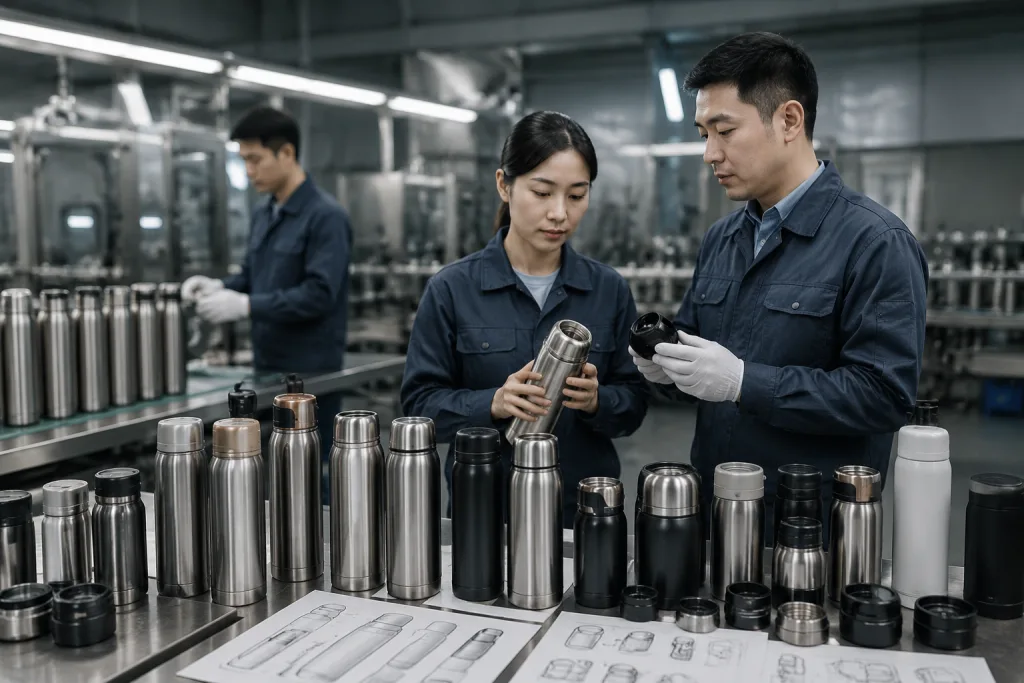
For stainless thermos branding, we run laser engraving, silkscreen printing, heat transfer, UV printing, silicone embossing, and custom cap tooling. Laser engraving is clean and durable on stainless steel or powder coating, with a typical setup cost of USD 30-80 and a low per-unit cost; QC checks the logo position with a 0.5 mm steel ruler before the line keeps moving. Silkscreen suits simple solid-color logos, usually 1-3 colors, but thin fonts under 1.2 mm can fill in. Full-color artwork usually goes to heat transfer or UV, and adhesion must be tested on textured powder coating with a cross-cut tape test.
If you need a thermos promotional campaign with 2,000 pieces and a fixed event date, do not over-customize the lid unless you have at least 60-75 days. Custom mold work for a lid or handle can cost USD 1,500-6,000 and add 20-35 days before mass production; we have seen this go sideways when the first T1 lid sample had a 0.3 mm sealing gap and failed the leak test. For 10,000+ pieces, tooling can be justified. For 1,000 pieces, this is the wrong question to ask. Use an existing mold and put the budget into coating thickness control, retail packaging, or AQL inspection.
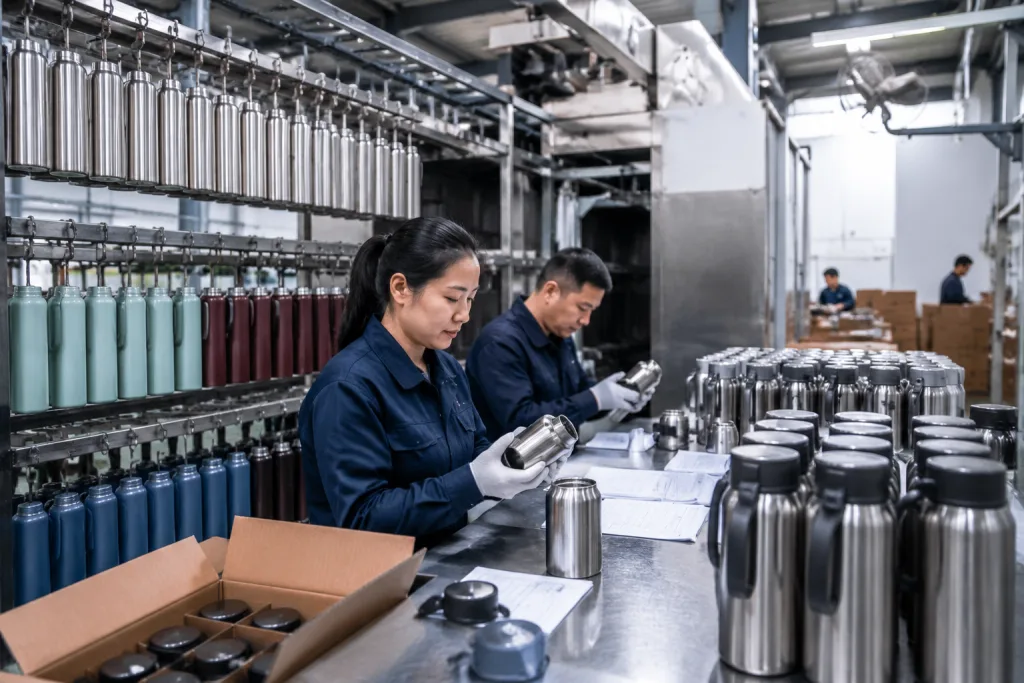
At BottleForge Industrial in Zhejiang, China, our usual MOQ is 1,000 pcs for laser logo on stocked shapes, 3,000 pcs for custom powder color, and 5,000 pcs or more for special lid components. Monthly stainless drinkware capacity is about 280,000 units across thermos flasks, tumblers, and sports bottles, but capacity still depends on welding slots, powder line color changes, and carton packing speed. We ship mixed thermos flask orders every month, and QC pulled 32 random samples from one 3,000 pcs batch last week before sealing the master cartons. Those numbers matter because a supplier thermos promise without capacity is just sales talk.
Check Compliance Before Deposit
Compliance is not a PDF you collect before shipment. If you sell in Europe or North America, it decides the 304 stainless grade, powder coating supplier, pad-printing ink, PE bag wording, and bottom label from day one. For EU buyers, confirm LFGB food contact testing, REACH coverage for coatings and plastics, and packaging rules before you approve recycled claims. For the US, confirm FDA food contact suitability and, for children’s products, CPSIA or ASTM requirements where they apply. Adult stainless thermos flasks are usually easier than kids bottles, but lids, paint, and silicone gaskets still cause trouble. We had QC pull 12 black-lid samples last year because the gasket supplier changed the silicone batch and the odor test failed after 24 hours in a 60°C cabinet.
A real thermos factory should be fine with third-party testing. SGS, Intertek, BV, and TÜV are the lab names buyers ask us for most often. Do not rely on a two-year-old report for another color, another gasket, or another cap plastic. The math doesn't work. A black powder coating report does not cover a metallic blue coating from a new paint supplier, even if the bottle shape and capacity are the same. We run into this on 5,000 pc trial orders: the buyer sends an old report, then their EU customs broker flags the color code on the packing list.
Inspection standards belong in the purchase order, not in a WeChat message after production starts. AQL 2.5 for major defects and AQL 4.0 for minor defects is common for drinkware. Critical defects should be zero tolerance. Define each one clearly: leakage after 10 minutes upside down, sharp edge over 0.2 mm burr, bad odor, rust spot, wrong logo position over 1.5 mm tolerance, wrong barcode, failed capacity, or crushed export carton. For vacuum insulation, require hot water testing on a sample size agreed before the line opens. Some buyers test 100% for premium orders, but that adds labor cost and time; we usually quote 12 days for normal QC versus 18 days when every flask must sit through the insulation check.
Do not accept “same as sample” as your only quality clause. The sample can pass, then the shipment fails because the coating, gasket, carton, or logo tolerance was never written down.
Good thermos suppliers in China will not be offended by clear QC terms. Vague orders become disputes. We have seen this go sideways from one typo on a PO, where “matte white” became “milk white” and 3,000 lids were already sprayed before the buyer flagged it.
Build A Landed Cost View
FOB price is a good starting line, but finance will judge the landed number. For thermos flask wholesale bulk, we build it from unit price, logo process, packaging, China inland trucking, export handling, sea or air freight, duty, broker fee, warehouse receiving, and FBA prep when the PO asks for it. A USD 4.90 FOB 750 ml flask can land above USD 6.20 in the US or EU after freight and import costs, depending on carton CBM and shipping season. Last month our forwarder remeasured a 58 × 42 × 36 cm carton with a tape measure at the Hangzhou warehouse; the buyer’s sheet was off by 0.018 CBM, and the math changed by USD 0.11 per bottle.
Stainless thermos products eat space. Carton efficiency matters more than most first-time buyers expect. A 500 ml flask might pack 24 pcs per master carton, while a 1,000 ml model may pack 12 pcs. Gift boxes improve retail presentation but increase CBM by 10-25%, and that hurts if the campaign ships by air. We’ve seen this go sideways: the buyer approved a window gift box, then flagged the air quote because chargeable weight jumped from 186 kg to 231 kg on 800 pcs. If you are a distributor thermos buyer holding inventory, the cleaner shelf look can still make sense.
Ask your thermos manufacturers for carton size, gross weight, net weight, HS code suggestion, and packing method at quotation stage, then put those numbers into your landed cost sheet before you approve the sample. If you sell online, request drop-test packaging, not just “safe packing” written on the PI. QC pulled the sample from line 3 last Tuesday and found one inner box corner crushed after a 76 cm drop; we changed the EPE thickness from 1.5 mm to 2 mm before mass production. If you ship to Amazon, confirm FNSKU labeling, carton weight under marketplace limits, suffocation warnings for polybags where required, and no mixed-SKU cartons unless your warehouse accepts them.
Payment terms are usually 30% deposit and 70% before shipment for first orders. For repeat buyers with stable volume, some manufacturers thermos suppliers may discuss 20/80, OA through trade insurance, or staged payments tied to material purchase and final inspection. Be careful with a quote that is 12% lower than the market but demands 100% upfront. The math does not work. In China, low price plus payment pressure often means the factory is using your order to cover cash flow, not improve your margin; we once saw a PO with “750ml” typed as “75ml,” and the supplier still chased full deposit before correcting the spec sheet.
Approve Samples Like A Buyer
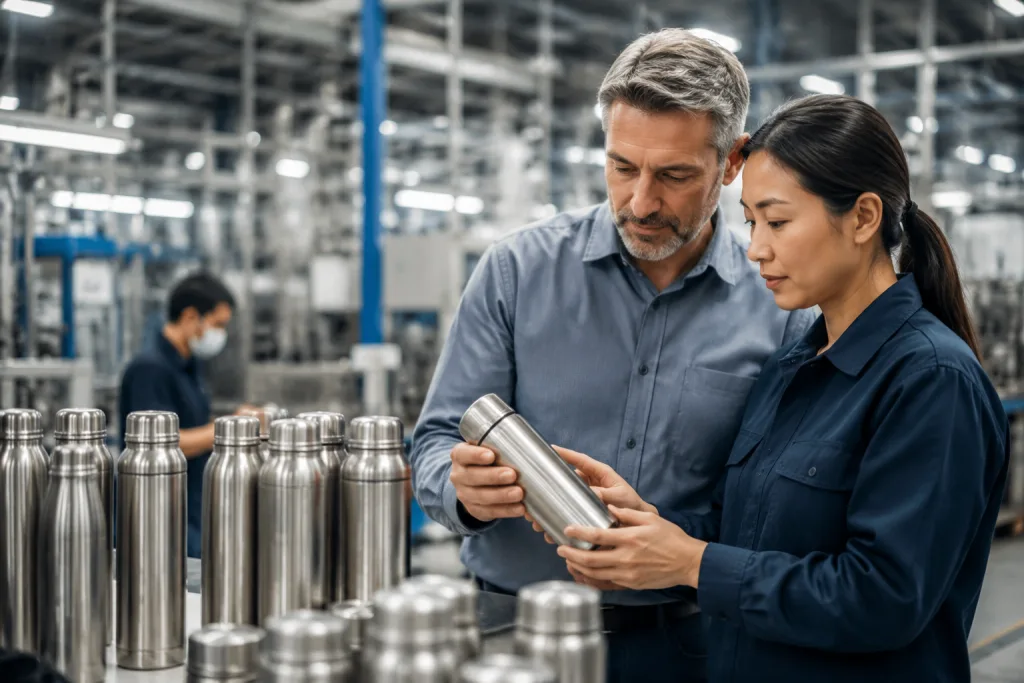
Samples are not souvenirs. They are the control reference for the line. When a customized thermos sample arrives, test it the same way your customer will: fill it with 95°C water, weigh it full and empty on a 0.1g scale, check real capacity against the PO, shake it upside down for 30 seconds, leave it on white A4 paper overnight, open and close the lid 50 times, then inspect the logo at a window under daylight. QC pulled one sample last month where the silicone ring sat 0.6mm proud; it looked fine until the leak test. If the coating still smells after two washes, stop and ask questions.
For a new thermos supplier, ask for a pre-production sample after artwork and color approval, not a random stock sample. Stock samples only prove the mold exists. They do not prove your PMS color, logo height, gift box dieline, barcode scan result, or gasket material. This is where we see buyers get pushed back by their own client: “The blue looked different on screen.” For powder coating, approve a physical color chip or a sprayed bottle from the same gun setting we run on bulk. Photos are not enough; a light box at 6500K still hides texture and gloss differences.
A practical approval sequence is: catalog model selection, blank sample, artwork proof, branded sample, packaging proof, pre-production sample, then mass production. It feels slow. The math doesn't work if you discover a logo sitting 4mm too high after 5,000 pieces are already coated. For normal thermos custom orders, sample preparation takes 5-10 days for laser logo and 10-18 days for powder color or complex printing. We ship faster only when the bottle body, lid, coating powder, and carton size are already on our sample rack.
If you are buying as a thermos distributor or promotional agency, keep one signed sample in your office and have the thermos factory keep one matching sample in Zhejiang. Photograph both with the date, version number, approved artwork file name, and PO number; we once had a buyer flag a carton mark because the PO said “matte black” but the artwork file was named “black gloss final.” When a dispute happens, version control saves 2-3 days of emails. Without it, everyone starts comparing different PDFs, old samples, and phone photos.
Decide Your Supplier Risk Level
The final decision is not “which thermos vendor is cheapest?” The better question is how much mess your team can absorb when the line is full and ETD is 12 days away. A trading company works if you need 6 mixed SKUs at 500 pcs each and you can accept looser control. A direct thermos manufacturer fits better when the same Pantone color must run again in March, the gift box has a barcode position of 38 mm from the edge, or the lid needs a mold change. A hybrid supplier with factory access can work too, but ask who signs off when QC pulled the sample and found the coating scratch rate above AQL 2.5.
For outdoor retailers, I would choose a factory thermos partner that runs vacuum testing on every batch, checks coating thickness with a film gauge, and keeps documented AQL inspection records. For promotional brands, artwork handling and carton labeling matter more than buyers expect; we once had a PO typo on “matte black” that turned into 3,000 pcs of black gloss before the buyer flagged it. For distributors thermos programs, repeatability carries the order. The second shipment must sit next to the first one on a retail shelf without customers asking why the logo looks 2 mm lower.
Ask blunt questions. How many units per month can you produce in peak season, 80,000 or 300,000? What is the real MOQ per color, not the number printed on the catalog? Can you provide BSCI or ISO 9001 documents? Do you subcontract coating? What happens if 3% of units leak during inspection? Can you hold 500 spare lids for after-sales service? A serious thermos suppliers team answers with numbers, photos from the line, and a QC report, not “no problem.” We have seen this go sideways.
China remains the strongest sourcing base for stainless drinkware because the supply chain is tight: steel forming and vacuuming are usually within the same industrial belt, while polishing, coating, printing, packaging, and export trucking can be arranged in 1 to 2 days. Hangzhou, Zhejiang gives us fast access to Ningbo and Shanghai ports, so we ship FOB Ningbo or FOB Shanghai without adding 5 extra domestic trucking days. Use that advantage, but do not let geography replace due diligence. The right supplier thermos choice protects your launch date and brand reputation; if the margin only works when nobody checks the leak test, the math does not work.
Send your thermos brief for a factory quote
Share capacity, logo, color, packaging, MOQ, and destination port. We will reply with practical options, FOB pricing, and sample timing.
Frequently asked questions
What MOQ should I expect for thermos flask wholesale bulk orders?
For a standard stainless thermos with laser logo, a realistic MOQ is 1,000 pcs per design. If you need custom powder coating, plan on 3,000 pcs per color because coating lines lose efficiency on small batches. For a new lid, handle, or unique shape, 5,000-10,000 pcs is more realistic due to tooling and production setup. Some suppliers offer 300-500 pcs, but the unit price is usually higher and customization choices are limited. For outdoor retail, it is better to start with 1,000-2,000 pcs across 1-2 core capacities than spread budget across too many colors.
How much does a custom stainless thermos cost from China?
As a rough FOB China range, a basic 500 ml custom thermos can be USD 3.20-5.20, a better 750 ml outdoor model can be USD 4.80-7.80, and a premium 1,000 ml flask with powder coating and gift box can reach USD 7.50-11.50. These prices move with steel cost, lid complexity, coating, logo method, and order volume. Laser logo is usually cheaper than full-color printing. Gift packaging can add USD 0.25-1.20 per unit. Always compare landed cost, not only FOB, because thermos cartons are bulky and freight can change your margin quickly.
Which logo method is best for promotional thermos programs?
For most promotional thermos orders, laser engraving is the safest choice. It is durable, looks clean, and works well from 500 to 10,000 pcs. Silkscreen printing is good for simple one- or two-color logos, especially on smooth powder coating, but adhesion should be tested. Heat transfer or UV printing is better for gradients and multi-color artwork, yet it adds setup time and more quality control risk. If your event date is within 45 days, choose an existing thermos factory model with laser logo and standard box. Save complex printing for repeat programs with more approval time.
How long does bulk thermos production and shipping take?
After sample approval and deposit, standard bulk thermos production usually takes 35-55 days. Laser logo on an existing model may be closer to 30-40 days if materials are ready. Custom powder coating, special packaging, or peak-season orders can push production to 50-65 days. Ocean freight from China to Europe or North America often adds 25-45 days port to port, plus customs and inland delivery. Air freight can move in 5-10 days, but the cost is high because stainless thermos flasks are bulky. Build your launch calendar backward from the required warehouse arrival date.
What should I check before choosing a thermos manufacturer?
Check whether the thermos manufacturer can prove capacity, testing, and repeatability. Ask for factory location, monthly output, MOQ by customization type, insulation test method, AQL inspection standard, and recent compliance reports for the same material family. Request photos or video of vacuum testing, coating, printing, and packing lines. Confirm whether coating and printing are in-house or subcontracted. For Europe, discuss LFGB and REACH. For the US, discuss food contact and labeling needs. A reliable manufacturer thermos partner should give specific answers, such as 1,000 pcs MOQ, 45-day lead time, and AQL 2.5/4.0 inspection.