Key Takeaways
- Start RFQs with capacity, steel grade, lid type, test standard, packaging, and target FOB price within 24 hours
- Use pre-production samples to lock artwork, vacuum performance, coating finish, carton strength, and barcode placement
- A practical custom thermos MOQ is 1,000 pieces per SKU, with lower MOQs usually raising unit price by 12-25%
- Your PO should list AQL level, inspection date, spare parts, Incoterms, payment split, and exact carton marks
If you sell outdoor gear or promotional merchandise, the thermos looks easy until the first RFQ comes back with 5 steel grades, 3 lid drawings, 2 vacuum claims, and a price that moves after artwork approval. That is where thermos flask vendors burn margin before the line even opens; we have seen a buyer flag a 0.3 mm logo shift on the pre-production sample and then ask why the unit price changed.
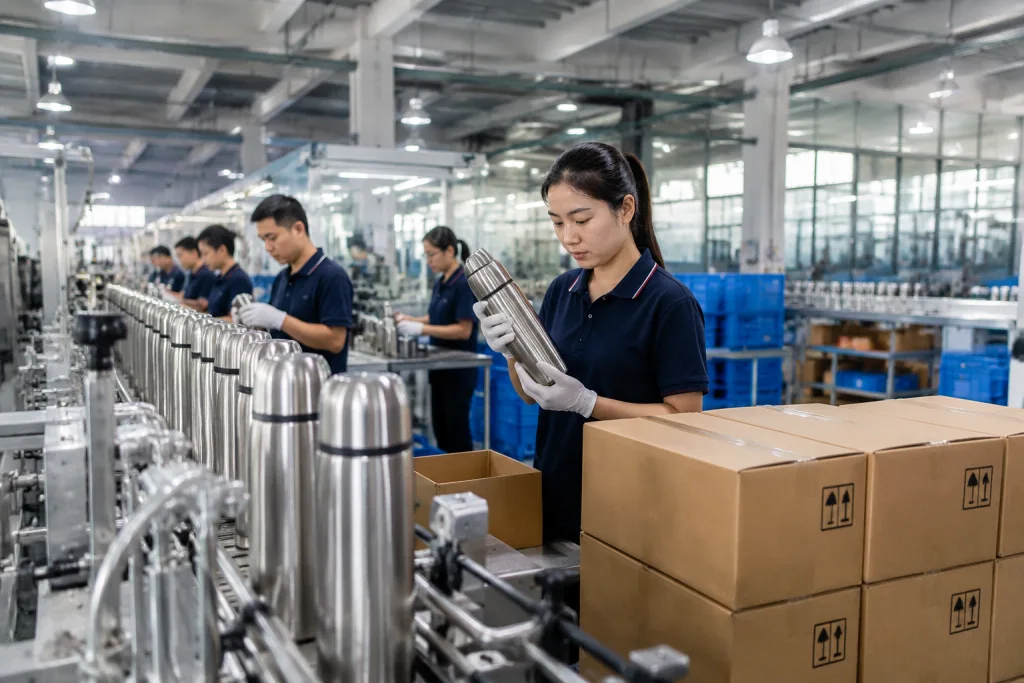
A stainless custom thermos is a small engineered product, not just a logo carrier. Wall thickness, vacuum retention, coating adhesion, carton drop strength, and compliance paperwork decide whether the second order comes back. BottleForge Industrial in Hangzhou, Zhejiang works with bulk thermos buyers who need specs they can put on a PO, not catalog poetry. We run stainless thermos lines at about 450,000 units/month in China, with typical MOQ from 1,000 pieces per SKU and 30-45 day bulk lead time after sample approval; QC still pulls random samples with a caliper and 24-hour hot-water test before we ship.
Start With A Buyer-Grade RFQ
A weak RFQ says, “500 ml stainless thermos with logo.” A buyer-grade RFQ gives thermos flask vendors enough detail to quote the same bottle, not fill in blanks with their own assumptions. We see this every week. One thermos supplier in China quotes 304 inner steel with a basic PP screw lid; another thermos factory quotes 316 inner steel, a push-button leak-proof lid, and a 350 gsm retail box. On paper the gap looks like USD 0.42. The cheaper offer is not cheaper. It is a different product, and the buyer flagged it only after QC pulled the pre-production sample.
For outdoor retail, start with the use case: hiking pack, campsite coffee, school commute, car cup holder, or cold-chain promotional gifting. Then lock the hard specs: capacity such as 500 ml, 750 ml, or 1,000 ml; body shape; mouth diameter in mm; 304 or 316 inner stainless steel; 201, 304, or 316 outer shell; powder coating or spray paint; copper plating if required; lid material; target heat retention, for example 60°C after 12 hours from 95°C fill under GB/T or equivalent internal test method. This is where the math often breaks. A 74 mm body may fit the buyer’s shelf tray, but the line may need a different chuck for coating if the shoulder radius changes by 3 mm.
Your RFQ should state quantity by SKU, not only total order volume. A 6,000-piece order split into 12 colors is not the same workload as 6,000 pieces in two colors. We run separate color approvals, logo screens, carton marks, and packing checks; even one typo on a PO color code can hold the line for 2 days. For a custom thermos, color changes, logo setup, and packing variations all cost money. Asking “best MOQ?” is the wrong question to ask. Ask what MOQ applies per color, per logo, and per carton style.
RFQ line items to send:
- Capacity, exact dimensions in mm, mouth diameter, and target weight with tolerance, such as ±20 g
- Steel grade for inner and outer walls, plus any buyer limit on 201 stainless for price-sensitive programs
- Lid function, gasket material, and leak-test requirement, such as inverted 30 minutes with no visible drip
- Logo method with artwork size: laser, silk screen, heat transfer, embossing, or sleeve
- Packaging type and board strength: bulk pack, white box, kraft box, color box, or PDQ
- Target MOQ per SKU, annual forecast, destination port, and preferred Incoterm
Quote The Real Product Cost
After the RFQ is locked, ask your thermos manufacturer for a costed quotation, not a one-line price. For stainless thermos bulk orders, the body takes the biggest share, but lids, coating, packaging, and inspection can shift the final FOB price by 15-35%. We run this check on a weighing scale and coating thickness gauge before quoting. A 750 ml double-wall vacuum flask may quote at USD 3.20 FOB Ningbo with a standard screw lid and plain white box, then hit USD 4.10 after a flip lid, Pantone powder coating, retail box, and individual polybag-free packing. Small changes bite.
A solid thermos factory should show the assumptions behind the price. At BottleForge in Zhejiang, China, we usually quote stainless thermos projects with tooling, sample cost, bulk unit price, carton size, gross weight, estimated CBM, and lead time. Our packing engineer often checks the 5-layer export carton on a tape measure because 3 mm extra on a gift box can change the carton layout. That lets you calculate landed cost instead of arguing over USD 0.03 on FOB. Freight matters: a tall 1,000 ml factory thermos in a gift box can reduce container loading efficiency by 8-12% compared with nested bulk packing. The math does not work if the buyer only compares unit price.
For promotional thermos programs, ask whether the unit price includes artwork setup. Laser engraving may have a one-time fixture charge of USD 50-120. Silk screen plates may run USD 30-80 per color. Heat transfer films can require MOQ per design. We have seen this go sideways when a PO says “logo as attached” but the attachment is a low-resolution JPG, not AI or PDF. If you sell as a thermos distributor, those charges become real when 27 customers each want a different logo.
Quotation line items to confirm:
- FOB port, usually Ningbo or Shanghai for Zhejiang production, with the port name written the same way on PI and PO
- Unit price by quantity tier: 1,000, 3,000, 5,000, and 10,000 pieces, including any price break tied to lid color
- Sample charge and refund policy after bulk PO, with courier cost separated
- Tooling or mold charge for custom lid, handle, or silicone boot, including the expected mold life in pieces
- Estimated lead time for blank sample, logo sample, and mass production, counted from deposit and artwork approval
- Carton dimensions, pieces per carton, gross weight, and CBM, checked against the final packing method
Make Samples Prove The Claim
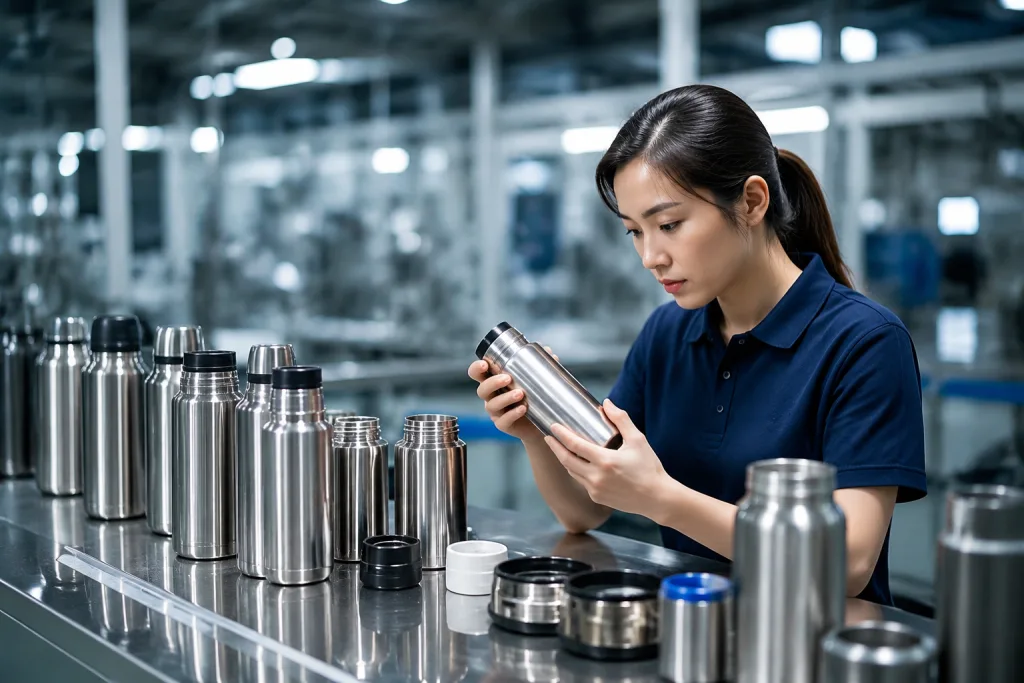
Samples decide whether a customized thermos becomes a sellable SKU or stays a clean rendering on a PDF. Do not approve from photos. Get a physical sample on the buyer’s desk: one blank structure sample and one decorated pre-production sample. We run this on almost every OEM order above 1,000 pcs because a 3D mockup made in two hours tells you nothing about vacuum retention, lid torque, scratch resistance, or Pantone match under a D65 light box. Last month QC pulled a 500 ml sample that looked fine in photos, then the lid squeaked at 0.8 N·m and the buyer flagged it immediately.
For most custom thermos projects, the first blank sample takes 5-7 days if it uses an existing mold. A logo sample usually takes another 7-10 days after artwork confirmation. If a new mold is needed for a handle lid, cup lid, or special bottom, allow 20-30 days. Pushing this stage is the wrong place to save time; the math does not work when a revised logo after bulk powder coating means stripping or scrapping 3,000 units. On the line, we check sample dimensions with a digital caliper, and even a 0.4 mm lid fit change can turn into leakage after the silicone ring is assembled.
Test the sample like your end customer will use it. Fill it with 95°C water, close the lid for 6, 12, and 24 hours, and measure temperature with the same probe depth every time, not one reading near the wall and another in the center. Check leakage by laying the flask horizontally for 30 minutes and shaking it 20 times. For outdoor retailers, add a drop or impact check from 80 cm onto plywood or rubber mat. For promotional brands, check logo rub resistance with 3M tape and 50 alcohol wipes if the decoration will be handled daily. We have seen this go sideways: one PO said “matte black,” the approved sample was “black sand texture,” and QC caught the mismatch only because the golden sample was tagged on the inspection table.
Sample approval line items:
- Approved golden sample number, signed label, and dated photos from front, side, lid, and base
- Color standard: Pantone code or physical color chip checked under D65 light box
- Logo size in mm, position from rim or base, artwork file name, and print method
- Heat retention result and leak-test result, with test time and room temperature written down
- Packaging layout, barcode, FNSKU if required, and carton mark, including any PO spelling that must match exactly
- Allowed changes before mass production, written clearly so the line does not guess
Write A PO That Factories Can Follow
A purchase order for a thermos bulk project should read like a production sheet the line leader can tape beside the laser marking machine. We’ve seen 7 of the last 40 PO disputes start with the same lazy phrase: “as per approved sample.” It helps, but it does not carry the order. The factory team needs price, material, artwork, carton packing, inspection rule, and delivery date in one document. If you are a distributor thermos buyer handling 3 retail accounts at once, a clean PO saves 18 email checks later. This is the wrong place to be brief.
Use one PO line per SKU. If the same 500 ml bottle comes in black, green, and sand, list each color on its own line with quantity, Pantone number, logo file name, box file name, barcode number, and carton mark. For a promotional thermos order with 10 end-client logos, split every decoration version even when the bottle body is identical. We run print counts from those lines; last month QC pulled the sample because the PO said “logo A/B” but the artwork folder had 12 files and 2 were old versions.
Payment terms should be plain. Common terms are 30% deposit and 70% balance before shipment after passed inspection. For established buyers, other terms can be discussed, but new custom thermos projects usually need deposit because 304 stainless steel sheet, powder coating, lids, and color boxes are paid out before the first carton is sealed. Define Incoterms precisely: FOB Ningbo 2020 is not the same as EXW Hangzhou or DDP to a US warehouse. The math doesn’t work if a buyer writes “FOB China” and later expects us to cover 1,200 kg of inland trucking to Shenzhen.
PO line items to include:
- SKU code, product name, capacity, and approved sample reference with sample tag number
- Quantity per color and per logo version, checked against the artwork folder
- Unit price, total value, tooling cost, and sample credit if any
- Incoterm, port, payment schedule, and shipment window in calendar dates
- Packaging BOM: box, insert, manual, silica gel if used, master carton with carton size in mm
- Inspection standard: AQL level, critical defects, and booking responsibility
A good PO removes interpretation. If a line can be misunderstood, it will be misunderstood during a busy production week.
Control Production Before Final Inspection
Mass production is not one big button press. On the line, a stainless thermos order moves from 304 tube cutting on the pipe cutter to forming, laser welding, vacuum brazing, polishing, powder coating, logo printing, lid assembly, 100% water leak testing, inner-bag packing, and carton sealing. Check only at final inspection and the bad parts are already buried in 42 x 38 x 32 cm export cartons with tape over the seam.
Ask your manufacturer thermos partner for a production schedule with three hard stops: material arrival, first finished units, and packing start. For a 5,000-piece custom thermos order, we normally recommend confirming the first 50-100 finished units before running full decoration. QC pulled the sample at 9:40 last Tuesday, and the buyer flagged a 1.5 mm logo shift before the pad-printing line went full speed. This is where you catch coating gloss, logo position, lid thread feel, and EAN-13 barcode scanning under a handheld Zebra scanner. If the first 100 units are wrong, the loss is annoying. If 5,000 are wrong, the margin is gone.
Quality standards should match the selling channel, not a generic factory checklist. Outdoor retailers usually push us on leak rate after a 30-minute inversion test, dent resistance after carton drop, finish durability after cross-hatch tape pull, and complaint rate after launch. Promotional brands care more about logo accuracy, clean gift boxes, and the event date printed on the PO. We once saw a buyer type “matte balck” on the PO; the sales team knew it meant matte black, but the artwork file still had to be corrected before coating. For EU and North American markets, keep REACH, LFGB where food contact is required by customer, FDA food-contact expectations, and California Proposition 65 review in mind. For children’s lines, ASTM and CPSIA may become relevant, but adult thermos flasks are usually handled under different assumptions.
Production control line items:
- Approved material grade certificate, such as 304 stainless steel, matched to the coil batch number on the warehouse tag
- First article photos and measurement report, including height, mouth diameter, lid torque, and logo position in mm
- In-line leak test record and vacuum retention sample log, with failed pieces held in a red reject bin
- Coating adhesion or cross-hatch check where applicable, using 3M tape after the powder coat has cooled
- Packing start approval before full carton sealing, checked against the shipping mark and inner box artwork
- Defect classification list: critical defects that stop shipment, major defects that hit selling value, minor defects that stay inside the agreed limit
Thermos suppliers who resist in-line checkpoints are not always hiding problems. Still, for branded retail work, this is the wrong place to save 2 hours; we have seen it go sideways when 18 cartons were sealed before anyone checked the lid gasket color.
Ship Bulk Without Surprise Charges
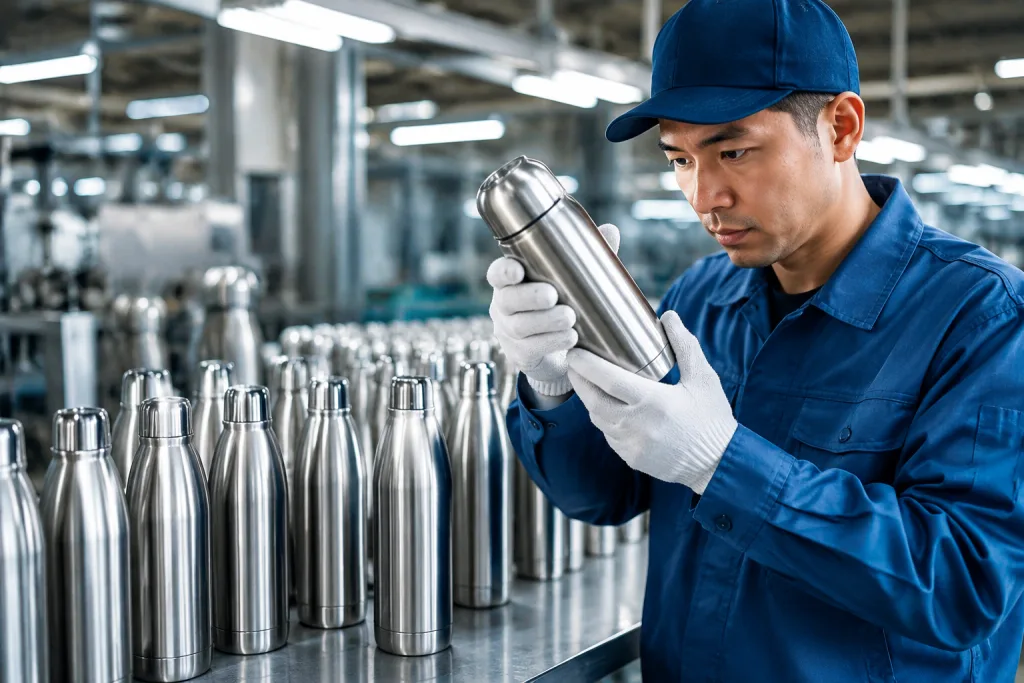
After production, final inspection should protect both sides, not just tick a box. For stainless thermos orders, we run ANSI/ASQ Z1.4 sampling with AQL, usually critical 0, major 2.5, minor 4.0, and we tighten it for retail launches when the buyer asks before mass production. QC pulled 200 samples last month on a 12,000 pcs flask order and found 7 crooked laser logos at 1.5 mm off-center, so the line reworked them before the inspector sealed cartons. Inspectors should check quantity, workmanship, dimensions, logo position, leakage, heat retention samples, packaging strength, carton drop if required, barcode scanning, and shipping marks. Don’t push barcode and carton mark checks to the warehouse. Repacking there hurts.
For Amazon-style or distributor thermos channels, confirm FNSKU, suffocation warnings when polybags are used, carton weight limits, and pallet rules before packing starts. A carton above 22 kg can trigger handling issues in some warehouses; we try to keep boxed 500 ml bottles at 18–20 kg per master carton when the carton size allows it. For retail distributors, ask whether mixed-color cartons are allowed. We have seen this go sideways: one buyer’s PO said “assorted colors,” but their routing guide rejected mixed cartons, and 36 cartons had to be opened and sorted again.
Shipping terms need factory math, not brochure math. FOB is clean when you or your forwarder control freight. DDP works for smaller promotional thermos orders, but compare the landed cost line by line because duty, local delivery, and warehousing are bundled. The wrong question is “which term is cheaper”; ask who controls the cost after the goods leave Ningbo or Shanghai. Stainless vacuum flasks are not fragile like glass, but gift boxes crush fast if the master carton is weak. We often use 5-ply export cartons for boxed stainless thermos, check edge crush by hand at packing, and adjust carton size when empty space goes over 15 mm around the inner boxes.
Shipment line items:
- Final inspection report, defect photos, and written release decision from the buyer
- Commercial invoice, packing list, bill of lading details, and the exact consignee name copied from the PO
- HS code, country of origin, buyer tax details, and any special customs wording requested by the broker
- Carton marks, pallet marks, FNSKU, or retail routing labels checked by scanner before sealing
- Spare lids, gaskets, straws, or display parts packed in a marked accessory carton if ordered
- Agreed shipment date, vessel cutoff, document deadline, and who pays if cutoff moves from Friday to Tuesday
A reliable thermos manufacturer should make shipment boring. Boring is good when your launch date is already printed in a retailer catalog, and nobody wants a 6 mm barcode typo holding 80 cartons at the dock.
Send Your Thermos RFQ For A Practical Quote
Share capacity, quantity, logo method, packaging, and destination port. We will return FOB pricing, MOQ, sample timing, and production notes.
Frequently asked questions
What MOQ should outdoor retailers expect for a custom stainless thermos?
For an existing stainless thermos mold, a realistic MOQ is usually 1,000 pieces per SKU when you need a custom logo and standard color. If you need a custom powder-coated Pantone color, 2,000-3,000 pieces is more practical because coating lines have setup loss. A customized thermos with a new lid, handle, silicone boot, or molded part may need 3,000-5,000 pieces to spread tooling cost. Some thermos suppliers will accept 500 pieces, but expect a 12-25% higher unit price and fewer packaging choices. For outdoor retailers testing a new line, we often suggest 1,000 pieces in one body color with two laser logo versions, then scale once sales data is clear.
How long does a custom thermos project take from RFQ to shipment?
For a normal custom thermos using an existing mold, plan 45-65 days from RFQ to shipment. Quotation usually takes 1-2 working days if the spec is complete. Blank samples take 5-7 days, logo samples 7-10 days after artwork approval, and mass production about 30-45 days after deposit and signed sample. Add 3-5 days for inspection booking and export documents. If you need a new mold, add 20-30 days before the final pre-production sample. China public holidays matter, especially Chinese New Year, when production capacity in Zhejiang and other provinces can tighten for 3-5 weeks.
Which logo method works best for promotional thermos orders?
Laser engraving is the safest method for stainless or powder-coated promotional thermos orders because it is durable, clean, and usually has low setup cost. It works well for 1-color corporate logos and outdoor brands that want a premium look. Silk screen is cheaper for large flat areas but can scratch if the coating and ink system are not matched. Heat transfer supports full-color graphics, but film MOQ and registration must be controlled. For a 1,000-piece promotional order, laser is often the practical default. For 5,000-10,000 pieces with colorful artwork, heat transfer or wrap printing may justify the extra setup time and approval steps.
What should be checked during final inspection for thermos bulk orders?
For thermos bulk orders, final inspection should check more than visual defects. Use AQL sampling, often critical 0, major 2.5, minor 4.0, unless your retailer requires stricter limits. Inspect quantity, carton condition, box printing, barcode scanning, logo size and position, coating scratches, dents, lid assembly, gasket fit, smell, leakage, and a heat retention sample test. For leakage, selected units should be filled and placed horizontally for 30 minutes, then shaken. For packaging, do a carton drop test if required by your customer. If you ship to a distributor warehouse, carton marks and SKU labels are just as important as the flask itself.
Can one thermos factory supply both retail and promotional channels?
Yes, but only if the factory understands that retail and promotional channels have different failure points. Retail buyers need stable SKU specs, repeatable color, stronger packaging, compliance documents, and lower complaint rates over multiple shipments. Promotional brands need fast artwork handling, many logo versions, event-date reliability, and flexible packing. A capable thermos factory should separate SKU records, approved artwork, packaging BOMs, and inspection standards for each channel. At BottleForge in Hangzhou, Zhejiang, we treat a distributor thermos order differently from a retail shelf program, even when the bottle body is identical. That discipline prevents the wrong barcode, logo, or carton mark from reaching the wrong customer.