Key Takeaways
- For most custom thermos projects, 304 inner steel and 0.4-0.5 mm body wall thickness is the safe retail baseline
- Vacuum performance should be checked by batch testing, not trusted from a catalog claim
- Laser engraving suits 1,000-3,000 piece premium orders; powder coating plus screen print suits larger promotional thermos runs
- AQL 2.5/4.0 inspection and pre-shipment leak testing should be written into the PO
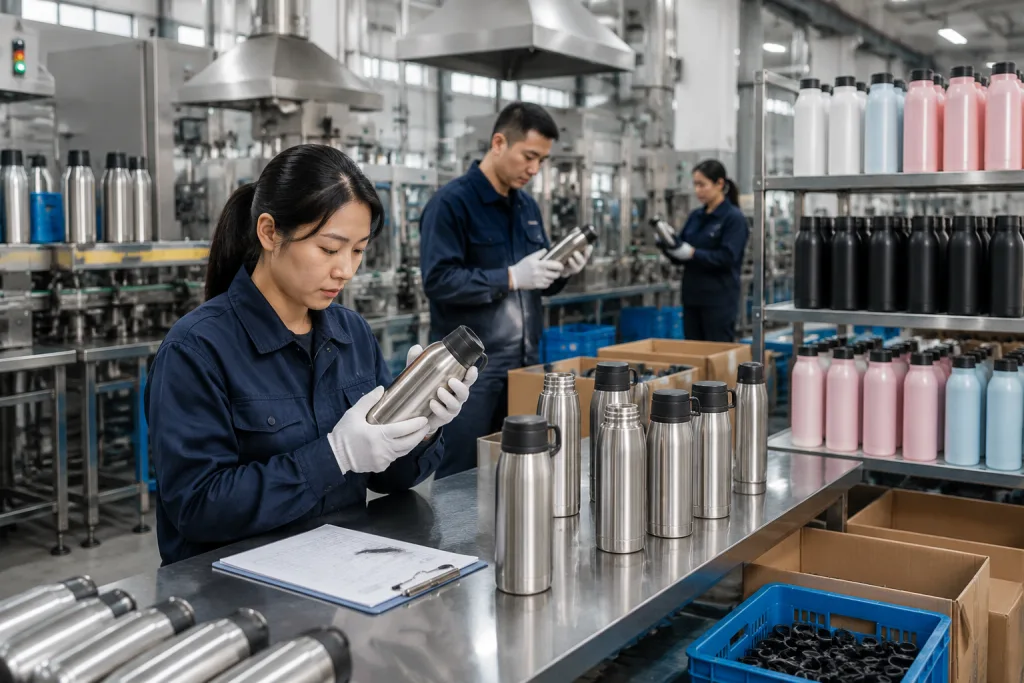
If you are comparing thermos flask suppliers, catalogs are the easy part. The real decision is what you freeze before tooling, samples, artwork, and the production slot go on the schedule. Outdoor retailers usually ask for bottles that can take a 1.2 m drop test without a dented base or loose lid. Promotional buyers push us harder on logo edges, carton print, and leak complaints after delivery; last month QC pulled 32 samples from a gift-order run because the silicone ring sat 0.6 mm proud.
From our factory in Hangzhou, Zhejiang, we see four choices decide most of the order result: vacuum structure, 304 stainless wall thickness, decoration method with real artwork tolerances, and order control from PO to AQL inspection. We run stainless thermos lines in China with capacity around 450,000 units/month, typical MOQ from 1,000 pieces per SKU, and 30-45 day lead time after sample approval. The wrong question is “who has the cheapest 500 ml bottle?” The better question is whether the line can repeat your sample at 20,000 pieces without logo shift, carton mix-ups, or lids that fail the 24-hour inverted leak test.
Start with the real use case
A stainless thermos for an outdoor retailer is not the same job as a promotional thermos for a conference pack. Same silhouette on a quotation sheet, different trouble. Before asking thermos flask suppliers for prices, decide where the bottle will be used, who gets the angry email if it leaks, and what shelf price the channel can still carry. We had a buyer flag a 0.6 mm body as “fine for gifts” but reject it for trail retail after QC pulled the sample and found a dent from a 1.2 m drop test.
For hiking, camping, fishing, and winter commute products, insulation and impact resistance beat saving USD 0.20. A 500 ml or 750 ml vacuum flask with 304 stainless steel inside, 201 or 304 outside, and a real copper-coated vacuum layer can hold hot water above 60°C for roughly 8-12 hours depending on lid design and test conditions. The math does not work if the cap gasket is cheap. On the line, we run the vacuum check, then measure mouth roundness with a vernier caliper; a thin promotional bottle may claim similar numbers, but gasket compression and vacuum consistency expose the difference fast.
For promotional brands, the buyer usually watches unit cost, logo readability, carton strength, and delivery date. Quality still counts. A leaky thermos customized with a client logo is worse than no gift at all. If you are buying thermos bulk for a campaign, ask the supplier thermos team to quote the exact cap type, coating, packing, and testing level, not just capacity and color. We have seen this go sideways when a PO said “black lid” but the approved sample had a black lid plus silicone carry ring; that one typo held 3,000 pcs for 2 days.
We usually split projects into three lanes: retail-ready outdoor product with drop testing and stronger gift box, mid-range distributor thermos program with stable MOQ and repeat cartons, or event-driven customized thermos order where the ship date drives most decisions. Each lane has a different acceptable defect rate, packaging cost, and sample process. Good thermos suppliers should push you to define that lane early. If they only send a PDF with 200 shapes and no questions, you are being treated as a spot order, not a repeat account.
Choose construction before decoration
About 7 out of 10 buyers open the project with Pantone color and logo size. Wrong order. For a custom thermos, construction decides food safety, insulation hours, dent rate, carry weight, and which lids will fit. Decoration can move after the pre-production sample. Steel grade, mold set, mouth diameter, and cap thread are painful to change once the line has cut steel; last month QC pulled a 500 ml sample where the buyer’s PO said 58 mm mouth, but the approved drawing was 53 mm. That mistake stopped tooling for 2 days.
The common stainless choice is 304 for the inner liner because it handles coffee, tea, and acidic drinks with better corrosion resistance. For the outer shell, 201 stainless cuts cost, while 304 outer steel gives stronger corrosion resistance and a cleaner retail claim on the carton. If your outdoor retailer customers sell near coastal markets or wet winter conditions, full 304 construction is easier to defend when the buyer asks about salt-spray risk. If the order is a 90-day promotional thermos, 304 inner and 201 outer may be enough. We ship both, but the math does not work if a premium camping brand asks for 201 outside and then complains about rust spots after a 24-hour salt spray check.
Wall thickness is where quotations hide real gaps. For most 500-750 ml bottles, a 0.4 mm inner wall and 0.5 mm outer wall is a reasonable standard. Some low-cost thermos manufacturer offers go thinner, often 0.32-0.35 mm inner steel on the caliper. The bottle feels lighter and the unit price drops, but dent resistance drops too, especially after powder coating. We have seen cartons pass AQL 2.5 and still get buyer pushback because 6 pieces in 200 showed shoulder dents after transit. For wide-mouth food jars, 0.5-0.6 mm outer steel is usually the better call.
Vacuum structure matters just as much. A proper thermos factory should run vacuum pumping, tail sealing, temperature aging, and leak testing as controlled steps, not as a sales line on a quotation. Copper plating improves heat reflection but adds cost. A basic stainless vacuum bottle might be quoted FOB Ningbo at USD 3.20-4.20 for 500 ml at 3,000 pieces, while a premium copper-coated, powder-coated, retail-packed version may run USD 5.20-7.50 depending on lid and finish. When comparing thermos manufacturers, do not compare the cheapest line item unless the structure is identical. We’ve seen this go sideways: one supplier quoted 12-hour heat retention, another tested at 6 hours, and the buyer treated both prices as the same product.
Ask for a construction sheet with the steel grade for inner and outer parts; wall thickness in mm; vacuum process and aging time; lid material with gasket material; test standard such as FDA, LFGB, or the buyer’s own protocol. If a thermos vendor cannot provide it, the low price is not yet a real price.
Match customization to order risk
A customizable thermos can be marked a few ways, and each one fails in a different place. Outdoor retail programs need a finish that survives shelf rub, carton dust, and 30 days of buyer-side handling. Promo buyers usually push us on logo contrast and sample approval time; one buyer last month rejected a navy cup because the gray logo measured only 18% contrast under our D65 light box. The right question is not “which customization looks best?” It is “which risk can this order afford?”
Laser engraving is clean and permanent on stainless or powder-coated bottles. It will not give the punch of white ink on black coating, but it avoids ink adhesion trouble and looks more premium on 304 stainless. For 1,000-3,000 pieces, laser is often the safest thermos custom method if the logo has thick lines; our operator checks position with a 0.5 mm acrylic jig before we run the line. Unit decoration cost may be USD 0.12-0.35 depending on size and position.
Silkscreen printing fits promotional thermos orders because the color is strong and the math stays under control. It works on smooth powder coating, but we still run a 3M tape pull test before approval, especially on matte or textured finishes. Two-color logos need tight registration; QC pulled one sample where the second color drifted 0.8 mm, and the buyer flagged it right away. Heat transfer handles full-color artwork, but we’ve seen it go sideways on curved shoulders and cup edges.
Powder coating is now the normal finish for outdoor bottles. It feels better than basic spray paint and usually resists abrasion better after a 500-cycle rub test. Still, not all powder is equal. Ask for cross-hatch adhesion testing, dishwasher claims if needed, and color tolerance with a Delta E target such as 1.5-2.0 where the project allows it. For a branded retail line, define Pantone or RAL references and accept a workable tolerance; demanding a perfect match across 2 production batches is where the math doesn't work.
Packaging is part of customization, not cleanup work at the end. A distributor thermos might need a white box with barcode sticker; a retail thermos customized for stores may need a color box plus hangtag, instruction sheet, and an outer carton that passes a 76 cm drop test. For Amazon or 3PL shipments, FNSKU labeling and master carton limits should be confirmed before mass production. We ship late more often when the logo file is approved but the packing PO has one typo in carton size, such as 43 cm written as 34 cm.
Set MOQ and price expectations
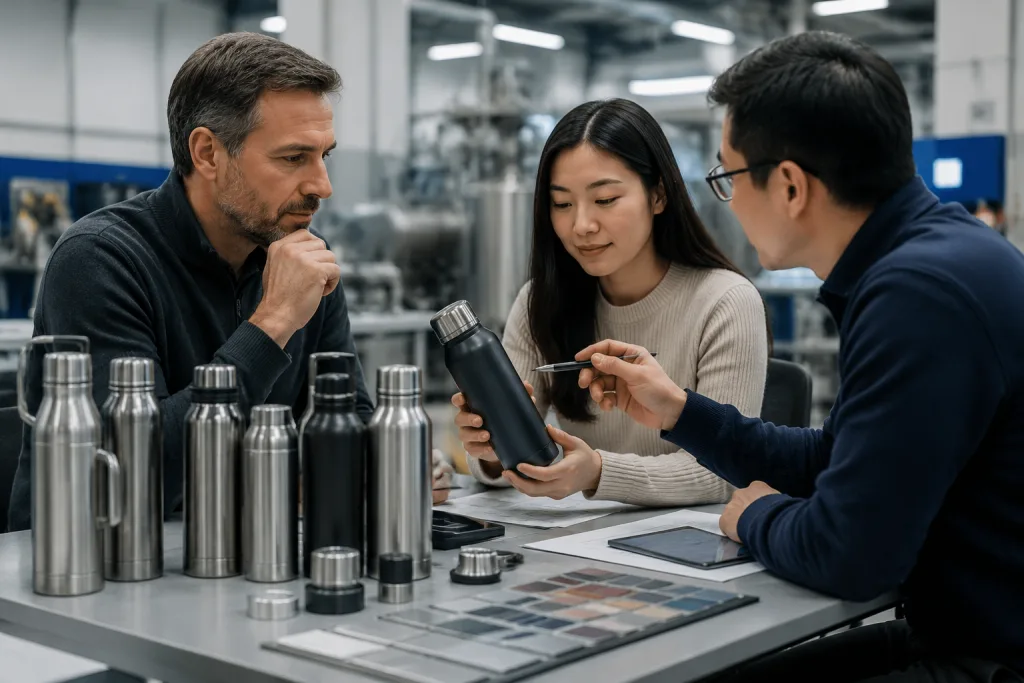
MOQ is not a punishment. It is the break-even line. On our stainless thermos line in Zhejiang, coil purchase, mold changeover, silk-screen jig setup, carton die-cutting, and AQL 2.5 inspection all start to make sense at a certain volume. For our stainless thermos lines in Zhejiang, a realistic MOQ is usually 1,000 pieces per existing shape and color, 3,000 pieces for custom powder color, and 5,000-10,000 pieces if you need a new lid mold or private body tooling. Last month QC pulled a 750 ml sample because the logo sat 2 mm off-center; fixing that on 300 pieces costs more per unit than fixing it on 3,000.
When you ask thermos flask suppliers for thermos bulk pricing, split the cost drivers before comparing quotes. Capacity changes steel weight. Lid design changes tooling and leak risk. Finish changes reject rate. Packaging changes carton volume and freight. A 500 ml factory thermos with basic lid and single-color print may be FOB USD 3.50-4.80 at 3,000 pieces. A 1,000 ml outdoor flask with handle lid, powder coating, laser logo, and retail box may be FOB USD 7.80-11.50. Cheap quotes usually cut one of five things: steel thickness, vacuum performance, coating quality, inspection time, or honest packaging. We have seen this go sideways when a buyer flagged “same item, lower price,” then the incoming sample showed a 0.35 mm inner wall instead of the quoted 0.4 mm.
For new buyers, the better move is often to start with an existing mold and customize finish and logo, then upgrade packaging after the first sell-through. It gives speed and lower risk. A full thermos manufacturer custom mold makes sense when you have annual volume above 30,000-50,000 units, need channel exclusivity, or must hit a special ergonomic design. Tooling can range from USD 2,000 for a simple cap component to USD 12,000+ for a more involved body and lid set. The wrong question is “Can you make my own shape?” The right question is whether the math survives the first 12 months; we run the CNC trial, 3D lid fit, and vacuum test before we tell a buyer to spend mold money.
Payment terms also affect price. Standard China export terms are often 30% deposit and 70% before shipment, FOB Ningbo or Shanghai. If you need LC, extended credit, DDP, or split shipments, put that into the quotation stage, not after PI approval. A serious thermos supplier will price the operational work instead of pretending it is free. We once had a PO with “FOB Shanghai” typed in the header and “DDP Hamburg” in the remarks; the buyer wanted the same unit price, but the freight, duty handling, and 2 extra warehouse labels made the math fail.
Control samples like a buyer
Samples are where 6 out of 10 customized thermos projects start to drift. The buyer approves a clean-looking bottle, then bulk goods come back 8 g lighter, Pantone 286C looks dull after powder coating, the lid thread feels loose, or the logo sits 4 mm higher than the PDF. We’ve seen this go sideways. The fix is not another WeChat photo; approve a sealed pre-production sample with written specs, signed date, and a sample tag tied to the PO.
We run three sample stages, but each one answers a different question. The stock sample checks shape, actual capacity, lid comfort, hand feel, and whether the buyer’s team likes the model before tooling or printing starts; if the model is on our shelf, we ship it in 3-7 days. The logo sample checks decoration size, color, and placement, usually in 7-10 days, and QC measures it with a digital caliper instead of judging by eye. The pre-production sample uses the confirmed material, finish, logo, and packaging, including the insert card and carton mark. For a retail or distributor thermos program, skipping this stage is the wrong place to save 12 days.
Your approval document should include actual capacity, brimful capacity if relevant, weight tolerance, steel grade, finish, logo artwork version, logo position in millimeters, lid material, gasket material, carton quantity, barcode, and any market compliance requirement. Put the file name on it too; one buyer once approved “logo_final_v3.ai” while the PO showed “logo_final_v2.ai,” and the line printed the older artwork. For Europe, REACH and LFGB food-contact expectations may apply depending on the product and importer. For North America, FDA food-contact material expectations and ASTM-related packaging or children’s product concerns may matter if the item is positioned for kids.
Insulation testing needs a fixed method. For example, fill with 95°C water at 20-25°C room temperature, close for 6 hours, then record internal temperature with a probe thermometer through the test lid. If you require 12-hour or 24-hour claims, define the start temperature, ambient temperature, fill level, and pass threshold. A thermos manufacturers quote that says “keeps hot 24 hours” without test conditions is marketing, not engineering; the math doesn’t work when the lab uses 20°C room temperature and the buyer tests beside an air-conditioner at 16°C.
Keep one signed golden sample at your office and one in the factory thermos QA room. QC pulled the sample before one 3,000 pcs order because the spray finish was half a gloss level off under the light box, and that saved a full rework bill. If there is a dispute, everyone compares against the same physical reference. Boring work. Expensive arguments disappear.
Write inspection into the PO
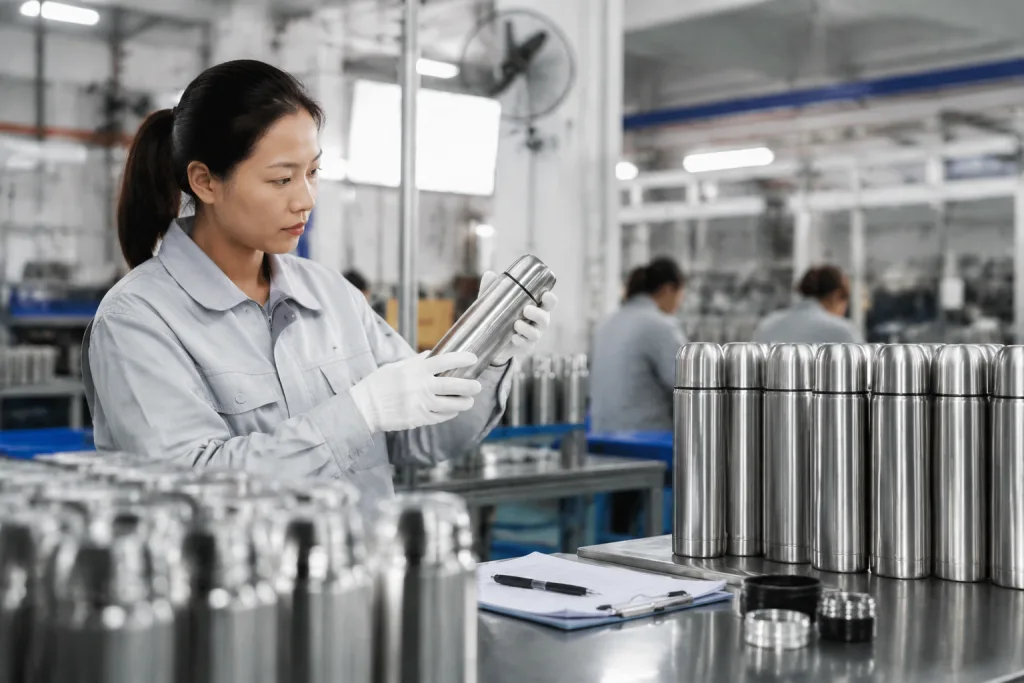
Quality control does not run on goodwill. Put it in the purchase order, confirm it before the 30% deposit, and leave the balance payment until inspection is passed. A serious thermos factory in China will accept clear inspection terms; if the buyer flagged this clause and the supplier pushed back, we would treat that as a warning, not a negotiation point.
For bulk thermos orders, we usually write AQL general inspection Level II into the PO, with critical defects at 0, major defects at 2.5, and minor defects at 4.0. QC pulled one 500 ml sample last month with a 0.4 mm burr inside the drinking lip; that is not a “small scratch,” it is a critical defect. Critical defects include sharp edges, serious leakage, wrong food-contact material, contamination, or unsafe lid failure. Major defects include poor vacuum performance, visible dents, wrong logo, coating peel, wrong color outside tolerance, missing accessories, or barcode errors. Minor defects are small cosmetic marks inside the approved limit sample, such as a 3 mm hairline mark on the powder coating away from the logo area.
Leak testing belongs on the line, not only at final inspection. We run water fill, inversion, shaking, and pressure or vacuum sampling depending on lid type; the jig and timer should be named in the QC sheet, not guessed by the inspector. For straw lids and flip lids, the pass criteria need to match the design because some lids are spill-resistant, not fully leakproof. This is the wrong question to ask: “Can we call it leakproof for marketing?” If the lid is not 100% leakproof after a 10-minute inversion test, say it on the product page.
For outdoor retail, carton strength decides how the bottle looks when it reaches the shelf. A good bottle still arrives dented if the inner box has 6 mm of play or the master carton collapses under a mixed pallet. Ask for 5-ply export cartons for heavier flasks, edge crush strength suitable for pallet stacking, and carton drop testing for retail packaging. For thermos distributors shipping mixed pallets across Europe or North America, approve carton marking and pallet configuration before booking freight; we have seen a PO typo on “12 pcs/ctn” turn into “24 pcs/ctn,” and the math does not work once the pallet height is fixed.
Third-party inspection makes sense for a new supplier relationship or any order above USD 15,000. In China, it typically costs USD 250-350 per man-day, and a one-day pre-shipment check catches the boring problems: wrong EAN label, weak carton tape, mixed lid colors, missing silica gel. That fee is small next to air-freighting replacements or explaining to a retailer why 480 bottles failed intake inspection.
Pick a supplier for repeat orders
The best thermos flask suppliers are not always the cheapest on the first quote. The better test is whether they can run the same bottle 6 months later with the same 18–22μm powder-coating feel, lid torque, barcode sequence, and 5-layer export carton strength. We have seen this go sideways: QC pulled 32 samples from a repeat order, and the lid gasket sat 0.4mm higher than the approved sample. That eats margin fast.
Look for a manufacturer thermos partner that gives clear technical answers, not just fast prices. Ask for monthly capacity by line, current bottlenecks, audit status, and how they handle AQL 2.5 inspection before loading. BSCI, ISO 9001, Sedex, or retailer-specific audits may be relevant depending on your channel. Not every order needs every certificate. Vague answers are a warning sign, especially when the sales rep cannot tell you whether the bottleneck is laser engraving, spray coating, or 304 stainless body forming.
Communication speed matters, but accuracy matters more. If a thermos vendor confirms every request in 3 minutes, check whether engineering has reviewed it with a caliper and BOM sheet. Lid changes, coating changes, and packaging changes can move cost and lead time; a soft-touch coating, for example, may push delivery from 28 days to 35 days when the spray line is full. In Hangzhou, Zhejiang, our export team sits close to production planning because a promised ship date is only useful if it matches line capacity, material arrival, and the final inspection window.
Check whether the supplier thermos team understands your market. Outdoor retailers need sellable features and low returns, so the buyer will flag things like weak carry handles or a stopper that leaks after 3 drop tests. Promotional brands need artwork discipline and deadline control; one PO we received had the Pantone code typed as 186C instead of 186U, and that would have changed the logo shade. Thermos distributors need stable SKUs and reorder MOQs that make sense, often 1,000–3,000 pcs per color. One factory can serve these channels, but the project has to be framed correctly from day one.
If you are choosing between thermos suppliers, send the same RFQ package to each: capacity, steel grade, finish, logo method, packaging, target MOQ, destination port, compliance needs, inspection standard, and required delivery date. Better yet, include the carton drop-test requirement and barcode rule, because those details decide whether the warehouse accepts the goods. The best response is not the lowest FOB number. It is the quote that explains the trade-offs clearly enough for you to place the order without guessing.
Send your thermos RFQ for factory review
Share capacity, quantity, logo, packaging, and destination. We will return a practical FOB quote with MOQ, sample timing, and QC notes.
Frequently asked questions
What MOQ should I expect from thermos flask suppliers?
For existing stainless thermos shapes, 1,000 pieces per SKU is a common workable MOQ. If you need a custom powder-coated color, expect 3,000 pieces because coating setup and material matching need volume. New lid tooling or a private body shape usually starts around 5,000-10,000 pieces, plus tooling fees. Some suppliers thermos offers will accept 500 pieces, but the unit cost is higher and decoration choices are limited. For first orders, we usually suggest using an existing mold, then customizing logo, finish, and packaging. That keeps lead time around 30-45 days after sample approval instead of stretching into a tooling project.
How do I know if a custom thermos will really keep drinks hot?
Do not rely on a catalog claim like “24 hours hot” unless the test method is defined. Ask the thermos manufacturer to test with 95°C water, a 20-25°C room temperature, a stated fill level, and a measured result after 6, 12, or 24 hours. A good 500 ml vacuum flask may hold above 60°C after 8-12 hours, depending on mouth diameter and lid structure. Wide-mouth jars lose heat faster than narrow-mouth bottles. For mass production, require vacuum performance sampling during QC and keep the test threshold in the purchase order. Copper-coated vacuum layers can improve performance, but process consistency matters more than the claim.
Which logo method is best for a promotional thermos?
For a promotional thermos order with simple one-color branding, silkscreen printing is usually the most economical and visible option. It works well at 1,000-10,000 pieces when the surface coating is stable and ink adhesion is tested. Laser engraving costs more per unit, often around USD 0.12-0.35 depending on size, but it is permanent and gives a more premium result. Heat transfer is better for full-color artwork, but it adds edge and curve risks. If the bottle will be handled outdoors or sold retail, ask for cross-hatch adhesion testing and abrasion checks before approving mass production.
Should I buy from a trading company or a thermos factory?
A trading company can be useful for mixed small orders, but a direct thermos factory is usually better when you need repeat SKUs, technical changes, and stable QC. The practical test is whether the supplier can answer steel grade, wall thickness, vacuum process, gasket material, AQL standard, and monthly capacity without delay. If they cannot, they may not control production. For outdoor retail and distributor thermos programs, direct factory communication reduces mistakes in lid selection, coating, and carton packing. BottleForge Industrial is based in Zhejiang, China, with stainless thermos production capacity around 450,000 units/month and normal lead time of 30-45 days after sample approval.
What should be included in my RFQ for thermos bulk orders?
Your RFQ should include capacity, target quantity, steel grade, body finish, logo method, logo size, packaging type, destination port, compliance market, inspection requirement, and target delivery date. If you only ask for “500 ml thermos bulk price,” suppliers will quote different constructions and you will compare bad data. Add whether you need FOB Ningbo, FOB Shanghai, DDP, or FBA-style carton labels. For Europe, mention REACH or LFGB expectations if relevant. For North America, mention food-contact requirements and barcode or FNSKU needs. A clear RFQ often saves 3-5 days of back-and-forth and prevents a cheap but unusable quotation.