Key Takeaways
- Shortlist 5-8 thermos flask suppliers, then reduce to 2-3 after samples and AQL review
- For custom thermos orders, expect MOQ from 1,000 units per color for standard molds
- A 500 ml stainless thermos usually needs 0.4-0.5 mm inner steel for stable vacuum performance
- Normal production lead time from China is 30-45 days after artwork and deposit approval
A thermos flask supplier list is not a dump of Alibaba links and sales emails. If you buy for outdoor retail or a 30,000 pcs promo order, the risk sits in the line: lids leaking at 80 kPa air-pressure test, cups losing heat after 6 hours, cartons missing the 5-ply spec, logos drifting 2 mm off center, or a factory saying “yes” before the mold room checks the cap tooling.
From Hangzhou, Zhejiang, we see the same pattern every season. Buyers compare 12 thermos suppliers, chase the lowest FOB price, then QC pulled the sample and found 0.38 mm outer steel instead of the quoted 0.45 mm, no drop test record, or a 45-day delay right before peak season. The lowest price is the wrong question to ask first. A useful supplier thermos shortlist should catch those problems before you send artwork or pay a deposit.
Start With Supplier Type
Before you build a thermos flask supplier list, decide what kind of partner you need. A trading company, a small assembly workshop, and a full thermos factory can all print “thermos supplier” on a PI. The quote can sit within USD 0.20 of each other, but the control points are not close. We’ve seen this go sideways when QC pulled the sample and found the inner liner wall was 0.28 mm thinner than the approved sample.
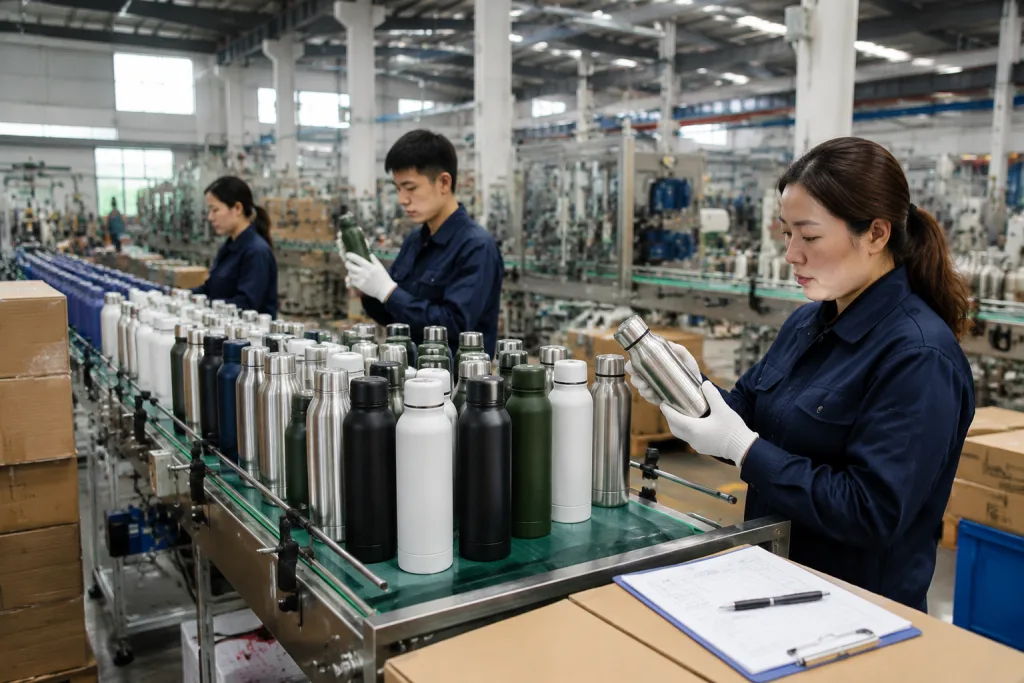
If you buy bulk thermos units for an outdoor retail range, you normally want a manufacturer thermos setup with vacuum forming, polishing, powder coating, lid assembly, and leak testing either in-house or under daily factory control nearby. The line needs a vacuum tester, salt spray records for coated parts, and someone who can explain why 304 stainless failed at the weld bead. If you buy a short promotional thermos campaign with 1-color logo and a fixed event date, a capable export supplier can work, but ask for current production photos, inspection records, and a carton mark photo before balance payment. One buyer once flagged a PO typo: “matte black” on page 1, “gloss black” on page 3. Catch it early.
Use this first filter. Do it before price talk. A supplier who cannot name the coating thickness in μm or show the last AQL 2.5 report should not sit in the same column as a factory running its own leak-test bench.
- Factory thermos partner: better for repeated SKUs, custom mold work with 2D/3D drawings, Pantone color matching checked under a light box, and stable QC records by production batch.
- Supplier thermos exporter: workable for mixed products and smaller trial orders, but check the actual production site, welding line photos, and who signs the final inspection report.
- Thermos vendor: acceptable for spot buying from ready stock, not ideal for customized thermos programs with retail packaging, barcode labels, drop-test requirements, and tight launch dates.
At BottleForge Industrial in Zhejiang, China, our stainless thermos capacity is about 420,000 units/month across standard travel and outdoor models, with MOQ normally 1,000 units per color for existing molds. Those numbers matter. A factory running 30,000 units/month and a factory running 400,000 units/month handle rework, carton changes, and urgent replenishment in different ways. If 12,000 lids need gasket replacement after an inspection finding, the math does not work the same on a two-table assembly shop as it does on a line with spare lid presses and 18 kg master carton checks already scheduled.
Ask These Technical Questions
I’ll rewrite this section in a more senior factory-sales voice, keep the HTML intact, and make the technical asks sharper with concrete shop-floor detail.A customizable thermos looks simple outside and gets picky fast once we run the line. You are buying vacuum insulation, food-contact safety, and assembly that repeats the same way every shift. Ask loose questions, and you get loose answers back. Ask numbers.
For stainless steel, ask for the grade on the inner wall, outer wall, lid contact parts, and tea filter if there is one. For most export thermos custom orders, 304 stainless steel inside is the normal baseline. We’ve seen buyers try to save on the outer shell with 201 stainless; that can work in dry retail, but it is the wrong call for marine, ski, or wet-camping channels. If your market is Europe, ask for LFGB, REACH, and food-contact declarations. For the US, ask for FDA food-contact compliance and, for kids or school channels, the CPSIA items that apply.
Heat-retention claims need a test method, not a slogan. A serious manufacturers thermos quote should state water starting temperature, room temperature, fill volume, and test hours. One 500 ml double-wall vacuum flask we checked on the bench held above 60°C after 12 hours with a 95°C start and 20°C room condition. A wide-mouth bottle usually comes in lower; the lid area is bigger, and the math does not work in your favor.
Your checklist should include:
- Inner wall thickness: usually 0.4-0.5 mm for common 304 stainless models.
- Vacuum rejection rate target: often under 2% before final packing.
- Leak test: 100% water or air pressure test, not random only.
- Coating thickness: powder coating commonly 60-90 microns.
- Salt spray request: 24-48 hours if you sell outdoor or coastal products.
Do not accept “same as sample” as a spec. QC pulled the sample, and the PO still had a typo on gasket material. Put the steel grade, lid material, gasket material, coating process, and test standard in the purchase order, or you’ll spend time fixing avoidable problems later.
What Should Samples Prove
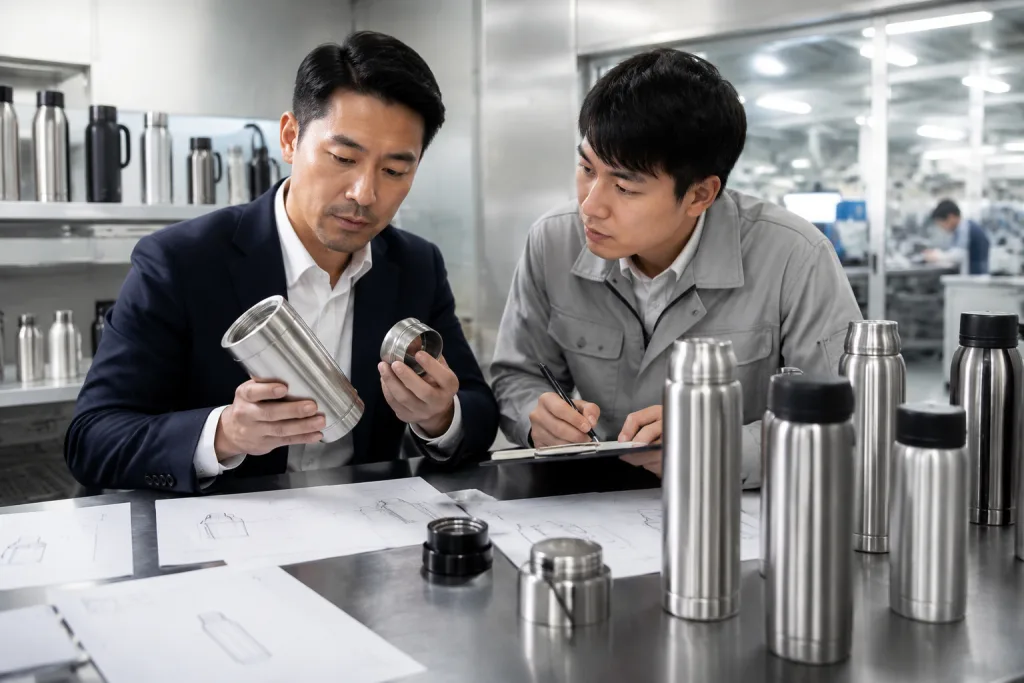
I’ll keep the HTML exactly as-is and rewrite only the prose, tightening the sales-engineer tone while preserving the section structure and numbers.Samples are not souvenirs. They prove the line can hold spec. For a custom thermos or thermos promotional program, ask for three sample stages if the order matters: blank reference sample, logo/color sample, and pre-production sample.
The blank reference sample shows whether the base flask is worth your money. Check weight, mouth finish, lid thread smoothness, gasket fit, odor, inside polishing, and whether the base sits flat. We run a 30-minute hot-water inversion, then a hard shake. It is no lab test, but it exposes lazy lid design fast.
The logo/color sample tells you if the branding method fits the product. Laser engraving is durable and clean on stainless or powder coat, but it can go low-contrast on light colors. Silkscreen is cheaper for simple promotional thermos work, often USD 0.05-0.12 per position, but QC should still run abrasion testing. Heat transfer or full wrap can look retail-ready, but scrap rates climb when the bottle has a strong taper.
The pre-production sample is the one buyers skip, and that is the wrong move. It should use mass-production materials, confirmed packaging, barcode, care card, and carton marks. For Amazon-style or distributor thermos channels, check FNSKU placement, carton drop requirements, and master carton weight. We keep master cartons under 15 kg for EU and North American distribution because once cartons get heavy, the damage rate goes up.
One practical rule: if the supplier cannot produce a correct pre-production sample in 7-10 days after artwork approval, they may also struggle under mass-production pressure.
Price Quotes Need Boundaries
I’ll rewrite this section in-place, keep the HTML structure unchanged, and tighten the sales-engineer tone with concrete pricing and factory-floor detail.Do not compare thermos manufacturers on a bare unit price. A USD 3.20 FOB Ningbo quote and a USD 3.55 FOB Ningbo quote can be different builds. One may include 304/304 steel, powder coating, a 1-color logo, an individual kraft box, and AQL inspection support. The other may use thinner outer steel, skip the retail box, and ship with a cheaper lid. We’ve seen buyers flag this on a PO after QC pulled the sample at 48 hours.
For a 500 ml stainless steel thermos bulk order using an existing mold, real FOB China pricing often lands around USD 3.20-5.80, depending on steel grade, coating, lid complexity, packaging, and order volume. A 1,000-unit run costs more per unit than a 10,000-unit run because color setup, logo setup, and line changeover get spread across fewer pieces. For thermos customized with new mold work, budget tooling separately. A simple lid change can start around USD 800-1,500, while a new body mold can go above USD 3,000 depending on shape. The math does not work any other way, and we run into that pushback every week.
Ask every thermos supplier to quote with the same table:
- MOQ by color and total order quantity.
- FOB port, usually Ningbo or Shanghai for Zhejiang production.
- Steel grade and wall thickness.
- Logo method and number of positions.
- Retail box, insert, manual, barcode, and master carton specs.
- Sample fee, tooling fee, and refund conditions.
- Production lead time after deposit and artwork approval.
This is where weak thermos supplier lists fall apart. Good suppliers answer in a table. Weak ones send a photo and a price. We’ve seen a buyer lose a week because the PO said “logo on bottle” and the factory had to ask which side, which size, and whether they wanted laser or silk screen.
Quality Control Is Not Optional
I’ll rewrite the section in place, keep the HTML structure intact, and tighten the copy so it sounds like a real factory-side sales engineer.If you sell to outdoor retailers, one leaking cap turns into a return, a bad review, and a buyer asking why your brand picked that thermos vendor. QC has to sit in the order from day one. On our line, the first thing we check is the cap torque with a simple torque tester, not after cartons are sealed.
Put AQL terms in the purchase order. For drinkware, most buyers use AQL 2.5 for major defects and 4.0 for minor defects, with critical defects at 0. Critical defects are sharp edges, contamination, unsafe material substitution, and serious leakage. Major defects are poor vacuum performance, lid failure, wrong logo size, coating peel, or color outside the approved sample. Minor defects are small cosmetic marks within the agreed limit. The math works only if the PO is clear; we’ve seen buyers write “acceptable quality” and then argue later, which helps nobody.
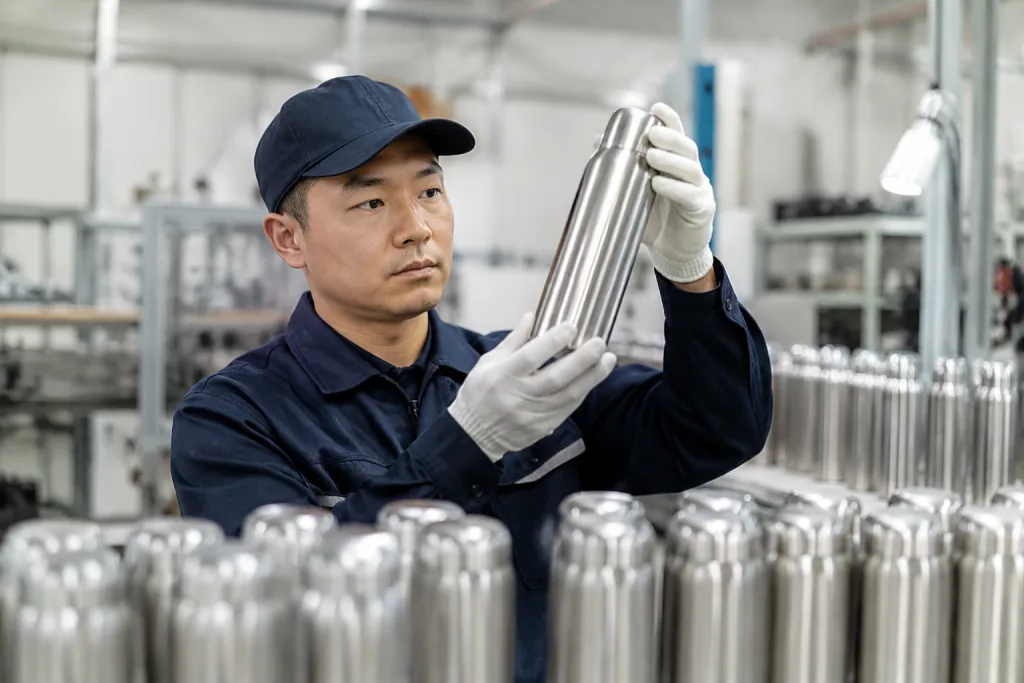
Factory checks should cover incoming steel verification, vacuum test after welding, polishing inspection, coating adhesion, logo position check, leak test, final appearance inspection, and carton drop test. For a thermos manufacturer in China, none of that is exotic. The real issue is whether the records exist and whether you can pull them fast. QC pulled the sample sheet last week on a 500 ml flask order, and the buyer flagged a 1.5 mm logo shift before shipment.
If your order is over USD 10,000, book a third-party final random inspection or ask your China agent to inspect under AQL. For first orders, inspect before balance payment. Do not wait until goods arrive in Rotterdam, Hamburg, Los Angeles, or Toronto. By then, sorting 5,000 bad bottles costs more than the inspection you skipped. We run into this all the time with buyers who want to “save” 300 USD on inspection fees.
Ask about social compliance too. BSCI, Sedex, ISO 9001, and factory audit reports do not guarantee perfect goods, but they show whether the supplier understands export buyer expectations. A cleaner audit file also helps when the retailer asks for it during onboarding, and that question usually lands right when the PO is already moving.
Build The Shortlist Properly
I’ll rewrite the section in-place, keep the HTML structure unchanged, and tighten the sales tone with a few concrete factory details.A useful thermos flask supplier list is short, scored, and kept fresh. Forty names just burn time. We usually see better results with 5-8 thermos suppliers, then 2-3 qualified partners after sample testing. The clean shortlist has one primary manufacturer thermos partner, one backup supplier thermos partner, and one niche option for special finishes or rush promotional thermos work.
Score each company from 1 to 5 on the stuff that hits your margin, not on who sends a reply at 11:40 p.m. For outdoor retailers, put more weight on vacuum performance, coating wear, spare lid stock, and carton crush resistance. For promotional brands, care more about logo position, mixed-carton handling, campaign lead time, and whether the factory can run three artwork versions without drama. We’ve seen buyers chase the cheapest quote, then the line loses two days fixing a lid typo on the PO.
Your checklist can stay simple:
- Can they support 1,000-3,000 units for trial orders without punishing pricing?
- Can they scale to 20,000 units if the SKU works?
- Do they send clear FOB China terms and packing data within 24 hours?
- Can they make a thermos customizable program with Pantone color, laser, silkscreen, or full-wrap print?
- Do they have current audit, compliance, and AQL inspection documents?
- Do they explain problems before production, or only after shipment?
Keep notes after every order. A thermos distributors program lives or dies on repeatability. If one factory thermos partner ships 98.5% acceptable goods on time for three orders, that beats a new supplier offering USD 0.18 less per unit. On our QC table, that usually means the same carton size, the same foam insert, and no surprise thread issue on the lid. In Zhejiang, we tell buyers the boring supplier is often the profitable one: steady samples, steady cartons, steady lead times.
Send your thermos shortlist for a factory review
Share target capacity, logo plan, and delivery market. We will reply with MOQ, FOB pricing, sample timing, and practical production risks.
Frequently asked questions
How many companies should be on my thermos flask supplier list?
Start with 10-12 names if you are searching from scratch, but reduce quickly. After checking product fit, factory type, certifications, and export experience, you should have 5-8 real candidates. After samples, your working list should be 2-3 suppliers: one primary thermos manufacturer, one backup supplier, and possibly one specialist for promotional thermos decoration or special finishes. More names usually create more noise, not more safety. Score each supplier on MOQ, sample speed, heat retention data, AQL acceptance, FOB pricing, packaging control, and response quality. If a supplier cannot answer technical questions within 48 hours, remove them before you spend money on samples.
What MOQ should I expect for custom stainless thermos orders?
For existing molds, a practical MOQ is usually 1,000 units per color and 3,000 units total if you want stable factory pricing. Some suppliers accept 500 units, but the unit price may rise by 10-25% because coating setup, logo setup, and packing line changeover cost the same. For a customized thermos with Pantone powder coating, expect 1,000 units per color as a normal baseline. For new mold work, factories may ask for 5,000-10,000 units to justify engineering time. If you are testing a new outdoor retail SKU, ask for a paid 1,000-unit pilot run with written terms for the 5,000-unit repeat price.
Which logo method is best for promotional thermos programs?
It depends on budget, finish, and durability. Laser engraving is the safest for long-term outdoor use because it will not peel, and setup is usually low. It works well on stainless steel and dark powder coating, but contrast can be weak on white or light colors. Silkscreen is cost-effective for simple thermos promotional work, often around USD 0.05-0.12 per position for one color, but you should request tape and abrasion testing. Heat transfer or full-wrap printing gives stronger retail shelf impact, but it adds setup time and higher reject risk on tapered bodies. For 5,000 units or more, approve a decorated pre-production sample before mass production.
How long does China production take for bulk thermos orders?
For standard stainless thermos models from China, plan 30-45 days after deposit, artwork approval, and pre-production sample approval. Add 5-10 days if you need a custom Pantone powder coating or a complicated retail box. New lid tooling or body tooling can add 20-35 days before production starts. During September to November, many factories are full with holiday and Q1 retail orders, so book capacity earlier. Sea freight to North America or Europe can add roughly 25-45 days depending on port and service. If your event date is fixed, work backward from delivery date and lock carton marks, barcodes, and packaging before deposit.
What documents should a thermos supplier provide before an order?
At minimum, request a formal quotation, product specification sheet, packing details, material declaration, food-contact compliance documents, and sample invoice. For Europe, ask about LFGB, REACH, and relevant food-contact migration testing. For the US, ask for FDA food-contact support and CPSIA considerations if the item may be used by children. For factory evaluation, request BSCI, Sedex, ISO 9001, or audit reports if available. Before mass production, confirm artwork, Pantone color, logo size, carton marks, barcode or FNSKU placement, AQL standard, and inspection timing in writing. If any of these items stay vague, the supplier is not ready for a serious distributor thermos program.