Key Takeaways
- 304 stainless steel at 0.4-0.5 mm wall thickness is the normal baseline for bulk thermos orders
- Vacuum performance should be tested at 95°C fill temperature over 6, 12, and 24 hours
- A realistic custom thermos MOQ starts at 1,000 pcs for laser logo and 3,000 pcs for custom powder coating
- AQL 2.5/4.0 inspection is more useful than a polished directory profile
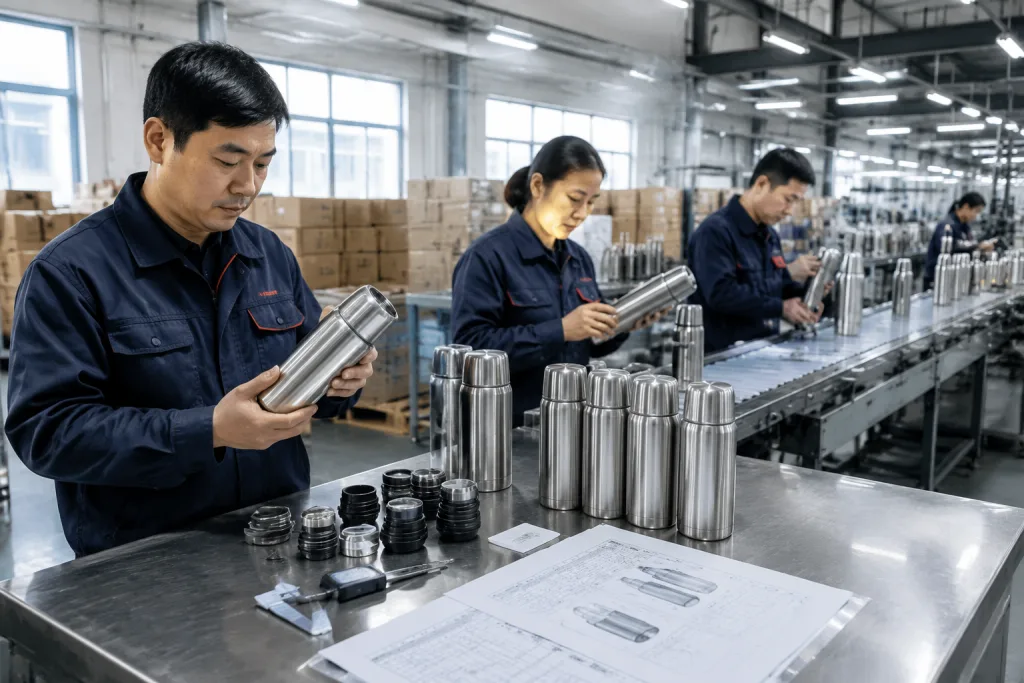
A thermos flask supplier directory can hand you 200 names in ten minutes. It will not tell you which thermos line still holds temp after a dent test, which quote hides thin steel, or which vendor knows retail carton drop rules. We see that mismatch all the time.
If you buy for outdoor retail or a promo run, start with the spec sheet. BottleForge Industrial in Hangzhou, Zhejiang runs custom thermos projects from 1,000 pcs MOQ to 80,000 units/month capacity. QC pulled the sample on a 38mm neck finish last week; that is the kind of detail that keeps the math honest before you compare FOB China prices.
Steel Grade Is Not Decoration
I’ll rewrite the section in-place, keep the HTML exactly as-is, and tighten the copy so it reads like a factory-side sales engineer wrote it.The first line that matters on a stainless thermos spec sheet is material. For most outdoor and promo programs, start with 304 stainless steel on the inner liner and, if the budget allows, the outer shell too. If a thermos supplier only writes “stainless steel” and skips the grade, the spec is still not locked.
For food-contact export to Europe and North America, 304 stainless steel is the baseline because it holds coffee, tea, sports drinks, and daily wash cycles better than lower-grade steel. We’ve seen quotes swap 201 stainless onto the outer body to shave about USD 0.20-0.45 per unit. That works for a 3-month giveaway run. It is the wrong call for retail, where the buyer expects years of use and the buyer will flag a rusty seam fast.
Wall thickness matters just as much as grade. A normal manufacturer thermos body runs around 0.4-0.5 mm stainless sheet before forming, and the line can hold that with the right tooling. At 0.32 mm, the cup looks fine in a photo and fails harder on a drop test; QC pulled one dented sample after a 1.2 m carton drop, and the math did not work. For distributor thermos programs, that kind of dent becomes a return.
Ask for the steel callout in black and white: inner 304, outer 304 or 201, cap contact material, silicone ring grade, and the plastic resin, such as PP or Tritan, if used. For China export, request LFGB or FDA food-contact test reports tied to the exact material family, not an old report from another item. We run repeat stainless jobs in Zhejiang, and the file set is usually ready in 2 working days if the PO has no typo in the material code.
Capacity, Shape, And Real Volume
I’ll rewrite the section in a supplier-sounding voice, keep the HTML tags untouched, and make the details more concrete and buyer-facing.Capacity sounds simple until the sample lands on the buyer’s desk. A 500 ml customized thermos can be 500 ml to the rim and only 470-480 ml at the working fill line. That gap hits hard when someone prints “17 oz” on the carton or builds an outdoor set around a measured hydration target.
For a thermos flask supplier directory search, sort by real capacity families first: 350 ml for commuter gifting, 500 ml for daily retail, 750 ml for hiking, and 1,000 ml for worksite or camping use. We run the line around body diameter before anything else. A 74 mm body usually clears a cup holder; 80 mm often gets the buyer flagged as “too wide.” Check backpack side pockets too, not just the catalog photo.
Shape changes the math. A straight cylinder is faster to form, polish, powder coat, and pack. A tapered or stepped body can add USD 0.10-0.35 per unit and 5-7 days in tooling or fixture setup. If your thermos custom project uses a special shoulder, handle lid, or cup-style cap, ask for a 2D drawing with height, diameter, mouth opening, and thread dimensions before you pay for samples. The buyer pushback here is always the same: “looks close enough.” It isn’t.
Do not approve from a photo. Ask the thermos manufacturer for a measured spec sheet with nominal capacity, brimful capacity, product weight, carton quantity, gross weight, and carton size. QC pulled the sample on one 1,000 ml job and found a 38 mm carton gap that pushed freight up for no sales gain. A bulky thermos bulk order can look cheaper at the factory and still lose money after ocean freight, warehouse handling, and retailer chargebacks.
Vacuum Performance Needs Numbers
I’ll rewrite the section in place, keeping the HTML tags and the supplied specs intact while making the prose sound like a factory-side sales engineer wrote it.“Keeps hot for 24 hours” means nothing unless the test method is on paper. A proper thermos quote should list starting water temperature, room temperature, fill level, test time, and final temperature. Without that, two thermos flask suppliers can both claim 24 hours and ship different results.
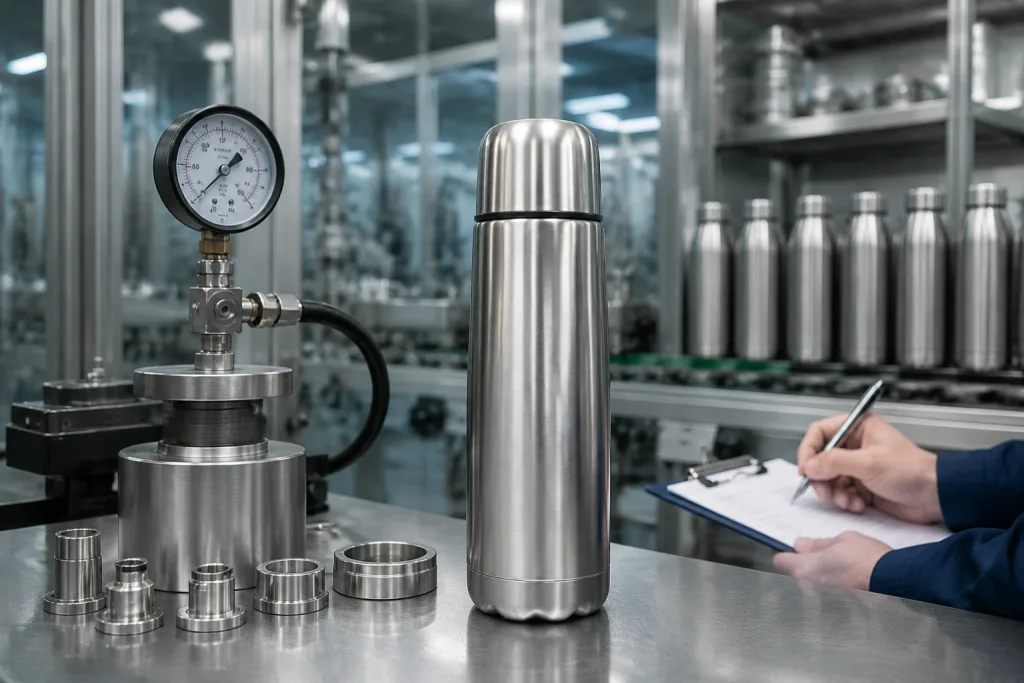
For stainless vacuum flasks, we run a simple check: fill with 95°C water, close the lid, then read the bottle at 6, 12, and 24 hours at 20°C ambient temperature. A well-made 500 ml bottle often stays above 65°C after 6 hours and lands around 45-55°C after 12 hours, depending on body size, mouth opening, lid structure, and copper coating. Wide-mouth models lose heat faster than narrow-mouth models. The buyer flagged this on a PO once and wrote the comparison wrong.
The vacuum step is where cheap thermos vendor selection goes sideways. Poor vacuum sealing, weak tail sealing, or sloppy welding can pass a quick look and fail after a few weeks. Ask straight: does the supplier thermos factory run 100% vacuum testing? At BottleForge Industrial in Zhejiang, every vacuum body gets an infrared temperature check before assembly, and the packed lot goes back through AQL inspection. We ship to a 2.5 standard, not hope.
Copper lining is another line item. It helps heat retention, but it is not magic. On common sizes, it adds USD 0.15-0.30 per unit, and the payoff depends on the full build. For a 90-day promo run, standard double-wall vacuum is often enough. For outdoor retail, copper coating and a tighter lid spec make more sense. The math does not work any other way.
Lids Decide Daily Usability
I’m rewriting the section in-place, keeping the HTML structure intact and tightening the sales-engineer tone. Next I’ll swap in concrete factory-floor details and trim the AI-sounding phrasing.The lid decides whether a thermos works in daily use or ends up in a drawer. The body can pass inspection, but one bad gasket brings leaks, odor, sticky drinking flow, or a hinge that snaps after 3,000 opens. We run the same bottle shell with 5 lid builds in the directory all the time, and each one needs its own sample sign-off.
Common choices are screw cap, push-button cap, cup lid, straw lid, and handle lid. For hot liquid, a straw lid is the wrong call unless the design has pressure control and clear warnings on the pack. For hiking and field retail, a screw cap with a silicone seal is plain but dependable; for promo programs, buyers like one-hand push lids, but QC pulled the sample after 500 cycles because the spring felt weak.
Ask for silicone ring hardness and the spare-part policy. Food-grade silicone around 50-60 Shore A is normal for sealing rings. Too soft, and it creeps; too hard, and it stops sealing after a drop test. If you are a thermos distributor, this is not a side issue. We ship spare lids at 1-2% of bottle quantity, packed separately, and that cuts return fights fast.
Leak testing has to be written down. We do 100% water leak testing on assembled samples, then production sampling with inversion and shake test. For retail jobs, add a carton drop test: full export carton, 1 corner, 3 edges, and 6 faces from 76 cm. The buyer flagged one PO typo on the lid code once, and the wrong cap got packed; that kind of mistake is why we check the lid as its own part, not a line item in the bottle spec.
Logo Method Changes The MOQ
I’ll rewrite this section in-place, keep the HTML unchanged, and tighten the sales-engineer tone with specific shop-floor details and cleaner MOQ language.Decoration is not just a branding call; it changes MOQ, lead time, defect rate, and replacement math. A custom thermos with laser engraving can usually start at 1,000 pcs per design because setup is simple and the mark lasts. Silk screen often starts around 1,000-2,000 pcs, and once the buyer asks for 3 colors on a curved body, registration gets tight fast. Powder coating in a custom Pantone color normally starts at 3,000 pcs because the coating line, color changeover, and scrap allowance need scale.
Laser engraving fits outdoor retailers that want a permanent mark and fewer complaints. The logo cuts through coating or marks the steel surface, so it does not peel. Silk screen gives stronger color, but if the ink system and coating do not match, QC pulls scratched samples off the line. Heat transfer and water decals handle complex graphics, but this is the wrong question to ask without dishwasher, tape, and abrasion tests on the exact bottle spec.
For promotional brands, ask for artwork rules before you send a purchase order: vector file format, minimum line width, logo position tolerance, color tolerance, and proofing method. A fair position tolerance for curved bottles is often ±1.5-2.0 mm. We have seen buyers flag a PO with “center logo” and no height called out, then argue when the mark lands 2 mm low. If a thermos factory promises perfect alignment on every unit, be careful. Cylindrical products move during printing.
Pre-production samples usually take 7-10 days after artwork approval for stock body plus logo. A new mold or new lid can push sampling to 25-35 days. Bulk production is commonly 30-45 days after deposit and sample approval in China, depending on season and capacity. Put that timing on the spec sheet, not in email. A clean PO with the right SKU code saves a week.
Compliance Belongs On The Sheet
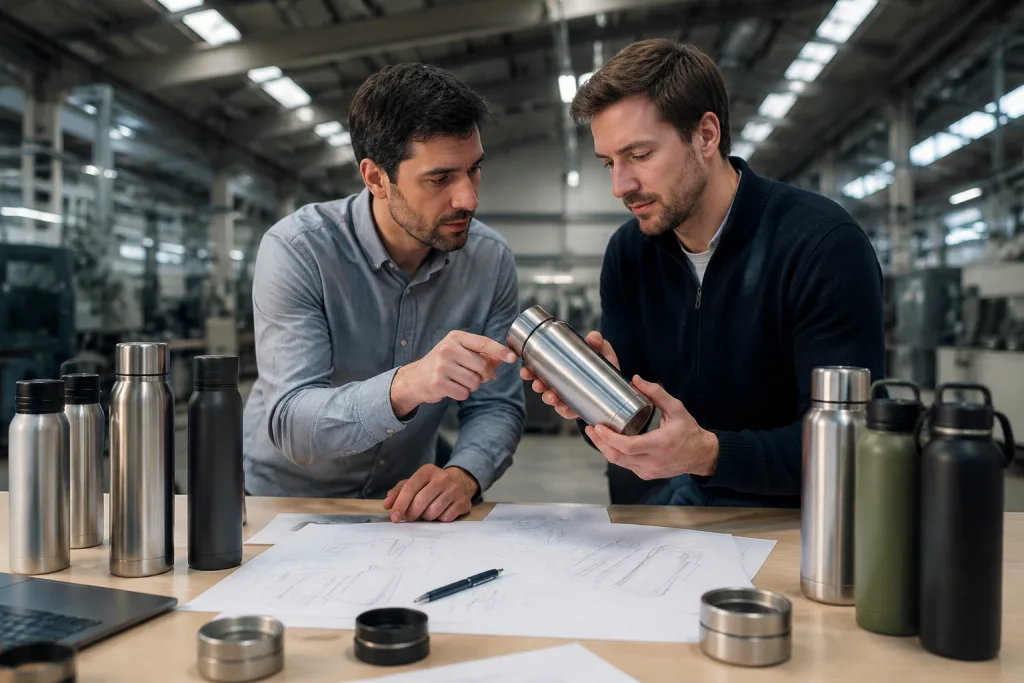
I’ll rewrite the section in-place, keep the HTML exactly as-is, and tune the copy to sound like a factory-side sales engineer. Then I’ll sanity-check that the compliance terms and structure stay intact.A thermos flask supplier directory does not prove compliance on its own. We see BSCI, ISO 9001, FDA, LFGB, REACH, and BPA-free on a lot of listings, but the paper has to match the exact cup, lid, coating, and market. Put compliance on the spec sheet before the price talk starts. That saves time on the line, and it cuts out bad quotes.
For Europe, ask for LFGB food-contact testing, REACH for coatings and surface treatments, and packaging checks if you claim recycled content. For the United States, FDA food-contact requirements and California Proposition 65 review may apply. If the order is for children’s retail, ASTM or CPSIA can come up fast. Do not let a supplier thermos quote adult drinkware reports for a kids campaign; we have seen that go sideways on one PO typo alone.
Factory audits matter for distributor thermos and retailer programs. BSCI or Sedex helps with social compliance review, and ISO 9001 shows the quality management setup, but neither replaces incoming inspection. We run AQL 2.5 for major defects and AQL 4.0 for minor defects as a normal starting point. Critical defects stay at zero: leaks, sharp edges, contamination, wrong material. QC pulled the sample once on a 500 ml model and caught a lid gasket mismatch before shipment.
Packaging compliance is part of the product, not an afterthought. Retail cartons need barcode placement, warning text, country of origin, recycling marks, and sometimes language versions. Amazon orders may need FNSKU labels and carton limits, while outdoor retail pallet programs care more about master carton strength and clean scannable barcodes. Good thermos suppliers in Zhejiang and wider China ask these questions early. Weak ones wait until the goods are packed, and then the buyer flags it.
Price Lines That Actually Matter
I’ll keep the HTML intact and rewrite the prose to sound like a factory sales engineer, with tighter pricing language and a few concrete shop-floor details.FOB unit price is one line, nothing more. For manufacturer thermos sourcing, put the full commercial sheet side by side: MOQ, sample cost, mold cost, logo setup, inner carton, master carton, spare parts, inspection allowance, payment terms, and lead time. We had a buyer fixate on USD 4.20 and skip the packaging line; that order ended up higher after silk-screen setup and two rounds of rework. The math does not work.
As a rough China FOB range, a 500 ml double-wall 304 stainless vacuum flask may sit around USD 3.20-5.80 depending on steel thickness, lid type, coating, copper lining, and order quantity. A 750 ml outdoor model may land around USD 4.80-8.50. These are sanity checks, not promises. QC pulled a 0.35 mm shell sample last month, and the buyer flagged the thinner wall before we shipped. If a thermos manufacturers quote is 25% lower than the pack, ask which spec line changed.
Payment terms are usually 30% deposit and 70% before shipment for new buyers. Repeat distributor thermos accounts may get better terms after 3 clean shipments. Samples can cost USD 50-150 per style with logo, often refundable against bulk thermos orders above a set quantity. We run the sample press and laser line in a separate corner, and that setup time is what you are paying for.
The best use of a thermos flask supplier directory is to build a shortlist, then force every thermos vendor onto the same spec sheet. Same steel, same capacity, same lid, same coating, same test method, same packaging, same AQL. Then the price comparison becomes real. Without that discipline, you are not comparing suppliers thermos options; you are comparing guesses. One typo on a PO, like “inner carton 12 pcs” instead of “24 pcs,” can swing the landed cost fast.
Send your thermos spec sheet for review
We will check material, MOQ, decoration, packaging, and lead time before you commit to a bulk stainless thermos order.
Frequently asked questions
What MOQ should I expect for a customized thermos order?
For a stock stainless body with laser engraving, a practical MOQ is 1,000 pcs per logo. Silk screen is usually 1,000-2,000 pcs depending on colors and logo size. Custom powder coating or Pantone body color normally starts at 3,000 pcs because coating line setup and scrap control need volume. New mold development can require 5,000-10,000 pcs commitment. If a thermos supplier offers 100 pcs with full customization, check whether it is actually local rework, not factory production.
How do I compare suppliers from a thermos flask supplier directory?
Do not compare profile claims first. Send every thermos supplier the same spec sheet: capacity, 304 or 201 steel, wall thickness, lid type, coating, logo method, carton packing, compliance market, AQL level, and target FOB port. Ask for unit price at 1,000, 3,000, and 5,000 pcs. Then request a production video, audit documents, and recent test reports. A directory is useful for finding names; the spec sheet is what separates a real thermos manufacturer from a trading-only vendor.
What lead time is normal for bulk thermos production in China?
For stock shapes with standard colors, sampling usually takes 5-10 days and bulk production takes 30-40 days after deposit and sample approval. Custom color, new lid, or special retail packaging can push production to 45-60 days. Chinese New Year and peak Q3 promotional season add pressure, so confirm capacity early. BottleForge Industrial in Hangzhou, Zhejiang runs up to 80,000 stainless thermos units per month, but coating color changes and packaging complexity still affect schedule.
Which logo method is best for outdoor retail thermos products?
Laser engraving is usually the safest choice for outdoor retail because it is permanent, clean, and resistant to scratching. It works especially well on powder-coated stainless bottles. Silk screen is better when you need exact brand color, but it should pass tape and abrasion testing before mass production. Heat transfer is useful for complex graphics, though it adds more quality-control risk. For a 3,000 pcs custom thermos order, approve a pre-production sample and set logo position tolerance around ±1.5-2.0 mm.
What inspection standard should I use before shipment?
Use a pre-shipment inspection with AQL 2.5 for major defects and AQL 4.0 for minor defects. Critical defects should be zero tolerance, including leaks, sharp edges, rust, contamination, wrong material, and unsafe lids. The inspection should include appearance, capacity check, logo position, barcode scan, carton drop test, leak test, and random temperature-retention test. For thermos bulk orders above 5,000 pcs, add during-production checks at around 20-30% completion so problems are caught before final packing.