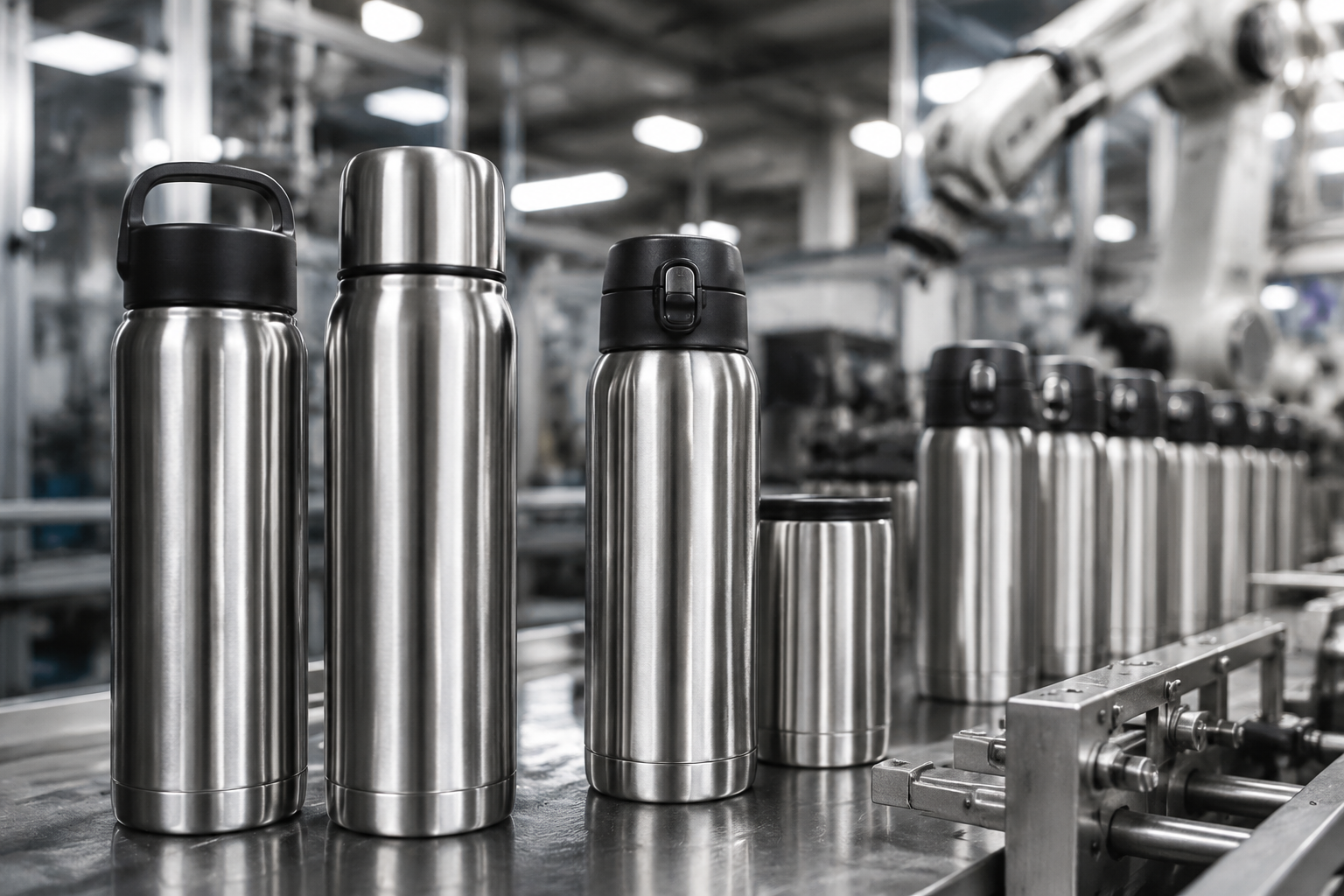
Key Takeaways
- Most thermos flask promotional products start at MOQ 3,000 units, while complex lids can push MOQ to 5,000+.
- Typical FOB China pricing for a 500 ml stainless thermos runs USD 2.10-4.80 depending on finish, lid, and packaging.
- Standard lead time is 20-35 days after sample approval; peak season in China can add 7-14 days.
- Laser logo adds almost no unit cost at scale, while full-color print or gift-box sets can lift cost by 8-20%.
When you buy thermos flask promotional products, the expensive mistake is not the unit price. It is assuming every stainless bottle behaves the same on cost or lead time. A 500 ml double-wall thermos with a powder coat, laser logo, and gift box lands very differently from a plain bulk thermos with one-color print. If you are buying for outdoor retail or a promo run, the real drivers are steel grade, wall construction, lid tooling, decoration method, and packaging.
We build and export from Zhejiang, China, so we see the numbers from both sides of the quote sheet. A practical thermos custom order on our factory line usually starts at 3,000 units, with 20-35 days after sample approval. QC pulled a sample last week and caught a lid mismatch at 0.3 mm, which is the kind of issue that turns a clean PO into a delay. For bigger campaigns, this is the wrong question to ask: thermos supplier or thermos manufacturer? The math only works when you know who can move spec changes fast and who is just passing the delay down the chain.
What really drives unit cost
I’ll keep the HTML structure intact and rewrite the prose to sound like a factory sales engineer, with tighter pricing language and a few concrete shop-floor details.Pricing on thermos flask promotional products looks simple until you split it by material and process. The body spec drives the bill. For most custom thermos orders, we run 304 stainless inside and out, and 0.4 mm wall thickness is the usual starting point on a 500 ml bottle. If the buyer wants 0.5 mm, or a heavier base that survives drops on the line, the unit price can climb by USD 0.20-0.45 right away.
The lid is the next swing factor. A plain PP screw cap stays cheap. Add a push-button vacuum lid with a lock and silicone sealing ring, and you are looking at USD 0.35-0.90 more. If the PO says bamboo cap, stainless accent ring, or tea filter, we usually budget another 8-15%. We had a buyer flag a “bamboo lid” typo on the PO once; the sample was correct, but the spec sheet was not, and that is the wrong question to ask before production starts.
Decoration changes cost fast. Laser engraving is the cleanest option for a thermos manufacturer because QC pulled the sample at once and the mark held after abrasion testing. Silk screen, pad print, and 360-degree wrap labels all work, but each one adds setup time, scrap, or a second pass on the line. On a 5,000-piece bulk thermos order, the print method can move the price as much as the bottle body.
- Plain 500 ml 304 stainless thermos: USD 2.10-2.80 FOB
- Powder-coated custom thermos with laser logo: USD 2.60-3.60 FOB
- Premium customized thermos with upgraded lid and gift box: USD 3.80-4.80 FOB
If the target is distributors thermos or shelf-ready units, packaging is not a side note. A printed color box adds USD 0.18-0.45, and the math changes again if you need barcodes, master cartons, or Amazon prep at 24 pcs per inner box. We ship these cases every week, and the cleanest quotes always start with use case first, artwork second.
MOQ tiers that buyers can use
I’ll rewrite just the prose, keep the tags and table structure intact, and tune it to sound like a factory-side sales engineer with concrete MOQ detail.MOQ is where a lot of buyers waste a week. A thermos supplier in Zhejiang may write 500 units on the quote, but that usually means one stock color, an existing mold, and no real change to the line. For a true thermos custom project with logo, special lid, or color-matched coating, 3,000 units is the number we usually run. At that level, the factory can buy raw tubes, schedule powder coating, and keep the unit cost from drifting.
For outdoor retailers, we see three workable tiers on the shop floor. At 1,000-2,000 units, you can usually take a stock thermos with one decoration method and standard packaging. At 3,000-5,000 units, QC can hold a custom thermos color, logo, and carton print without slowing the line. At 8,000+ units, a manufacturer thermos line can justify extra work, like custom lid color, embossed base, or a fully branded box set. The buyer flagged this once as “too rigid,” but the math does not work any other way.
The better move is to treat MOQ as a trade-off on complexity. A thermos distributor buying for a seasonal launch should ask for the simplest structure that still fits the brand. We’ve seen this go sideways when the buyer wants five changes at once. A thermos manufacturer can often cut MOQ on one variable if you freeze the others; stock body color plus custom logo may stay at 3,000, while stock color plus custom lid can jump to 5,000. That comes straight from the packing bench, where one extra lid carton adds time.
| Tier | Typical MOQ | Best fit |
|---|---|---|
| Entry | 1,000-2,000 | Simple promotional thermos, stock finish |
| Core | 3,000-5,000 | Brand campaigns, retail tests, distributor thermos buys |
| Scaled | 8,000+ | National promotions, multi-SKU programs, annual supply |
If you are comparing thermos bulk quotes, ask whether the MOQ is tied to color, lid mold, or packaging. Those three items drive the order more than the bottle body, and a PO typo on lid color has stalled production here for 12 days before.
Lead times by order type
I’ll rewrite the section in place, keep the HTML untouched, and tighten the sales-engineer tone with concrete factory details and cleaner timing language.Lead time on thermos flask promotional products is usually easier to forecast than price, if you split sampling, production, and shipping. A sample normally takes 5-10 days when the thermos factory already has the base model in stock. A new sample with custom logo or color usually needs 7-14 days, and a new lid spec can stretch that because QC pulled the first fit check before we release tooling.
For production, a standard custom thermos order of 3,000-10,000 units often runs 20-35 days after sample approval and deposit. Special coating, gift packaging, or mixed SKUs adds 5-8 days. If the order hits China’s peak export windows before Lunar New Year or before Q3 retail launches, build in another 7-14 days. Zhejiang factories can move fast, but not when the buyer flags a PO typo on the last artwork round.
Sea freight and air freight are different jobs. A thermos supplier can finish production in 25 days, yet the landed schedule still depends on freight booking. For North America and Europe, ocean transit often adds 18-35 days, while air is 5-10 days and only makes sense for urgent replenishment or a small high-margin run. We run this math every week, and the freight slot is usually the bottleneck, not the line.
Buyers who lock artwork, carton specs, and test requirements before production usually save 1-2 weeks. Buyers who change the logo after pre-production sample approval usually pay for it in time and scrap.
If you need a thermos customized for a trade show date, work backward from the event, not forward from the PO date. One 1,000 pcs trial run once missed a ship date because the carton height changed by 8 mm. That is the wrong question to ask if you want the order on schedule.
Decoration choices that affect margin
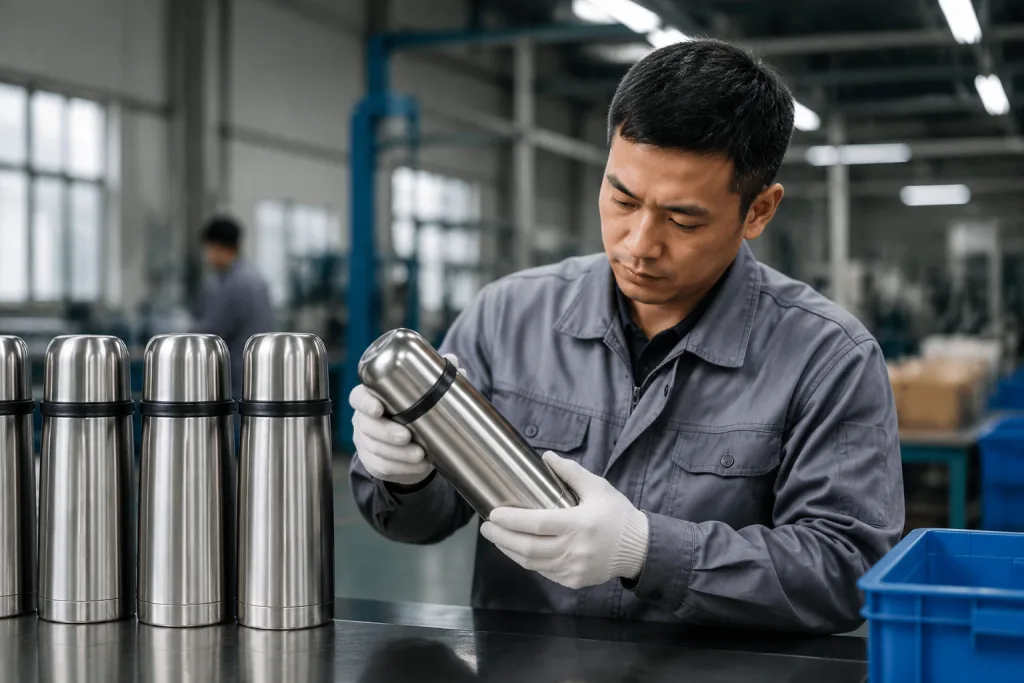
I’ll keep the HTML exactly as-is and rewrite only the prose for a more grounded sales-engineer tone, with specific factory-floor details and cleaner margin language.Not every branding method behaves the same on stainless steel. We run laser engraving on the line for a lot of promotional thermos orders because it stays clean, holds up in transit, and usually keeps the margin steady. It works best on matte black, gunmetal, and brushed silver finishes. On a 5,000-piece run, laser is often the safer call because the mark is permanent, and QC pulled the sample after a 48-hour rub check with no lift.
Silk screen is the standard option for simple logos and 1 to 2 colors. On some orders, it comes in cheaper than a premium laser effect, but coating choice matters and rough packing can scratch it. If the buyer wants a bright logo on a dark thermos promotional surface, silk screen gives that punch. If scratch resistance matters, laser is the better bet. We had one PO typo where the Pantone code was missing, and the buyer flagged it before we burned the screens.
Pad print works for curved bodies or small icons. UV print can carry more detailed artwork, but for hard-use outdoor retail, that is the wrong question to ask if durability is the priority. Thermos suppliers like to sell on appearance, yet we ask for rub testing, dishwasher expectations, and the real field-use target. A 12-day sample loop beats an 18-day reprint after the first shipment goes sideways. One inspection note on a 304 stainless job found the logo held, but the coating scuffed at the base ring after forklift contact.
- Laser: durable, low maintenance, mid-range setup time
- Silk screen: strong for simple brand marks, cost-effective at scale
- UV print: better for artwork, higher visual impact, less rugged than laser
For brands buying from China, request one decorated sample and one abuse-tested sample. A thermos manufacturer in Zhejiang can usually turn those around fast, and it saves a lot of back-and-forth when the buyer starts checking carton marks, logo placement, and the actual finish under warehouse light.
Testing and compliance buyers should ask for
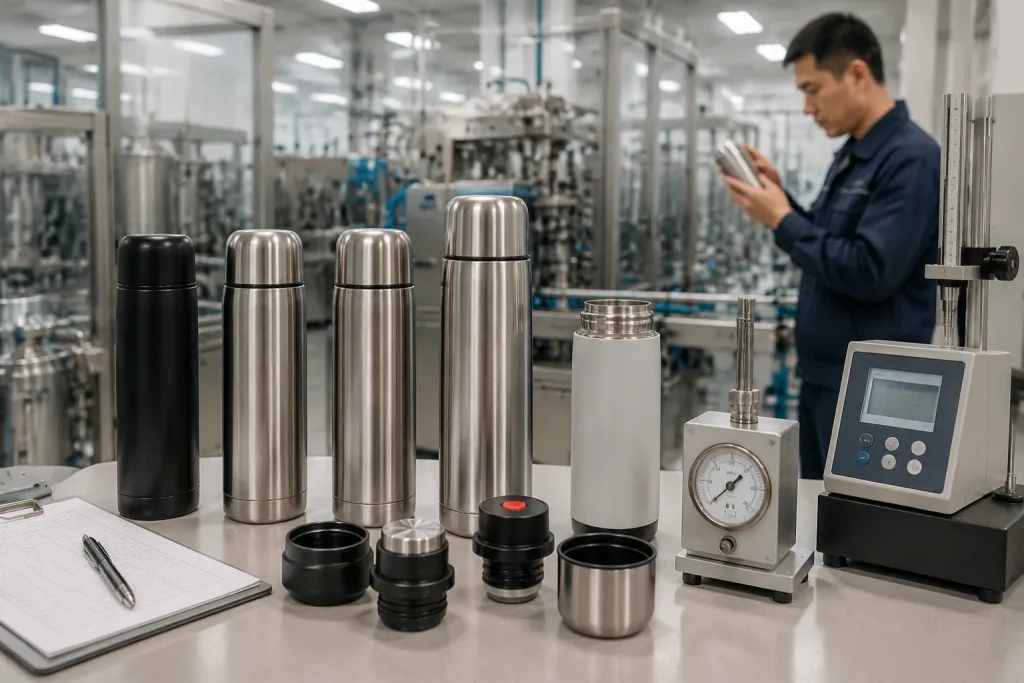
I’ll keep the HTML exactly as-is and rewrite only the prose, with tighter buyer-language and a few concrete factory details.Compliance is boring until a shipment gets held up. Then it is the whole job. Serious buyers separate a real thermos supplier from a risky one by asking for material declarations, migration paperwork where it applies, and proof that the coating and lid parts meet the destination market rules. On our side, we run this with a simple component map on the line: body tube, cap liner, silicone ring, and paint sample. If the supplier cannot tell you which parts touch the drink, do not place a branded order yet.
For stainless thermos projects, buyers usually ask for REACH-related declarations for the EU, food-contact confirmation, and factory QC records. That is the normal stack. Outdoor chains often add AQL inspection, and AQL 2.5 for major defects plus 4.0 for minor defects is a common target, but the channel risk decides the number. QC pulled the sample at 30 pcs per lot on one recent order, and the buyer flagged a warped cap ring before packing. If you sell into retail chains, ask for carton-drop rules and leak testing in writing.
A proper thermos manufacturer should show boil test records, insulation-retention targets, and lid-cycle checks. A vacuum bottle may claim 12 hours hot and 24 hours cold, but the math only works if the test conditions stay fixed. We have seen this go sideways when one factory tested at 20°C and another at 25°C. Ask for the method, the ambient temperature, and the probe point, not just the headline number. A 2 mm lid gap can change the result fast.
If you buy as a thermos distributor or brand owner, put the testing standard on the PI before production starts. That avoids the usual argument after shipment. We had one PO with a typo on the test clause, and it cost two days on the line while both sides argued over wording. For a Zhejiang supplier, this is the cleanest way to hold the factory to the spec.
How to compare quotes without guessing
I’ll rewrite the section in-place, keep the HTML exactly as-is, and make the wording sound like a real factory-side sales note.Two quotes for what looks like the same bottle can still land 20-40% apart, and one of them usually leaves something out. We’ve seen the cheap thermos bulk number hide thinner steel, a plain lid, no carton print, or a weak vacuum pull. The higher one may cover a cleaner brushed finish, tighter inspection, or retail-ready packaging. Don’t chase the lowest line. Compare spec for spec.
When you ask a thermos vendor for pricing, make them split the sheet into body, lid, decoration, packaging, and testing. Then you can see where the money sits. A proper manufacturer thermos quote should also show FOB China, EXW, or DDP, because freight and duty can make a bad comparison look normal. For Europe and North America, FOB is usually the clean baseline if you handle freight yourself.
Here’s the rule we use in Zhejiang: if the quote leaves out steel grade, wall thickness, decoration method, carton type, or lead time, it is not a real quote yet. It is a placeholder. We had a buyer flag a PO typo on the carton spec once, and the whole comparison went off the rails. A serious thermos factory should turn that placeholder into a commercial sheet within 24-48 hours once the spec is fixed.
If you want the order to stay profitable, pick one primary customization point and keep the rest standard. That is the better way to buy customized thermos products for outdoor retail, seasonal promotions, or distributor programs. The math does not work when every part gets customized and the packaging eats margin. One strong change is enough.
Request a clear thermos quote today
Send your target MOQ, lid style, logo method, and delivery window. We will price it like a real factory thermos job, not a guess.
Frequently asked questions
What is a realistic MOQ for thermos flask promotional products?
For a true custom thermos order, 3,000 units is the most common starting point. If you only need stock color plus logo, some thermos suppliers can work from 1,000-2,000 units. Once you ask for a new lid, custom carton, or special coating, MOQ often rises to 5,000 units. In Zhejiang, many thermos manufacturers price better at 5,000+ because the line setup and material purchase become more efficient.
How much does a stainless promotional thermos cost FOB China?
A basic 500 ml promotional thermos usually lands around USD 2.10-2.80 FOB China. Add powder coating, laser logo, or a better lid and it moves to about USD 2.60-3.60. Premium customized thermos sets with upgraded packaging often reach USD 3.80-4.80. Exact cost depends on steel thickness, lid type, decoration method, and whether you want a printed gift box.
How long does production take for a bulk thermos order?
After sample approval and deposit, a standard bulk thermos order usually takes 20-35 days. If the order includes special coating, mixed models, or complex packaging, expect 25-40 days. Add 5-10 days for samples if you need a fresh decoration setup. China peak season can add another 7-14 days, especially for factory thermos lines in Zhejiang that are already booked.
Which decoration method is best for custom thermos branding?
Laser engraving is usually the safest choice for a long-life custom thermos because it resists wear and looks clean on stainless steel. Silk screen works well for one-color or two-color logos and can be cost-effective on promotional thermos runs. If you want detailed artwork, UV print can work, but it is less rugged than laser for outdoor retail use. For most buyers, the decision comes down to durability versus visual impact.
What quality checks should I request from a thermos manufacturer?
Ask for leak testing, insulation retention testing, lid cycle checks, and AQL inspection records. A common commercial target is AQL 2.5 for major defects. For Europe, request REACH-related declarations and food contact confirmation where applicable. A good thermos manufacturer in China should also state the test temperature, duration, and sample method so the results are repeatable, not just marketing claims.