Key Takeaways
- MOQ for thermos flask private labeling usually starts at 500-1,000 pcs, with better pricing from 3,000 pcs up
- Typical stainless thermos ex-factory pricing ranges from USD 2.80-8.50 depending on vacuum wall, finish, and decoration
- Lead time is usually 20-35 days for standard factory thermos orders, plus 25-40 days by sea
- A practical buyer should expect AQL 2.5 inspection, REACH-compliant materials, and carton/FNSKU planning before shipment
If you are buying stainless thermos for retail, promo, or a new house brand, the first mistake is chasing the lowest unit price and ignoring tooling, decoration, and shipping reality. We quote a 1,000-unit sample run all the time, and the math changes fast once you add cap molds, logo setup, Pantone matching, and export cartons. Last month a buyer flagged a PO typo on the lid color code, and that tiny mistake would have held the line for 4 days. In Zhejiang, we see this every week: buyers ask for a custom thermos quote, then find the real cost sits in the production path, not the bottle body.
Thermos flask private labeling works best when you treat it like a supply chain decision, not a design exercise. You want clear MOQ tiers, a lead time that matches the line, and a supplier thermos that can hold repeat quality on a bulk thermos order. QC pulled the sample on one 500 ml run and found a 0.8 mm wall variation near the shoulder; that is the kind of issue that shows up after launch if nobody checks it early. For outdoor retailers and promo brands, the numbers matter more than the pitch: what does 500 units cost, what changes at 3,000 units, and how many days until FOB Ningbo or Shanghai is ready? That is the right question to ask in China.
What actually drives the price
I’ll rewrite the section in place, keep the HTML exactly as-is, and tighten the pricing language so it reads like a factory-side sales note.The unit price of a thermos flask private labeling order usually comes down to five cost blocks: body construction, lid parts, surface finish, decoration, and packaging. A plain 304 stainless steel vacuum bottle with a standard screw cap can land at USD 2.80-3.60 at 1,000 pcs. Add a tea infuser, powder coating, laser logo, and a gift box, and that same custom thermos jumps to USD 4.80-6.20 fast. For a 500 ml double-wall bottle with a 316 inner liner, we see another 8-15% on material cost. The buyer flagged it on one PO before: they wanted “same bottle, better price,” and the math just didn’t work.
Wall thickness moves the number more than most buyers expect. A common outer shell runs 0.35-0.40 mm stainless, while the inner liner sits around 0.30-0.35 mm. Thicker metal is not a free upgrade; it adds weight and eats material without giving you much back on insulation. The real issue is vacuum consistency. We run a 95°C fill test on the line, then QC pulls the sample at 6 hours, 12 hours, and 24 hours to log the temperature drop. If a supplier cannot show those figures, the low quote is just noise.
- Plain stainless thermos: USD 2.80-3.60
- Powder-coated branded bottle: USD 3.40-4.60
- Tea infuser or extra lid parts: add USD 0.40-1.20
- Gift box / color carton: add USD 0.25-0.80
For promotional thermos programs, decoration often costs more than the vessel itself. Screen printing stays cheap at high volume, but multi-color logos or wrapped artwork bring in extra labor and more reject risk. We’ve seen this go sideways when a buyer sent a PO with the logo size off by 2 mm, then asked why the setup fee changed. The better move is to keep one spec for retail and another for campaigns. Factory thermos cost is straightforward; brand spec is where the bill climbs.
MOQ tiers that make sense
I’ll rewrite the section in-place, keep the HTML exactly as-is, and tune the sales tone so it sounds like a factory-side rep wrote it.Thermos flask private labeling works best when MOQ matches the channel. At 500 pcs, you pay for flexibility, not line efficiency. At 1,000-2,000 pcs, pricing starts to settle. At 3,000-5,000 pcs, we can lock raw material buys, pack cartons tighter, and spread setup cost across more units. That is where bulk thermos pricing starts to make sense for outdoor retailers and distributor thermos programs.
A practical MOQ ladder from a Zhejiang factory looks like this:
- 500 pcs: good for a test run, USD 0.30-0.70 higher per unit than larger runs
- 1,000 pcs: common MOQ for custom thermos with one logo location
- 3,000 pcs: better pricing, easier color matching, more packaging options
- 5,000+ pcs: strongest cost position for thermos bulk and thermos customized programs
Do not assume every thermos supplier or thermos vendor uses the same MOQ logic. Some add one-time fees for new cap tooling, artwork plates, or custom cartons. Others roll that into piece price once the order clears a threshold. Ask for the real gap between 1,000 and 3,000 pcs. On a recent PO, the buyer wrote “3,000 pcs” but missed the carton spec, and QC pulled the sample before we shipped. Usually the spread is only USD 0.35-0.80 per unit, which beats splitting inventory across too many SKUs. For a promotional thermos campaign, fewer variants usually win over a lower headline price with more moving parts.
When buyers search for thermos distributors or thermos suppliers in China, they often fixate on minimum order first and miss channel fit. A retailer launch needs sell-through data; a giveaway program needs low artwork risk; a private label line needs repeatability. MOQ should follow the use case, not the factory’s convenience. This is the wrong question to ask if you want clean reorders.
Lead time from sample to ship
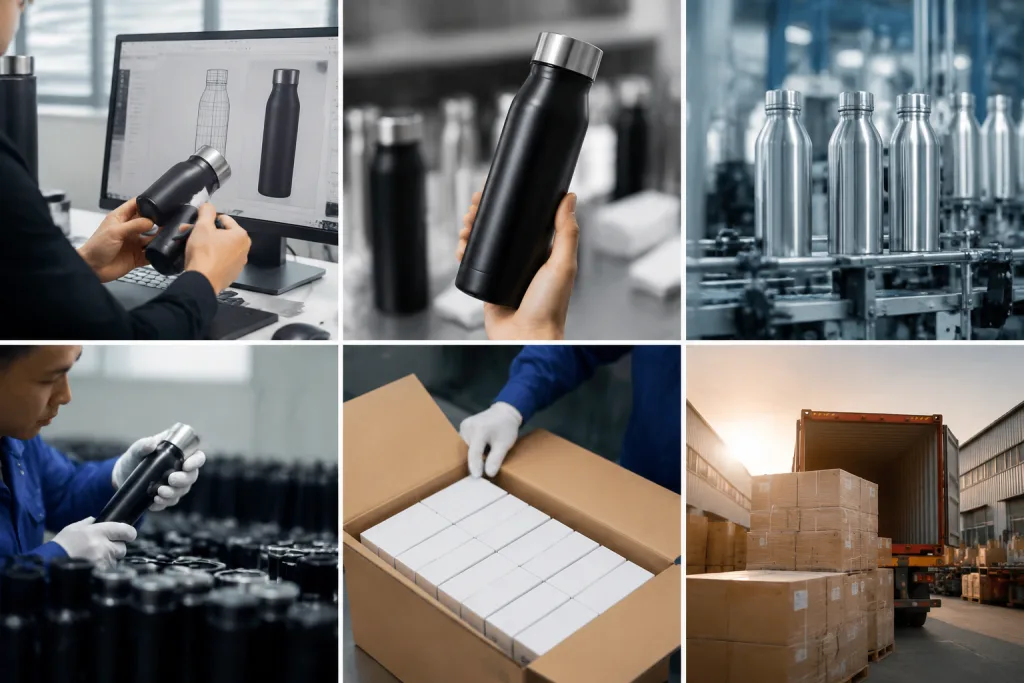
I’ll rewrite the section in place, keep the HTML exactly as-is, and strip the AI-style phrasing while adding a few concrete factory-floor details.A practical lead time for thermos flask private labeling is 7-12 days for sampling, 15-25 days for production after sample approval, and another 5-10 days for packing and export booking. If the design needs a new lid mold, add 20-30 days. If you stay with a standard factory thermos structure and only change the logo and carton, we often ship in 20-35 days from deposit. That is the real benefit of working with a manufacturer thermos that already runs the mold set in Zhejiang. We cut samples on the laser machine, and the line does not wait for a buyer to guess on artwork.
Here is the timeline buyers should plan around:
- Day 1-3: confirm capacity, logo file, Pantone, and carton spec
- Day 4-12: sample making and photo approval
- Day 13-18: material booking and pre-production setup
- Day 19-35: mass production and AQL inspection
- Day 36-45: export loading, documents, and vessel departure
Sea freight adds another 18-35 days to Europe and 22-40 days to North America, depending on port and season. If you need a promotional thermos for a trade show, work back at least 70 days. If you need Amazon FBA inventory, add carton labeling, master carton size checks, and FNSKU application before the goods leave China. We had one PO where the buyer flagged a typo in the carton mark on Day 14, and the schedule slipped by 6 days. A supplier thermos with 200,000 units/month output can still miss your date if artwork comes in late. The math does not work any other way.
In Zhejiang, the best thermos factory is not the one promising the fastest ship date. It is the one giving you a believable schedule and holding it.
Decoration choices and hidden costs
I’ll keep the HTML intact and rewrite the copy with a more field-tested sales tone, tighter phrasing, and concrete shop-floor details.Your logo method changes both cost and scrap risk. Silk screen still wins on price for a one-color custom thermos, usually USD 0.08-0.20 per location at volume. Laser engraving costs more up front, but it holds up, and outdoor buyers pay for that clean look. Heat transfer or full-wrap print can look stronger on promotional thermos pieces, yet it adds setup time, color drift, and more rejects. We run this on the line all the time. If you buy from a thermos manufacturer in China, ask whether decoration happens in-house or through a subcontractor. That one answer can move lead time by 3-7 days.
Typical hidden costs include:
- Artwork setup: USD 20-80 per color/position
- Logo plate or screen: USD 30-120
- Custom carton: USD 0.25-0.80 each
- Drop-test rework: can add 2-5 days if packaging fails
A customized thermos with powder coating and a laser logo sells better in outdoor channels because it feels retail-ready, not giveaway-grade. But if the order is for a promotion, do not overbuild it. QC pulled the sample last week because the buyer flagged a PO typo on the carton size, and that cost two extra cartons to remake. A thermos customizable enough for the logo, the color, and the carton is usually the right call. The math does not work if you add a second process just for show. The bad move is letting a supplier surface those charges after sample approval.
Quality checks you should demand
I’ll rewrite the prose inside the existing HTML only, keep the tag structure intact, and make it sound like a factory-side sales engineer wrote it.For a stainless thermos, quality starts with the steel and ends with the carton surviving the truck ride. Ask for 304 stainless steel at minimum for beverage contact, or 316 for premium programs where chloride resistance matters more. We check REACH for Europe, and we also ask for food-contact status on paint, inks, and rubber parts for the target market. A real thermos supplier should show inspection records, vacuum leak test sheets, and temperature-retention data. Pretty photos do not ship.
Use these checkpoints on every thermos bulk order:
- Vacuum retention: no seal failure, no early heat drop
- Leak test: inverted shake test on random samples
- Drop test: carton and bottle impact verification
- Appearance: logo alignment, coating uniformity, dent check
- Sampling standard: AQL 2.5 for major defects is common
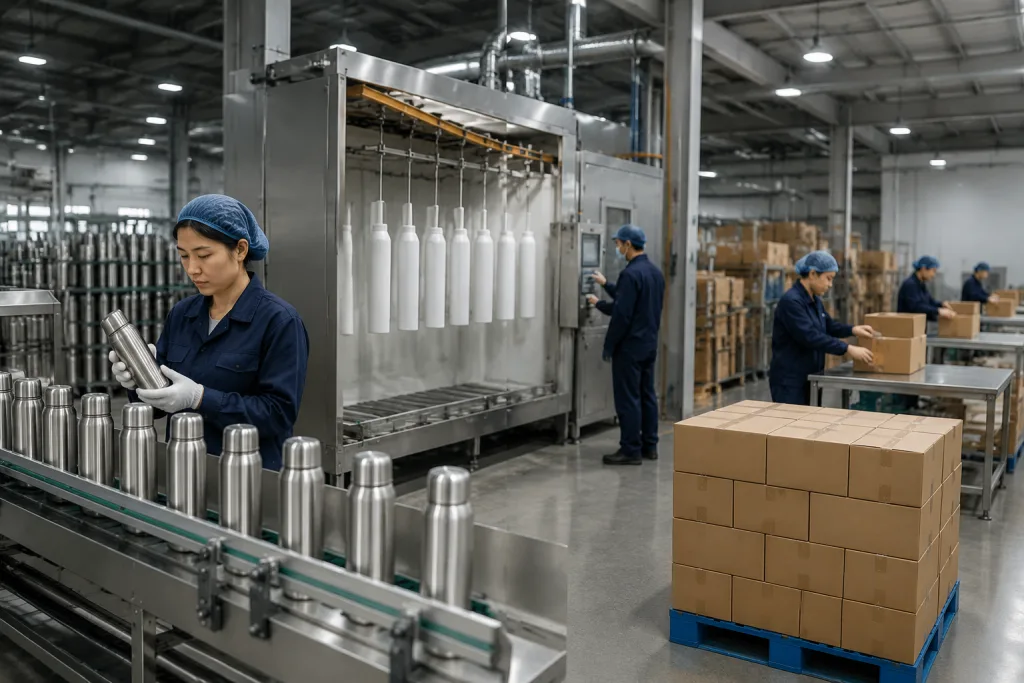
If your supplier says the thermos line can run 100,000 units a month, ask for the line count and the shift plan, not the headline number. On a proper Zhejiang factory floor, we expect separate forming, polishing, vacuum, coating, and packing lines, with QC pulling samples at each gate. Capacity protects your ship date. Quality protects your margin. A 2% defect rate on 5,000 units leaves 100 pieces you cannot sell, and that math does not work for distributors.
Buyers often treat quality as a final check. That is the wrong question to ask. Quality is built into tooling, steel thickness, weld consistency, and carton spec. We have seen this go sideways when the PO had a 0.5 mm wall-thickness typo and nobody caught it before sampling. If you want fewer claims, lock the spec before the first sample leaves China.
Choosing the right factory partner
I’ll keep the HTML structure unchanged and rewrite the prose to sound like a factory-side sales engineer, with concrete shop-floor details and fewer generic phrases.Thermos flask private labeling works best with a factory that knows your channel, not just your artwork. Outdoor retail wants 12-hour insulation, a clean powder coat, and the same lid fit from batch to batch. Promo buyers care about landed cost and carton mix. We’ve told clients flat out when a spec was chasing a price point that the line could not hold, or when a standard PP lid beat a fancy one on both cost and leak risk. That kind of pushback saves a lot of trouble after the first shipment.
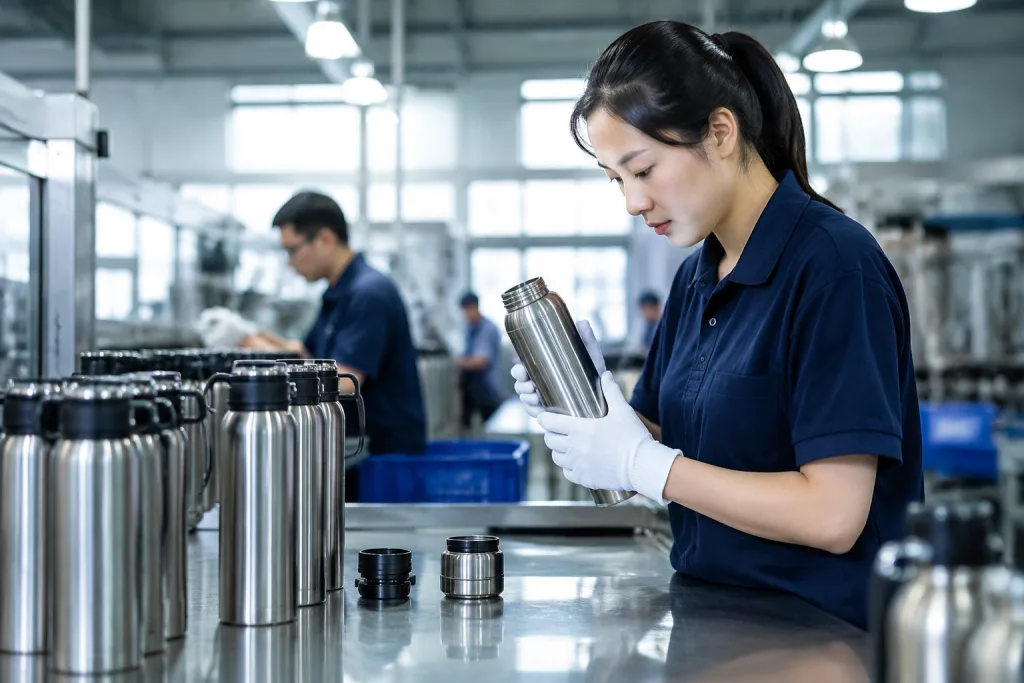
When you compare a thermos manufacturer, a thermos supplier, and a thermos vendor, check three things: in-house forming, response time, and file control. Can they run the bottle, the spray line, the leak test, and final packing without handing off the critical steps? Do they quote FOB cleanly, not just ex-factory? Can they send a packing list, HS code support, and compliance files without three follow-up emails? QC pulled a sample last week with a 0.8 mm gap at the cap shoulder; that is the kind of issue a real factory catches before the buyer flags it.
For most buyers, the clean setup is one custom thermos platform, two logo versions, and one spare carton spec. Simple. It keeps reorders sane and cuts changeover time on the line. A 500 ml bottle with one mold, one laser logo, and one export carton is easier to manage than three bottle shapes with mixed inserts. In Zhejiang, that is how we run a thermos distributor account: stable tooling, MOQ you can plan around, and repeat production that does not drift. If you need a thermos customizable enough for retail but still workable for campaigns, keep the spec lean and the paperwork tight. The math works better that way.
The best signal from a factory is not a low number. It is a quote that explains why the number is what it is, and how long they can hold it. We’d rather see a price held for 60 days with a clear resin basis than a cheap line that changes after one container is booked.
Get a clear thermos quote today
Send your target MOQ, logo file, and carton spec. We’ll return costed options, lead time, and the cleanest production path.
Frequently asked questions
What is a realistic MOQ for thermos flask private labeling?
For most stainless thermos projects, 500-1,000 pcs is the practical starting point. At 500 pcs, you pay a premium of about USD 0.30-0.70 per unit versus larger runs. At 3,000 pcs, pricing improves because material purchase, decoration setup, and packing are spread across more units. A factory in Zhejiang with stable lines can usually support both test orders and repeat bulk thermos programs, but the price gap between tiers is where your real decision sits.
How much does a custom thermos cost ex-factory?
A straightforward custom thermos with 304 stainless steel, one logo, and standard carton usually lands around USD 2.80-3.60 at 1,000 pcs. Add powder coating, a better lid, or a tea infuser and you may move to USD 4.20-6.20. Premium wall construction, 316 inner liner, or complex print can go higher. Ask your thermos supplier to separate bottle cost, decoration, carton, and one-time setup fees so you can compare real total landed cost.
How long does production take in China?
For standard thermos flask private labeling, sampling usually takes 7-12 days and production 15-25 days after approval. If you already have a common mold, total factory time can be 20-35 days. Add 5-10 days for export booking and documentation. Sea freight from China to Europe often adds 18-35 days; to North America, 22-40 days depending on route and season. If you need FBA delivery, include carton labels and case pack checks before shipment.
Which decoration method is best for promotional thermos orders?
If you want the lowest cost, silk screen is usually best for one-color promotional thermos work. If you want durability and a more premium retail look, laser engraving performs well on stainless steel. Full-wrap print looks strong but adds setup time and color-control risk. For a distributor thermos program, I usually suggest one logo position and one coating color first, then expand only after reorder data proves the SKU moves.
What quality documents should I request from a thermos manufacturer?
Ask for material confirmation, temperature-retention test results, leak-test records, and packing photos from pre-shipment inspection. For Europe, REACH-related material compliance is important. For general production control, AQL 2.5 is a common inspection standard on major defects. If your order is going to Amazon or a retailer DC, also request carton dimensions, gross weight, barcode placement, and case pack confirmation before the goods leave Zhejiang or any other China port.