Key Takeaways
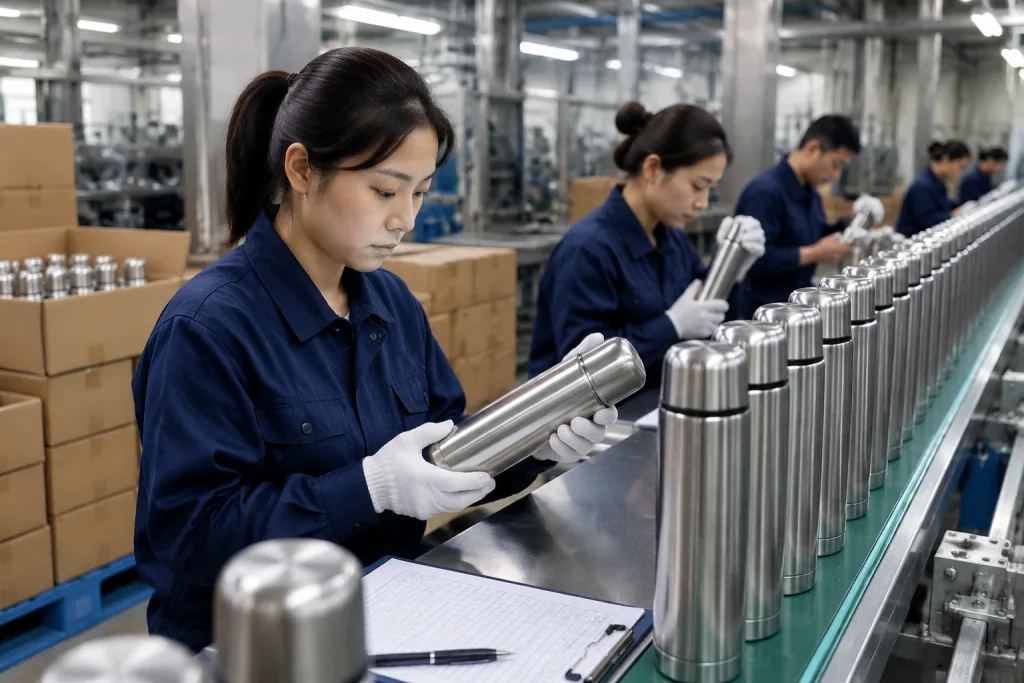
- A practical thermos flask private label MOQ starts at 1,000-3,000 pcs per color for existing molds
- 304 stainless inner walls at 0.35-0.45 mm are common for reliable vacuum flasks
- Laser engraving adds about USD 0.08-0.25 per unit; powder coating adds more but improves shelf appeal
- Plan 35-55 days production after PP sample approval, plus sea or rail transit
If you sell outdoor gear or promotional drinkware, a thermos flask private label project looks simple until the quotation sheet lands on your desk. We once had two 500 ml bottles that matched in photos, but one used 18/8 steel and the other came with a thinner liner, and the buyer flagged it before QC even finished pull tests.
You need hard answers before you commit to thermos bulk inventory: what MOQ is real, which custom thermos details move the price, how long a Hangzhou line needs for sampling, and what tests matter for Europe or North America. BottleForge Industrial runs stainless vacuum drinkware in Hangzhou, Zhejiang, China, and we’ll say it straight: private label works when specs are locked early and every carton, lid, and vacuum result is checked against numbers, not guesswork.
What are you actually buying?
I’ll rewrite the section in place, keep the HTML structure intact, and strip the AI-style phrasing while adding factory-floor specificity and a sharper sales-engineer voice.A thermos flask private label order is not a blank bottle with your logo. You are buying a built spec: inner shell, outer shell, vacuum gap, copper plating if you asked for it, cap system, gasket material, coating, decoration, packaging, and test records. If one line is vague, the thermos quote looks good on paper and fails in your channel. We’ve seen a buyer flag a PO typo on capacity — 500ml written as 50ml — and the line still had to stop.
For outdoor retailers, the baseline is 18/8 or 304 stainless steel for food-contact parts, a double-wall vacuum structure, BPA-free PP or Tritan cap parts, and silicone gaskets. Inner wall thickness usually runs 0.35-0.45 mm, outer body 0.45-0.55 mm, depending on size and dent resistance. For promo thermos jobs, buyers sometimes cut wall thickness to save USD 0.15-0.30 per unit. The math works on a giveaway. It does not work on a retail shelf. QC pulled the sample on one 350 ml run because the base ring was 0.32 mm and the dent rate jumped after a 1.2 m drop test.
Buyer checklist:
- Confirm steel grade for the inner wall, outer wall, and lid contact parts separately.
- Ask whether the quoted capacity is brimful capacity or usable capacity.
- Request temperature retention data at 6 hours and 12 hours, not marketing copy.
- Define coating type: spray paint, powder coating, rubber paint, or raw brushed steel.
- Check if the thermos factory owns the mold or is quoting from a shared trading catalog.
A manufacturer thermos partner in China should answer these points cleanly. If the reply is “standard quality,” keep pressing. That is the wrong question to ask. Standard for a festival giveaway is not standard for a mountain retail shelf, and we run those two jobs on different lines.
Which MOQ is honest?
I’ve got the scope: rewrite just this section, keep the HTML exactly intact, and make it read like a factory-side sales engineer wrote it. I’ll tighten the MOQ language, add concrete shop-floor details, and strip the AI-ish phrasing.MOQ is where private label talks get fuzzy fast. For an existing bottle shape in our Zhejiang line, a straight answer is 1,000-3,000 pcs per color for a customized thermos with logo, color, and retail box. If you ask for a new cap mold, a special handle, a unique body profile, or exclusive tooling, you are in custom mold territory. Then 5,000-10,000 pcs per SKU is the normal starting point, and tooling usually runs from about USD 1,500 to USD 8,000 depending on how many parts the mold has and how much polishing the cavity needs.
Small sample runs happen, but they do not show the real cost. A 200 pc trial order needs manual setup, more material loss, and line changeovers that slow the workshop. We run this every week. That is why a factory thermos price at 200 pcs can be 40-80% higher than the thermos bulk price. If a thermos vendor says mass-production pricing at that quantity, the buyer flagged it for a reason. Check what got cut: coating thickness, carton spec, inspection steps, or packing control.
MOQ decision points:
- Existing mold plus laser logo: 1,000 pcs is often workable.
- Existing mold plus custom PMS coating: 2,000-3,000 pcs per color is more realistic.
- Custom lid or body tooling: plan at least 5,000 pcs for a commercial price.
- Multiple colors below MOQ: expect a surcharge of USD 0.10-0.35 per unit.
BottleForge Industrial’s stainless thermos line runs about 450,000 units/month across standard vacuum flask models, and regular private label lead time is 35-55 days after pre-production sample approval. QC pulled the sample with a 1.2 mm lid gap check before release. That number matters more than a pretty catalog. Capacity gives you room when a distributor thermos reorder lands before peak season.
How should specifications be written?
I’ll rewrite the prose to sound like a factory-side RFQ note, keep the HTML exactly as-is, and preserve all technical numbers and tags.A solid RFQ for thermos flask private label reads like a production sheet, not a mood board. We run quotes off what is on paper. If the spec is loose, the factory has to guess, and that is where price gaps start. A buyer sees “supplier A is cheaper,” but supplier A may have quoted a thinner wall, a lighter lid, or a plain box.
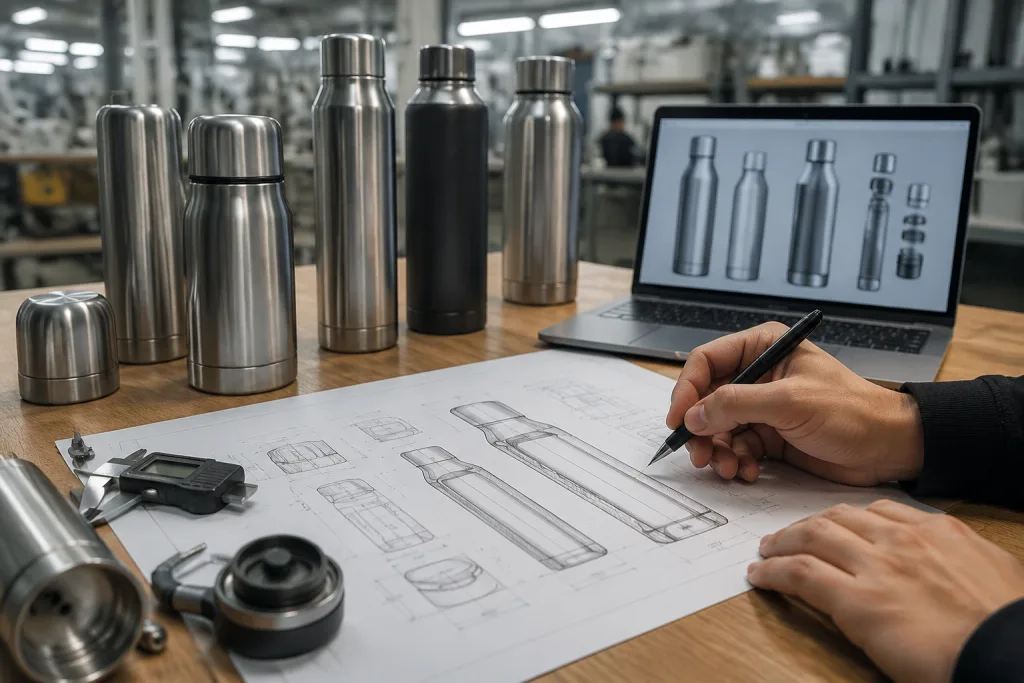
Write in millimeters, grams, and test targets. For a 500 ml outdoor thermos, call out body height, diameter, mouth width, net weight tolerance, steel grade, lid material, gasket material, coating, logo process, box type, carton quantity, and the carton drop-test requirement. If you need REACH or LFGB for the EU, put it in before sampling. For the US, ask for FDA food-contact declarations, and for kids’ lines, state ASTM or CPSIA-related requirements where applicable. QC pulled the sample on a 0.3 mm neck gap last week; that kind of miss starts with a weak RFQ.
RFQ checklist for suppliers thermos evaluation:
- Capacity: 500 ml usable capacity, tolerance ±5%.
- Material: inner 304 stainless steel, outer 201 or 304 as selected, silicone gasket.
- Performance: hot water at 95°C, room at 20°C, target ≥55°C after 12 hours.
- Surface: powder coating, matte black, Pantone reference, adhesion cross-cut test 4B or better.
- Decoration: laser engraving, logo size 45 x 28 mm, one position.
- Packaging: 350 gsm color box, 24 pcs/export carton, 5-ply carton.
- Inspection: AQL 2.5 major, 4.0 minor, 100% leak test during production.
This is where thermos custom buying beats catalog buying. The math does not work any other way. In outdoor retail, weak specs come back as returns; in promo orders, they show up when 20,000 pcs land with a logo 6 mm off-center. We have seen that one go sideways more than once.
Which logo method makes sense?
I’ll rewrite the HTML in place, keep the tag structure unchanged, and make the wording sound like a factory-side sales engineer wrote it.Logo choice is not just about looks. It hits MOQ, unit cost, wear resistance, lead time, and whether your customizable thermos still looks clean after six months in a backpack. For stainless thermos private label, the usual picks are laser engraving, silkscreen printing, heat transfer, and full-wrap powder coating with a second decoration step.
Laser engraving is the toughest option and usually runs about USD 0.08-0.25 per unit, depending on logo size and placement. We run it best on powder-coated or painted bottles, because the laser burns through the top layer and exposes the metal underneath. It is the wrong choice for gradients or full-color promotional thermos art. Silkscreen printing is cheaper for a simple one-color logo, usually USD 0.05-0.15 per unit, but scratch resistance depends on ink, curing, and surface prep. Heat transfer can handle multi-color graphics, and QC pulled the sample if the adhesion failed on a curved body.
For premium retail, powder coating plus laser logo is our standard call. For event giveaways, a single-color silkscreen on a normal coating is enough. For a distributors thermos program with 12 regional logos, keep the bottle color standard and change only the logo. The math works better, and we have seen color changeovers waste 18 days of line time across a season.
Before approving artwork:
- Request a physical decoration sample, not only a digital mockup.
- Confirm logo tolerance: position ±2 mm is fine for mass production.
- Run tape test, cross-hatch adhesion test, and 20-cycle dishwasher simulation if claimed dishwasher-safe.
- Ask whether barcode, FNSKU, or retail sticker is applied in the factory or by your warehouse.
A customized thermos is only customized well if the decoration process fits the sales channel. A trade-show giveaway and a USD 24.99 outdoor flask do not use the same decoration brief. We shipped a PO with the logo typo fixed before mass run; that kind of mistake is cheap to catch, expensive to ship.
What does pricing include?
I’ll rewrite the section in-place, keep the HTML exactly as-is, and tighten the copy so it sounds like a factory sales engineer wrote it.Thermos flask private label pricing usually comes out as FOB Ningbo or FOB Shanghai for Zhejiang and the nearby belt. EXW may look lower on paper, but then your forwarder has to handle export release, inland trucking, customs docs, and port booking. For a Europe or North America buyer, FOB is cleaner unless you already run a China consolidation lane.
For a straight reference, a 500 ml stainless vacuum flask from a China thermos factory often sits around USD 3.20-5.80 FOB for 3,000-10,000 pcs, depending on steel spec, cap structure, coating, logo, and pack-out. A 750 ml or 1 L outdoor bottle often lands at USD 4.80-8.50 FOB. QC pulled a sample on a 304 liner at 0.35 mm, and the quote moved once the buyer flagged the lid insert. If someone is 25% under that band, the math does not work without a cut somewhere.
Cost items to separate in the quote:
- Base bottle cost with material and capacity stated.
- Coating surcharge by color and finish.
- Logo charge by method, color count, and position.
- Custom box, insert, manual, hangtag, and barcode label.
- Tooling or mold fee, if any, with ownership terms.
- Testing fee for LFGB, REACH, FDA, or third-party lab reports.
- Spare parts, replacement lids, and after-sales allowance.
Do not compare thermos manufacturers on one-line pricing. Ask each thermos supplier to quote the same spec, same Incoterm, same pack, and same inspection level. Then compare. We’ve seen this go sideways when a PO had “matte black” typed once and the line assumed standard spray instead of soft-touch; the landed cost blew up. A supplier quote without carton size and gross weight is not ready for landed-cost work.
How do you control quality?
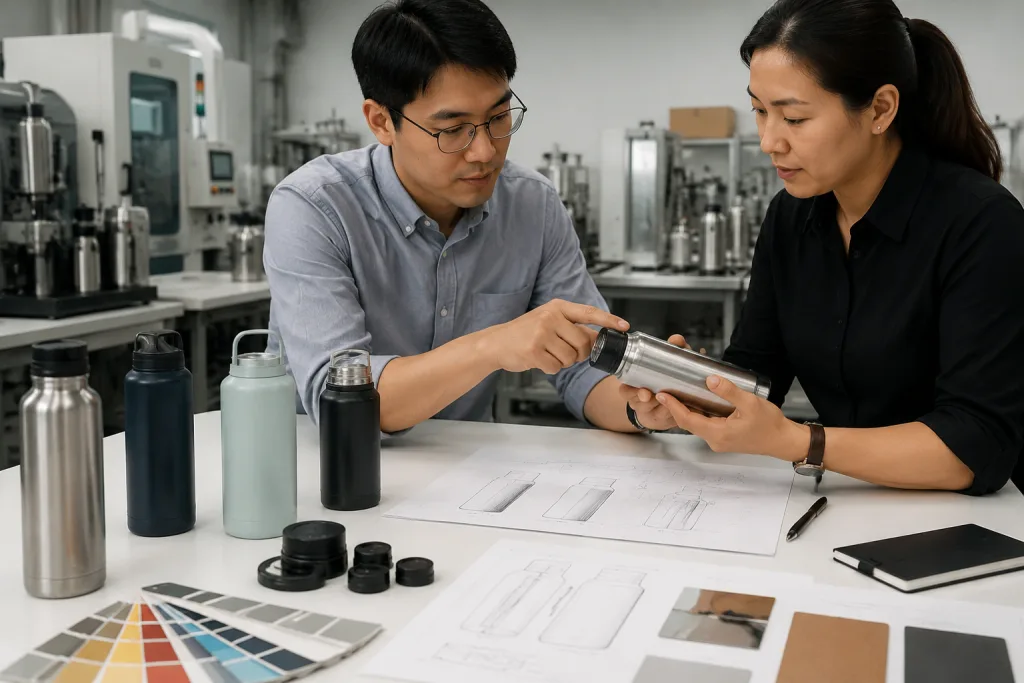
I’ll rewrite the section in-place, keep the HTML structure exactly, and tighten the prose so it sounds like a real factory-side sales engineer.Quality control starts before the line runs, not after the container is sealed. For thermos flask private label orders, we ask buyers to sign off the pre-production sample, spec sheet, artwork files, packaging layout, and inspection criteria before bulk material is ordered. If your brand has restricted substances rules, put them on the PO; we’ve seen that typo turn into a rejected shipment.
Common checks include 100% leak testing, batch vacuum insulation testing, coating adhesion, salt spray on exposed metal parts, lid torque or open-close cycling, carton drop testing, and visual inspection under AQL. We usually work to AQL 2.5 for major defects and 4.0 for minor defects. Critical defects stay at zero: leakage, sharp edges, wrong material, heavy contamination. That is the right question to ask.
For outdoor retailers, impact resistance matters. Ask for a controlled drop test, say 1.0 m onto plywood or concrete, depending on the claim you want on the box. For promotional brands, logo placement and packaging accuracy usually matter more because 5,000 or 20,000 units can go straight to one event or one corporate buyer. If you sell online, carton strength and barcode accuracy are not side issues. We had a buyer flag one wrong FNSKU on a 10,000-piece order, and the math on relabeling did not work.
Inspection checklist:
- Measure capacity, net weight, height, diameter, and mouth opening.
- Check 30 pcs minimum for logo position and color consistency.
- Fill and invert samples for at least 30 minutes for leak checks.
- Test temperature retention against the approved sample.
- Verify master carton markings, shipping marks, and pallet plan.
A reliable thermos manufacturer in China will accept third-party inspection without drama. If a thermos vendor pushes back on AQL or refuses in-line checks, we’d treat that as a real procurement risk. QC pulled the sample, not the buyer, and that tells you enough.
When should you place orders?
I’ll keep the HTML structure intact and rewrite the prose to sound like a factory-side sales engineer, with tighter timing language and a few concrete shop-floor details.Order timing is where a lot of private label thermos plans start bleeding cash. We run stainless thermos lines through seasonal peaks, and the queue tightens fast: outdoor retail buys stack up before spring and summer launches, while promo thermos orders hit before Q4 gifting. If you want cartons in a North American warehouse by September, starting sampling in late July is the wrong move.
A practical schedule is 5-10 days for artwork and spec sign-off, 7-15 days for sampling, 3-5 days for sample review, then 35-55 days for production. After that, you still need inspection, export booking, and transit. Ocean freight to the US West Coast often takes 18-25 days port-to-port; Europe is usually 30-40 days. Rail into parts of Europe can beat sea on paper, but when the slots tighten, the line gets messy.
Order planning checklist:
- Set the retail launch date first, then work backward by 90-120 days.
- Approve one golden sample and keep it on the QC table for final comparison.
- Freeze artwork before mass production; a late logo change turns into scrap, not “small edits.”
- Book third-party inspection at least 7 days before the estimated finish date.
- Keep 2-3% spare lids or gaskets if you sell replacement parts.
For distributor thermos programs, first orders and reorders need different math. The first run may include full packaging and mixed colors; the reorder is often a tighter SKU list and moves faster through the filling line. Tell your thermos supplier which items will repeat. We’ve seen this go sideways when a buyer asked for “best price” but never shared quarterly volume; a Hangzhou, Zhejiang factory can stock caps, liners, and gift boxes better when the forecast is real.
Send your thermos flask brief for a factory quote
Share capacity, color, logo method, MOQ target, and destination. We will return practical options, not a vague catalog price.
Frequently asked questions
What is the best MOQ for a first thermos flask private label order?
For a first order, 3,000 pcs is usually the cleanest MOQ if you want custom color, logo, and retail packaging without paying too many small-run surcharges. Some thermos suppliers can start at 1,000 pcs for an existing mold with laser engraving, but custom PMS coating often becomes inefficient below 2,000 pcs per color. If you are testing an outdoor retail line, choose one proven 500 ml or 750 ml body and two colors instead of five colors. For promotional thermos campaigns, 1,000 pcs may be acceptable when deadlines matter more than unit price. Ask the thermos factory to separate base cost, decoration, packaging, and inland freight so you can see where MOQ affects price.
Should I choose 304 stainless steel for both inner and outer walls?
The inner wall should normally be 304 stainless steel because it contacts beverages and needs good corrosion resistance. The outer wall can be 201 or 304 depending on your market position. A 304 outer wall increases cost, often by USD 0.20-0.60 per unit depending on size and steel price, but it improves corrosion resistance around dents, scratches, and exposed edges. For outdoor retailers, full 304 construction is easier to explain and defend. For promotional brands, 304 inner plus 201 outer may be enough if the coating is good and the product is not marketed for harsh use. Whatever you choose, write it into the specification sheet and inspection documents.
How long does private label stainless thermos production take in China?
For an existing mold, plan 7-15 days for sampling and 35-55 days for mass production after you approve the pre-production sample. Complex customized thermos projects with new tooling can add 20-35 days for mold development and adjustment. Shipping time is separate. From Zhejiang or nearby China ports, sea freight to the US West Coast may take about 18-25 days port-to-port, while Europe is often 30-40 days. Add time for customs, trucking, and warehouse receiving. If you need a fixed event date, work backward by at least 90 days for repeat items and 120-150 days for new private label development.
What certifications should a thermos manufacturer provide?
For Europe, ask about LFGB food-contact testing, REACH restricted substances, and packaging compliance if you use printed retail boxes. For the US, FDA food-contact declarations are common, and children’s products may need CPSIA or ASTM-related review depending on design and age grading. Factory audits such as BSCI or ISO 9001 help, but they do not replace product testing. A thermos manufacturer should provide current material declarations, test reports linked to similar materials, and willingness to support third-party lab testing on your production sample. Be careful with generic certificates that do not name the material, model, or test standard. They look reassuring but may not protect your shipment.
Can one thermos supplier support both retail and promotional channels?
Yes, but only if the supplier thermos process can separate specifications by channel. Retail needs stronger packaging, tighter cosmetic control, repeatable colors, barcode accuracy, and better documentation. Promotional thermos orders often need fast artwork handling, multiple logo versions, and event-date discipline. The bottle body can sometimes be the same, but the inspection checklist should not be identical. For retail, use AQL 2.5/4.0, carton drop testing, and golden sample comparison. For promotion, add logo placement checks across at least 30-50 samples per design and confirm individual box or bulk-pack requirements. A good China factory will help you build two cost structures instead of pretending one product fits every buyer.