Key Takeaways
- For custom thermos wholesale, 500-1,000 pcs MOQ is realistic for standard colors; 3,000 pcs is common for private mold or matched Pantone coating
- 304 stainless steel with 0.45-0.55 mm inner wall thickness is the practical baseline for outdoor retail thermos bulk orders
- AQL 2.5/4.0 inspection, 1.2 m drop testing, and 24-hour leakage checks should be written into the PO
- Normal production from Zhejiang, China is 30-45 days after sample approval, with 7-10 days for pre-production samples
Buying a thermos flask online wholesale looks simple until 4 quote sheets hit your inbox. One supplier thermos offer says 304 stainless steel, another says 316, one claims 24-hour heat retention, and the lowest price often means a 0.38 mm inner wall, loose cap thread, or no clear carton drop test. We’ve seen this go sideways. For outdoor retailers and promotional brands, those small lines decide return rates, margin, and whether your launch ships in 12 days vs 18 days.
At BottleForge Industrial in Hangzhou, Zhejiang, we quote stainless thermos projects for Europe and North America every week, usually from 1,000 pcs MOQ to 20,000 pcs seasonal runs. China has hundreds of thermos manufacturers, but not every thermos factory explains what each spec does to cost, lead time, and QC risk. Treat the product sheet like a contract, not decoration. Last month QC pulled a 500 ml sample from the line because the buyer’s PO said “matte black” while the artwork file said “sand black”; that kind of typo can hold cartons for 2 days. Below is the line-by-line buyer reading we use before confirming a bulk thermos order.
Capacity Is A Shelf Decision
Capacity looks like one line on the spec sheet, but it decides the shelf before the buyer sees the color card. For outdoor retail, 500 ml and 750 ml are the safer middle: 500 ml fits most 73-76 mm car cup holders and slides into commuter backpacks, while 750 ml has enough volume for hiking sets and winter sports ranges. We run a 74 mm ring gauge on new 500 ml bodies because one US buyer once rejected a batch after testing only a Toyota cup holder. Do not start a distributor thermos range with six capacities. Start with two bodies and two lid sets, then add sizes after 60-90 days of sell-through.
For promotional thermos programs, 350 ml and 500 ml move better because shipping weight and carton cube stay under control. A 500 ml double-wall vacuum flask typically lands around 285-340 g depending on wall thickness and lid structure; powder coating can add 8-15 g after curing. A 1,000 ml model can reach 520-650 g, so the math changes on parcel freight, FBA fees, and retail shelf handling. On the packing table, we check this with a 0.1 g digital scale and a 5-layer export carton mock-up before quoting 3,000 pcs.
Be careful with quoted capacity tolerances. A good thermos manufacturer should state nominal capacity and fill-to-brim capacity separately. A 500 ml body may hold 530 ml to the rim, but the usable fill line sits lower because hot liquid expands and the lid thread needs clearance, usually 8-12 mm on our standard mouth designs. QC pulled the sample last month after a buyer flagged “500 ml actual volume” printed on the color box; this is the wrong wording for EU and UK retail. If the packaging overstates functional capacity, home-measurement complaints will come back to the importer.
For our Hangzhou, Zhejiang production planning, standard cylindrical stainless thermos bodies can run at 120,000 units/month across shared lines, but capacity mix changes the schedule fast. A large 1,200 ml body uses more steel, needs extra polishing passes on the rotary wheel, and takes more carton space. We have seen this go sideways when a PO said “1,000 ml same carton as 500 ml” because someone copied last season’s packing line by mistake. If your thermos supplier says all sizes have the same price step, ask again. The math does not work; something has been averaged, hidden, or guessed.
Steel Grade And Wall Thickness
I’ll rewrite the section in place, keep the HTML untouched, and tune the copy to sound like a factory-side sales engineer.The spec sheet often says “304 stainless steel,” but that line alone does not tell you how the bottle is built. For most custom runs, SUS304 in the inner liner and SUS201 or SUS304 on the outer shell is the working setup we see on the line. If a buyer wants a cleaner marketing story and stronger corrosion resistance for food-service or outdoor use, 304 inside and 304 outside makes sense. We have quoted 316 inner liners too, but for coffee, tea, water, or soup, that is usually the wrong question to ask unless the brand is selling a marine-grade angle.
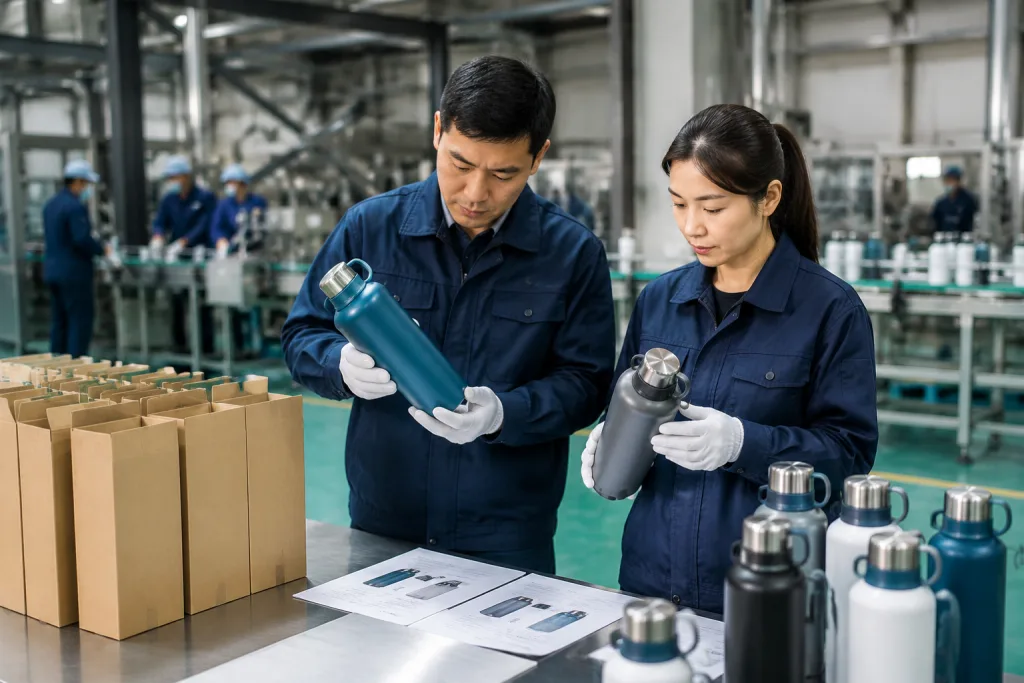
Wall thickness is where cheap thermos quotes start to bend. On a normal double-wall vacuum flask, 0.40-0.50 mm for the inner wall and 0.45-0.60 mm for the outer wall is the range we run. Once you drop below 0.35 mm, denting shows up fast and polishing gets patchy. Go past 0.60 mm and the bottle feels stout, but weight and material cost climb hard. A proper quote should spell out stainless grade, wall thickness, and whether the base gets reinforcement; QC pulled a sample last week at 0.38 mm and the buyer flagged it right away.
Ask how the factory forms the body: water expansion, stretch forming, or welded tube forming. Water expansion gives cleaner curves and steadier shape on rounded shoulders. Welded tube forming works for straight bodies and travel mugs, but seam control has to be tight; we’ve seen a 0.2 mm seam step ruin an otherwise good order. For retail-grade custom thermos work, the outside should come off the line without sanding marks, weld shadows, or powder coat build-up near the shoulder.
Food-contact compliance belongs in this section too. For Europe, ask for LFGB or EU 1935/2004 food-contact reports and REACH checks on the coating and silicone parts. For North America, ask for FDA food-contact material declarations and, where needed, ASTM physical safety testing. The report has to match the exact material, coating, and color in your PO; a test file for a black bottle does not cover metallic green paint. We had one order held because the buyer’s PO typo listed “green” while the sample approval was “teal,” and the paperwork had to be fixed before we could ship.
Vacuum Performance Is Not Magic
I’ll rewrite the section in place, keep the HTML intact, and tighten the sales-engineer tone with concrete factory details and fewer stock phrases.Every thermos vendor says “keeps hot 12 hours, cold 24 hours.” Those numbers mean nothing until the test method is pinned down. On our line, we fill the flask with water at about 95°C, close the lid, and check the reading at 6, 12, and 24 hours in a 20°C room. For a 500 ml stainless vacuum flask, a fair result is above 60°C after 6 hours and above 40°C after 12 hours. A 1,000 ml body usually holds better than a 350 ml one because the surface area is spread out.
The vacuum layer is formed after welding and before final assembly. If the evacuation step is weak, heat retention falls off even when the steel finish looks clean. We have seen buyers miss this and blame the cap; that is the wrong question to ask. For thermos bulk orders, ask for 100% vacuum screening by thermal detection or a hot-water pre-test before packing. It adds one more station at QC, but it catches the dead bottles before they hit the carton.
Lids matter as much as the body. A thin plastic stopper, a loose silicone gasket, or sloppy thread pitch can wreck an otherwise solid vacuum bottle. For outdoor retail, a screw cap with a deep silicone seal is safer than a push-button lid if the bottle will live in backpacks and cargo boxes. Push-button lids are fine for desk promos, but they bring more parts, more assembly drift, and more leak risk. We had a buyer flag a 0.5 mm thread mismatch on a PO once; the cap felt fine in hand, then leaked after a shake test. For mountain or jobsite use, keep the lid simple.
When comparing thermos manufacturers, ask for test data by SKU, not a generic claim. A 350 ml coffee flask and a 1,000 ml hiking flask will not show the same heat-retention curve, and the math does not work that way. We normally attach a pre-shipment temperature record for custom thermos projects above 2,000 pcs, especially when the buyer is launching a new retail listing. QC pulled the sample, wrote the time and temperature on the tag, and that record saves a lot of back-and-forth later.
Coating, Color, And Logo Limits
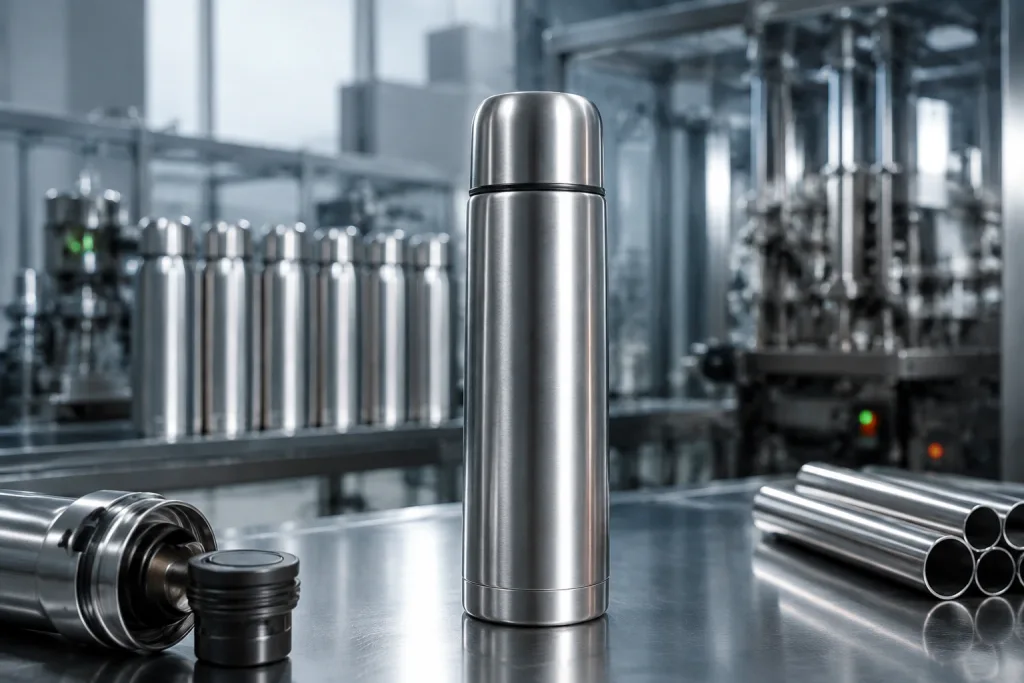
I’ll rewrite the section in place, keep the HTML intact, and tighten the copy so it reads like a factory-side sales engineer wrote it.Customization is where most online wholesale jobs go off track. A custom thermos is not infinitely flexible at the same MOQ and price. Standard powder coat colors move fastest: black, white, navy, army green, and stainless silver usually work at around 500 pcs per color. Pantone-matched powder coating is more realistic at 1,000-3,000 pcs per color because the line needs a washdown, trial panels, and scrap allowance.
Logo method depends on how the buyer will use the bottle. Laser engraving holds up well on powder coat or bare stainless steel, but the final mark color changes with the coating and substrate. Silk screen printing gives a stronger brand color for promotional thermos runs, though it can scratch if surface prep is weak. Heat transfer handles gradients and larger artwork, but the cost climbs and placement tolerance is usually ±1.5-2.0 mm. For retail, a small laser mark with a second print often sells better than one oversized logo. We’ve seen that choice save a lot of rework.
For a thermos custom project, ask the factory for an artwork proof with the actual printable area in millimeters. A 500 ml straight body may take a 65 x 90 mm front logo, while a tapered body usually needs smaller art to avoid distortion. Wrap prints need a different setup, and QC pulled the sample before approval because the buyer flagged a 4 mm seam shift. Do not sign off from a flat PDF only.
Surface durability should be written as a test, not a promise. Common checks include 3M tape adhesion test, 100-grid crosshatch where suitable, alcohol rub test, and dishwasher simulation if you plan to claim dishwasher safety. Many powder-coated stainless thermos products are hand-wash recommended. If your retail packaging says dishwasher safe, you need test evidence for the exact coating and logo method.
Lid, Gasket, And Leak Testing
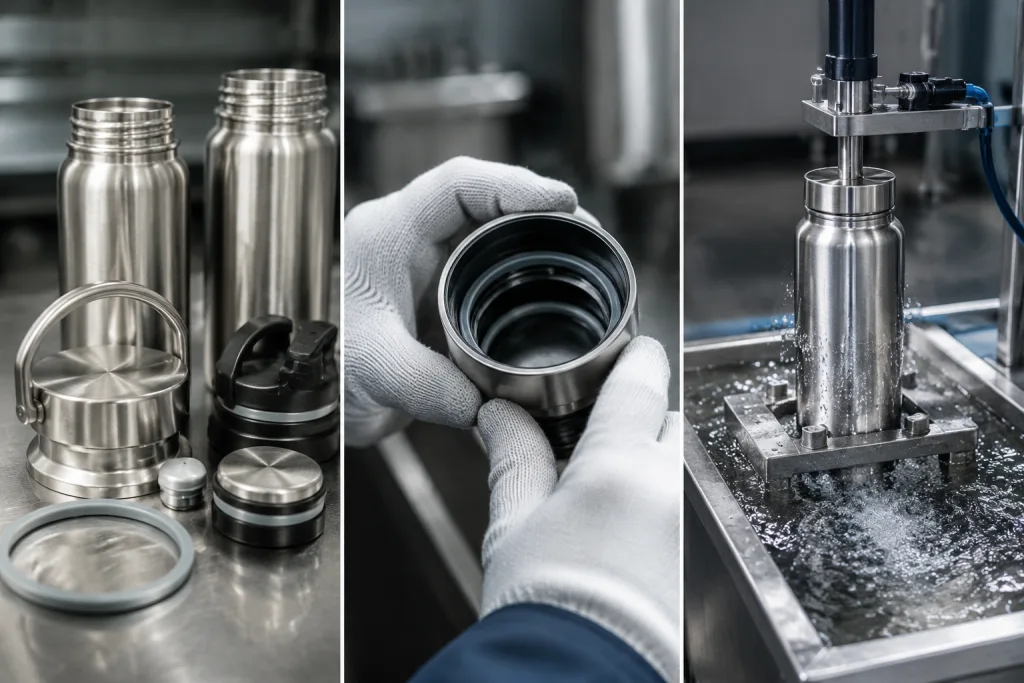
I’ll rewrite the section in the factory voice, keep the HTML intact, and make sure the wording feels like a real export-sales note, not generic copy.A stainless body may run five years, but a gasket can fail in three months if the compound, fit, or compression is off. For outdoor thermos orders, we specify food-grade silicone gaskets and, for retail packs, a spare gasket in the box. The lid material is usually PP, Tritan, or stainless-covered PP. PP keeps cost down and handles heat well. Tritan makes sense when the lid needs a clear window, but we do not push it on every model. On the line, QC pulled one batch where the gasket groove was 0.3 mm too shallow; that small miss turned into a leak complaint in testing.
Thread engagement should feel boringly secure. On a 500-750 ml screw-lid thermos, we like at least 2.5-3 turns to close. Short threads look fast on paper, but the math does not work when buyers start flagging cross-threading, especially with gloves on in winter. Handle lids need their own check. A foldable carry loop should hold at least 10 kg static pull for 60 seconds, and a fixed handle on a 1,000 ml flask should be tested higher. We ran a sample once where the buyer flagged a 12 mm handle gap as “loose” even though the lid passed basic closure.
Leak testing belongs in production and final inspection. A practical factory thermos protocol means 100% water fill and inversion check on the assembly line, then AQL sampling at final inspection. For export orders, we add a 24-hour inverted sample test and a 1.2 m drop test on filled units in retail packaging. The drop test is not because customers should abuse the bottle. It is because cartons, couriers, and warehouse staff will. One PO typo changed the test note from “inverted” to “inserted,” and the buyer caught it before shipment—small mistake, big headache.
If your channel includes e-commerce, lid failures get expensive fast. One leaking distributor thermos shipment can trigger dozens of negative reviews before you trace the gasket lot. Ask your thermos supplier to hold spare lids and gaskets from the same production batch. For orders above 5,000 pcs, keeping 1-2% spare parts is cheap insurance. We ship this way because we have seen it go sideways when a later batch uses a slightly different mold finish.
MOQ, Price, And Lead Time
I’ll rewrite the section in-place, keep the HTML structure untouched, and make the copy sound like a real factory-side sales engineer.Online wholesale pricing can be slippery because stainless thermos cost moves with steel grade, coating, lid structure, logo method, packaging, and inspection level. On the line, a 500 ml double-wall stainless thermos with 304 inner liner, standard powder coating, one-position laser logo, and white box packaging often lands around USD 3.20-4.80 FOB Ningbo or Shanghai at 1,000-3,000 pcs. A 750 ml outdoor model with carry handle and retail color box may sit at USD 4.60-7.20 FOB. These are sanity-check numbers, not promises.
MOQ should be read by component. The bottle body may open at 500 pcs, but custom color coating may need 1,000 pcs, and a molded custom lid may need 8,000-10,000 pcs plus tooling. We had a buyer flag a PO typo once—500 pcs for the body, 5,000 pcs for the lid—and the math did not work. A full customized thermos with private shape is a different job from putting your logo on an existing thermos body. Existing mold plus custom logo is the right starting point for most outdoor retailers and promotional brands.
Normal lead time from Zhejiang, China is 7-10 days for digital proof and pre-production sample after artwork confirmation, then 30-45 days for mass production after deposit and sample approval. QC pulled the sample with a caliper at 0.5 mm tolerance on the thread fit, and that check saves headaches later. Peak season from August to November can add 7-15 days, especially for powder coating and gift-box printing. If your buyer needs a Christmas or Q1 outdoor campaign, do not approve samples at the last minute and expect miracles.
Payment terms are usually 30% deposit and 70% balance before shipment for first orders. Larger distributor thermos programs with credit history may negotiate better terms, but factories protect cash flow because steel, caps, cartons, and coating are paid upfront. We ship on this basis because the spray booth, carton line, and carton labels all get booked before the truck moves. If a thermos vendor offers a low deposit and a low unit price, check whether quality control, packaging, or compliance testing has been left out.
Inspection And Export Documents
I’ll rewrite the section in-place, keep the HTML intact, and tighten the copy so it sounds like a factory-side sales engineer wrote it.A purchase order for thermos flask online wholesale needs the inspection terms in writing. We usually set AQL 2.5 for major defects and AQL 4.0 for minor defects, and the line treats leakage, sharp edges, wrong material, wrong logo, or contamination as zero tolerance. Put the cosmetic callouts on paper too: no visible dent over 0.5 mm on the front logo area, no coating scratch longer than 3 mm, and no color shift beyond the approved sample under D65 light. If the buyer flags a “close enough” sample, we push back. That math does not work.
For outdoor retail, carton strength is where trouble starts. A common export carton uses 5-ply corrugated board, with 24 pcs or 30 pcs per master carton depending on capacity, and we try to keep gross weight under 16-18 kg so warehouse guys can move it without drama. Ask for a carton drop test and confirm pallet loading if you ship LCL or FCL; one crushed corner can kill a full PO. Wet cartons and smashed gift boxes are not product defects, but your customer will not split packaging failure from product quality.
Documentation changes by market and channel. For Europe, ask for the commercial invoice, packing list, bill of lading, certificate of origin if needed, food-contact reports, REACH-related declarations, and BSCI or social audit documents when the retailer asks for them. For North America, you may need FDA material statements, Prop 65 review for California sales, and ASTM-related test support for certain use claims. If you sell through online marketplaces, send FNSKU labeling, suffocation warnings for polybags, carton labels, and carton weight data before production packing starts. QC pulled the sample, and half the problems were just label typos.
The good thermos suppliers make inspection boring. They ship production photos, random sample videos, carton markings, and test records before balance payment. The weak ones send a polished catalog and ask you to trust the rest. We’ve seen that go sideways on a 5,000-piece order with one wrong PO code. For a thermos distributor or promotional brand, written specs and inspection records are cheaper than returns.
Send Your Thermos Spec Sheet For Factory Review
Share capacity, logo, color, MOQ, and target price. We will check the spec and quote practical FOB options from Zhejiang.
Frequently asked questions
What MOQ should I expect for a custom stainless thermos?
For an existing mold with your logo, 500 pcs is often workable for standard colors, though 1,000 pcs gives better pricing and smoother production scheduling. Pantone-matched coating usually starts around 1,000-3,000 pcs per color because coating lines need setup and waste allowance. A private lid or private body shape can require 8,000-10,000 pcs plus tooling. If you are testing a new outdoor retail SKU, start with a thermos custom order using an existing 500 ml or 750 ml body, one logo method, and retail packaging. That keeps risk controlled while still looking like a real brand product.
How do I compare thermos flask online wholesale prices fairly?
Compare the same stainless grade, capacity, wall thickness, coating, lid, logo method, packaging, inspection level, and FOB port. A 500 ml bottle at USD 3.30 FOB with 201 outer shell, thin coating, and white box is not the same as a USD 4.50 FOB bottle with 304 outer shell, powder coating, laser logo, and color box. Ask each thermos manufacturer to quote by line item: bottle, decoration, packaging, test reports, spare parts, and inland freight if any. If a quote is 15-25% lower than all others, something has usually been removed.
Can a promotional thermos be dishwasher safe?
Sometimes, but do not claim it without testing. Bare stainless steel handles dishwashing better than powder-coated or printed surfaces. Powder coat can survive many cycles if the coating and curing are good, but logos may fade, lift, or scratch. For a promotional thermos, hand-wash recommended is the safer default unless you run dishwasher simulation on the exact coating, print, and lid. If dishwasher safety is important, ask for at least 20-50 test cycles and check logo adhesion, lid deformation, gasket fit, and coating gloss change before approving packaging copy.
Which lid is best for outdoor retail thermos bulk orders?
For outdoor use, a simple screw lid with a deep silicone gasket is usually best. It leaks less, cleans more easily, and tolerates backpacks better than push-button mechanisms. For 500-750 ml bottles, target 2.5-3 turns to close and specify food-grade silicone. For 1,000 ml models, test the carry handle with at least 10 kg static pull for 60 seconds. Push-button lids are fine for office gifts and desk use, but they add more parts and more inspection points. If your return policy is strict, choose simple over clever.
How long does production take from a China thermos factory?
For standard stainless thermos wholesale using an existing mold, expect 7-10 days for artwork proof and pre-production sample, then 30-45 days for mass production after approval and deposit. Add 7-15 days during peak season or if you require Pantone coating, custom gift boxes, or third-party testing. Ocean freight to Europe or North America is additional and can range from about 25-45 days depending on route and port congestion. For a new customized thermos mold, add tooling and trial time, often 25-40 days before mass production even starts.