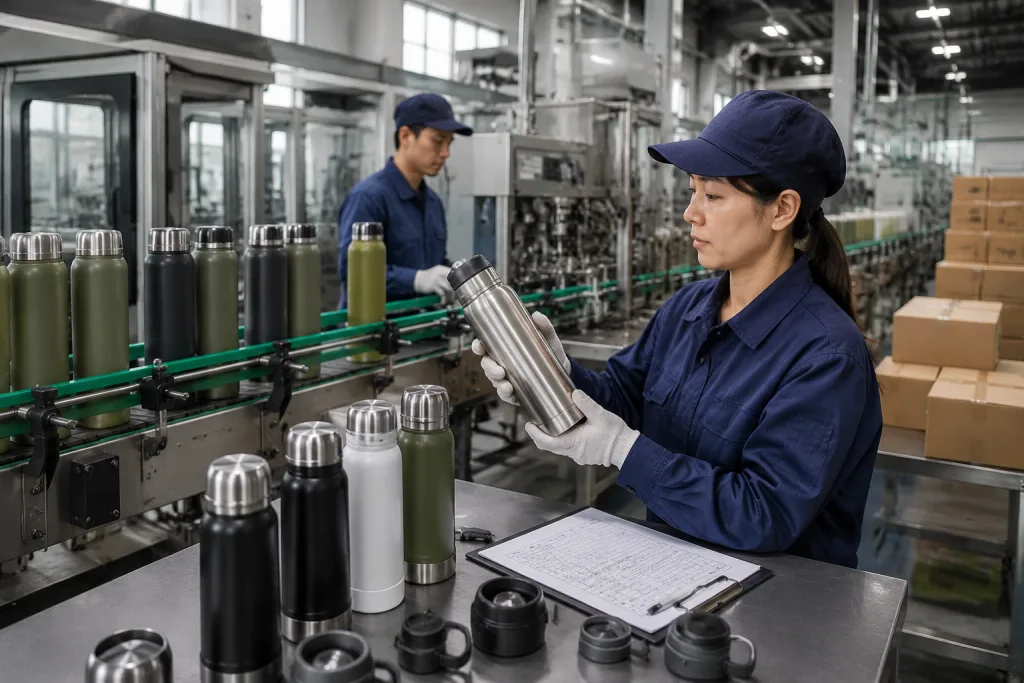
Key Takeaways
- Plan 1,000 units per color as a realistic OEM MOQ for most stainless thermos flask projects
- Use 304 stainless steel inside and confirm LFGB, REACH, or FDA testing before deposit
- Allow 7-10 days for logo samples and 30-40 days for mass production after approval
- Write your leak test, vacuum test, AQL level, carton mark, and spare parts rules into the PI
You are not buying “a bottle with insulation.” That is the wrong question to ask. You are buying a retail promise: coffee still hot at a 6:30 a.m. trailhead, zero leakage after a 24-hour upside-down test, and a logo that still reads clean after 200 dishwasher cycles. Last month QC pulled 32 random lids from the line and found one silicone gasket sitting 0.8 mm proud; if that reaches a backpack, the buyer flags your brand, not the thermos flask OEM manufacturer in China.
BottleForge Industrial is based in Hangzhou, Zhejiang, and we run stainless thermos programs for outdoor retailers, promotional brands, and distributors. Our standard MOQ starts at 1,000 units per color for most 500 ml and 750 ml models, with typical mass production lead time of 30-40 days after approved sample. We ship from Ningbo or Shanghai, and yes, buyers still push back when a PO says “matte black” but the artwork file says Pantone 426C.
Start with the real use case
The first question we ask is not “what size do you want?” It is “where will this thermos be used?” This is the wrong question to skip. A retail hiking thermos, a promotional thermos for an insurance campaign, or a distributor thermos for wholesale catalogs will need different lid tooling, coating thickness, and carton drop-test planning. On our line, QC checks the lid thread with a go/no-go gauge before we even talk about color.
For outdoor retail, buyers care about one-hand opening and glove-friendly lids because bad lid feedback shows up in reviews within 30 days. Powder coating grip matters too. A 750 ml factory thermos with 0.5 mm outer wall and 0.4 mm inner wall in 304 stainless steel is a common starting point, and we run heat retention checks with 95°C water before packing approval. For promotional brands, the buyer usually pushes on logo area, unit price, gift box look, and delivery date. A 500 ml customized thermos with laser engraving and a plain white box can ship in 12 days vs 18 days for a retail-ready set with custom inserts.
If you are sourcing thermos bulk for distributors, do not over-customize the first order. Pick 2-3 proven shapes, 3 colors, and one logo method the factory can repeat without slowing the line. We have seen buyers lose 3 weeks choosing a special cap texture, then accept air freight because the event date did not move. The math does not work. Last March, one PO even had “mat black” typed instead of “matte black,” and QC pulled the sample before mass packing because the carton label followed the typo.
A practical brief to a thermos supplier should include capacity, target FOB price, market, compliance requirement, lid style, coating, logo process, packaging, and expected annual volume. If you only send a photo and ask “best price,” any thermos manufacturer can quote low by removing the silicone seal grade, carton spec, or 1.2 m drop-test requirement you actually need. We ship cleaner orders when the brief states MOQ, barcode position, and whether FDA or LFGB is required.
What OEM really changes
OEM does not always mean cutting a new mold. We usually sort custom thermos projects into 3 quoting levels: stock shape with logo and retail box, stock body with changed lid color, silicone ring color, coating, and accessories, or private mold with its own body profile and cap tooling. On the line, the difference shows up fast; a lid color change is a Pantone card and incoming plastic check, while a new cap means 2D drawings, T1 samples, and caliper checks on the thread at 0.10 mm tolerance.
For a first order, we usually recommend the middle level. It feels like your brand, but you are not paying USD 8,000-25,000 for tooling before the market proves demand. Simple math. On a 1,000-3,000 unit order, tooling can ruin your landed cost; on a 50,000 unit annual program, private mold starts to make sense because the cost spreads across 8 or 10 shipments. We have seen this go sideways when a buyer approved a private lid, then the first PO came in at 1,200 pcs with a note saying “same target price as stock.” The math does not work.
Logo choice changes the finished look more than buyers expect. Laser engraving is durable and clean, but it cuts back to the stainless base color, so full-color artwork will look flat. Silk screen printing is better for 1-2 colors on straight walls, and we run a 3M tape pull after curing because weak ink shows up before packing. Heat transfer handles complex graphics, but QC pulled the sample last month after 500 abrasion cycles because one edge lifted near the cup curve. UV printing gives strong color on promotional thermos orders, though curved powder-coated surfaces punish poor fixture alignment by 1-2 mm.
Ask your suppliers thermos contact to split the quotation into bottle, logo, packaging, testing, and inland freight. A price of USD 4.20 FOB Ningbo can look better than USD 4.55 until the cheaper quote excludes gift box, silica gel, spare gasket, or drop test packing. We ship from Zhejiang, China, and we see this comparison every week; 6 factories can show a similar-looking thermos customized order, but only 2 will itemize the real build before you push them. This is the wrong question to ask: “What is your best price?” Ask what is inside the carton, down to the 5-layer export box and gasket count.
Checklist before you pay deposit
A deposit is not a handshake. Tie it to a written spec sheet, signed PI, and the sample number on your shelf. Before you pay 30%, freeze the items that hit heat retention, unit cost, and AQL inspection. We have seen this go sideways over a PO typo: “matte black” entered as “mate black,” then the buyer flagged the cartons 18 days later.
- Material: confirm 304 stainless steel for the inner wall and food-contact lid parts. Specify 316 only if your sales channel can pay for the marine-grade story; otherwise the math often does not work.
- Wall thickness: record 0.4 mm inner wall and 0.5 mm outer wall if that is what the approved sample used. QC checks this with a digital micrometer after cutting one retained sample.
- Vacuum performance: define the heat retention test: 95°C water, 20°C room temperature, and readings after 6, 12, and 24 hours. Write the minimum pass temperature on the PI.
- Leak test: request 100% inverted leak test on the line, then random checks after packing. On our line, bottles sit upside down for 30 minutes before QC pulls the sample.
- Coating: specify powder coating, spray paint, or polished finish. Add the Pantone or RAL number, gloss level if needed, and acceptable color tolerance under the light box.
- Logo: approve logo size in millimeters, placement from bottle base, and artwork file version. Do not approve from a phone screenshot; we run laser and silk-screen files differently.
- Packaging: confirm polybag, box type, master carton strength, carton mark, barcode, and FNSKU if needed. For Amazon orders, one missing FNSKU can hold 200 cartons at the forwarder.
For inspection, AQL 2.5 for major defects and 4.0 for minor defects is common for distributor thermos shipments. Critical defects such as leakage, wrong material, sharp edges, or contaminated interior should be zero tolerance. “Normal quality standard” is the wrong phrase to accept. Normal in one workshop may allow 1 mm coating dust; normal in another means QC rejects it before packing.
A clear PI is cheaper than a dispute after 12 pallets arrive at your warehouse.

Price questions buyers should ask
I’ll rewrite the section in place, keeping the HTML tags and the quoted numbers/certifications intact, while making it sound like a factory-side sales engineer wrote it.Most outdoor retailers and promotional brands ask for the lowest unit price too early. That is the wrong question. Price only makes sense when you compare the same build. A 500 ml stainless thermos custom order may run from about USD 3.20 to USD 6.80 FOB China, depending on lid complexity, coating, logo, packaging, and inspection requirements. A 750 ml model often sits around USD 4.20 to USD 8.50. Those are planning numbers, not a promise from the line.
Ask the thermos vendor what sits inside the quote. Is it FOB Ningbo or FOB Shanghai? Does it include 1-color silk screen logo, laser engraving, or blank bottle only? Is the carton 5-ply export grade or thin domestic carton? Are spare silicone gaskets included at 1%? Does the price include an LFGB or FDA food-contact report under your item name, or only an old factory report? We’ve seen buyers miss a PO typo on the packing spec and lose a week fixing it.
Quantity breaks are real, but they are not magic. Moving from 1,000 to 3,000 units may cut cost by 5-10% because setup waste gets spread out. Moving from 3,000 to 10,000 units can help more if the factory thermos line can buy steel, lids, and cartons in larger lots. At BottleForge Industrial in Zhejiang, our stainless thermos capacity is about 450,000 units/month across standard models, but August to October gets tight fast. QC pulled a sample yesterday at 1.2 mm wall thickness, and the schedule still mattered.
If a thermos manufacturers quote is 18% lower than the others, ask where the saving comes from. Sometimes it is efficient production. More often it is thinner steel, weaker coating, low-grade plastic, untested silicone, or packaging that will collapse in ocean freight. We have seen this go sideways on a 40HQ load. The math does not work.
Samples, testing, and compliance
I’ll rewrite this section in-place, keep the HTML exactly as-is, and tune the prose to sound like a factory-side sales engineer, not generic copy.A sample should answer questions, not create new ones. For a custom thermos order, we split samples into three buckets. A reference sample checks shape, lid action, and hand feel on the line. A pre-production sample locks in material, color, logo, and packaging. A sealed golden sample becomes the QC standard for mass production.
Sample timing is usually 3-5 days for stock blanks, 7-10 days for logo samples, and 15-25 days if you need custom color coating or new packaging mockups. If a thermos supplier says they can finish a fully customized thermos sample in 2 days, the math does not work. We’ve seen that turn into a photo sample, not a real unit, and the buyer flagged it right away.
For Europe, ask about LFGB, REACH, and food-contact declarations. For the United States, FDA food-contact compliance and, where applicable, California Proposition 65 review may matter. For kids or school programs, ASTM and CPSIA checks can apply, especially around coatings, small parts, and lead/cadmium limits. A 304 stainless body does not close the file by itself. Lids, straws, paint, silicone, and printed inks still need review, and we have had a PO typo on the ink spec trigger a second round of paperwork.
Thermal performance must be tested the same way every time. We run a written method: fill with 95°C water to rated capacity, close the lid after 1 minute, hold at 20°C ambient temperature, and measure at set intervals. A 500 ml vacuum bottle may stay above 60°C after 12 hours, but lid design and mouth diameter change the result. Wide-mouth bottles pour better and clean easier, but they usually lose heat faster than narrow-mouth designs, and that is the wrong trade-off if the buyer wants long hold time.
Production control for bulk orders
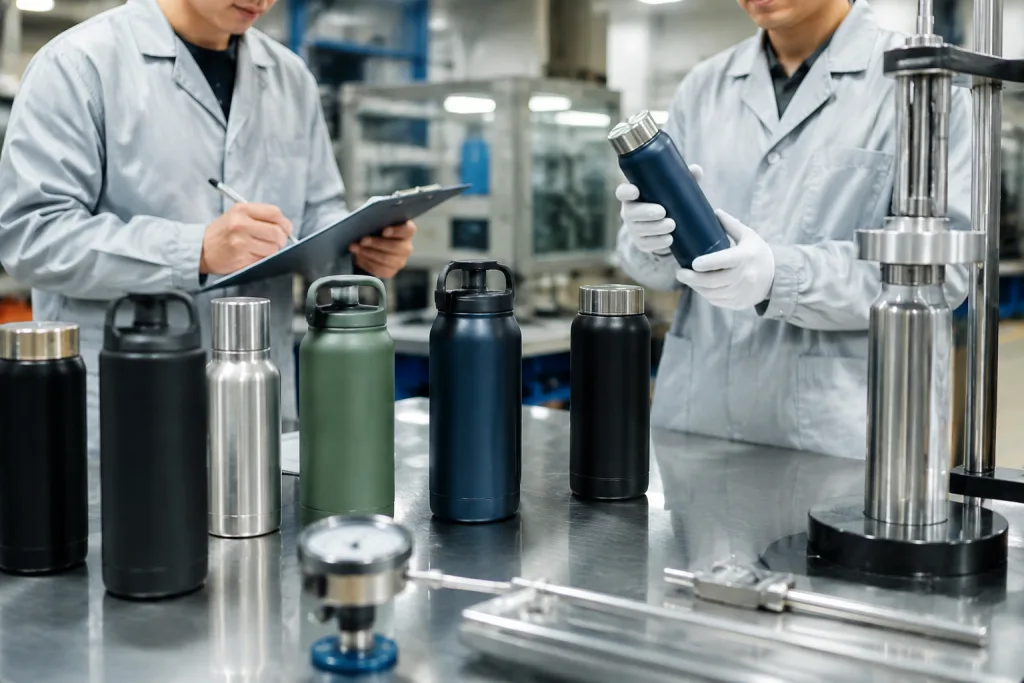
I’ll rewrite the HTML prose tightly and keep every tag and structure intact. Then I’ll do a quick pass to strip any AI-ish phrasing and add the factory-floor specifics the brief asks for.Mass production is where good samples fail. A thermos factory has to control incoming steel, deep drawing, welding, vacuuming, polishing, coating, logo, assembly, and packing. Every station has a weak point. A 0.2 mm weld gap can hurt vacuum retention. A rough polish line can make coating peel. A silicone ring off by 1 mm can cause leakage. A weak carton shows up as crushed corners in warehouse checks.
For bulk thermos programs, ask for a live production schedule with dates for material arrival, body forming, vacuum test, coating, logo, assembly, packing, and final inspection. We run this on the line with one shared sheet, not vague promises. A real manufacturer should send that before production starts. If they only say “don’t worry,” that is the wrong question to ask. You need dates, not comfort.
We recommend an inline inspection when the first 10-20% is packed, especially for new thermos suppliers or first-time artwork. QC pulled the sample on one 8,000-piece order and caught a logo shift of 3 mm at 420 units; that saved a lot of rework. Catching the same issue at 12,000 units is a mess. Final random inspection should cover function, appearance, barcode scanning, carton drop, quantity, carton mark, odor check, and vacuum performance sampling.
For outdoor retailers, coating durability needs hard checking. Powder coating should pass cross-hatch adhesion tape testing and abrasion checks. For promotional brands, logo registration and color matching usually trigger more complaints than insulation. We’ve seen this go sideways when a buyer flagged a PO typo on the carton mark and three countries received the wrong master file. Keep one artwork file, one carton mark rule, and one approval trail. Small differences slow receiving.
China can produce high-quality stainless drinkware, but quality does not happen by default. It comes from locked specifications, process control, and inspection authority written before the order starts.
A buyer-ready RFQ format
I’ll rewrite the prose only, keep the HTML tags intact, and make it sound like a real export-sales RFQ note.If you want fast, usable quotes from thermos manufacturers, send a structured RFQ. It cuts 3-5 email rounds and stops the supplier from guessing. Keep it tight. Make it specific.
Use this format: product type, capacity, drawing or reference photo, target market, annual forecast, first order quantity, stainless grade, lid style, coating color, logo method, packaging, compliance, delivery term, destination port, inspection requirement, and target launch date. If you need Amazon or marketplace fulfillment, add FNSKU label position, carton weight limit, and master carton dimensions. If you sell to retail stores, add hanger tag, color box artwork, inner carton rules, and pallet preference. We run these details through the line before we price, because a 2 mm carton error or a missing label note can wreck the quote.
For example: “750 ml stainless vacuum flask, 304 inner and outer, powder coated matte black, laser logo 35 mm wide, retail color box, LFGB and REACH, 3,000 units first order, FOB Ningbo, AQL 2.5/4.0, delivery needed by 15 May.” That is the kind of RFQ a thermos manufacturer can price without playing telephone with the buyer. QC pulled the sample, checked the logo width, and the numbers lined up.
Also say what you do not need. If you do not need private mold, say so. If existing lid tooling works, say so. If your budget is USD 5.00 FOB and not USD 7.00, say so. The math does not work if the factory has to guess. A good thermos supplier will adjust material, finish, packaging, or carton quantity to hit the target. We’ve seen this go sideways when a buyer hides the budget and the PO shows a typo on the finish code later.
BottleForge Industrial works from Hangzhou, Zhejiang with export routes through Ningbo and Shanghai. Send a complete RFQ, and we can usually return a serious OEM stainless thermos quotation within 24-48 hours on working days.
Send your thermos RFQ for a factory quote
Share capacity, quantity, logo, packaging, and compliance needs. We will reply with practical options, MOQ, lead time, and FOB China pricing.
Frequently asked questions
What MOQ should I expect from a thermos flask OEM manufacturer?
For most stainless thermos models, a realistic MOQ is 1,000 units per color when using existing molds. If you need a custom thermos color, custom box, and logo, 1,000-3,000 units is the practical range. Private mold projects usually need 10,000-30,000 units annual volume to make tooling worthwhile. Some factories may accept 300-500 units, but the unit price can increase 15-35%, and color consistency or packaging options may be limited. For distributors thermos programs, we suggest starting with fewer SKUs and deeper quantity per SKU.
How long does a customized thermos order take from China?
A normal timeline is 7-10 days for logo sample, 3-5 days for sample approval and deposit paperwork, then 30-40 days for mass production. Add 25-35 days for ocean freight to many European ports and 18-30 days to the US West Coast depending on routing. New coating colors, private mold lids, or retail packaging can add 10-20 days. Peak season in China, especially August to October, can stretch lead times if you do not book production capacity early.
Which logo method is best for a promotional thermos?
For promotional thermos orders, laser engraving is the safest choice when durability matters and the design is simple. It does not peel, and it works well on powder-coated stainless bottles. Silk screen printing is cheaper for 1-color or 2-color logos on straight surfaces, usually with lower setup cost. UV printing is better for full-color artwork but needs testing on curved or textured surfaces. For 1,000 units, logo cost may range from USD 0.08 to USD 0.45 per unit depending on method, size, and color count.
Can one thermos supplier handle both retail and bulk thermos programs?
Yes, but check whether they understand both channels. Retail thermos needs stronger packaging, barcode control, color box consistency, and often LFGB, REACH, or FDA documentation. Bulk thermos for corporate campaigns may prioritize deadline, logo accuracy, and lower carton cost. A good thermos supplier should quote both versions separately instead of forcing one specification. For example, the same 500 ml bottle might be USD 4.10 FOB with plain box for promotion and USD 4.75 FOB with retail color box, insert, barcode, and carton drop-test packaging.
What defects should I treat as critical in final inspection?
Treat leakage, failed vacuum insulation, sharp edges, wrong material, wrong logo, strong odor, contaminated interior, and unsafe lid function as critical defects. These should not be accepted under normal AQL limits. Major defects can include dents, serious scratches, poor coating adhesion, incorrect carton marks, barcode failure, or loose lids. Minor defects may include tiny cosmetic marks within an agreed limit. For most manufacturer thermos shipments, AQL 2.5 major and 4.0 minor is workable, but critical defects should be zero tolerance in your inspection instruction.