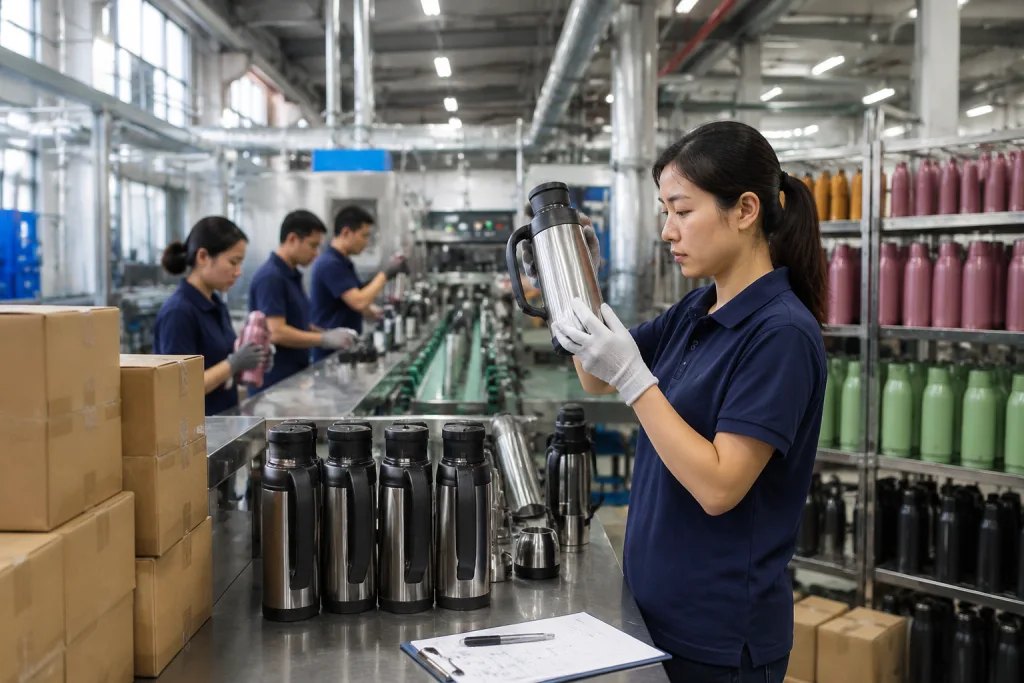
Key Takeaways
- A useful RFQ needs 12 line items, including capacity, steel grade, decoration, packaging, MOQ, Incoterm, and target delivery date
- For custom thermos orders, realistic MOQ is usually 1,000-3,000 pcs per color for powder coating
- Sample development normally takes 7-12 days for existing molds and 25-35 days for new tooling
- Use AQL 2.5 major / 4.0 minor inspection and define vacuum performance before mass production
You are not buying a bottle with a logo. You are buying heat retention curves, retail color boxes, customs paperwork, 5-layer export cartons, and the risk of a launch date slipping by 3 weeks. A good thermos flask manufacturer puts those items on the table before you issue a PO, not after the deposit lands; last month QC pulled a 500ml sample after the lid gauge showed a 0.3mm mismatch on the silicone seal.
From our factory base in Hangzhou, Zhejiang, we see outdoor retailers and promotional brands repeat the same sourcing mistake: they ask for “your best price” before fixing capacity, 304 stainless grade, lid structure, powder coating, test standard, and shipping pack. Wrong question. In China, a loose RFQ gets a loose quote, and we have seen a buyer flag a PO typo where “750ml” became “500ml” after artwork approval. Start with the RFQ details, lock the sample, then move to bulk thermos shipment with carton specs, AQL 2.5 inspection points, and the shipping mark confirmed.
Start with a buyer-grade RFQ
A serious RFQ is not a paragraph. It is a buying document. If you want a thermos supplier to price accurately, give the factory enough detail to fix the steel grade, welding time, coating method, carton CBM, and inspection workload before sales sends it to costing. We once received an RFQ that said “500 ml bottle, black, logo”; QC pulled the nearest 500 ml sample with a 72 mm body diameter, while the buyer expected a tapered car-cup shape. The quote looked cheap. The math was wrong.
For a 500 ml stainless vacuum flask, put these PO-style line items in the first email, not after 6 rounds of pricing:
- Product type: double-wall vacuum stainless thermos; say straight body for shelf display or tapered body for car cup holders.
- Capacity: 350 ml, 500 ml, 750 ml, or 1,000 ml; add tolerance if your market checks fill volume by ml.
- Steel: 304 stainless inner wall, 201 or 304 outer wall, 0.40-0.50 mm typical body thickness; tell us if your buyer rejects 201 outer shells.
- Lid: screw cap, push-button cap, cup lid, handle lid, or food-jar lid; each one uses a different mold set and leak test fixture.
- Surface: powder coating, spray paint, electroplating, brushed steel, or matte polish; powder coating usually needs a color chip, not a phone photo.
- Decoration: laser engraving, silk screen, heat transfer, UV print, or full-wrap decal; send logo artwork in AI or PDF, with Pantone code if color matters.
- Packaging: white box, kraft box, color box, gift tube, or retail sleeve; include carton drop-test requirement if your warehouse checks ISTA-style damage.
- Compliance: LFGB, REACH, FDA food contact, CA Prop 65, or ASTM where applicable; name the market, because test items change by country.
- Quantity: total units and units per color; do not hide the real annual volume, because 3,000 pcs and 30,000 pcs do not run the same way on the line.
- Incoterm: FOB Ningbo, FOB Shanghai, EXW Zhejiang, or DDP if requested; we ship different carton marks for each routing.
- Delivery date: required ship date, not only event date; a June 20 event date is useless if the vessel must leave Ningbo on May 12.
- Inspection: AQL level, third-party inspection, and who pays if rework is needed; write this before production, not after the inspector finds 2.5 mm logo drift.
At BottleForge Industrial in Zhejiang, our monthly stainless thermos capacity is about 450,000 units across standard bottle and food jar lines, but capacity means little if the coating line or logo room is booked. We run powder coating through fixed color-change windows; switching from matte black to cream can cost 4-6 hours if the booth needs cleaning. Send the RFQ 60-90 days before your retail launch if you need customized thermos packaging and mixed colors. We have seen this go sideways when the PO says “assorted colors” but the carton mark file lists only blue.
Price the product, not a guess
Do not read a thermos quote by the unit price alone. A USD 3.20 offer and a USD 3.85 offer can be two different bottles on the line. The cheaper one might be 201 outer steel, 0.18 mm lighter body stock, thin paint, a basic PP lid, no 1.2 m drop test, and a soft K=K export carton. The better quote might cover 304/304 steel, 24-hour vacuum testing, color box packing, and 5-layer cartons that survive pallet stacking at 14 kg per carton. We have had buyers flag a USD 0.28 gap, then accept it after QC pulled the sample and showed the lid seal and coating thickness. For outdoor retail or a premium promotional thermos, the math doesn’t work if the bottle comes back with dents or peeling paint.
For standard existing molds, FOB China reference pricing usually sits in workable bands. A 350 ml stainless vacuum thermos may sit around USD 2.60-3.40 at 3,000 pcs. A 500 ml custom thermos with powder coating and one-position laser logo may be USD 3.20-4.60. A 750 ml or 1,000 ml outdoor bottle with handle lid, carry strap, and retail box can move into USD 5.20-8.50 depending on lid tooling and coating. Treat these as a quick smell test, not a promise. Last month we saw a 500 ml bottle quoted at USD 2.95 with “304 stainless” on the PI, but the PO typo said “204”; that is where orders go sideways.
Your quote sheet should split the base bottle, lid upgrade, coating surcharge, logo charge, packaging charge, sample fee, mold fee, and inland freight if the Incoterm is not FOB. Ask the supplier thermos team to write carton dimensions and gross weight, not “standard carton.” We ship 500 ml bottles in 24 pcs cartons often around 45 x 31 x 26 cm, and one carton size change can push volume weight above actual weight. Freight cost can wipe out a cheap unit price, especially for thermos bulk orders where volume weight controls the shipment. This is the wrong question to ask: “What is your best price?” Ask what is included.
Cheap quotes usually remove something you still need: steel grade, paint durability, vacuum test time, carton strength, or after-sales responsibility. QC pulled the sample for a buyer in Chile and found the carton burst at the corner after one 80 cm drop.
If you are sourcing a distributor thermos range for repeated seasonal orders, ask for price breaks at 1,000, 3,000, 5,000, and 10,000 pcs. It gives your sales team real numbers for margin planning, and it lets our factory thermos planner block the line before the powder coating booth is full. We run capacity in batches, not wishes. A 10,000 pcs reorder booked 12 days earlier can hold a better ship date than a rushed 3,000 pcs order dropped in after artwork approval.
Confirm the sample before tooling
Sampling is where the job stops being a rendering and becomes a bottle on the bench. Do not treat the pre-production sample as a photo for your boss’s WhatsApp approval. It is the master for steel finish, lid fit, sip feel, logo position, packaging, barcode position, and hand feel. QC pulled one 500 ml sample last month where the logo sat 3 mm too high against the artwork, and the buyer flagged it before we even ran the leak tank. For outdoor retailers, lid bite and grip matter almost as much as insulation. For promotional brands, logo edges and color match usually decide whether the shipment gets accepted.
For existing molds, a plain stock sample can usually ship in 2-4 days from China. A decorated custom thermos sample normally takes 7-12 days after artwork confirmation. If you need a new lid, new body shape, silicone grip, or special cup cap, tooling can add 25-35 days before a working sample is ready. Mold costs swing a lot, but a new stainless body mold may start around USD 1,200-2,500, while a more complex plastic lid set can run USD 2,000-6,000 depending on cavities and structure. We run EDM and CNC checks before trial assembly, and a 0.2 mm mismatch on the lid thread is enough to make the line stop.
Your sample approval sheet should include line items that later move into the PO. This is where we see orders go sideways: the buyer approves a sample, then the PO says “same as sample” but the artwork file says 42 mm logo and the email says 45 mm. The math does not work.
- Item code and mold number, including the factory mold ID used on the sample tag.
- Approved capacity and fill volume tolerance, such as 500 ml with the checked fill line in mm.
- Approved Pantone or RAL color with finish type, checked under a D65 light box if color matters.
- Logo size in mm, placement from top or bottom edge, and process method.
- Packaging dieline version, barcode, FNSKU if needed, and carton mark.
- Leak test requirement, such as no leakage after 30 minutes inverted.
- Vacuum requirement, such as hot water at 95°C retaining above 60°C after 12 hours for a 500 ml flask.
Do not approve samples only by photos unless the order is low risk. Powder coating can shift between warehouse light and office light. Laser engraving can be too shallow; our QC gauge caught one logo at about 0.03 mm depth when the buyer expected a darker mark. A push-button cap can feel loose even if it looks fine in a video. Pay the courier charge and inspect the real sample.
Build the PO like a control sheet
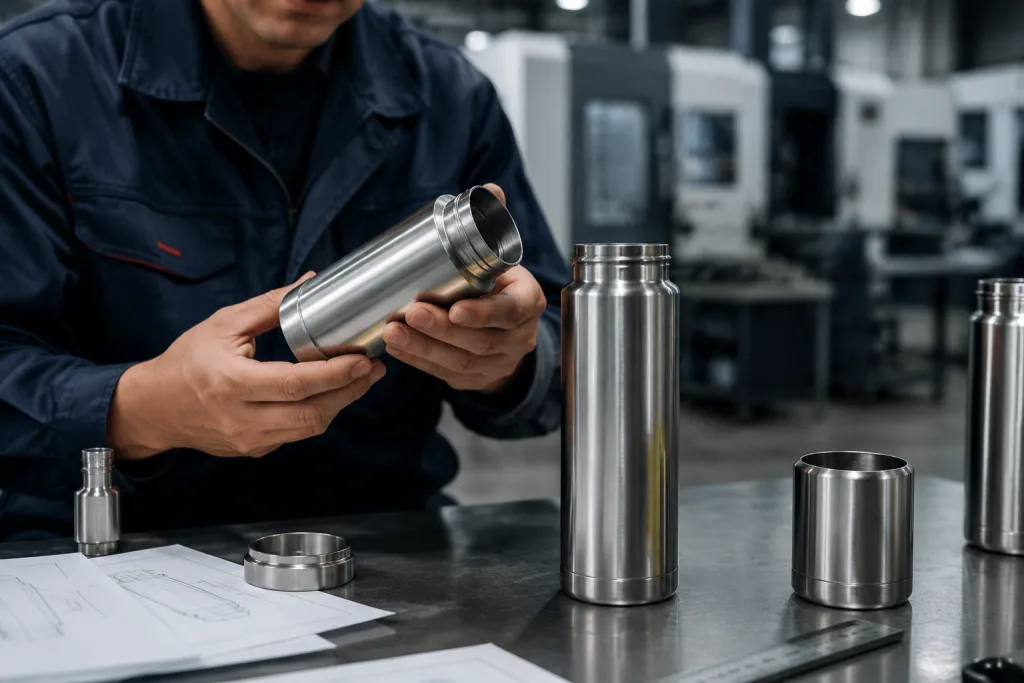
I’ll rewrite the prose only, keep the HTML tags and structure intact, and make it read like a factory-side sales engineer wrote it.A purchase order for custom thermos production should never be a one-line note saying “5,000 pcs stainless bottle with logo.” That is how the fight starts. The PO is your control sheet. We use it to lock the approved sample, the commercial terms, and the measurable specs so the line can run without guesswork.
Write the PO line item like a production card. For example: “500 ml double-wall vacuum stainless thermos, 304 inner / 201 outer, matte black powder coating, wall thickness 0.45 mm inner and 0.50 mm outer before forming, screw lid with stainless cup, laser logo 45 x 18 mm one side, individual kraft box, 24 pcs per 5-layer export carton.” QC pulled the sample on our bench with a caliper before release, and that level of detail kills most disputes before they reach the packing table.
Commercial terms belong in the PO too. Standard payment is 30% deposit and 70% balance before shipment or against copy of bill of lading for approved accounts. Normal lead time after deposit and artwork approval is 30-45 days for 3,000-10,000 pcs using existing molds. For 20,000 pcs with multiple colors and retail packaging, 45-60 days is the honest number. If your campaign date is fixed, put the required FOB date in the PO; a loose “deliver to warehouse” note is the wrong question to ask.
For a customizable thermos program, MOQ depends on process. Laser logo on stock color can start around 500-1,000 pcs. Powder coating in a custom color is usually 1,000-3,000 pcs per color because the coating line loses time on cleaning and powder changeover. Full custom packaging often needs 1,000 pcs minimum, while offset color boxes make more sense at 3,000 pcs and above. We’ve seen buyers push for a 600 pcs custom Pantone run, and the math doesn’t work on the line.
If you are a thermos distributor handling many SKUs, add a packing schedule to the PO: SKU, color, barcode, inner box, master carton, pallet requirement, and destination. Mixed cartons save space on paper, but they turn into receiving headaches when the carton mark is missing or the PO typo puts the wrong barcode on the label.
Lock quality before mass production
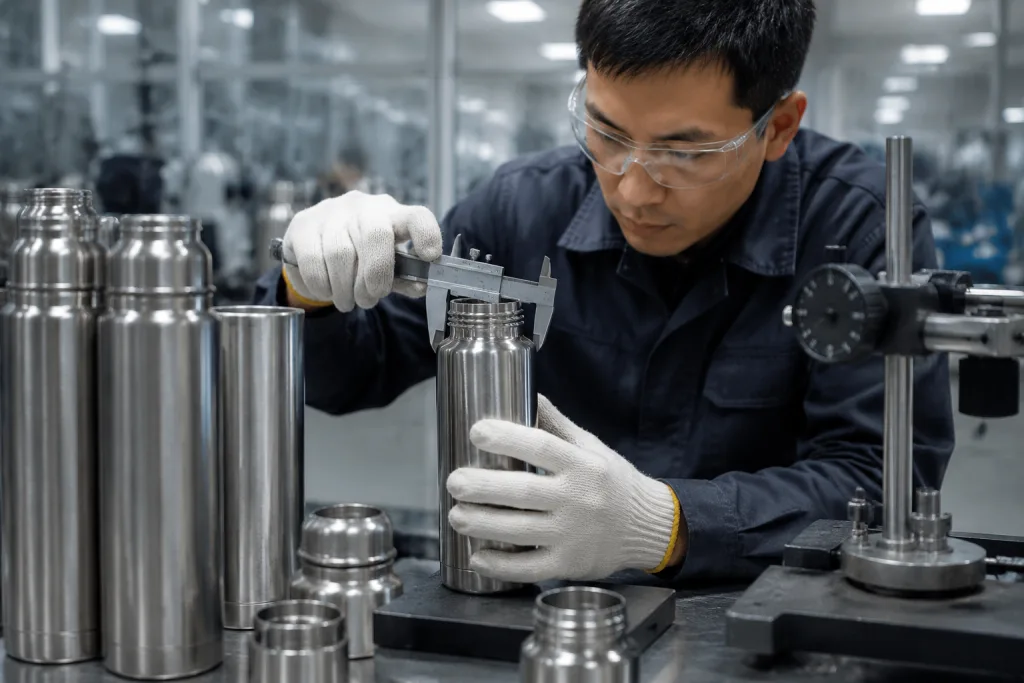
I’ll rewrite the section in-place, keep the HTML tags untouched, and tighten the sales-engineer tone with more concrete factory details.Quality control starts before the steel is cut or the powder coat goes on. Lock the inspection standard before mass production, not after cartons are sealed. For a stainless thermos, the usual trouble spots are vacuum loss, leakage, lid thread mismatch, coating scratches, color drift, logo offset, plastic odor, and weak outer cartons. These are normal line risks. The math does not work if you wait until shipping day.
Ask your thermos factory for a pre-production meeting record. It should lock down material grade, coating route, logo fixture, lid assembly method, carton layout, and the exact checkpoints we run. At BottleForge Industrial in Hangzhou, Zhejiang, we check incoming coils, sign off the first piece, pull vacuum samples during the run, test coating adhesion, and finish with final AQL inspection before shipment. For a 50,000-piece bulk order, we add an inline check at 20-30% completion. QC pulled the sample, and that caught a thread mismatch before the line kept moving.
A workable final inspection standard is AQL 2.5 for major defects and AQL 4.0 for minor defects under ISO 2859-1. Critical defects stay at zero tolerance. That means sharp metal burrs, leaking bottles, heavy rust, wrong logo, wrong barcode, or foreign matter inside the flask. Minor defects cover small coating specks within the agreed limit, light carton scuffs, or a tiny logo edge shift that does not hurt shelf appearance. We’ve seen buyers try to loosen this later; it usually goes sideways.
Put the performance tests in writing. A common leak test fills the bottle with room-temperature water, tightens the lid, and holds it upside down for 30 minutes. A vacuum check uses 95°C water, a fixed ambient temperature, and readings at 6, 12, or 24 hours. If you need dishwasher testing, salt spray, 3M tape adhesion, cross-hatch coating adhesion, or drop tests, say it before pricing. A PO typo on the test spec can add 3-5 days to the schedule, and that delay lands on your ship date.
Prepare packaging and logistics early
I’ll rewrite the section in-place, keep the HTML intact, and tune the copy to sound like a factory-side sales engineer.Packaging is often treated like the last artwork task. That habit costs money. For stainless thermos, the box changes unit cost, carton size, Amazon or retail compliance, damage rate, and customs paperwork. If you sell to outdoor retailers, the carton has to survive warehouse forks and shelf display. If you sell a customized thermos for a promo run, the unboxing matters more than stack efficiency.
For export orders from China, we usually run a 5-layer master carton for stainless thermos unless the flask is very small. A typical 500 ml bottle ships 24 pcs per carton, with gross weight around 10-14 kg depending on the lid and inner box. Once a carton goes over 15 kg, warehouses start pushing back. If the carton is too large, compression strength drops and pallet stacking gets shaky.
Your packaging PO should list the individual box type, material thickness, finish, barcode format, country of origin text, warning labels, recycling marks, and carton marks. For North America ecommerce, specify FNSKU label size and placement if required. For Europe, check packaging waste marks and language rules with your importer. We’ve seen buyers lose a week because the PO said “barcode sticker” and QC pulled the sample after the print spec was still open. The vendor prints what you approve; you still own the label risk.
FOB Ningbo is common for Zhejiang production because trucking is clean and sailing space is steady. FOB Shanghai also works on some lanes. If you need DDP delivery, ask for a separate logistics quote and confirm whether duties, taxes, customs clearance, and final-mile delivery are included. DDP looks simple on paper, but for repeat distributor programs the math often works better with your own forwarder. One shipment we checked had a PO typo on the consignee name, and the fix cost two extra days at the port.
Do not wait until mass production is done to ask about pallets, carton drop tests, or retail routing guides. Those details change the carton drawing and the warehouse bill. We have seen that go sideways fast.
Approve bulk with evidence
I’ll rewrite the prose in-place, keep every HTML tag and number intact, and tighten the language so it sounds like a factory-side sales engineer.Bulk approval should rest on evidence, not trust alone. A serious thermos manufacturer should send production photos, packing photos, test records, and inspection results. You do not need a 60-page report for every order. You do need enough proof that the goods match the approved sample and PO.
Before you pay the balance, ask for the final inspection report with defect photos, carton count, SKU count, gross weight, net weight, carton dimensions, and test results. If you use a third-party inspector, send the approved sample, PO, artwork file, and packaging file first. Inspectors cannot check what they do not have on the table. For a 5,000 pcs order, QC may sample 200 pcs under normal AQL levels, but the exact sample size still follows inspection level and lot size.
For bulk thermos shipments, check three points. Carton marks must match your receiving plan. Commercial invoice, packing list, and HS code must match the goods. Stainless vacuum flasks often move under HS code 9617.00, but your broker should confirm that for your market. The factory should also send loading photos showing container number, seal number, carton condition, and pallet layout if pallets are used. We once caught a PO typo on the seal number, and that kind of small miss turns into a port headache fast.
If defects show up, handle them commercially and fast. Small minor-defect issues may justify a discount, spare parts, or replacement units in the next order. Major failures like leakage, wrong color, wrong logo, or failed food-contact documentation need rework or remake before shipment. We’ve seen buyers try to skip the paperwork on a 304 stainless order, and that math does not work. A good thermos supplier is not one where problems never happen. It is one where problems are measured, documented, and fixed before they reach your customer.
Send us your thermos RFQ before pricing goes sideways
Share capacity, quantity, logo method, packaging, and delivery date. We will return a practical FOB China quote and sample plan.
Frequently asked questions
What MOQ should I expect from a thermos flask manufacturer?
For existing molds, MOQ depends on customization. A stock color with laser logo can often start at 500-1,000 pcs. A custom powder-coated color is usually 1,000-3,000 pcs per color because the coating line needs setup and cleaning time. Full custom retail packaging is workable at 1,000 pcs but more cost-efficient from 3,000 pcs. If you need a new lid or body mold, expect higher commitment, often 5,000-10,000 pcs for the first run. For distributor thermos programs, it is better to consolidate colors and packaging sizes so the thermos factory can hold pricing for repeat orders.
How long does a customized thermos order take from RFQ to shipment?
A normal project using existing molds takes about 45-65 days from serious RFQ to FOB shipment. Quote review may take 2-4 days, decorated samples 7-12 days, sample shipping 3-6 days by courier, and mass production 30-45 days after deposit and sample approval. Add 25-35 days if you need new tooling. Peak season in China, usually before major summer and Q4 promotional shipments, can stretch lead times by 10-15 days. If your outdoor retail launch is fixed, start sourcing 90 days before the required warehouse date.
Which stainless steel grade is best for a custom thermos?
For most export stainless thermos orders, 304 stainless steel for the inner wall is the practical standard because it contacts water, coffee, tea, and acidic drinks. The outer wall may be 201 or 304 depending on budget and positioning. A 304/201 structure is common for promotional thermos orders where price matters. A 304/304 structure is better for premium outdoor retail, coastal markets, or brands that want a stronger material claim. Ask your manufacturer thermos contact for material certificates and, when needed, food-contact testing such as LFGB or FDA-compliant reports.
Should I choose laser engraving or silk screen for logos?
Laser engraving is durable and clean on powder-coated or stainless surfaces. It works well for premium custom thermos orders, especially one-color logos, but it cannot reproduce full-color artwork. Silk screen is better for simple colored logos and can be economical at 1,000 pcs and above, but adhesion depends on coating quality, ink type, and curing. For detailed or multi-color promotional branding, UV print or heat transfer may be better. Always approve a physical sample and measure logo size in mm. A 2 mm placement error is visible on a straight bottle.
What inspection standard should I use for thermos bulk orders?
For thermos bulk orders, AQL 2.5 major and 4.0 minor under ISO 2859-1 is a practical default. Set critical defects at zero tolerance. Critical defects include leakage, sharp burrs, serious rust, wrong logo, wrong barcode, unsafe odor, and missing food-contact documentation. Major defects include poor lid fit, obvious coating scratches, failed vacuum performance, or carton count errors. Minor defects include small cosmetic marks within the approved limit. For orders above 5,000 pcs, consider inline inspection at 20-30% production plus final inspection after at least 80% goods are packed.