Key Takeaways
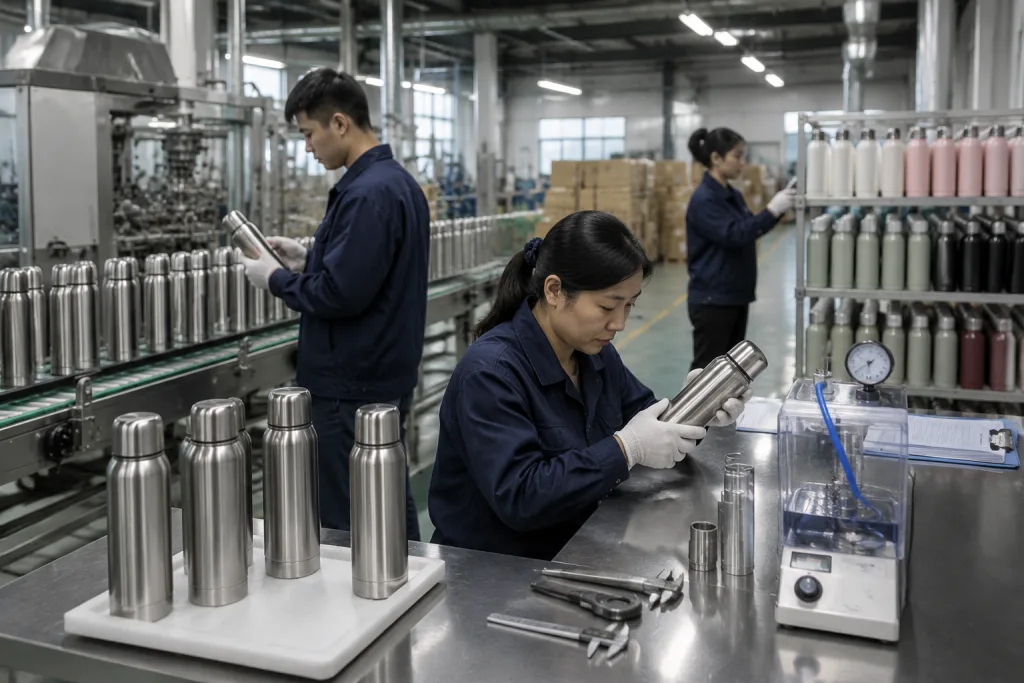
- Specify 304 inner steel, 201 or 304 outer steel, and 0.45–0.55 mm wall thickness before quoting
- Use AQL Level II with critical 0, major 2.5, minor 4.0 for bulk thermos inspections
- Powder coating needs 3M tape testing, cross-hatch testing, and carton vibration checks
- Custom logo lead time is usually 7–10 days for samples and 35–45 days for bulk production
A thermos flask in bulk order usually goes wrong in dull places: a lid thread that leaks at 70 kPa on the air-pressure jig, a powder coat that rubs through after 4 hours in a vibration carton test, or a logo that looks clean on 3 approval samples but ghosts after 5,000 units. We have seen this go sideways. Outdoor retailers and promo brands find the problem late, when 600 returns sit in the warehouse and the buyer flags the same question: why did the approved sample not match the shipment?
BottleForge Industrial manufactures stainless vacuum drinkware in Hangzhou, Zhejiang, and we see the same preventable problems in first-time custom thermos projects every month. China can build excellent product, but “make it premium” is the wrong instruction to put on a PO; the line needs measurable specs like coating thickness in μm, lid torque range in N·m, carton drop height, and logo position tolerance in mm. Our stainless thermos line runs about 450,000 units/month, with typical MOQ from 1,000 units per SKU and 35–45 day production after artwork approval. QC pulled one sample last week because the PO said Pantone Black C, while the artwork file said Pantone 433 C. Small typo. Big delay.
Vacuum Loss Starts With Thin Specs
The first failure mode in a thermos flask in bulk program is usually boring. The bottle just stops holding temperature. Your customer pours coffee at 07:30, and by 12:15 it tastes flat and lukewarm. On the line, we trace this back to three places: vacuum pumping time, steel gauge, or the TIG weld around the mouth. QC pulled 32 samples last month after a buyer flagged “12 hours hot” claims, and 5 failed before the 6-hour mark.
For a serious outdoor or promotional thermos, we normally run 304 stainless steel for the inner wall and either 201 or 304 for the outer shell. If you sell through outdoor retailers, use 304 outside too. It costs more, often USD 0.25–0.60 per unit depending on capacity, but it takes dents and corrosion better when the buyer’s lab starts rubbing salt spray marks with a white cloth. For 3,000–5,000 pcs promotional thermos projects, 201 outer steel is fine for offices, conferences, or gift sets. Not for marine shops. Not for ski retail.
Wall thickness matters. A cheap thermos factory may quote a 500 ml flask with 0.35 mm outer wall to win the order. It looks fine in photos, then the shoulder dents under a 1.2 kg carton compression check and the vacuum chamber gives us less room during forming. We prefer 0.45–0.55 mm for most stainless thermos bodies. The exact number depends on diameter, body curve, and whether the PO asks for a carry handle or cup lid; we once had “0.5 mm” typed as “0.05 mm” on a buyer’s draft spec, which would have made the math nonsense.
Ask your thermos manufacturer to write the heat retention test into the purchase order. A common benchmark for a 500 ml stainless vacuum flask is water at 95°C, tested after 6 hours at 20°C ambient, with remaining water temperature above 68–72°C depending on shape and lid design. Wide-mouth models lose heat faster than narrow-mouth flasks, so copying one standard across every SKU is the wrong question to ask. We test with a calibrated probe thermometer, log the ambient room temperature, and reject the lot if the sample spread runs past 3°C.
Bad spec: “Keeps drinks hot for 12 hours.” Better spec: “500 ml flask, filled with 95°C water, ambient 20°C, after 6 hours water temperature ≥70°C.”
Leaks Hide In Lids And Threads
Most warranty complaints do not come from the stainless body. They come from lids. We see it on the returns table: wet cartons, stained hangtags, and one buyer asking why 27 pieces leaked after a weekend camping promo. If you buy thermos bulk for outdoor retail, the lid has to take backpacks, car cup holders, dishwasher mistakes, and customers who crank the cap like a pipe fitting. If you buy promotional thermos for a campaign, the lid still matters. One leaking gift hurts the brand faster than a logo scratch.
The leak paths usually sit in two places: silicone gasket compression and the cap-thread assembly. A supplier thermos quote should name the gasket material, usually food-grade silicone, and show the compression structure with a simple section drawing or 0.1 mm tolerance callout. The gasket should come out for cleaning, but QC should not be able to shake it loose during packing. We run lid sealing at 60–80 kPa air pressure, or an inverted water test for 30 minutes, depending on model. Last month QC pulled the sample after bubbles showed at 70 kPa near the vent plug.
Thread fit is the quiet one. If the mold is worn, or the lid supplier changes resin shrinkage without telling the thermos manufacturer, the cap starts to feel gritty or loose. One golden sample will not show it. You notice it when 3% of cartons contain flasks that need two attempts to close, and the buyer flags “bad thread feel” on the inspection report. For a distributor thermos order, the math does not work: repacking 18 cartons at the warehouse costs more than fixing the mold insert before mass production.
Write lid requirements clearly. State whether the flask must be leakproof when inverted, whether carbonated drinks are excluded, and whether hot liquid pressure release needs a warning label. For kids and hiking models, ask for opening torque and closing torque ranges instead of asking if the lid “feels OK.” For example, 0.6–1.2 N·m is a usable range for many screw lids, though the right number depends on thread diameter and gasket structure. We check this with a digital torque meter on the line; if the cap closes at 1.8 N·m, some customers will overfight it and deform the gasket.
If your thermos vendor says “all lids are universal,” be careful. We have seen this go sideways. Universal often means easy for production, not right for your retail shelf, MOQ split, or customer use case.
Coating Failures Look Like Freight Damage
I’ll rewrite the section in place, keep every tag exactly as-is, and make it sound like a factory-side sales engineer wrote it. I’m checking for any repo-specific instructions first, then I’ll patch the prose only.I’ve got the target style and constraints. Next I’m editing just this HTML block, with tighter numbers, a few shop-floor details, and no AI filler.Powder coating and spray paint failures often get blamed on shipping. Sometimes freight is rough, but we see the problem start before the carton is sealed. Poor degreasing, a cure at 170°C instead of the set 190°C, thin film build, or weak adhesion shows up as chips at the base, scratches on the shoulder, and color rub after carton vibration.
For custom thermos programs, name the finish type on the PO. Powder coating usually works better for outdoor retail because it leaves a thicker, tougher surface and better hand feel. Typical powder thickness is 60–90 microns. Spray paint fits glossy gradients or lower-cost campaigns, but you need abrasion testing on the line. For a customizable thermos with 3 to 6 colorways, approve color chips under D65 lighting and set Delta E tight, usually ΔE ≤1.5 for strict retail programs or ΔE ≤2.0 for promotional runs.
A practical QC package should include a 3M tape adhesion test, cross-hatch test, alcohol rub test, and basic drop test. We use 3M 600 tape after cross-hatch cutting and check whether coating lifts from the cut grid. QC pulled a sample last month and the buyer flagged edge flake after 20 rubs, so we added a second pass with the taber wheel. For outdoor retail orders, add a carton vibration test: packed cartons vibrated for 60 minutes, then checked for scuffing, cap marks, and color transfer.
China factories vary widely here. A thermos supplier in Zhejiang with in-house coating can control pretreatment and curing better than a trader sending parts to three coating shops. That does not mean every factory thermos with outsourced coating is bad, but it does mean you need process records, not just sample photos. If the line cannot show pretreatment time, bath pH, and oven curve, the math does not work.
Also check carton dividers. A USD 0.03 paper sleeve can prevent a USD 2.00 return. We have seen that go sideways on a 24,000-piece order when the buyer skipped the insert spec. Not glamorous sourcing. It protects margin.
Logo Decoration Can Ruin A Good Flask
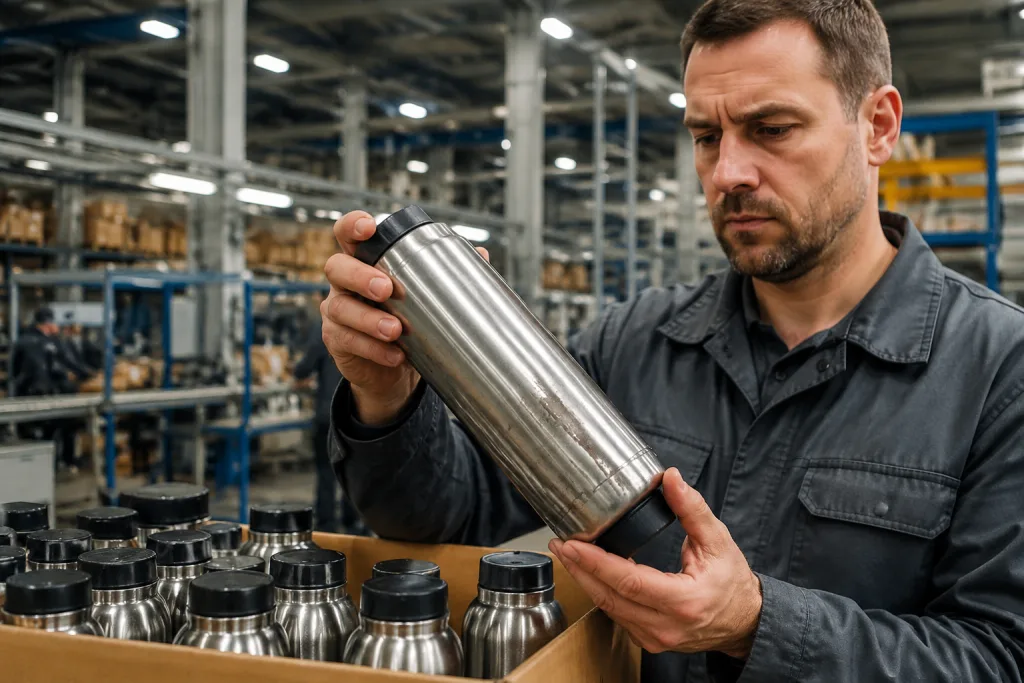
I’ll rewrite the section in-place style, keeping the HTML tags and the heading logic intact while stripping the AI-ish phrasing and adding a few shop-floor details.The body can pass vacuum testing and the lid can seal tight, then the logo still makes the order look cheap. We see this all the time in thermos custom work because decoration gets treated like an add-on. It is not. The logo method changes MOQ, unit cost, lead time, color match, and the QC checklist.
Laser engraving is the safest choice for stainless and powder-coated flasks when durability matters. It cuts or marks the surface permanently, so there is no ink adhesion problem. The tradeoff is color: you get exposed metal or a shade shift, not a Pantone-matched print. For a premium outdoor customized thermos, laser looks clean and holds up after 20 washes and a few hard drops.
Silkscreen printing works best for simple one- or two-color logos on straight walls. It costs less than most buyers expect, often around USD 0.08–0.18 per position for basic single-color printing at bulk quantity, but curved bodies and textured powder coat need a real test on the line. Heat transfer handles more complex artwork, though we still check edge lift and film visibility. UV printing gives sharp detail, but scratch resistance has to clear rub and tape tests; QC pulled a sample once and the logo failed after 50 rubs.
For a promotional brand ordering a customized thermos, send vector artwork, Pantone references, logo size in millimeters, placement distance from the base, and whether the logo must face the drink opening or handle. If you leave out orientation, the factory will use the easiest jig position. The buyer flagged this as a defect once, but the PO never said which side should face forward. That is a weak purchase order.
We advise a pre-production sample for every new thermos promotional decoration. Typical timing from Zhejiang is 7–10 days after artwork confirmation. Do not skip it unless you are reordering the same SKU, same logo, same color, and same coating batch. We’ve seen this go sideways when a buyer tried to save 3 days and then found the logo sat 6 mm too low.
Compliance Is Not A PDF Folder
I’ll rewrite the section in-place, keep the HTML untouched, and tighten the wording so it reads like a factory-side sales engineer wrote it.Buyers often ask for an “FDA certificate” or “EU certificate” as if one PDF covers every thermos flask in bulk. It does not. Compliance changes with the body steel, coating, lid plastic, silicone gasket, inks, and the market you sell into. On our line, we separate food-contact safety, chemical limits, factory social audits, and retailer paperwork; mixing them up causes trouble fast.
For Europe, start with LFGB food-contact testing, the EU 1935/2004 framework, and REACH for restricted substances. For North America, FDA food-contact expectations and California Proposition 65 screening may apply, depending on the sales channel. If the flask is for children, ask for CPSIA in the United States and EN 14350 or the right child-use standard in Europe, based on the product design. For adult outdoor flasks, we sometimes run ASTM drop or impact checks in-house on a 1.2 m bench, even when the law does not force it.
Factory audits are a different bucket. BSCI, Sedex, ISO 9001, and similar papers speak to management systems or social compliance, but they do not prove the gasket passed migration testing. A proper thermos manufacturers shortlist needs both factory documents and SKU-level test reports. Check the report against the exact material and color you are buying. A black powder-coated 750 ml flask with a PP lid is not covered by a two-year-old report for a silver 350 ml cup with another lid; the buyer flagged that mismatch, and the math does not work.
For Amazon, retailer warehouses, and distributor thermos channels, packaging labels matter too. You may need FNSKU labels, suffocation warnings on polybags, country of origin marking, recycling icons, and carton marks. We have seen a PO typo on carton count turn into a 3-day delay at QC, and that is the wrong time to fix labels. In China export, FOB Ningbo or FOB Shanghai is common for Zhejiang factories. Put label rules into the order before mass packing starts, not after the 6,000 pcs are stacked in the warehouse.
Inspection Must Catch Batch Variation
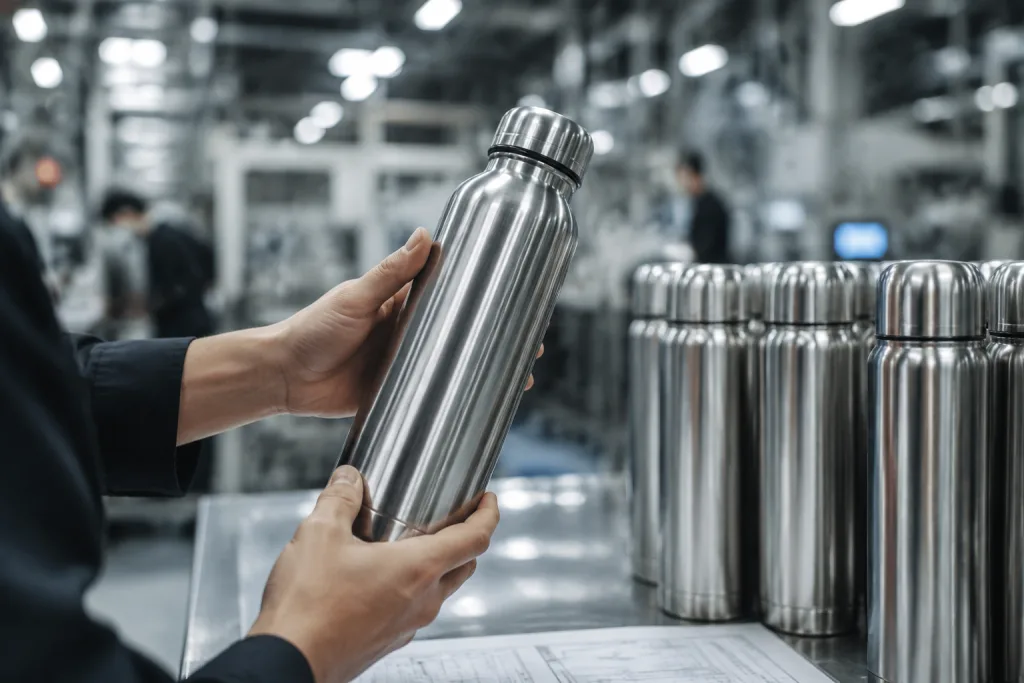
I’ll rewrite the section in place, keep the HTML untouched, and tighten the sales-engineer tone with concrete factory details and cleaner inspection language.A golden sample is not a shipment. That is the first mistake thermos distributors make. Sample approval does not control mass production by itself. We run incoming material checks, in-process checks, and a final random inspection with AQL levels written into the contract. On one 12,000-piece lot, QC pulled the sample and found two neck rings with burrs that never showed up on the signed sample.
For thermos flask in bulk orders, a standard final inspection can use ANSI/ASQ Z1.4 or ISO 2859-1 sampling, General Inspection Level II. Many buyers use AQL critical 0, major 2.5, minor 4.0. Critical defects include sharp edges, contamination inside the flask, serious leakage, broken glass liners if applicable, or unsafe packaging. Major defects include failed vacuum performance, serious coating chips, wrong logo size, wrong color, missing accessories, and incorrect barcode. Minor defects include small cosmetic marks within an agreed limit. The buyer flagged a batch once because the logo was 1.8 mm high off spec; that sort of miss is small on paper and ugly in the market.
Do not let the inspection company decide everything from scratch. Give them a checklist. Include capacity tolerance, weight tolerance, dimensions, logo placement, lid sealing, vacuum heat test, coating adhesion, carton drop, barcode scan, and carton quantity. If you are shipping to distributors thermos warehouses, barcode and carton marks matter as much as cosmetics because bad labels slow receiving. We once saw a PO typo on carton marks: 24 pcs/carton printed as 42, and the warehouse rejected the lot at the gate.
For large thermos supplier orders, we also recommend an early production inspection when 10–20% of goods are completed. This catches coating shade drift, gasket fit, or wrong accessories before 30,000 units are packed. It costs less to stop a line for 4 hours than to sort finished cartons for 4 days. The math doesn't work any other way. On one line, a 4-hour stop saved us from reworking 8,600 lids with loose silicone rings.
At BottleForge Industrial in Hangzhou, Zhejiang, our normal custom stainless thermos MOQ is 1,000 units per color for existing molds and 3,000–5,000 units for new molded lids or special structures. That MOQ is not arbitrary. It reflects coating line setup, logo jigs, material purchasing, and QC labor. A low MOQ can help with a test run, but the unit cost climbs fast and the options shrink. We run the line on fixed setups, so a 500-piece trial usually costs more than buyers expect.
Quoting Cheaply Creates Expensive Surprises
I’ll keep the HTML exactly as-is and rewrite only the prose to sound like a factory-side sales engineer, with sharper commercial detail and fewer generic phrases.The last failure mode is commercial, not technical. A buyer sends five thermos suppliers “500 ml stainless flask, logo, gift box,” then sorts by FOB unit price only. Lowest wins. The bill shows up later: 0.4 mm thinner steel, a cheaper PP lid, no inner carton, weak spray paint, missing test reports, or a 12-day slip because the line never booked coating capacity.
A useful RFQ for a thermos flask in bulk order needs capacity, lid type, steel grade, wall thickness target, finish, logo method, packaging, market compliance, target order quantity, delivery term, and inspection standard. If you need a retail-ready outdoor flask, say that. If you need a promo thermos for a 6-week event deadline, say that too. The buyer flagged this on one PO once: the carton size was missing, and the freight math blew up by 18% after packing.
Price moves with steel, exchange rate, decoration, and packaging, but as a working reference, a 500 ml double-wall stainless custom thermos from China may land around USD 3.20–5.80 FOB at 3,000–10,000 units for existing molds. Premium lids, 304 outer steel, retail gift boxes, color powder coating, and multi-position logos push it up. A quote under USD 2.80 usually means someone cut something you will later pay for; we’ve seen that go sideways on the first QC pull.
Ask every thermos manufacturer the same plain questions: Who makes the lid? Is coating in-house? What was the defect rate on the last three similar orders? What AQL do you accept? Can you share a blank inspection checklist? How many units a month can the line run in peak season? A real manufacturer answers without dancing around it. A trading thermos vendor may still work, but you need to know who actually owns the press, the spray booth, and the QC table.
Bulk thermos buying is not about removing every risk. It is about putting the risk on paper before steel is cut, coating powder is mixed, and cartons are sealed.
Send your thermos flask bulk spec for review
Share capacity, logo, market, quantity, and target delivery date. We will flag the risky parts before quoting production.
Frequently asked questions
What MOQ should I expect for a custom stainless thermos flask in bulk?
For existing molds, a realistic MOQ is usually 1,000 units per color or finish. If you need a custom lid, special handle, new body shape, or private tooling, expect 3,000–5,000 units minimum because molds, jigs, and material purchasing have fixed costs. Some thermos suppliers offer 300–500 units, but the unit price is usually higher and decoration choices are limited. For promotional thermos projects, 1,000–3,000 units is the practical starting point. For retail programs with multiple colors, plan each color as a separate MOQ unless your thermos factory confirms a shared coating setup.
How long does production take after I approve the sample?
For an existing stainless thermos mold with standard coating and one-position logo, typical production is 35–45 days after sample and artwork approval. Pre-production samples usually take 7–10 days, longer if you need custom color matching or a molded lid. Add 3–5 days for final inspection and shipping documents. During peak China export months, especially before major holiday shutdowns, add a buffer of 10–15 days. If your event date is fixed, tell the thermos manufacturer before quoting so they can confirm coating line capacity and packaging lead time.
Which logo method is best for outdoor retail thermos flasks?
For outdoor retail, laser engraving is usually the safest method because it will not peel, crack, or fail a tape test. It works well on powder-coated stainless and bare stainless, but it does not give Pantone color. If you need color, silkscreen printing is fine for simple artwork on smooth surfaces, while heat transfer or UV printing can handle complex designs. For any thermos customized order, test the exact logo on the exact coating. Use alcohol rub testing, tape testing, and scratch checks before approving mass production. A logo that passes on silver stainless may fail on textured black powder coat.
What inspection standard should I use for bulk thermos orders?
Use ANSI/ASQ Z1.4 or ISO 2859-1 with General Inspection Level II for normal final random inspection. A common AQL setup is critical 0, major 2.5, minor 4.0. Critical defects include leakage, contamination, sharp edges, unsafe parts, or failed food-contact safety. Major defects include wrong logo, poor heat retention, coating chips, wrong color, missing gift box, or unscannable barcode. Ask your thermos supplier to accept the checklist in writing before production. For orders above 10,000 units, add an in-process inspection at 10–20% completion to catch coating, lid, and packing issues early.
Should I buy FOB China or delivered duty paid for thermos bulk orders?
FOB Ningbo or FOB Shanghai is common for Zhejiang stainless thermos factories and gives you control over freight, insurance, and customs broker selection. It works well if you already import drinkware or have a forwarder. Delivered duty paid can be easier for small promotional brands, but compare the full cost carefully because freight, duties, and local delivery may be bundled with less transparency. For North America and Europe, confirm HS code, country of origin marking, carton dimensions, gross weight, and pallet requirements before shipping. A 3,000-unit order can change freight cost noticeably if packaging is oversized.