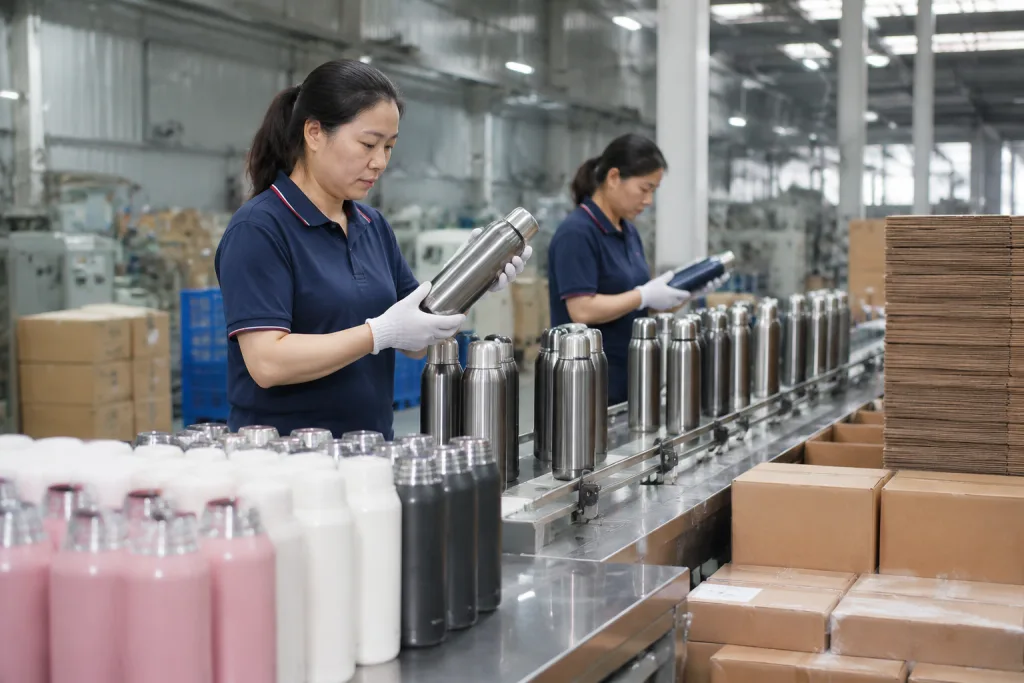
Key Takeaways
- For stainless thermos bulk orders, plan MOQ from 1,000 pieces per color and 35-45 days after approved sample
- 304 stainless steel is standard for inner walls; 316 is worth pricing only for acidic drinks or premium outdoor ranges
- Powder coating usually adds USD 0.25-0.60 per unit versus plain stainless, depending on finish and color control
- Use AQL 2.5 for major defects and test at least 3 filled samples per SKU for 12-hour heat retention
If you sell outdoor gear or run promo campaigns, a stainless thermos looks simple until the PO says 5,000 pcs and the buyer asks why the 500 ml bottle now needs a 62 × 45 × 38 cm master carton. Small choices hit cost, lead time, carton CBM, complaint rate, and reorder chance. We see this every week. A thermos flask factory can send a quote in 20 minutes, but a fast price is not a safe sourcing decision.
From our Hangzhou, Zhejiang export desk, good custom thermos projects usually start with four calls: insulation target in hours, body construction, surface finish with logo process, and inspection level such as AQL 2.5. QC pulled one sample last month where the laser logo was 1.8 mm off-center; the buyer flagged it before we packed the first carton. China has 300+ thermos manufacturers quoting similar photos, so the wrong question is “who is cheapest?” Ask which factory thermos spec will survive bulk thermos production without turning into claims.
Start with the buying decision
A serious thermos factory discussion should not start with color chips. Start with the job. For an outdoor retailer, the bottle may need to keep coffee above 60°C after 12 hours in a -5°C test box, and QC will check it with a probe thermometer before we pack. For a promotional thermos order, the same body may only need a clean leak test, a logo area that does not distort on the curve, and a landed cost that stays under the buyer’s budget.
Before we quote, we ask buyers to pick one operating target. Retail-grade durability means double-wall vacuum insulation, 304 stainless steel inner and outer, a thicker base around 0.5 mm, powder coat or brushed finish, and carton drop testing from 76 cm. Promotional-grade value means an existing mold, 304 inner wall, 201 or 304 outer wall based on price, one-color silkscreen or laser logo, and standard white box packing. Premium outdoor positioning means 304 or 316 inner wall, optional copper lining, a coating with better hand feel, a stronger handle lid, and tighter cosmetic inspection under the light booth. QC pulled the sample last month because the lid handle had a 1.2 mm gap. Small gap, big complaint.
The trade-off is blunt. A customized thermos with a heavy cap, complex powder color, individual gift box, and tight AQL inspection may cost USD 5.20-8.80 FOB Ningbo or Shanghai at 3,000 pieces. A simpler promotional thermos can sit around USD 3.20-5.00 FOB, but the math does not work if you still ask for 18-hour heat retention, a velvet insert, and six-color carton artwork. You give up insulation margin, packaging feel, or finish choice. Neither spec is automatically better. We’ve seen this go sideways when a buyer saved USD 0.35 per unit, then the outdoor customer tested every bottle on a ski trip.
At BottleForge Industrial in Zhejiang, China, we run about 420,000 units per month across standard bottles, tumblers, and flask bodies. Capacity helps. The buying decision still matters more than factory size, because one wrong line on a PO—201 outer written where 304 outer was approved—can delay samples by 12 days vs 18 days once the tube stock has already been cut. Give us the use case, target price, MOQ, and test requirement first. That saves more time than sending a random photo and asking for “best price.”
Choose steel and vacuum performance
The standard build we run for stainless thermos orders is double-wall vacuum 304 stainless steel. For outdoor retailers and promo brands, a 304 inner wall is the right baseline for coffee, tea, water, and normal alkaline cleaning chemicals. Inner tank thickness usually sits around 0.4-0.5 mm, with the outer shell at 0.5-0.6 mm, depending on capacity and mold. Check the weight. If a quote comes in 18-25 g lighter than the market sample, ask where the supplier cut metal; our QC team checks this with a digital caliper and a 0.1 g bench scale before we approve the pre-production sample.
316 stainless steel is not a magic upgrade for every buyer. The math doesn't work on every program. It gives better corrosion resistance for salty or acidic drinks, but it can add roughly USD 0.35-0.90 per unit depending on capacity and order quantity. For a 500 ml distributor thermos sold through outdoor shops, 304 is normally enough. For a premium 1 L flask aimed at marine, fishing, or acidic sports drinks, a 316 inner wall gives the buyer a cleaner selling point and a real performance gain; we had one EU buyer flag rust complaints after customers used electrolyte drinks daily, and 316 solved that claim pattern on the next 3,000 pcs run.
Vacuum performance is not decided by steel grade alone. Neck diameter, cap design, welding quality, vacuum evacuation, copper plating, and stopper fit all affect heat loss, so this is the wrong question to ask if the buyer only says “304 or 316?” A narrow-mouth 750 ml flask usually beats a wide-mouth food jar because less heat escapes through the opening. Copper lining can improve heat retention and often adds USD 0.15-0.35 per unit, but it will not save a weak cap. We have seen this go sideways: QC pulled a sample with good vacuum readings, then the silicone stopper showed a 0.8 mm flash line and leaked heat through the lid area.
For buyer approval, do not trust only the sample that looks good on a desk. Ask your manufacturer thermos partner to fill hot water at 95°C, close the lid, test after 6 hours and 12 hours, and record the final temperature at a controlled room temperature of about 20°C. For retail-grade custom thermos projects, we suggest testing at least 3 samples per SKU before mass production and again during final inspection. If you plan thermos bulk launches across multiple colors, test each color lot because coating bake temperature and handling can affect assembly consistency; on the line, we mark each color tray with the PO color code after one buyer sent “mat black” instead of “matte black” and approved the wrong shade for 1,200 pcs.
Match capacity to channel economics
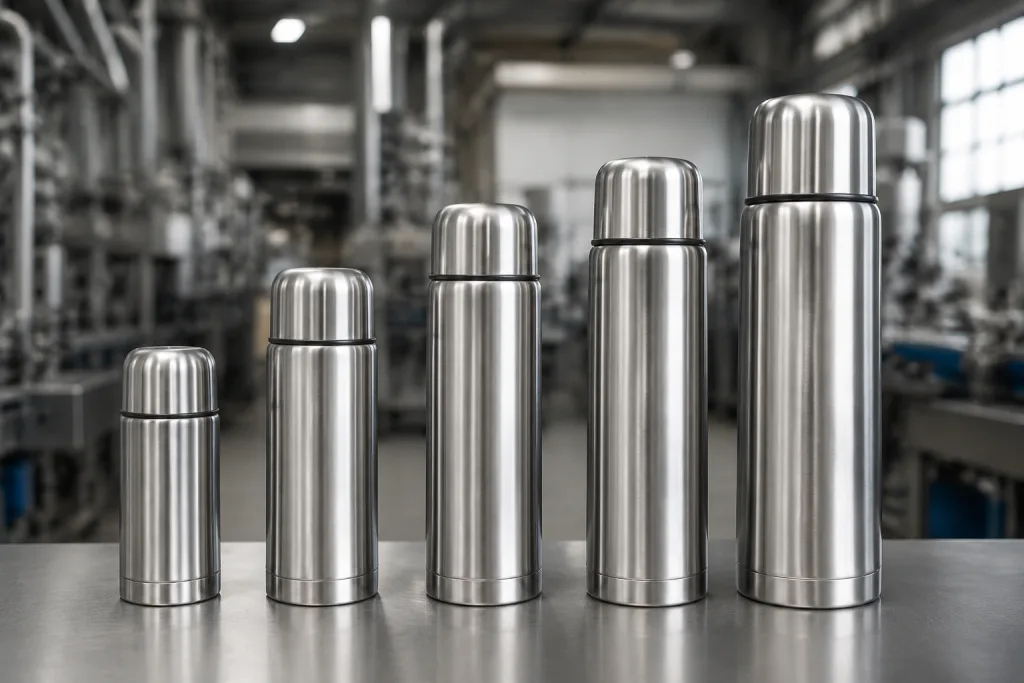
Capacity decides where the bottle sells and what the freight bill looks like. A 350 ml custom thermos fits office gifting, commuter bags, and 70 mm backpack side pockets; QC pulled one last week because the buyer wanted it to slide into a laptop bag without bulging. A 500 ml or 600 ml model is the safer promotional choice: it fits most car cup holders, keeps the export carton under about 12 kg, and does not scare the warehouse team. A 750 ml or 1 L flask looks right for outdoor retail and distributor thermos programs, but it eats shelf space fast. The math gets ugly.
Do the carton math before you approve the sample. A 500 ml stainless bottle may pack 24 pieces per export carton, while a 1 L flask with a handle lid may pack only 12 pieces. We run a tape measure across the gift box, inner carton, and master carton before quoting because 8 mm added to a lid can change the pallet count. If the 1 L model costs only USD 1.20 more at FOB level, the landed cost gap still widens after ocean freight, duties, warehousing, and domestic parcel handling. For North American e-commerce, dimensional weight punishes bulky gift boxes. For European distributors thermos shipments, pallet efficiency and EAN labeling matter more than buyers expect; one German PO once had the EAN digit typed wrong, and the buyer flagged it before booking.
MOQ is tied to capacity and finish. For our standard molds in China, a plain stainless or black powder coated thermos custom order can usually start at 1,000 pieces per SKU. Custom Pantone powder coating usually makes sense from 2,000-3,000 pieces per color because the paint room needs a clean spray gun, a cleaned hanging line, and one approved color chip under the light box. New mold development for a fully customizable thermos body is a separate job, not a small tweak: expect tooling from USD 3,000-12,000 and 45-70 days before a reliable pilot run. We have seen this go sideways when a buyer asks for a new shoulder curve but keeps the old 30-day launch plan.
Outdoor buyers should plan spare parts on day one. If your flask uses a special lid, request a 1%-2% spare lid allowance or buy extra lids as service stock. Promotional buyers often skip this, then get stuck when a recipient loses a gasket; our QC table has a simple 0.1 g scale for checking silicone seal weight because a thin gasket is the kind of small defect that becomes a big complaint. A good thermos vendor should quote caps, silicone seals, straws, and boxes as separate lines when asked. Hiding every accessory inside one vague unit price is the wrong way to quote.
Decide logo before finish
Choose the logo method at the same time as the surface finish, before we open the production order. Laser engraving is clean and durable on 304 stainless, powder coat, and corporate marks with 0.3 mm fine lines; our line checks depth with a caliper after the first 20 pcs. It adds no ink color. Good for a quiet premium look. Silkscreen saves cost on a simple one-color logo and still shows up on plenty of promotional thermos orders, but we have seen it go sideways on rough outdoor use when the coating is thin or the curing oven runs short.
For multi-color branding, heat transfer and UV printing give stronger shelf impact. Use them for retail carton graphics, outdoor artwork, or campaign designs where the buyer wants the bottle to look like the deck. The trade-off is setup cost and tighter artwork control, plus higher defect risk on curved bodies. QC pulled one tapered 500 ml flask last month because the wraparound mountain line bent 4 mm near the seam. A digital mockup will not catch that. Ask for a printed pre-production sample.
Powder coating is the default choice for around 7 out of 10 custom thermos programs we run because it feels better in hand and hides fingerprints. Standard black, white, navy, and army green are easier to control; our coating room checks them against the color chip under a D65 light box before packing. Custom Pantone colors need a tolerance discussion. This is where some buyers ask the wrong question: “Can you match it exactly?” Stainless powder coating is not paper printing. Under warm retail lighting, the same coating can shift. For strict brand programs, approve one golden sample and state the acceptable Delta E tolerance if your team measures color formally.
Cost impact stays manageable if you decide early, before the PO reaches our laser room or printing vendor. Laser engraving may add USD 0.08-0.25 per unit depending on logo size. One-color silkscreen may be USD 0.06-0.18. Full wrap heat transfer can add USD 0.35-0.90. Individual kraft boxes may add USD 0.20-0.45, while rigid gift boxes can add more than USD 1.00. If your promotional thermos budget is tight, put the money into leak-proof performance before fancy packaging; during AQL 2.5 inspection, a wet inner carton hurts more than a plain box. A beautiful box does not stop returns.
Set compliance and inspection rules
For Europe and North America, stainless thermos compliance is not “paperwork after shipment.” Food-contact parts need the right file for the destination, such as FDA/LFGB, and the powder coat, pad-print ink, or silicone gasket may need REACH or California Proposition 65 review if the channel asks for it. Kids bottles bring ASTM or CPSIA into the discussion. If you sell promo bottles to corporate clients, ask the end client about BSCI, ISO 9001, Sedex, and restricted substance declarations before we lock the supplier thermos quote. We had one PO in March where the buyer typed “LFGB only” but the carton label showed a California address; QC pulled the sample, and the buyer flagged Proposition 65 one day before packing. That delay cost 4 days.
AQL belongs on the purchase order, not in a WhatsApp message. For most distributor thermos and retail projects, we run AQL 2.5 for major defects and 4.0 for minor defects as the working baseline. Critical defects should be zero. Major defects include leakage, poor vacuum, sharp edges, wrong logo, broken cap, strong odor, and failed drop test. Minor defects include small scratches under 10 mm, slight color shade difference, or packaging scuffs inside the signed limit sample. On the line, our inspector uses a 0.5 mm feeler gauge on rough rim complaints because “sharp edge” is too easy to argue about later.
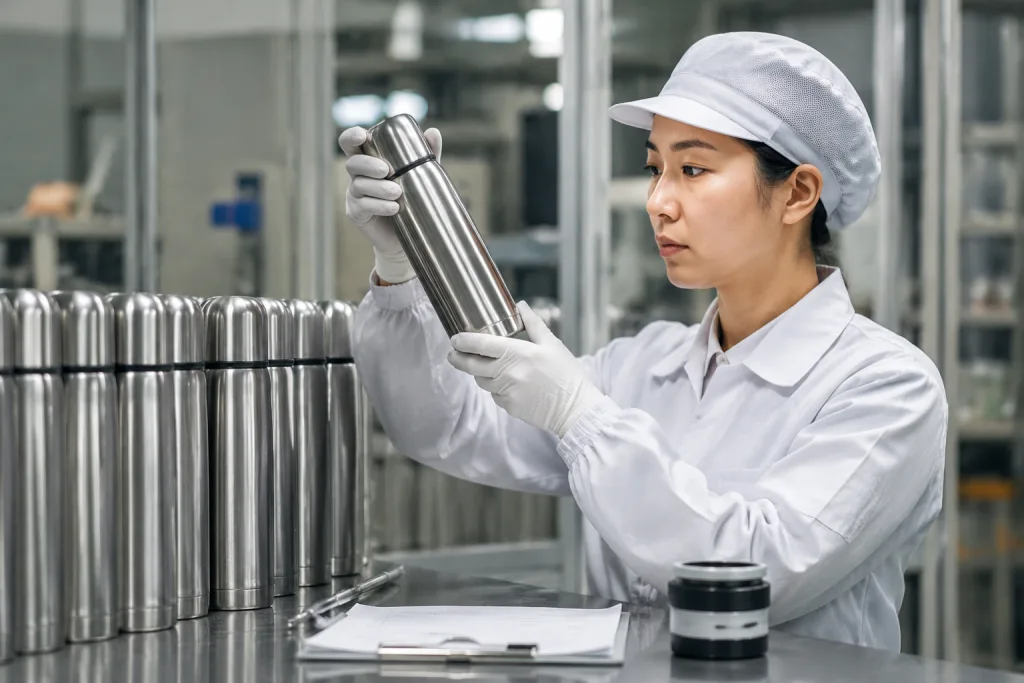
Inspection should cover more than carton counting. A proper final check looks at appearance, logo position, capacity, weight, wall scratches, lid torque, leak test, barcode scan, carton marks, and packaging drop. For vacuum testing, random samples should be filled with hot water and checked after a fixed holding time, such as 95°C water held for 6 hours in a 20°C room. We also run a quick acoustic vacuum check during production with a tap rod, but heat retention data is what settles the argument. The wrong question is “Did the factory pass QC?” Ask what was checked, how many pieces were opened, and what the reject numbers were.
Be careful with “factory passed QC” statements that do not mention sample size. If your order is 5,000 pieces, checking 20 pieces is a showroom check, not shipment control. A standard Level II inspection under ISO 2859-1 may select 200 pieces for a 5,000-piece lot, depending on lot size and inspection plan. That is a cleaner conversation with thermos suppliers than arguing after goods arrive. In Zhejiang, we see fewer disputes when buyers approve a written inspection checklist before deposit payment; our team prints it and clips it to the first packed carton with the color card, barcode sheet, and signed lid sample.
Quote the full landed program
FOB unit price is only one line on the cost sheet. A thermos manufacturer can quote USD 4.10 FOB and still land 9% higher after export cartons, color box packing, logo film, sample fees, Hangzhou-to-Ningbo trucking, sea freight, duty, warehouse intake, and FNSKU labels for marketplace orders. Outdoor retailers should price display cartons and spare lids too; we had one buyer flag a missing 2-piece stopper set after the PI was signed, and the carton plan had to move from 24 pcs/ctn to 20 pcs/ctn to pass the drop test.
For a typical 3,000-piece thermos customized order from China, we run 5-7 days for initial sampling when the mold is already on the shelf, 7-10 days for logo and color sample approval, 30-40 days for mass production, and 3-7 days for final inspection and export handling. Ocean freight to Europe or North America then adds several weeks. Fixed launch date? Work backward from the in-hands date, not the purchase order date. QC pulled the sample on one matte black flask last March and found the logo 1.5 mm off center, which cost 2 days before the buyer approved the revised pad-print jig.
Payment terms change the risk. About 8 of 10 first thermos projects we see use 30% deposit and 70% balance before shipment. Larger repeat programs can move to staged payment after 2 clean shipments, but first orders usually stay tight. The math doesn't work when a supplier offers a low price, vague payment terms, no FDA or LFGB files, and no inspection allowance. One PO even had “304 stainless” in the item name but “201 outer” in the remarks column; the buyer flagged it before deposit, luckily.
Ask each thermos vendor for the same quote format: model number, capacity, steel grade, finish, logo method, packaging, carton quantity, carton size, gross weight, MOQ, sample cost, production lead time, FOB port, validity period, and test standards. Then the comparison is fair. Without that structure, you might compare a 201 outer wall quote against a 304 full-body quote and blame the wrong factory for being expensive. We ship cleaner programs when the RFQ includes carton size in cm and gross weight in kg; our merchandiser checks those against the packing table before finance issues the PI.
When custom tooling makes sense
A fully custom thermos body sounds attractive because it protects your range and gives the sales team a cleaner story. It also adds mold cost, sampling time, and engineering risk. We run new body tooling only when the buyer expects repeat orders above 10,000-20,000 units per year, needs a shelf shape that cannot be copied with our current molds, or has a lid system that needs a new thread and gasket seat. For a one-off promotional thermos order of 1,000 pieces, the math usually does not work. Last month QC pulled a trial body with a 0.4 mm shoulder mismatch after polishing, and that small line would have killed the whole retail look.
There are safer middle paths. Use an existing body mold, then change the lid color and handle design, add a silicone boot with your Pantone code, specify powder coating texture, place the logo by laser or screen print, and build proper packaging with a retail insert. That gives a custom thermos look without paying for full mold development. For 6 out of 10 outdoor retailer projects we see, this is the better route: stable product quality, controlled cost, and enough brand ownership to avoid the catalog-item feel. The buyer may ask, “Can we make the body 3 mm slimmer?” Sometimes yes, but if it means new tooling and 18 days more sampling, we say so early.
If you do choose new tooling, insist on staged approval. Start with 2D drawings, move to 3D rendering, make a 3D printed appearance sample if the grip or curve is new, then approve soft tooling or first metal samples before pilot production. Slow is faster here. Check lid thread fit with a go/no-go gauge, gasket compression after 24 hours, drinking angle, handle pull strength, and whether a brush can reach the inner corner for cleaning. A beautiful CAD file does not mean the bottle will pass a leak test; we have seen a 0.2 mm thread change turn a good-looking lid into a complaint ticket.
A good thermos flask factory should push back when a design creates production problems. Sharp shoulders can leave uneven polishing marks under the buffing wheel. Oversized lids can hurt heat retention because the plastic bridge gets too wide. Deep recessed logo panels can trap powder during coating, and the buyer flagged this once after finding orange peel around a 35 mm logo recess. As a China manufacturer thermos team, we would rather argue about these details before tooling than apologize after 8,000 finished units are packed. This is the difference between a catalog seller and a manufacturing partner.
Send your thermos brief for factory review
Share capacity, target price, logo method, and delivery market. Our Zhejiang team will return a practical MOQ, timeline, and FOB quote.
Frequently asked questions
What MOQ should I expect from a thermos flask factory?
For existing stainless thermos molds, a realistic MOQ is usually 1,000 pieces per SKU for standard colors such as black, white, navy, or plain stainless. If you need custom Pantone powder coating, 2,000-3,000 pieces per color is more practical because the coating line has setup loss and color approval time. Fully custom body tooling normally only makes sense when annual volume is above 10,000-20,000 pieces. Some suppliers thermos offers below 500 pieces exist, but the unit price, logo cost, and inspection control are usually weaker.
How long does a custom thermos order take?
Using an existing mold, plan 5-7 days for a plain sample, 7-10 days for logo or color approval, and 30-40 days for mass production after deposit and confirmed artwork. Final inspection and export handling add about 3-7 days. A new mold project can add 45-70 days before stable pilot samples. If your promotional thermos has a fixed event date, build in buffer for sample revisions, China holidays, vessel delays, and customs clearance at destination.
Is 316 stainless steel necessary for outdoor thermos products?
Not always. 304 stainless steel is the normal choice for inner walls and is suitable for coffee, tea, water, and general outdoor use. 316 stainless steel gives better corrosion resistance, especially for salty or acidic drinks, but it may add about USD 0.35-0.90 per unit depending on capacity and volume. For a 500 ml retail flask, 304 is usually enough. For marine, fishing, or premium acidic beverage positioning, 316 inner wall can be worth the extra cost.
Which logo method is best for bulk thermos orders?
Laser engraving is the safest durable option for stainless steel and powder coated bottles, especially for outdoor retailers. One-color silkscreen is economical for promotional thermos campaigns and can add only USD 0.06-0.18 per unit, but it is less durable under heavy abrasion. Heat transfer or UV printing works for multi-color artwork, often adding USD 0.35-0.90 per unit. Choose the logo method before approving the finish, because coating texture, curvature, and logo size affect results.
What should I inspect before shipping thermos bulk orders?
Use a written checklist and AQL plan before production starts. For a 5,000-piece order, Level II inspection under ISO 2859-1 may mean around 200 pieces checked, depending on the lot plan. Major checks should include leakage, vacuum performance, cap fit, sharp edges, logo position, color, odor, capacity, barcode scan, carton marks, and drop testing. For heat retention, test at least 3 filled samples per SKU over 6 and 12 hours at a controlled room temperature.