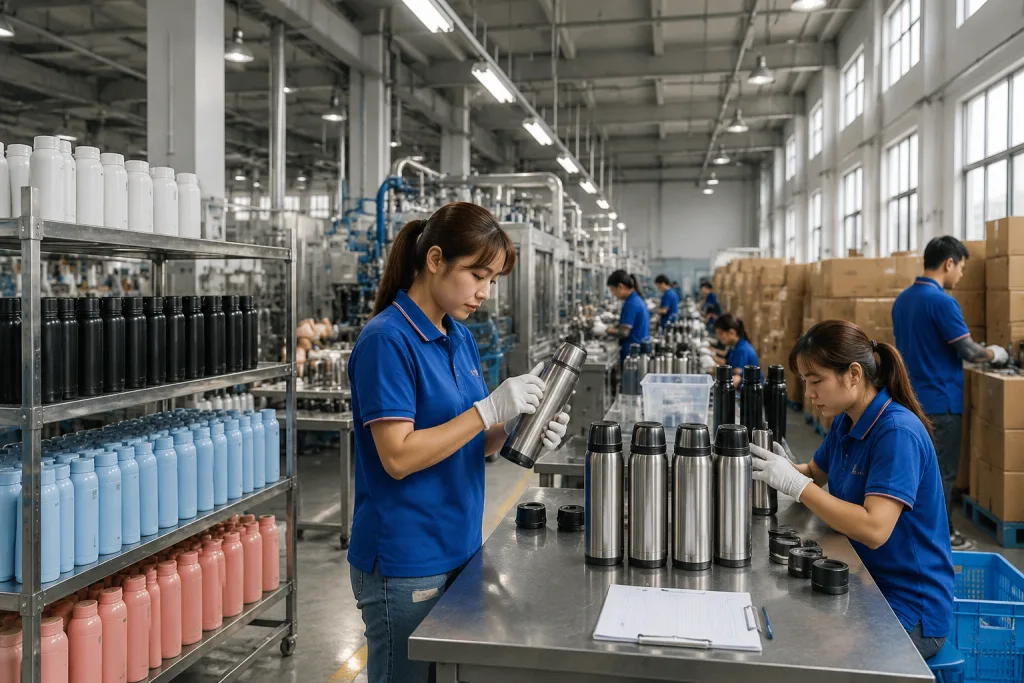
Key Takeaways
- A realistic MOQ for a customized thermos order is 3,000 pieces per color or 5,000 pieces for new packaging
- 304 stainless steel at 0.45-0.50 mm outer wall is the usual balance for durability and cost
- Plan 35-45 days production after sample approval, plus 7-10 days for pre-production samples
- Use AQL 2.5 for major defects and AQL 4.0 for minor cosmetic defects on bulk thermos inspections
You are not just buying a bottle. You are giving up shelf space, promo budget, and customer trust for one stainless item that has to hold temperature, pass carton drop testing, and land with the right logo on every piece. Factory direct can save margin, but the math doesn't work if the spec is loose when we open the 304 stainless coil and set the first drawing die.
Here is the Zhejiang buyer scenario we run into 20 times before peak season: an outdoor retailer or promotional brand needs 5,000 pieces of a 750 ml custom thermos for autumn delivery. The target FOB price is already on the PO, matte powder coating is requested, REACH-compliant materials are required for Europe, and the buyer flagged one hard limit: lid leak complaints must stay under 1%. We will walk that order from brief to final inspection, including the parts where QC pulls the sample and the line slows down over a 0.3 mm lid gasket issue.
Start with the selling use case
The first mistake in a thermos flask factory direct project is asking for “your best price” before the selling use case is clear. Wrong question. A 500 ml conference giveaway and a 1,000 ml outdoor retail flask sit on different lines in the buyer’s head, even if both use double-wall vacuum insulation. The promo cup gets judged on logo size, carton count, and whether the unit price fits a USD 5 gift budget. The outdoor flask gets judged after 6 hours on a cold dock, after the screw lid has been opened 40 times, and after the powder coat rubs against a truck cup holder. QC pulled one black sample last year with a 0.4 mm coating chip on the shoulder; the buyer flagged it before we even discussed price.
For our buyer scenario, assume you sell to hikers, fishing clubs, and corporate outdoor campaigns. We would start with a 750 ml stainless vacuum flask, 304 inner and outer body, with 201 stainless acceptable only for the outer shell if the price pressure is severe. I would not use 201 for premium outdoor retail. The math doesn't work. Saving USD 0.20-0.35 per unit looks nice on the PI, then one rust complaint in a fishing club order eats the margin. If your brand promise is rugged, run 304 throughout and say it clearly on the spec sheet.
A workable starting brief for a manufacturer thermos order looks like this: 750 ml capacity with leakproof screw lid, cup-style outer cap with 0.5 mm wall thickness, powder-coated matte finish, laser logo on front, individual kraft box, 24 pieces per export carton, FOB Ningbo or Shanghai. For a customized thermos with these specs, a normal FOB China range is about USD 4.20-6.80 depending on lid structure, coating, carton strength, and testing requirements. We usually ask for the logo file, Pantone number, and carton drop requirement before quoting, because a weak 5-layer carton can fail faster than the flask itself.
When you contact a thermos supplier in Zhejiang, give the target retail channel first. Outdoor retail needs better abrasion resistance and stronger packaging than distributors thermos programs for one-time promotional giveaways. If you buy for a distributor thermos catalog, repeat-order consistency matters more than shaving USD 0.08 off one shipment. We ship both types from Zhejiang, but the factory needs to know which problem hurts your business most: missed delivery, color mismatch, or field performance. We’ve seen this go sideways when the PO only said “matte green” and the approved sample was closer to Pantone 5743 C than the bulk coating.
Lock the construction before artwork
Artwork feels urgent, but the bottle construction sets the order. For stainless thermos bulk buying, lock the steel grade, wall thickness, vacuum target, lid system, coating spec, and mouth diameter before anyone opens the logo file. We run quotes through a BOM sheet first; if those cells are blank, the factory thermos quote is not comparable across 3 suppliers a thermos buyer may contact.
For a 750 ml factory thermos, our recommended body is 304 stainless steel with 0.45-0.50 mm outer wall and 0.40-0.45 mm inner wall. Going thinner cuts cost, but dent resistance drops fast. The math doesn't work for a retail outdoor flask if the bottle feels like a disposable promotional thermos. For the inner liner, use food-contact 304 stainless steel, passivated and cleaned before assembly; QC checks oil marks under a 600 mm inspection lamp before the liner goes to welding. If you need North American compliance, ask for FDA food-contact documentation. For the EU, request LFGB or relevant food-contact migration reports plus REACH declarations for coatings and plastic parts.
Vacuum performance should be written as test conditions, not sales language. Use this standard: fill with 95°C water, close lid, test at 20°C ambient, measure after 6, 12, and 24 hours. For a 750 ml flask, 68°C after 6 hours and 45°C after 12 hours is a reasonable production target. Some thermos manufacturers can do better with copper plating inside the vacuum layer, but expect added cost of around USD 0.20-0.45 per piece. Last month QC pulled the sample at hour 12 and found 41°C on a no-copper trial; we rejected that build before artwork approval.
Lid choice is where 7 out of 10 custom thermos projects get messy. Push-button lids look convenient, then the line has to manage springs, small gaskets, button pins, and leak complaints. For outdoor and promotional brands that want fewer complaints, a simple screw stopper with silicone seal is safer. Specify food-grade silicone, usually 50-60 Shore A hardness, and require spare gasket availability for repeat orders. A thermos vendor who cannot identify gasket material and durometer is probably trading from a catalog, not controlling production; we have seen buyers flag this after the first 500-piece pilot run.
Coating needs real language. “Matte black” is not enough. State powder coating, target Pantone or RAL, 60° gloss value if it matters, and adhesion test requirement. For powder coat, a cross-hatch adhesion test at 3M tape pull should reach 4B or 5B. If the product will be clipped to backpacks, ask for a simple abrasion test on approved samples and keep one sealed golden sample in your office. We mark ours with the PO number and date; one buyer once typed “RAL 9011” on the PO after approving “Pantone Black C,” and that small typo nearly cost 12 days on the coating line.
Price the order like a buyer
A thermos flask factory direct price comes from steel weight, lid structure, coating pass rate, logo method, box spec, testing plan, labor, and today’s exchange rate. If one thermos factory is USD 0.40 below the other 6 quotes, this is the wrong question to ask: “Can they do cheaper?” Ask what they removed. We’ve seen it go sideways with 0.38 mm outer steel instead of 0.45 mm, 201 outer material sold as 304 stainless, B-flute cartons that crushed at the corner, skipped vacuum testing, or a lid pulled from old stock. QC pulled one sample last year where the silicone ring had a 1.2 mm gap. It leaked on the tilt test.
For our 5,000-piece thermos custom order, a realistic quote sheet from a Zhejiang manufacturer thermos factory would read like this: base 750 ml stainless flask at USD 4.35 FOB Ningbo, powder coating USD 0.35, laser engraving USD 0.12, kraft box USD 0.28, upgraded 5-layer export carton USD 0.08 per unit, and pre-shipment testing allocation around USD 0.05-0.10 per unit depending on the lab scope. That puts the order near USD 5.25 per piece FOB. Simple math. If you need a molded custom lid or new body tooling, budget USD 1,500-5,000 tooling cost and 20-30 extra days; our tooling room still checks the first T1 lid with a caliper before we run the line.
MOQ depends on the part you change. For standard body and standard colors, 1,000-2,000 pieces may work, but the unit price climbs because the line still needs setup time, masking fixtures, and powder purge. For a custom color powder coat, 3,000 pieces per color is the more honest MOQ. For new retail packaging with offset printing, 5,000 pieces runs cleaner because the box factory has plate setup, paper waste, and minimum sheet runs. Our Hangzhou coordination team usually handles stainless thermos programs from 3,000 pieces MOQ, with partner factory capacity around 300,000 vacuum bottles per month during normal season. The buyer once flagged a PO typo: “Pantone 486C” on page 1 and “486U” on page 3. We stopped it before coating.
Payment terms should match risk. For a new custom thermos buyer, 30% deposit and 70% before shipment after inspection is common in China. Large distributors thermos accounts may negotiate 20/80 after 3 or 4 clean orders, but open account terms on the first order are not realistic. The math does not work. If your company requires FOB, define the port in the PO. FOB Ningbo is common for Zhejiang production; FOB Shanghai makes sense if your forwarder consolidates there and accepts the extra inland trucking cost, usually 1-2 days more than Ningbo pickup.
One practical point: do not squeeze every USD 0.05 out of the factory and then demand strict AQL, free spare parts, premium cartons, and 25-day production. We ship better orders when the cost sheet has room for proper cartons, leak testing, and a backup batch of lids. You can negotiate hard, but physics and production scheduling do not care about slogans. Leave enough margin for the thermos manufacturers to do the job correctly.

Sample approval is not decoration
The approved sample is the contract you can hold in your hand. For a custom thermos flask order, we run two approvals as a minimum: one blank functional sample and one decorated pre-production sample. The blank piece checks lid fit, real capacity, drinking feel, vacuum hold, and unit weight on a 0.1 g scale. The decorated piece checks logo size, logo position in mm from the cup bottom, coating texture, Pantone match, packaging, barcode, and carton marks. QC pulled one sample last month where the PO said “matte green,” but the artwork file said “matt green 5535C.” That typo would have gone straight to the line.
A normal sample schedule is 5-7 days for an existing blank and 7-10 days for a decorated sample. Custom powder coating adds 3-5 days because the spray room needs a color chip, curing test, and scratch check before we sign it off. New mold? Different story. Do not call it fast. First articles can take 25-35 days, and if the CNC lid thread is off by 0.2 mm, we cut again instead of forcing production.
For the buyer scenario, the promotional brand wants a white logo on matte forest green. Laser engraving exposes the 304 stainless underneath, so the logo comes out silver, not white. If the design must be white, use silk screen or heat transfer. Laser gives better wear resistance and a cleaner gift look, but it cannot print Pantone ink. We have seen this go sideways: the buyer flagged it only after 5,000 pieces were packed in export cartons, and the math did not work for rework.
Check sample weight against the quote. If the approved sample weighs 410 g and the mass production unit comes out at 365 g, something changed. Maybe the inner wall got thinner. Maybe the cap insert changed. Measure capacity with water to the practical fill line, not just brimful. A flask sold as 750 ml should hold close to 750 ml in normal use; allowing a 3% tolerance is fair. Check thread engagement too: the stopper should tighten smoothly without grinding, and the silicone gasket should sit flat with no twisting. We use a simple torque check on the line because a pretty bottle with a leaking stopper is still a claim.
For packaging, approve the dieline and one physical box. Do not approve from a PDF only. If you sell through outdoor retailers, the box needs to survive warehouse handling, pallet straps, and workers throwing cartons onto a 1.2 m dock. For e-commerce or distributor thermos shipments, consider a 32 ECT or stronger carton and drop testing. A nice flask in a crushed box becomes a discount item fast, and the buyer will not care that the bottle passed vacuum testing.
Run production with control points
After the deposit lands and the signed sample is approved, production cannot vanish into “under production” for three weeks. On a factory direct thermos flask order, we run control points at stainless coil receiving, body forming, seam welding, vacuum pumping, polishing, powder coating, logo work, assembly, leak testing, carton packing, and AQL 2.5 final inspection. Ask your supplier thermos contact for a dated schedule. Not a slogan. For example, our line sheet shows 304 stainless thickness checked by micrometer at incoming QC, then a welding pull sample before bodies move to vacuum.
For a 5,000-piece customized thermos order, 35-45 days after sample approval is normal in Zhejiang. Peak season before Q4 can stretch to 50-60 days if you place the order late. The usual choke points are powder coating oven slots and lid component supply; the stainless body is not always the problem. If your launch date is fixed, approve samples early and freeze artwork. Changing logo placement after coating starts is the wrong question to ask as a “small revision.” We have seen 312 coated bodies scrapped because the buyer moved the logo 8 mm after the coating line had already run.
Inline inspection makes sense on a first order or any order above about 3,000 pieces with custom color. At around 20-30% production completion, check coating color against the swatch under a D65 light box, logo alignment with a simple mm ruler, lid assembly torque, and vacuum test records from the line. A solid factory samples vacuum performance right after vacuuming, often using temperature decay or pressure-related methods depending on equipment. Failed vacuum units should be pulled before decoration. QC pulled the sample last month and found 17 weak-vacuum bodies before laser engraving; catching that at final inspection would have been expensive.
For decoration, define alignment tolerance before bulk starts. A front logo can reasonably allow ±2 mm vertical or horizontal tolerance on a cylindrical body. If you demand ±0.5 mm on a curved surface at bulk thermos pricing, the math doesn't work, and yes, the line will push back. For laser engraving, confirm the power setting, such as 28-32 W on coated samples, does not burn the coating edge. For silk screen, run tape adhesion and rub tests after curing; we usually check after 24 hours because fresh ink can fool you.
Keep communication in writing. Your purchase order should include model number, capacity, steel grade, color reference, logo file version, packaging file version, carton quantity, FOB port, inspection standard, and required certificates. We have seen disputes start from one typo on a PO, such as “350 ml” written while the approved sample was 500 ml. Problems blamed on China suppliers often come from loose purchase orders. Good thermos suppliers like tight documents because they cut arguments, rework, and those 11 p.m. WeChat screenshots nobody wants to read.
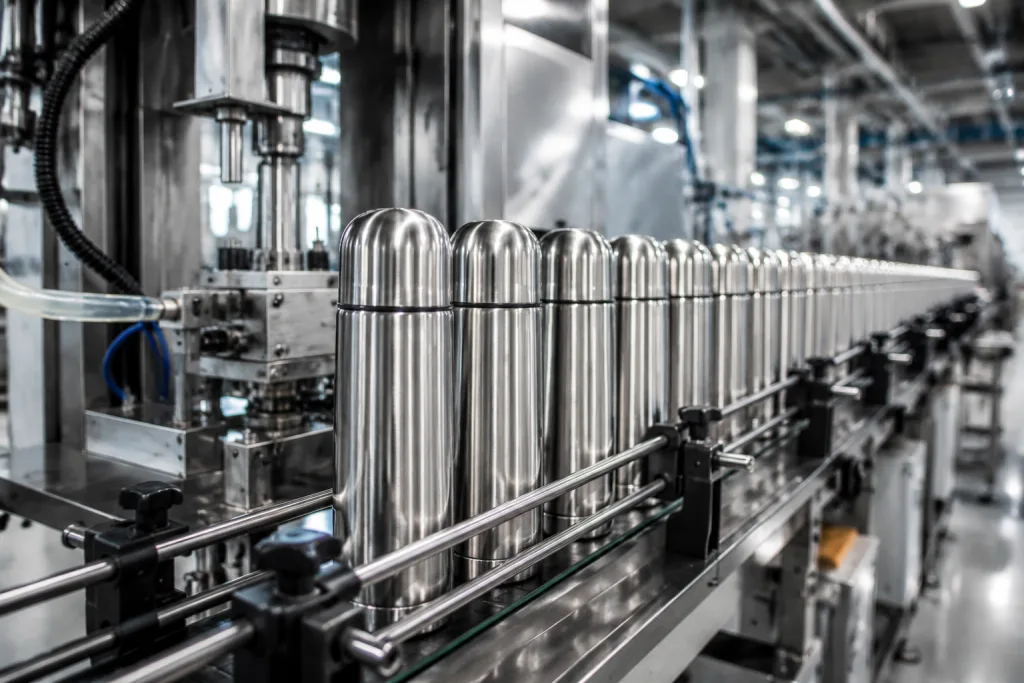
Inspect like complaints are expensive
Final inspection is where you protect your margin. For a 5,000-piece thermos bulk order, we run ANSI/ASQ Z1.4 sampling with general inspection level II unless the buyer’s QC manual says otherwise. A common setup is AQL 0 for critical defects, AQL 2.5 for major defects, and AQL 4.0 for minor defects. Critical defects include sharp metal burrs, unsafe contamination, broken glass-like fragments, or severe leakage. Major defects include failed vacuum performance, leaking lid, wrong logo, obvious coating peel, wrong capacity, or carton shortage. QC pulled 200 pcs from one 5,000 pcs lot last month and found 7 lids with flash on the drinking spout; that is exactly the kind of small plastic edge that becomes an expensive complaint.
Do not rely only on appearance. A decent inspection checklist for a custom thermos should include capacity check with a 1,000 ml measuring cylinder, net weight check on a 0.1 g scale, leak test, lid torque feel, gasket placement, coating defects, logo position, barcode scan, carton drop condition, and temperature retention sampling. That list is not paperwork. It catches real problems. For leak testing, fill with room-temperature water, close fully, invert for 10 minutes, then shake for 30 seconds. For a stricter outdoor product, test 13 samples with hot water at 95°C because heat can soften silicone gaskets and show leaks the cold-water test misses.
Temperature retention testing during final inspection is limited by time, but we still run a 2-hour or 4-hour comparison against the approved sample. For full 12-hour or 24-hour performance, use factory retained samples and periodic lab-style testing with a probe thermometer and room temperature logged at 23°C. If the factory claims every unit is tested for insulation, ask how. This is the wrong question to leave vague. Most factories test by batch, not piece by piece; for example, we may test 80 pcs after vacuuming instead of all 5,000 pcs. That is normal, but it should be stated honestly on the inspection plan.
Carton inspection matters for distributors thermos programs because your product may be handled 4 times before reaching the final buyer. Use 5-layer export cartons for heavier stainless orders. Keep gross carton weight under 15 kg where possible; warehouse staff do not treat overweight cartons kindly. We have seen cartons at 18.6 kg arrive with crushed corners after a Ningbo warehouse transfer. Add carton marks, SKU, PO number, quantity, gross/net weight, and made in China labeling as required by your market. Also check the PO number carefully; one buyer flagged a single digit typo on the side mark and held the shipment for 2 days.
If defects exceed AQL, do not automatically cancel. Ask for sorting, rework, and reinspection. A responsible thermos supplier can replace bad lids, repack cartons, or rework decoration depending on the defect. The math does not work if 320 cartons are already packed and the issue is only 46 loose gaskets. What you should not accept is a vague promise to “pay more attention next time” when the current shipment is still wrong.
Ship with documents ready
Once inspection passes and the balance payment is booked, shipping turns into paperwork and carton control. For FOB China shipments, your forwarder takes over at Ningbo or Shanghai port, but we still issue the commercial invoice, packing list, and carton data with L × W × H in cm plus gross weight in kg. Small errors cause big delays. Last month QC pulled 6 cartons because the PO said “matte black” while the shipping mark file said “mate black,” and the buyer’s forwarder would not accept the draft documents until both matched. If your thermos distributor customer needs HS code review, FNSKU labels, retail barcodes, or a 1.2 m pallet stack plan, lock it before the line seals cartons with BOPP tape.
For North America, most promotional thermos orders over 3,000 pieces move by sea if the retail date allows. A 750 ml stainless flask packed 24 pieces per carton may load roughly 10,000-13,000 pieces in a 20-foot container depending on box size, and 24,000-28,000 pieces in a 40HQ. LCL works for 3,000-5,000 pieces, but carton strength matters because mixed cargo gets hit by forklift forks and hand stacking; we run a 12 kg compression check on suspect cartons before booking. For Amazon-style fulfillment, apply FNSKU labels with a scanner check, not just a visual check, and avoid glossy labels that peel from kraft boxes in humid containers. We have seen this go sideways in July sailings.
For Europe, keep food-contact files clean and named the same way as the order. Buyers may ask for REACH, LFGB, BSCI, ISO 9001 factory documentation, and sometimes packaging waste declarations. Not every thermos manufacturers facility holds every certificate, so ask during quotation, not after mass production. A trading-style thermos vendor may send documents from another plant; the buyer flagged this twice for us when the test report factory name did not match the production site on the carton label. Ask for the business license name, factory address, and test report holder before you approve the PI.
Our Hangzhou advice is simple: plan backwards from the retail date. If you need goods in a European warehouse by September 1, sea freight and customs can consume 35-45 days after vessel departure, sometimes more. Add 35-45 days production, 10 days sampling, and a 7-day buffer for inspection or document corrections. That means serious sourcing starts in May, not late July. The math does not work if the buyer wants a new lid mold, a Pantone powder coat, and a third-party inspection slot inside 18 days; the CNC sample cup alone can take 4-6 days before vacuum testing.
Factory direct does not mean unmanaged. It means fewer people between you and the production decisions. Used well, thermos flask factory direct sourcing gives you tighter control over 304 stainless, lid fit, logo position, and AQL 2.5 QC results. Used casually, it just moves the mistakes closer to you. We ship cleaner when the buyer confirms artwork, carton marks, and document consignee details before the first 500 pieces leave the polishing line.
Send your thermos brief for a factory quote
Share capacity, quantity, logo method, target market, and delivery date. We will return practical specs, MOQ, and FOB pricing options.
Frequently asked questions
What MOQ should I expect for a factory direct custom thermos?
For a standard stainless body with your logo, 1,000-2,000 pieces may be possible, but the unit price is usually higher. For a custom powder-coated color, plan on 3,000 pieces per color because coating lines need setup and color change cleaning. For fully customized thermos packaging, 5,000 pieces is more realistic due to print setup and paper waste. New molds or custom lid tooling normally require 5,000-10,000 pieces to make commercial sense. At BottleForge in Zhejiang, we usually guide new outdoor and promotional buyers toward 3,000-5,000 pieces for the first order, then scale after sell-through data is clear.
How do I compare quotes from different thermos suppliers?
Compare the specification line by line, not just the FOB price. Ask each thermos supplier for steel grade, wall thickness, unit weight, lid material, gasket material, coating type, decoration method, carton specification, testing included, MOQ, lead time, and FOB port. A USD 4.60 quote may not be cheaper than a USD 5.20 quote if it uses thinner steel, 201 outer body, weak cartons, or no inspection support. For a 750 ml custom thermos, a weight difference of 40-60 g is a warning sign. Also confirm whether the quoted price includes logo setup, packaging, and China export cartons.
Is laser engraving better than silk screen for promotional thermos orders?
Laser engraving is more durable because it removes or marks the surface rather than placing ink on top. It is a good choice for outdoor retail, corporate gifts, and long-life promotional thermos programs. The limitation is color: laser usually shows silver stainless or a darker mark depending on coating and settings, not a Pantone ink color. Silk screen is better when you need a white, red, or exact brand color logo, but adhesion and curing must be controlled. For a 5,000-piece order, laser may add around USD 0.08-0.18 per unit, while one-color silk screen is often similar but depends on logo size.
What quality standard should I put on the purchase order?
Use ANSI/ASQ Z1.4 or ISO 2859-1 sampling, general inspection level II, with AQL 0 for critical defects, AQL 2.5 for major defects, and AQL 4.0 for minor defects. Define major defects clearly: leakage, failed insulation, wrong logo, wrong color, coating peel, sharp burrs, incorrect capacity, missing accessories, and incorrect carton marks. Add functional tests such as 10-minute inversion leak test, 30-second shake test, capacity tolerance within 3%, and logo position tolerance within ±2 mm. If your buyer requires stricter terms, share them before production. Changing AQL after goods are packed is a dispute starter.
How long does a thermos flask factory direct order take from China?
For an existing stainless thermos model, expect 7-10 days for decorated pre-production samples and 35-45 days for mass production after approval. Add 3-5 days if custom powder color matching is needed. Sea freight from China to North America or Europe often adds 25-45 days depending on port pair, season, and customs flow. If you need lab testing, add 5-10 working days depending on the test scope. A safe project calendar for a new custom thermos order is 75-100 days from confirmed brief to warehouse arrival. Rush orders are possible, but they reduce your room for proper QC.