Key Takeaways
- Set vacuum performance as a measurable target, such as 95°C water staying above 68°C after 6 hours
- For custom thermos orders, confirm 304 inner steel and 201 or 304 outer steel before quoting
- Use AQL 2.5 for major defects and AQL 4.0 for minor cosmetic defects on distributor thermos orders
- Typical MOQ is 1,000 units per color, with 25-35 days production after sample approval
If you buy for outdoor retailers or promo brands, the danger is not a stainless thermos looking flat in the catalog. The danger is 8,000 units landing with weak vacuum, coating lifting after a 3M tape pull, lids leaking at the silicone ring, or 5-ply cartons crushing under a 12 kg stack in the warehouse. Then the FOB price is the wrong question to ask.
Thermos flask distributors need a sharper brief than “500 ml, logo, black.” A solid China supplier should ask for steel grade, lid drawing with gasket size, coating spec, logo process with artwork tolerance, carton drop height, AQL level, and the exact heat-retention target, such as 95°C water holding above 60°C after 12 hours. At our Hangzhou, Zhejiang factory, QC pulled one pre-production sample last month because the PO said matte black but the approved sample was powder-coated charcoal; that small typo would have gone sideways on the line. Here is how we lock these points before mass production starts.
Vacuum failure starts before assembly
The costliest defect in a bulk thermos order is weak heat retention. No gasket fixes it. No gift box hides it. A stainless thermos needs a clean vacuum gap between the inner and outer walls, and that gap is already at risk during laser welding, vacuum pumping, and copper brazing at the base. If the neck weld pulls by even 0.15 mm on the fixture, the flask can look perfect on the packing table but behave like a normal steel bottle.
For thermos flask distributors, the spec should define the test, not the marketing line. “Keeps hot 12 hours” is the wrong question to ask. A better factory thermos requirement is: fill with 95°C water, close the lid, test at 20°C room temperature, and record water temperature after 6 hours and 12 hours. For a 500 ml customized thermos, a realistic target is above 68°C after 6 hours and above 50°C after 12 hours. Larger 750 ml and 1,000 ml bodies usually perform better because the volume-to-surface ratio gives the vacuum system more room to work. We run this on a digital probe with 0.1°C reading, and buyers have flagged us before when one PO said “500ml” while the artwork file said “17oz.”
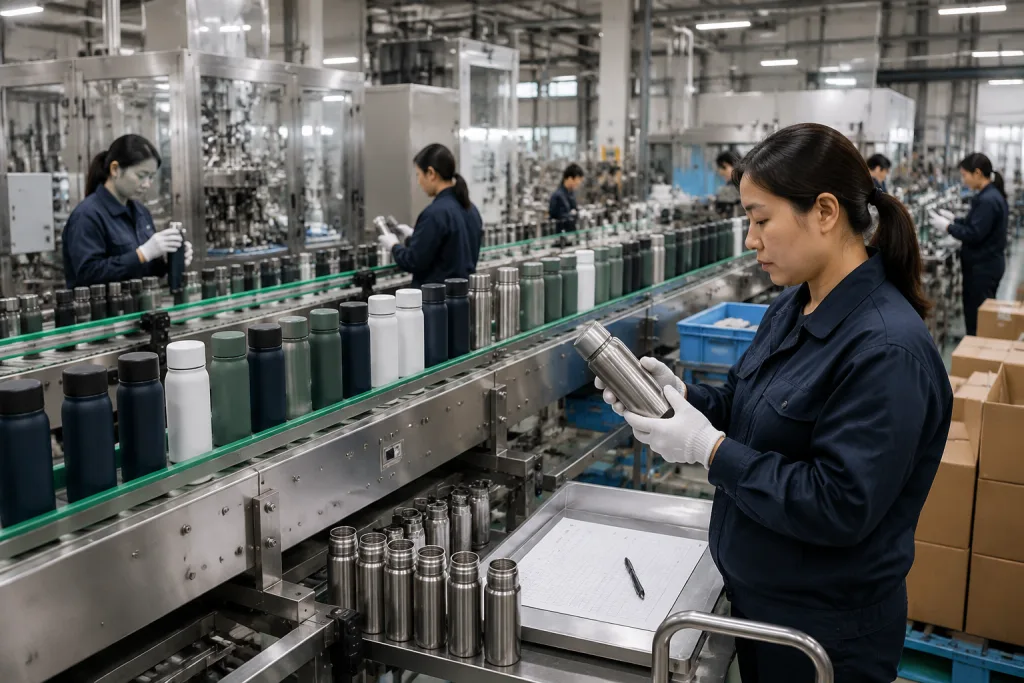
The weak points are usually the bottom seal and neck weld. Ask your thermos manufacturer whether each unit goes through vacuum detection, not only random thermal testing. On a serious China production line, vacuum detection sits inline after base sealing, while hot-water retention is sampled by batch. At BottleForge Industrial in Zhejiang, our stainless thermos line can produce about 300,000 units per month, but we still hold packing release when thermal data drifts 3°C from the last lot. QC pulled the sample last month after the bottom cap showed a faint heat ring under the infrared gun.
Do not approve a pre-production sample if it passes once. Ask for 3-5 samples from pilot production, tested together. If one sample is 8°C lower than the others after 6 hours, you are probably looking at process instability, not bad luck. We’ve seen this go sideways: 20 cartons looked fine in the showroom, then 2,000 cartons created distributor claims after winter retail testing. Catch it before the line prints the carton marks.
Steel grade mistakes are rarely visible
Buyers often write “stainless steel” on the inquiry sheet. That is the wrong spec. A manufacturer thermos can be 304 stainless steel inside with 201 stainless steel outside, or 304 inside and 304 outside. For drinking contact, the inner wall carries the risk. For outdoor retail, 304 inner steel is our practical floor. For premium supplier thermos programs, 316 inner steel is possible, but on our line it normally adds 8-15% cost and pushes MOQ from 3,000 pcs to around 5,000 pcs because we buy the coil separately. QC checks this with an XRF gun, not by eye.
The problem does not always show as rust on day one. We have seen tea staining around the inner seam after 30 dishwasher cycles, metallic odor complaints after the first hot-water rinse, and REACH/LFGB paperwork getting stuck when goods land in Europe. Promotional thermos buyers sometimes accept 201 outside steel to hold price down. Fine. Do not leave the inner grade open. Put “inner: SUS304, outer: SUS201 or SUS304 as quoted” on the purchase order and golden sample form. One buyer once typed “SUS430 inner” on a revised PO; QC pulled the sample before mass production, or that order would have gone sideways.
Wall thickness matters too. A typical 500 ml thermos custom body uses roughly 0.4 mm inner wall and 0.5 mm outer wall before forming, depending on the shape. We check coil thickness with a digital micrometer before drawing. Thin material can cut USD 0.10-0.20 per unit, but the math does not work if 2% of cartons arrive with dents. Polishing pressure, powder coating hooks, and truck loading all punish weak outer shells. If you sell to outdoor retailers, dent resistance is not a luxury feature. It affects returns.
Ask the thermos supplier for material test reports and tie them to the batch number on the carton mark. If the order is for the EU, request LFGB or relevant food-contact documentation. If it is for North America, check FDA food-contact expectations and any client-specific requirements. A reliable thermos factory should be comfortable with third-party testing, BSCI audit files, and ISO 9001-style traceability. We ship files with the lot record, usually 6-8 PDFs per order. If a thermos vendor refuses to state steel grade on the proforma invoice, treat that as a warning, not a negotiation tactic.
Lids leak when briefs stay vague
Lid complaints beat body complaints on our export orders by about 4 to 1. A flask can pass the 95°C thermal hold test and still leak in a backpack because the cap thread, gasket, stopper, or pour spout was picked to save USD 0.12, not to match the buyer’s channel. We see this on the line when QC pulls 20 samples and finds water sitting on the thread shoulder after inversion. Outdoor retailers usually care about one-hand opening, glove grip, and a lid that survives a 1.2 m drop. Promotional buyers usually want a flat logo pad and a lid cost that keeps the quote under target. Same bottle body. Different lid job.
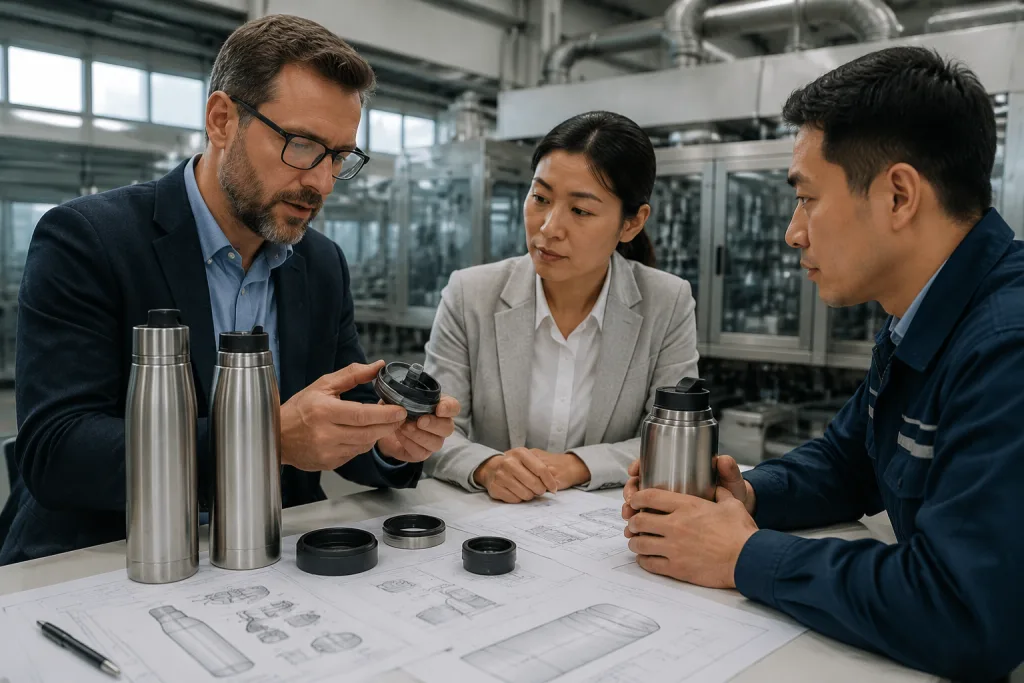
For a custom thermos, lock the lid type before we cut the sample tooling: screw cap, cup lid, push-button pourer, straw lid, or handle lid. Each one fails in its own way. Push-button pourers trap tea and milk powder around the spring seat; one German buyer flagged black residue after 3 cleaning cycles. Straw lids sell well for office use, but the heat-retention math often drops by 2-4 hours against a sealed cup lid. Cup lids are plain and dependable, but the PP insert must sit tight enough that it does not rattle after drop testing; our QC uses a 0.05 mm feeler gauge on the cap fit when the sample feels loose. Silicone gaskets should be food-grade, removable where the structure allows it, and controlled for hardness. Shore A 50-60 is a common range for sealing parts, but the drawing decides the final number.
A leak test does not need fancy lab gear. Fill the flask with room-temperature water, close the lid, invert it for 10 minutes, then shake it 30 times and check the thread, cap joint, and air vent with a dry tissue. We run this beside the packing table before pre-shipment inspection, usually on AQL 2.5 samples pulled from finished cartons. For travel and e-commerce orders, add carton vibration or a 76 cm drop simulation. If you sell thermos bulk into online channels, ask the wrong question and you get burned: “Did it pass in the factory?” matters less than “Will it survive 6 parcel handovers and a courier throwing it onto concrete?”
For thermos distributors, spare parts belong in the lid spec, not in a panicked email 45 days later. Ask your thermos suppliers to quote extra gaskets at 1-2% of order quantity and extra lids if your after-sales policy needs them. We had one PO where the buyer typed “extra gifts” instead of “extra gaskets,” and nobody caught it until packing list review; that tiny typo turned into 12 cartons reopened on the line. A USD 0.18 gasket shortage can become a customer service problem across three countries. Plan the parts upfront, because air freight from China for a bag of silicone rings is where the math doesn’t work.
Coating defects punish weak artwork files
Coating defects usually start before the bottle reaches the spray booth. Powder coating, spray painting, and printing all punish weak artwork files and loose color notes. A matte black customizable thermos sounds easy, but black shows 0.2 mm dust spots, oil fingerprints from packing gloves, sleeve scratches, and uneven oven curing. White shows yellowing and pinholes. Metallic colors shift between batches; we once had a buyer flag a champagne gold lid that was 1 shade warmer than the body under a D65 light box. If the flask goes on a retail shelf, use a stricter coating standard than a 7-day event giveaway. The math doesn’t work if you inspect retail goods like promo stock.
For a distributor thermos program, define color with Pantone for printing and a physical color chip for coating where you can. Digital renders are not enough. We run powder coating thickness around 60-90 microns on most bodies, checked with a coating thickness gauge before assembly. Too thin, and the body scratches after 3 passes in a carton rub test. Too thick, and the mouth area or base edge can chip when the line presses in the plastic base ring. Ask for cross-hatch adhesion testing, alcohol rub testing for printed logos, and a sample scratch test with a named tool, such as a 3M tape pull or 1 kg load scratch pen. “Looks durable” is not a QC method.
Logo method should match how the bottle will be used. Laser engraving is clean and durable on powder-coated bodies, but it cuts through to the metal or underlayer, so some brand colors look wrong after engraving. Silkscreen works well for 1 or 2 colors, often around USD 0.05-0.12 per print depending on size and quantity. Heat transfer handles gradient artwork and wrap graphics, but QC needs to pull samples after curing and check the edge lift with tape. For promotional thermos campaigns with individual names, digital print or laser personalization can work, but lead time and sorting control matter more; we’ve seen this go sideways when a PO had “Micheal” instead of “Michael” on 48 pieces.
One practical rule: approve a logo position jig before mass production. If your artwork says the logo is centered but the bottle has a tapered body, operators need a fixture, not judgment. A 500 ml flask with a 72 mm bottom diameter and 65 mm shoulder will visually move the logo if the jig is wrong by 2 mm. Thermos manufacturers hold better consistency when the brief includes print height from base, logo width in mm, rotation tolerance, and acceptable color deviation. QC pulled the sample for this exact issue last month: every carton was sellable, but the logo line drifted around the curve. That is the wrong problem to fix after packing.
Cartons fail after the factory gate
About 6 out of 10 thermos flask distributors we meet check the bottle carefully, then leave the export carton as “standard carton” on the PO. Bad call. A stainless thermos is heavy for its size; a 500 ml bottle with cup and color box can push the carton load faster than buyers expect. If the board is weak, the shipment looks clean at loading, then lands with crushed corners, rubbed coating, and dented cups. We saw this on a Ningbo container last winter: QC pulled the sample carton, the bottles passed AQL 2.5, but the outer carton corner collapsed after two forklift moves. The bottle was acceptable. The packing failed.
For FOB China shipments, our normal retail pack is polybag or tissue wrap, egg-crate divider or paper sleeve, color box if the buyer needs shelf display, then master carton. For Amazon-style cartons or parcel-heavy channels, the math changes. Stronger board, tighter fit, and cleaner label control are not optional. If FNSKU labeling, suffocation warnings, or carton size limits apply, put those lines into the packing instruction before sampling; we once had a PO typo showing “FNSK” and the buyer flagged it only after mass production. Reworking 18,000 labels after packing takes 2 days if the line is free, 5 days if it is not.
Specify carton material in terms the factory can test. “5-ply export carton” is not enough. Call out flute type, burst strength, and target gross weight, then ask the supplier to confirm with a carton scale and caliper reading in mm. For 500 ml stainless thermos flasks, 24 units per master carton is common. If gross weight goes above 14-16 kg, review the carton size and board strength before you approve packing. Ask for a 1.2 m drop test on a packed carton if the goods will enter e-commerce distribution. For palletized distributor thermos shipments, compression strength and stacking pattern matter more; we run a simple stack check in the warehouse, because a neat carton drawing does not always survive 3 layers on a hot container floor.
Packaging changes landed cost, so “cheapest box” is the wrong question to ask. A color box may add USD 0.18-0.45 per unit depending on paper, print, and inserts. Foam protection improves survival, but European buyers push back on it hard, especially outdoor brands selling through eco-positioned channels. Molded pulp costs more than thin dividers, yet it gives a cleaner unboxing and fewer rub marks on powder-coated bottles; our line usually sees the difference when QC checks the black samples under a 6500K light booth. A good thermos supplier should help you balance damage rate and freight efficiency, then make the brand presentation fit the channel.
Inspection plans need defect definitions
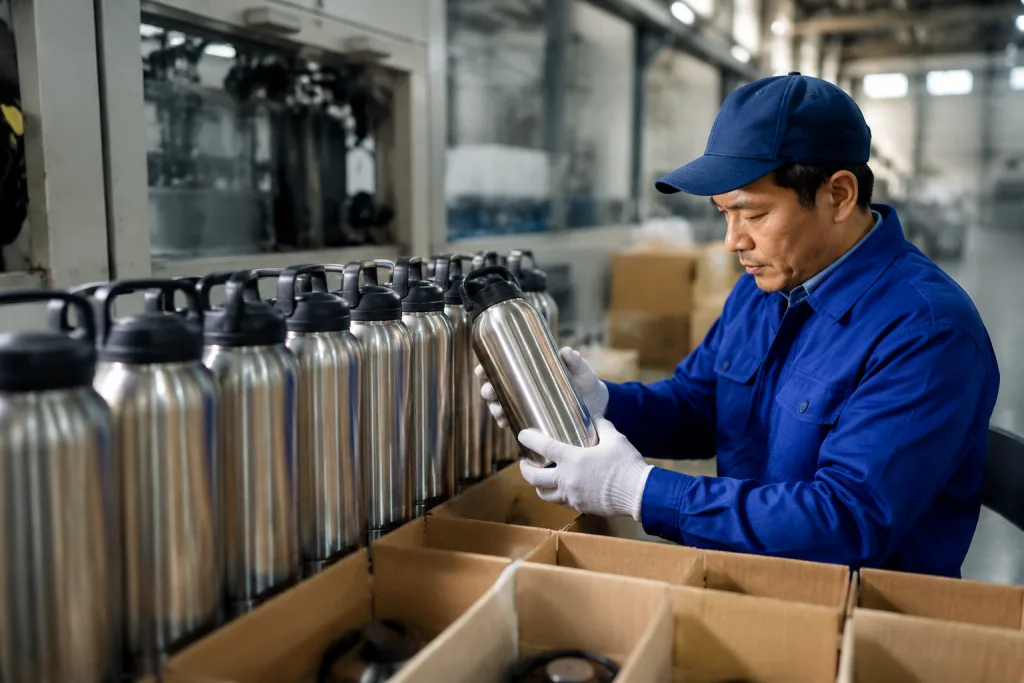
An AQL inspection only works when the defect book is written before the line starts. If the QC checklist says “surface must be good,” the inspector is guessing, and we have seen this go sideways at 2 a.m. before loading. For thermos distributors, lock critical, major, and minor defects before production, preferably with photos and a 0.5 mm / 1.0 mm scratch limit on the signed sample. Critical defects include sharp mouth edges that cut a cotton swab, oil or black dust inside the flask, wrong food-contact material, or leakage after the lid is torqued down. Major defects include failed heat retention, wrong logo height, peeling powder coat after 3M tape pull, lid button jamming, or a dented body. Minor defects include 2 dust points under the clear coat, small color drift against the Pantone chip, or hairline scratches inside the agreed size limit.
A common inspection setting is AQL 0 for critical, 2.5 for major, and 4.0 for minor defects. For a 5,000-unit thermos bulk order, the inspector may check around 200 units depending on the selected inspection level; on our floor, QC usually pulls the cartons with a random-number sheet, not from the top pallet only. Thermal testing is sampled separately because it takes hours. Don’t ask final inspection to test every unit for 12 hours. The math doesn't work, and the buyer will still be waiting while the truck sits at Gate 3. We run inline vacuum checks, production thermal sampling, then final visual and mechanical inspection with a leak-test jig.
Pre-shipment inspection should include capacity check, weight check, logo position, barcode scan, lid assembly, leak test, smell test, coating adhesion, carton markings, and quantity verification. Make each point measurable: 500 ml fill line within ±5 ml, body weight within the approved sample tolerance, logo centered within 1.5 mm, and EAN barcode readable on the handheld scanner. QC pulled a sample last month where the PO had “matte balck” instead of “matte black,” and the buyer flagged the carton label after 36 cartons were packed. If your customer needs REACH, LFGB, ASTM, or California Proposition 65 documentation, collect it before the balance payment. Chasing documents after the vessel departs from Ningbo or Shanghai is possible, but it is a bad habit.
The best suppliers thermos buyers work with do not argue against inspection. They prepare for it. At our Hangzhou, Zhejiang facility, we prefer buyers to send the QC checklist before the pre-production meeting, with the approved sample on the table and a caliper next to it. It saves time and prevents emotional debates at final inspection. A thermos manufacturer that only talks about price but not AQL is not ready for serious distributor business.
Price gaps hide production choices
If one thermos vendor quotes USD 3.10 and another quotes USD 4.25 for the same-looking 500 ml flask, the higher price is not always margin padding. This is the wrong question to ask from a photo. Ask what changed in the build: 304 inner wall versus cheaper substitute, 0.38 mm body wall versus 0.32 mm, PP lid plastic versus Tritan, powder line curing time, 5-layer export carton, AQL 2.5 inspection, and whether the supplier priced 30% deposit or a softer payment term. We had a buyer flag a USD 0.42 gap last March; QC pulled the sample and found the low quote used a lighter lid gasket and a 12 kg carton that crushed at the corner drop test. Thermos flask distributors should compare a costed specification, not a catalog photo.
For reference, a 500 ml stainless steel custom thermos with 304 inner wall, 201 outer wall, powder coating, one-color logo, and standard color box often lands in the USD 3.20-4.80 FOB range at 3,000-10,000 units, depending on shape and order timing. A heavier 750 ml outdoor model with handle lid and stronger packaging can move into the USD 5.20-7.50 FOB range. These are not promises. They are practical bands for early budgeting. On our Hangzhou line, the same 500 ml body may run through a 180°C powder-coating oven, then sit for adhesion testing with 3M tape; skipping that test saves minutes, not a claim headache.
MOQ depends on customization. For stock color with logo, 500-1,000 units can be workable. For custom coating color, expect 1,000 units per color. For new mold or unique lid structure, 3,000-5,000 units is more realistic because tooling, leak testing, and line setup need to be spread across enough pieces. The math does not work on 300 pieces with a private lid mold. Lead time is usually 7-10 days for a sample and 25-35 days for mass production after deposit and sample approval. Peak season before Q4 can add 7-15 days; last year one PO had “matte black” typed as “matt black,” and that small typo cost 2 days while the color chip sat on the merchandiser’s desk.
Payment and incoterms matter too. FOB Ningbo or FOB Shanghai is common for Zhejiang suppliers. If you need DDP delivery into the US, Canada, Germany, or the UK, make sure the quote spells out duties, anti-dumping checks, insurance, and last-mile rules. We have seen this go sideways when a buyer assumed DDP covered Amazon appointment fees; the forwarder did not. A clean manufacturers thermos quotation should list material, capacity, decoration method, packing detail, MOQ, lead time, sample cost, tooling cost if any, and inspection assumptions. Without those details, you are not comparing suppliers; you are comparing guesses.
Send your thermos spec before you lock pricing
We will review material, lid, coating, packing, MOQ, and QC risks before quoting your next stainless thermos order.
Frequently asked questions
What MOQ should thermos flask distributors expect for custom stainless thermos orders?
For a logo-only custom thermos using an existing factory model, 500-1,000 units is often workable, especially if you accept available colors. For a custom coating color, plan around 1,000 units per color because paint setup and color matching take time. For a new mold, special lid, or fully customized thermos shape, 3,000-5,000 units is more realistic. Some thermos suppliers will advertise 100-piece MOQ, but the unit price, color control, and packaging options are usually weaker. If you need retail packaging, barcode labels, and AQL inspection, do not build your costing around micro-MOQ samples.
How do I compare quotes from different thermos manufacturers fairly?
Build a one-page comparison sheet. Include capacity, inner and outer steel grade, wall thickness, lid material, gasket material, coating type, logo method, retail box, master carton, testing documents, MOQ, lead time, and FOB port. A USD 0.60 price gap can be explained by 304 outer steel instead of 201, stronger carton board, or better coating. Ask every thermos manufacturer to quote the same spec and state exclusions. If one quote does not mention AQL, REACH/LFGB options, or packaging details, you are missing cost variables. Photos alone are not a reliable basis for bulk thermos buying.
Which logo method is best for a promotional thermos?
For simple one-color logos, silkscreen is usually the cheapest and works well on smooth coated bodies. Typical cost can be USD 0.05-0.12 per unit depending on logo size and order quantity. Laser engraving costs more but is more durable and looks professional on powder-coated stainless thermos flasks. Heat transfer or UV print is better for gradients, multi-color artwork, or retail graphics, but adhesion testing is important. For promotional thermos campaigns under 2,000 units, avoid overly complex decoration unless the deadline has enough room for samples, approval, and rework if the first print is wrong.
What certifications should a thermos supplier provide for Europe and North America?
For Europe, ask about LFGB food-contact testing, REACH compliance for restricted substances, and packaging material declarations if your retailer requires them. For North America, FDA food-contact expectations and client-specific Proposition 65 screening may apply. If the product is for children, additional ASTM or CPSIA-related checks may be needed depending on design and market. Factory-level documents such as BSCI audit reports and ISO 9001 certificates are useful, but they do not replace product testing. Tie every test report to the actual material, coating, and gasket used in your production batch, not just an old sample from another order.
How long does a customized thermos order take from sample to shipment?
For an existing thermos factory model with logo, a realistic timeline is 7-10 days for sample preparation after artwork confirmation, then 25-35 days for mass production after deposit and sample approval. Custom coating colors may add 5-10 days for color matching and approval. New mold work can add 20-45 days before production, depending on body shape and lid complexity. Sea freight from China to Europe or North America is separate and can range from about 25-45 days port to port. If you need Q4 retail stock, start the project at least 90 days before the required warehouse date.