Key Takeaways
- Start RFQs with 304 inner steel, 201 or 304 outer steel, capacity tolerance, lid type, and target FOB price within USD 0.20
- Expect 7-10 days for standard custom thermos samples and 18-25 days for new mold or special cap development
- For a distributor thermos order, use AQL 2.5/4.0 and confirm 100% vacuum testing before final inspection
- BottleForge Zhejiang capacity is about 650,000 stainless vacuum units/month with practical MOQ from 1,000 pcs/SKU
If you are a thermos flask distributor selling to outdoor retailers or promotional brands, price is the wrong first question. The real risk is a 0.3 mm wall spec written as “standard,” samples promised in 7 days that need 12, cartons that fail a 76 cm drop test, and a factory that says yes before checking whether your cap tooling, powder coating, and laser logo can run on the line.
At BottleForge Industrial in Hangzhou, Zhejiang, we run into this every week. A 5,000 pcs thermos order looks clean in Excel, then QC pulls the sample and finds the PO forgot 304 stainless inside, vacuum hold hours, coating thickness, insert card size, LFGB wording, or AQL 2.5 terms. Lock those items before sampling. This guide shows the sourcing path from RFQ to samples to thermos bulk production, with the line items we want buyers to put in writing.
Start with an RFQ that factories can price
A clear RFQ saves more money than another round of price squeezing. Ask five thermos suppliers for “500 ml stainless flask with logo” and you will get five numbers that do not line up. We see this every week. One factory prices 201 outer steel with a 45 μm powder coat, one prices 304/304 stainless, and another quietly deletes the spare silicone ring to make the FOB look USD 0.08 lower. QC pulled a sample last month where the outer wall measured 0.38 mm on the digital caliper against a quoted 0.5 mm. The buyer flagged it.
For a thermos flask distributor, write the RFQ like the first draft of the purchase order. Include capacity, shelf-fit dimensions, target channel, insulation claim, lid structure, color count, logo method, packaging, destination port, and the compliance market. If the flask is going to outdoor retailers, say whether it must fit a 72 mm car cup holder or a backpack side pocket. If it is a promotional thermos program, give the logo size in mm and tell us if the buyer expects a gift box with barcode sticker. Small detail, big difference. We had one PO typo list “matte black” while the artwork said “pantone 426C,” and the line stopped for 6 hours before packing could restart.
Your RFQ line items should include: capacity such as 500 ml, 750 ml, or 1,000 ml, with carton quantity if warehouse weight matters; steel such as 304 inner and 201 outer, or 304 inner and 304 outer, because the price gap is not cosmetic; wall thickness such as 0.4 mm inner and 0.5 mm outer, checked by caliper before mass production; finish such as powder coating for retail color work, spray paint for lower MOQ color matching, mirror polish for classic models, or matte polish for fingerprint control; lid such as screw cap, cup lid, push-button stopper, or handle cap, with spare gasket requirement stated; and logo such as laser engraving, one-color silk screen, UV print, or embossing, with artwork size and position marked on the dieline.
Ask for FOB Ningbo or FOB Shanghai if you source from Zhejiang, China. Hangzhou can ship through both lanes, but we run Ningbo more often for full-container thermos orders because the loading schedule is steadier and the warehouse team knows the carton stack pattern. If your target is USD 3.20 FOB for a 500 ml factory thermos, say it upfront. This is the wrong question to hide. A serious thermos manufacturer will tell you whether the math works by changing the lid, coating thickness, carton pack, or steel grade, instead of letting the gap show up after sample approval.
Turn requirements into PO line items
After the first quotation passes your cost target, turn the buying notes into PO lines. This is where 6 out of 10 distributor thermos projects get messy. We’ve seen a buyer approve a good sample, then send a PO that only says “customized thermos bottle, black, logo printed.” The line can’t work from that. Our material clerk has to choose coil thickness, carton spec, insert tray, and lid packing from the PO, not from a WhatsApp photo.
Your PO should name the exact model number, capacity, unit weight tolerance, stainless grade, cap material, silicone grade, coating color code, logo file version, and packaging structure. If you sell in the EU or North America, put REACH, LFGB, FDA food-contact requirements, or California Proposition 65 requirements on the line item where they apply. For kids or family outdoor channels, ask before sampling whether ASTM or CPSIA applies if the item could be sold as a children’s product. QC pulled one sample last month where the silicone ring was marked “food grade” in email, but the PO had no grade listed; that becomes a dispute, not an inspection point.
For a custom thermos PO, write the decoration method like the operator will read it at the laser machine. “Laser logo 35 mm wide on front center, vertical tolerance ±2 mm” beats “logo on bottle” every time. For silk screen, specify Pantone color, print area, and curing requirement. For powder coating, list the color code and whether the surface needs a 3M tape adhesion test or cross-hatch test. If a customizable thermos has 3 lid colors across 2 body colors, show which lid goes with which body and which carton mark; we’ve seen this go sideways when the buyer flagged mixed lids only after the first 24 pcs/export carton was packed.
A practical PO line set might include: item BF-T500, 500 ml vacuum flask, 304 inner/201 outer, 0.4/0.5 mm wall, black powder coating, laser logo, PP lid with food-grade silicone ring, individual kraft box, 24 pcs/export carton, AQL 2.5 major and 4.0 minor, 100% vacuum test, FOB Ningbo, 30% deposit and 70% before shipment. This is not paperwork for fun. It is margin control. If the PO misses the vacuum test or carton count, the math doesn’t work when a 1,200 pcs order needs rework 3 days before vessel closing.
Sample before you sell the program
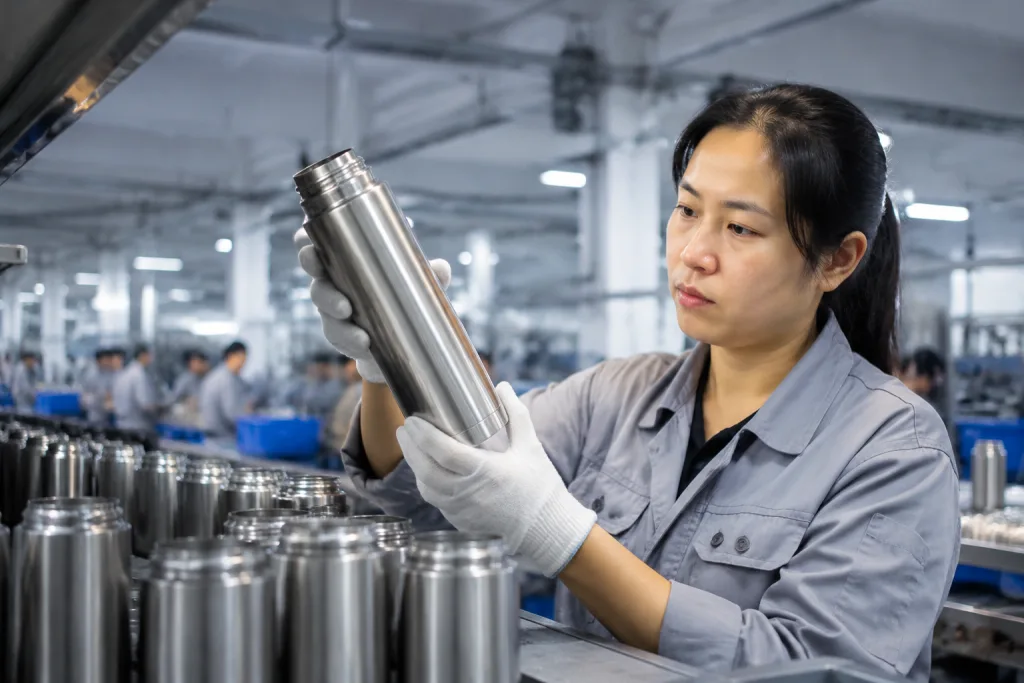
Do not book a retail program or promo campaign from a render. Wrong question. A rendered stainless flask will not show the drinking angle when the cup is tilted, whether the handle flexes under 3 kg pull, or whether the powder coat has that dry “cheap” feel buyers complain about in hand. For standard models at our Zhejiang factory, pre-production samples normally take 7-10 days after artwork confirmation; we run the first check with a caliper on the lid gap and a simple hot-water smell test. If you request a new lid mold, special stopper, or unusual shape, plan for 18-25 days before a usable sample is ready.
Ask for two sample rounds. Start with a blank engineering sample to check structure, weight, lid fit, odor, and insulation. Then approve a decorated sample with your logo and final finish, because a 0.8 mm logo shift looks small on PDF but obvious on a 500 ml bottle shoulder. If you are a promotional thermos buyer handling 8 or 10 end-client approvals in one month, get at least 2-3 decorated samples: one stays with you, one goes to the client, and one stays at the thermos factory as the production standard. QC pulled the sample once because the PO said matte black, while the buyer’s sample was satin black.
Test samples like a buyer, not like a photographer. Fill the flask with 95°C water, close it for 6 hours, then record temperature with a probe thermometer before anyone opens the lid twice “just to check.” For many 500 ml stainless vacuum flasks, a normal target is above 65°C after 6 hours, depending on mouth diameter and cap design. Check leakage by filling the bottle, closing it, placing it horizontally for 30 minutes, then shaking it 20 times; we have seen this go sideways when a silicone ring was seated 1 mm proud. Check coating by rubbing the logo area and edge zones, not only the center body.
Put the approved sample reference into the PO. Use wording such as “bulk production must match approved sample dated 12 May, including coating texture, logo position, lid fit, and carton layout.” A thermos vendor can only control what is defined, and the math does not work if the buyer changes artwork after we already ordered 12,000 printed cartons. If you change artwork after sample approval, reset the approval clock and confirm whether the unit price or lead time changes. Simple, but it saves arguments.
Price the bulk order honestly
Thermos bulk pricing is a stack of material, process, packaging, inspection, and freight assumptions. If one quote comes in 12% under the other 3 suppliers, check the missing line item before you celebrate. We see the same cuts on the factory floor: 0.38 mm outer wall changed to 0.32 mm, 201 stainless used outside instead of 304 stainless, paint film dropped from 55 μm to 35 μm, K=K carton swapped for a lighter carton, spare gasket removed, or vacuum rejects priced as if the line will run at 100%. It won’t. QC pulled 46 weak-vacuum samples from one 3,000 pcs run last spring, and the math did not work.
For distributor thermos sourcing, MOQ depends on how far you move away from the stock model. At BottleForge Industrial in Hangzhou, China, we run 1,000 pcs per SKU for standard stainless vacuum flask models with one logo and one color. For custom Pantone powder coating, plan on 2,000-3,000 pcs/color because the coating booth, cyclone filter, and spray guns lose powder during color change. For a new cap mold or body shape, the economic order is often 5,000-10,000 pcs because tooling, CNC fitting, and 2 trial runs need to be spread across enough pieces. Asking for 800 pcs with 4 colors sounds flexible; on the line it is just expensive.
Ask the thermos manufacturers to split tooling, sample, unit, and packaging costs. A clean quotation might show USD 3.65 FOB Ningbo for 3,000 pcs of a 500 ml customized thermos, USD 80 for laser sample setup, USD 180 for Pantone coating sample, and USD 0.18 per unit for a color gift box upgrade. Short quote, less trouble. If you need an Amazon or retail warehouse program, confirm barcode labels, master carton marks, pallet height, and any FNSKU or retailer label requirements before the final price is locked. We once had a PO typo, “FNSKQ” instead of FNSKU, and the buyer flagged it only after carton printing.
Payment terms change the price. For new customers, 30% deposit and 70% balance before shipment is standard in China. LC at sight works for larger accounts, but the bank charges and document checking add cost, often 5-7 days before we can release the BL. If you need 60-day credit on a first order, do not expect the lowest FOB price from a manufacturer thermos supplier. Someone has to finance the 304 stainless coil, gift box deposit, line workers, and export cycle. This is the wrong question to ask if the target price already leaves no room for cash flow.
Control production before final inspection
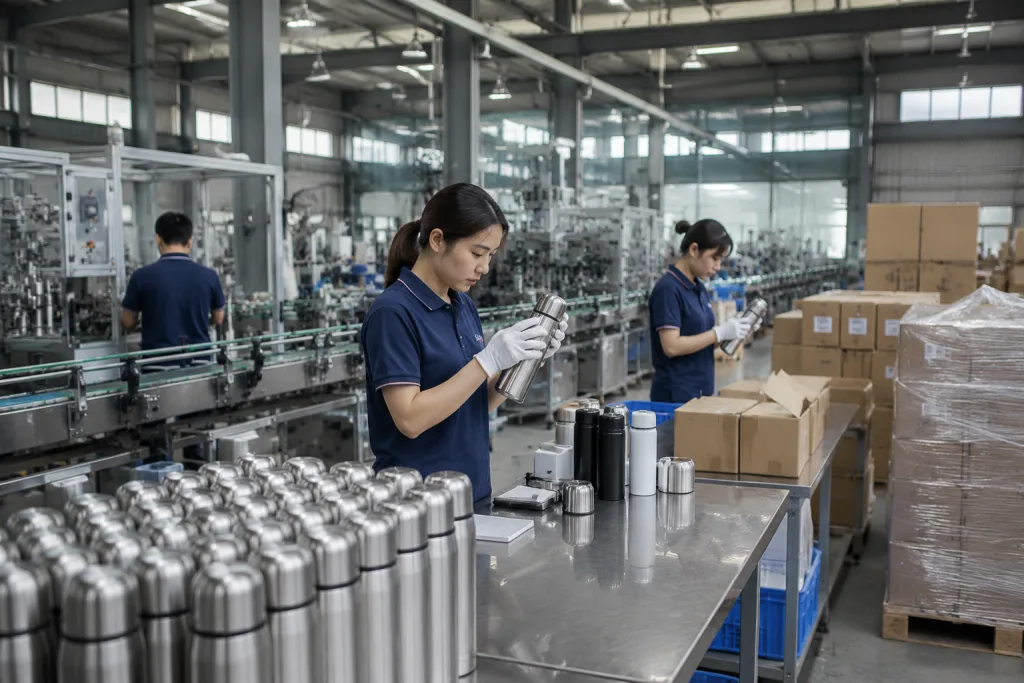
Bulk production should never feel like a sealed carton. A solid thermos manufacturer should confirm material arrival, tube forming, welding, vacuuming, polishing, coating, printing, assembly, and packing status. For a 3,000-10,000 pc supplier thermos order, we normally send 6 checkpoint photos: 304 stainless coil label, welded inner tanks, vacuum oven loading, powder coating panels, logo trial print, and pre-pack cartons on the line. No daily essay needed. You do need a production calendar with dates, not “soon.”
Typical lead time for a standard custom thermos order is 30-40 days after deposit and sample approval. Before Q4 retail delivery, 45-55 days is more honest, because coating rooms and gift box vendors get full fast. If the supplier promises 20 days for a fully customized thermos with Pantone coating, gift box, and logo, ask which machines and workers are already reserved. This is the wrong question to ask: “Can you rush it?” Ask for the slot. BottleForge’s stainless line in Zhejiang runs about 650,000 vacuum units per month, but a matte black 500 ml run still waits behind coating color changes, cap assembly, and carton delivery. Last October, one buyer flagged 12 days vs 18 days on the PO, and the carton supplier was the bottleneck, not the bottle line.
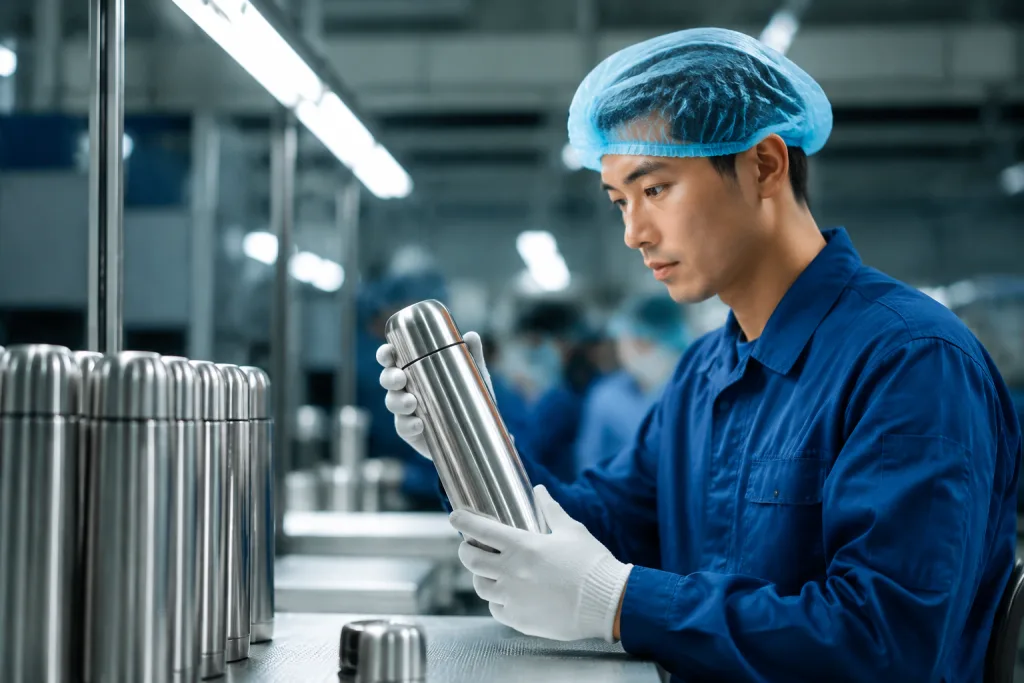
Insist on in-process controls, especially for vacuum performance and leakage. Stainless vacuum flasks are not simple plastic bottles. Once insulation fails, repair makes no commercial sense. Good factories run vacuum tests before final packing and pull weak units before they reach cartons. Ask whether testing is 100% or sampling-based. For distributor thermos programs, I prefer 100% vacuum testing plus random finished-goods inspection; our QC team uses a water bath leak test and keeps failed samples in a red bin beside the packing table.
Use AQL terms in the PO. A common setup is AQL 2.5 for major defects and AQL 4.0 for minor defects under ANSI/ASQ Z1.4 or ISO 2859-1 sampling. Define critical defects as leakage, sharp burrs, wrong material, unsafe odor, severe logo error, and failed insulation. Minor defects can be small dust points under 0.5 mm, light carton scuffs, or slight color variation within the approved range. The math does not work if everyone argues after cartons are sealed. Make acceptance measurable, then QC pulled the sample has a clear answer instead of a debate.
Ship cartons your customers can handle
A thermos promotional order can pass AQL 2.5 product inspection and still get the buyer angry if cartons land crushed or the carton mark will not scan in their warehouse. We have seen this go sideways. For stainless flasks, we usually run 1 pc in a polybag or tissue wrap, 1 pc in a white box or kraft box, then 24 pcs per five-layer export carton. Heavier 1,000 ml models should move to 12 or 18 pcs per carton; once gross weight passes 14 kg, the line workers and the retailer’s warehouse both start complaining.
Put carton strength into the PO, not in a WeChat message after production starts. A five-layer K=K or K=A carton holds up better than a light domestic carton; QC pulled one 29 kg sample carton last year and the corner failed after a 60 cm drop test. If the product is going to outdoor retailers, confirm whether the inner box needs a retail barcode and country-of-origin marking, then check recycling marks or multilingual warnings against the buyer’s artwork file. For promotional brands, ask about neutral cartons, project codes, and whether the factory name must stay off the outside.
Shipping terms should match how your team actually buys. FOB Ningbo is common if you already have a forwarder and can handle the booking. EXW looks cheaper on the quote sheet, but the math often does not work after Hangzhou local trucking, export declaration, and port handling are added. DDP works for 200 sample sets or a small urgent replenishment, but it hides cost and gets messy for regular wholesale programs. For North America and Europe, most thermos distributors we ship to use FOB for containers and DAP/DDP only for samples or small replenishment shipments.
Before shipment, ask for final inspection photos, carton marks, gross weight, net weight, carton dimensions, packing list, commercial invoice, and bill of lading draft. Check the carton label line by line; we once caught a PO typo where “750 ml” was printed as “570 ml” on 96 cartons, and fixing it before loading took 2 hours with new A4 stickers. If you sell to chain retailers, review documents before the vessel leaves China. Correcting carton marks or invoice descriptions after arrival takes 12 days vs 1 day at the factory, and the warehouse charge is avoidable.
Build a repeatable distributor file
Your first order should leave behind a sourcing file that makes order No. 2 faster. Put the approved sample, locked artwork, PO, inspection report, carton mark, test reports, and supplier notes in one folder; we label ours by model code and PO number, then keep one sealed sample on the QC rack. If you reorder 6 months later and only write “same as last time,” you are asking sales, engineering, purchasing, and the line leader to remember the same details. We’ve seen this go sideways. One buyer once sent a repeat PO with the old Pantone code still typed as “Panton 286C,” and QC pulled the sample only after the first 300 bottles had passed coating.
For a thermos flask distributor, the repeat order needs a controlled spec sheet, not a long email chain. Include the model number and revision date; steel grade and capacity; color chip or Pantone code; logo method with print size in mm; packaging drawing; compliance market; AQL 2.5 inspection level; shipment terms. If the buyer shifts from outdoor retail to a promotional giveaway, create a new revision. Don’t overwrite the old one. A promotional thermos can run with a plain white box at 500 pcs MOQ, but the logo color usually gets tighter scrutiny because the end customer approved a brand deck. A retail customized thermos needs stronger shelf display, barcode placement within 2 mm, and carton drop-test notes before we book packing materials.
Check sell-through and returns before you reorder. Simple step. If returns mention leakage, ask the factory to inspect cap torque with a torque meter, silicone ring hardness on a Shore A gauge, and thread tolerance with the mating cap fitted 10 times. If complaints mention chipped coating, raise the coating test requirement or remove sharp lower edges; the math doesn’t work if you save USD 0.06 on coating and lose 4% to claims. If customers like the 500 ml size but complain about the cup lid, move the next PO to another cap instead of changing the whole bottle and creating fresh tooling risk.
The target is not to hunt for new thermos suppliers every season. The target is to make one capable thermos factory understand your channel well enough to cut mistakes. A stable China supplier thermos relationship beats annual supplier hopping when your customers expect the same hand feel, color, and packaging from one delivery to the next. On our line, a 0.3 mm change in lid fit can trigger a buyer complaint even when the bottle still passes leak testing. Small details travel.
Send your thermos RFQ for factory review
Share capacity, logo, finish, quantity, and destination. We will return a practical FOB quote, sample plan, and production timeline.
Frequently asked questions
What MOQ should a thermos flask distributor expect for custom stainless flasks?
For standard stainless vacuum flask models, a realistic MOQ is 1,000 pcs per SKU with one logo and one body color. If you need custom Pantone powder coating, many China factories require 2,000-3,000 pcs per color because coating line changeover creates waste. New mold projects, especially custom caps or unique bottle shapes, usually need 5,000-10,000 pcs to make tooling economical. If a thermos vendor offers 300 pcs with full customization, check whether it is using stock color, manual decoration, and higher unit pricing.
How long does a custom thermos sample and bulk order usually take?
For an existing stainless thermos model, blank samples usually take 3-5 days and decorated samples take 7-10 days after artwork approval. New cap molds, new stopper structures, or special shapes can take 18-25 days before a reliable pre-production sample is ready. Bulk production for 3,000-10,000 pcs normally takes 30-40 days after deposit and sample approval. During September to November shipping pressure, plan 45-55 days. Add ocean transit separately: roughly 25-35 days to many North American ports and 30-40 days to Europe.
Which stainless steel grade should I specify for a distributor thermos program?
Most stainless vacuum flasks use 304 stainless steel for the inner liner because it contacts drinks and has better corrosion resistance. The outer shell can be 201 or 304 stainless. A 304/201 structure is common for price-sensitive promotional thermos orders, while 304/304 is better for higher retail positioning or marine outdoor use. Ask the thermos manufacturer to state wall thickness, commonly around 0.4 mm inner and 0.5 mm outer, and request material declarations or food-contact test reports for EU or North American markets.
What inspection standard should I put on the PO?
Use AQL 2.5 for major defects and AQL 4.0 for minor defects under ANSI/ASQ Z1.4 or ISO 2859-1. Define critical defects separately: leakage, failed insulation, sharp burrs, wrong steel grade, unsafe odor, or serious logo mismatch should not be accepted. For stainless vacuum flasks, also require 100% vacuum testing during production, not only final random inspection. A third-party inspection before shipment typically checks function, appearance, packaging, carton drop condition, barcode readability, and quantity against the packing list.
Can one thermos supplier handle both outdoor retail and promotional orders?
Yes, but the PO requirements are different. Outdoor retail orders usually need stronger packaging, consistent coating, barcode control, and better shelf presentation. Promotional thermos orders often prioritize logo accuracy, event deadlines, and price. A capable thermos factory can run both, but you should create separate specification revisions. For example, the retail version may use a color gift box and 304/304 steel, while the promotional version may use a kraft box, 304/201 steel, and laser engraving. Do not assume one approved sample covers both channels.