Key Takeaways
- Start RFQs with capacity, steel grade, insulation target, decoration method, MOQ 1,000 pcs, and FOB China terms
- A useful pre-production sample should confirm lid fit, logo size, color, carton drop resistance, and 6-hour heat retention
- For bulk thermos orders, lock PO lines for spare lids, retail boxes, master cartons, barcode labels, and AQL inspection
- Normal custom thermos lead time is 30-45 days after deposit and approved sample in Zhejiang, China
A thermos flask customizable project looks simple until your RFQ comes back with 10 loose quotes, 3 lid choices nobody explains, and a logo sample that fails after 6 dishwasher cycles. We see it on the line. One buyer flagged a 0.3 mm lid gap only after the pre-shipment photos, and by then 48 cartons were already packed. If you sell to hikers, campsites, corporate gift buyers, or retail chains, price is the wrong first question. Fit, finish, packaging, compliance, carton crush strength, and whether the factory can repeat the signed sample across 5,000 pcs matter more.
We manufacture stainless thermos products in Hangzhou, Zhejiang, and most sourcing mistakes happen before the first sample is made. The file needs to be boring and exact: product spec with capacity in ml and steel grade, decoration spec with Pantone code and logo size in mm, test standard, packing method, Incoterm, and PO lines with no guessing room. QC pulled one sample last month where the PO said “black lid” but the artwork file showed dark gray; that small typo cost 3 days before mass production could run.
Start with a usable RFQ
Your RFQ is not a polite hello. It is the sheet that decides whether you get a workable price or a safety-margin guess. For a thermos flask customizable program, send 1 RFQ sheet with capacity, drawing dimensions in mm, stainless grade, lid type, finish, logo method, packaging, compliance, quantity breaks, and shipping term. If you only write “500 ml custom thermos, logo printed, best price,” the supplier thermos quote will be full of hidden choices. We saw one buyer flag this after QC pulled the sample: the PO said “matte black,” but the approved sample was Pantone Black 6C powder coat with 70±5 gloss.
For outdoor retail, specify 18/8 stainless steel, usually SUS304 inside and outside, or SUS304 inner with SUS201 outer if you are chasing a lower promotional thermos price point. Wall thickness is normally 0.4-0.5 mm per shell before forming, and our caliper check after deep drawing often reads 0.38 mm at the shoulder if the mold is pushed too hard. Ask for vacuum insulation performance, not just “keeps hot.” A practical target is above 60°C after 6 hours when filled with 95°C water at 20°C room temperature. “How many hours does it keep hot?” is the wrong question to ask unless the test method is written down.
Your first PO planning line should look like this: Item 1: 750 ml stainless vacuum thermos, powder coating, screw cap with cup, 1-color logo, retail box, 3,000 pcs, FOB Ningbo or Shanghai. Add optional lines for 500 ml and 1,000 ml sizes, because thermos bulk pricing changes when the body mold, carton count, and coating line setup change. Small changes bite. A 750 ml body may pack 24 pcs per export carton, while a taller 1,000 ml version may drop to 12 pcs, so the freight math moves before the unit price does. We run this check against the carton drawing, not a sales table.
A manufacturer thermos quote from China should separate unit price, tooling or mold cost, sample cost, logo setup, packaging cost, and estimated carton data. Ask for gross weight, carton size, and lead time by step: sample 7 days, pre-production sample 5 days after artwork approval, mass production about 25-35 days after deposit for standard molds. At BottleForge in Zhejiang, a typical MOQ is 1,000 pcs per color for standard molds, with monthly capacity around 450,000 stainless drinkware units across thermos, tumbler, and sports bottle lines. We ship cleaner when the quote also names the inspection level, such as AQL 2.5, because vague “final inspection included” wording has gone sideways on mixed-color orders.
Choose the body before branding
Buyers often start with the logo. Wrong first question. We run the body check before any artwork, because a customizable thermos that photographs well can still die on a store shelf if it is 290 mm tall and sticks out of a backpack side pocket, 78 mm wide and misses a car cup holder, or 520 g empty before water goes in. For outdoor retail, 500 ml, 750 ml, and 1,000 ml cover most programs. Promo buyers usually push us toward 500 ml; the carton stays under about 12 kg for 24 pcs, freight per unit is easier to defend, and the gift still feels like a proper bottle.
Decide early: narrow-mouth flask, wide-mouth food-style thermos, or classic flask with cup cap. Narrow-mouth designs pour cleaner and lose less heat during use. Wide-mouth designs are easier to clean and work better for soup or ice cubes; our QC team checks the mouth opening with a digital caliper because a 1.5 mm change can affect spoon access. Cup caps sell well, but they add risk. Thread fit, gasket compression, and impact resistance matter more than the extra photo angle. If you are building a distributor thermos range, keep gasket designs consistent across sizes where possible. Spare parts stop becoming a warehouse headache.
Your PO line at this stage should define the structure, not just the image: Item 1A: double-wall vacuum flask, 750 ml, SUS304 inner, SUS304 outer, copper-coated vacuum layer optional, PP lid, food-grade silicone gasket, leakproof requirement 100% inline tested. We once had a buyer write “304 outer” in the email but “201 outer” on the PO, and QC pulled the sample before mass production because the magnet check did not match the approved spec. If the thermos factory offers copper lining, ask for test data from the same body shape. Some models gain 2-4°C after 12 hours; some do not justify the extra USD 0.20-0.45. The math does not work if the retail claim stays the same.
For a thermos custom program, request technical drawings with height, diameter, mouth opening, weight tolerance, and logo area. Ask for the logo panel in mm, not just “front side,” because laser engraving can look cramped once the curve starts. Outdoor customers notice small things: glove-friendly lids, non-slip texture, and powder coating chips around the base after a 1 m drop test. We have seen this go sideways when branding was approved first and the line later found the logo crossed the weld shadow.
Lock decoration and packaging specs
Branding is where 6 out of 10 customized thermos projects get untidy. Laser engraving, silkscreen, heat transfer, water transfer, and full-color UV printing each behave differently on a thermos body. Laser gives a clean, permanent mark on 304 stainless or powder coat, but it will not hit Pantone 186C like ink does. Silkscreen works for 1-2 colors on straight walls; once the body taper is over 2 mm from top to bottom, the line starts fighting registration. Heat transfer covers bigger artwork, but we run a 3M 610 tape pull and 500-cycle rub test before we trust it on curved bottles. The buyer flagged this last April: the mockup looked fine, then the red logo feathered near the shoulder radius.
If you buy promotional thermos stock, write the decoration rules into the PO instead of leaving them in email. A clean line is: Logo: 1-position laser engraving, 55 mm wide, centered 80 mm below shoulder, artwork file AI format, approval by photo and physical sample. For retail, spell out the color box board and finish, hang tag size, user manual language, warning label position, barcode type, plus country-of-origin marking. For North America, include UPC or FNSKU if the goods go through online fulfillment; Amazon rejected one carton lot for a 1 mm barcode quiet-zone issue. For Europe, confirm REACH expectations for coating, ink, silicone, and plastic contact parts before we open the printing screen.
Packaging is not decoration. It is protection and shelf selling. A 750 ml stainless thermos normally ships in a 350 gsm white card box with an E-flute insert and a 5-layer export carton. If you sell through outdoor distributors, the cartons get touched 4 or 5 times before the final store, and weak corners show up fast. Ask for carton size, gross weight, and the drop test method before production; we usually check 76 cm drops on 1 corner, 3 edges, and 6 faces when the carton is under 10 kg. This is the wrong place to save USD 0.08 if the bottle arrives with a dented retail box.
Your PO should split cost lines clearly: Item 2: retail color box, matte lamination, 4C print, barcode sticker applied; Item 3: master carton, 24 pcs/ctn, 5-ply K=A, shipping marks on two sides. That stops the thermos supplier from quoting a cheap plain box while you expected shelf-ready packaging. We have seen this go sideways from one typo too: a PO said 42 pcs/ctn instead of 24 pcs/ctn, and QC pulled the sample carton only after the gross weight jumped past 18 kg.
Make samples prove the order
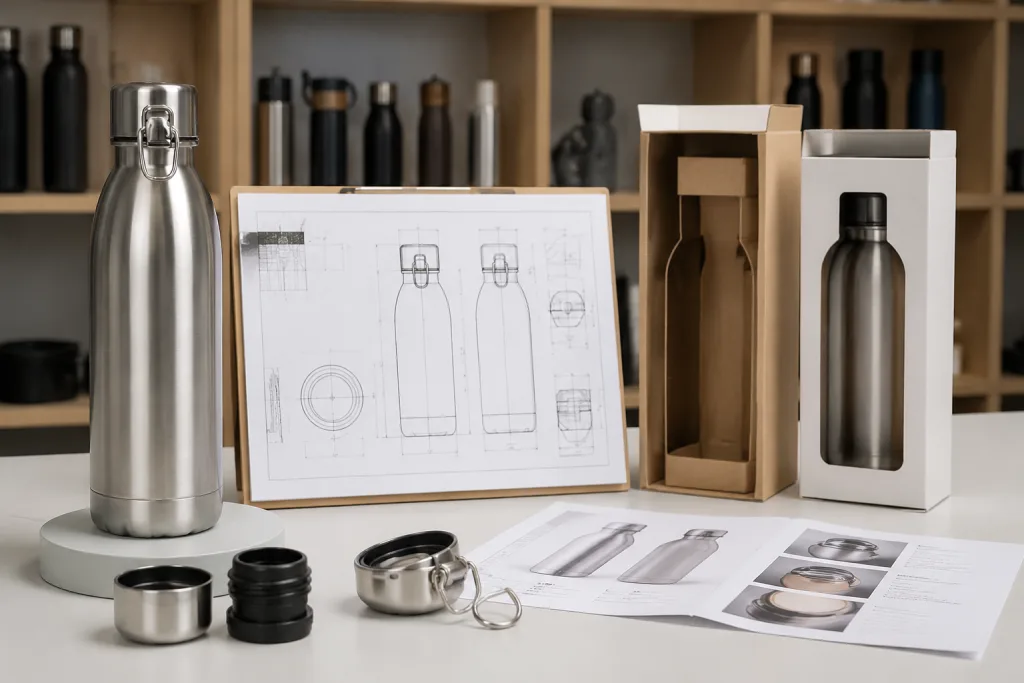
A sample is not a souvenir. It is the order reference we pin to the job card. For a thermos flask customizable order, we run three sample levels: stock sample, logo sample, and pre-production sample. Stock sample checks size, lid torque feel, coating, and insulation; logo sample checks the decoration method and position tolerance; pre-production sample locks the bulk spec: 304 stainless steel, finish, color, logo, packaging, manual, carton marks, and barcode. QC pulled a 500 ml sample last month where the lid looked fine in photos, but the silicone ring sat 0.8 mm proud and leaked after inversion. Photos missed it.
Sample timing from a thermos manufacturer in Zhejiang, China is usually 3-5 days for stock samples and 7-12 days for custom logo samples, assuming artwork is clean. If powder coating requires a new Pantone match, add 5-7 days because the coating room needs a spray plate, curing test, and daylight box check. Do not approve a sample from photos only unless the order is small and low risk. For retail programs above 3,000 pcs, ship at least two physical samples to your office; one buyer flagged a “black” bottle that passed on screen but measured closer to Pantone 426C under D65 light.
Use PO lines to control sample charges: Sample Line S1: 2 pcs stock sample, buyer pays courier; Sample Line S2: 3 pcs logo sample, USD 80 setup including laser engraving; Sample Line S3: 2 pcs pre-production sample with retail box, approval required before mass production. Be plain here. We once had a PO typo that said “matte sliver” instead of “matte silver,” and the line stopped for half a day while sales, QC, and the packing supervisor checked the approved sample. If you skip the pre-production sample, you are asking the factory thermos team to guess your brand standards during mass production. That math doesn't work.
Test the sample like your customer will. Fill with hot water, invert for 30 minutes, shake the lid, check smell after 24 hours closed, scrape the logo lightly with a fingernail, and put the bottle in the intended backpack pocket. Use a kitchen scale if weight matters; a 500 ml bottle that is 28 g heavier than the approved sample will get noticed on repeat orders. These checks catch more problems than a clean studio photo.
Price bulk without hiding costs
Thermos bulk pricing is not one number. It is a stack we cost line by line on the quotation sheet: 304 stainless thickness, body capacity, powder coat yield, lid parts, logo process, box style, K=K carton, inspection, and freight. A 500 ml custom thermos in a standard mold may quote around USD 3.20-4.80 FOB China at 3,000 pcs, while a 1,000 ml flask with cup cap, powder coat, and retail color box may sit closer to USD 5.80-8.50. These are working ranges, not promises, because last month our steel surcharge moved USD 0.18 per pc after the mill updated the 0.5 mm coil price.
Ask every thermos vendor to quote the same breaks: 1,000, 3,000, 5,000, and 10,000 pcs. If the 10,000 pc price barely improves, the supplier may already be near material floor, or the trading margin is fixed and does not scale. If the price drops too sharply, check whether steel grade, coating thickness, or packaging changed between breaks. We have seen this go sideways: QC pulled the sample, the buyer flagged a 12 μm powder coat instead of the quoted 18 μm, and the “better” price stopped looking cheap.
Your bulk PO should be boring and precise: Item 1: 750 ml thermos customized, 5,000 pcs at USD 5.35 FOB Ningbo; Item 2: laser logo included; Item 3: retail box USD 0.32; Item 4: spare silicone gasket 2% free of charge; Item 5: inspection AQL 2.5 major / 4.0 minor; Payment: 30% deposit, 70% before shipment after passed inspection. Boring saves money. Last season one PO had “mat black” typed instead of “matte black”; our merchandiser caught it before the line mixed the Pantone card, but that kind of typo can burn 7 days.
For outdoor retailers, plan landed cost before you chase the lowest FOB. A carton that packs 24 pcs may cut paper cost by USD 0.06 per pc, but the math does not work if the warehouse rejects heavy cartons. A 16-18 kg gross weight carton is usually safer than pushing past 22 kg. Your suppliers thermos quote should include carton dimensions, gross weight, and CBM; we ship 48 x 36 x 32 cm cartons often enough to know the forwarder will ask before you issue a PO.
Control production before shipment
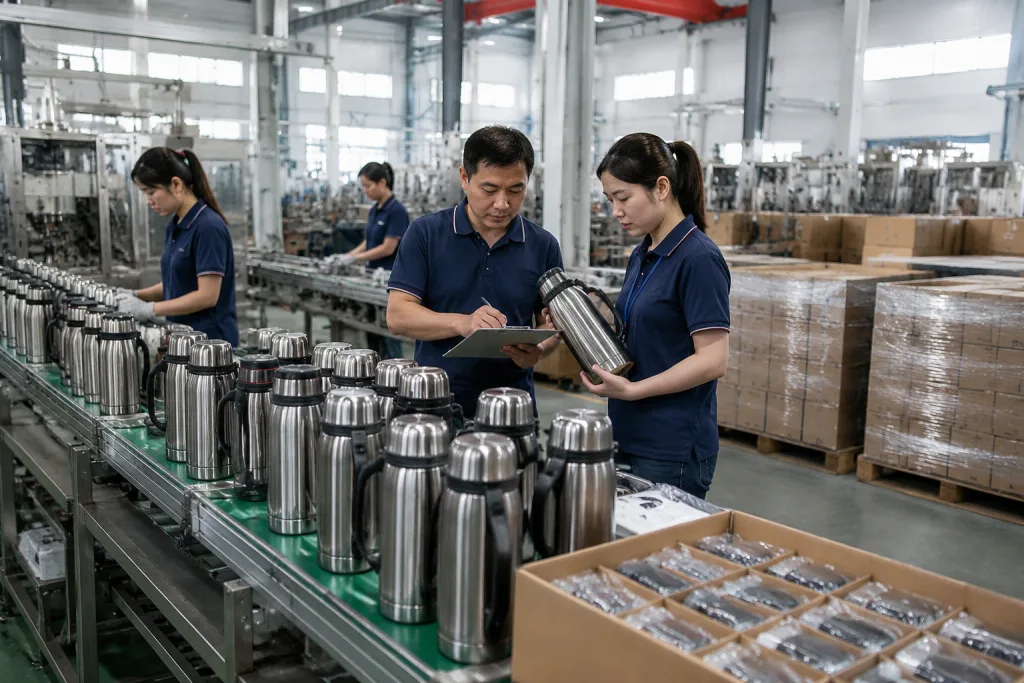
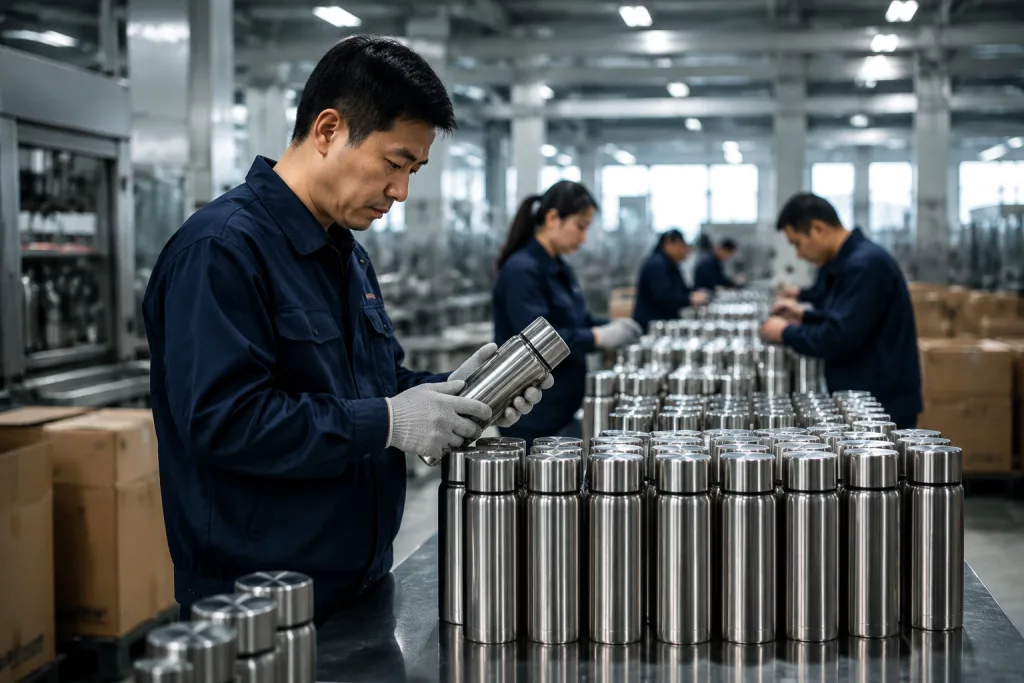
Once the deposit lands, the job is no longer “buying bottles.” It is control. We run incoming 304 stainless checks with a handheld XRF gun, then forming, welding, vacuuming, polishing, coating, printing or engraving, assembly, leak testing, insulation testing, packing, and final inspection. Ask for production photos at three points: raw bodies before coating, decorated bodies before assembly, and packed cartons before booking shipment. QC should pull at least 12 samples from the line at each photo stage, not just send the cleanest bottle from the sample room.
For a thermos factory in China, normal lead time is 30-45 days after deposit and approved pre-production sample for 3,000-10,000 pcs. Peak season before Q4 can add 10-15 days, mainly on powder coating and retail packaging. We have seen a matte black order move from 32 days to 46 days because the buyer changed the box insert from 300 gsm to 350 gsm after sample approval. If your campaign date is fixed, put the shipment deadline directly on the PO, not only in email. Email gets buried.
Quality terms belong in the PO. Use AQL unless you have your own inspection protocol. A practical line is: Final random inspection by buyer or third party, ANSI/ASQ Z1.4, General Inspection Level II, AQL 2.5 major, 4.0 minor, critical defects not allowed. Critical defects include leakage, sharp edges, wrong material contact parts, severe coating peeling, missing warning labels, and incorrect barcode. On one 5,000 pcs run, QC pulled the sample after the 6-hour insulation test and found 4 lids with silicone rings seated 1 mm off-center. That is the kind of issue you want caught before cartons are sealed.
Define the fail plan before production starts. Rework should be completed before balance payment. For distributor thermos programs, keep 1-2% extra cartons available for replacements if your customer has multiple store deliveries. We ship those extras in the same master carton spec, usually marked as “spare” on the packing list, because mixed labels cause warehouse trouble later. A good supplier thermos partner will accept clear inspection language; if they push back hard, the math does not work for you after the vessel has sailed.
Send your thermos RFQ for a practical factory quote
Share capacity, quantity, logo method, packaging, and target market. We will return workable specs, MOQ, lead time, and FOB pricing.
Frequently asked questions
What MOQ should I expect for a thermos flask customizable order?
For standard stainless thermos molds, a realistic MOQ is 1,000 pcs per color and logo design. At 500 pcs, some factories in China may accept the order, but the unit price can rise 15-30% because coating setup, logo setup, and carton printing are spread across fewer units. For custom body molds, expect 5,000-10,000 pcs as a starting point, plus tooling cost. If you are testing a new outdoor retail SKU, start with an existing 500 ml or 750 ml body, customize coating, logo, and packaging, then move to private mold after sales data proves demand.
How long does a custom thermos sample take?
A stock sample usually takes 3-5 working days before courier pickup. A logo sample takes about 7-12 working days if you use laser engraving or simple silkscreen printing. Pantone powder coating, full-wrap heat transfer, or retail box mockups can push sampling to 15-20 days. From Zhejiang to Europe or North America, courier transit is normally 3-6 days. For a serious bulk thermos order, approve a physical pre-production sample before mass production, not just photos. That sample should include the final logo, color, lid, gasket, box, barcode, and carton mark.
Which decoration method is best for outdoor promotional thermos products?
For rugged outdoor use, laser engraving is the safest option because it does not peel and handles abrasion better than ink. It works well on powder-coated stainless thermos bodies, but the mark color depends on the coating and base metal. Silkscreen is cheaper for simple 1-color logos, often adding USD 0.08-0.18 per unit, but it needs adhesion testing. Heat transfer or UV printing is better for full-color brand artwork, though costs and reject rates are higher. For promotional thermos campaigns under tight deadlines, choose laser or 1-color silkscreen unless the artwork truly needs full color.
What compliance documents should outdoor retailers request?
For Europe, request LFGB or EU food-contact test reports for stainless steel, plastic lid parts, and silicone gaskets, plus REACH information for coating and printed surfaces. For North America, ask for FDA food-contact conformity and, when relevant, California Proposition 65 review. If the item is for children, ASTM and CPSIA questions may apply, but most adult thermos flasks are not children’s products. Also ask about BSCI or similar social audit status if your retailer requires it. Match the test report to the exact material and model; a random old report from another thermos manufacturer is not enough.
What should be listed on a PO for thermos bulk production?
Your PO should list model number, capacity, stainless grade, finish, Pantone color, logo method, logo size, packaging, carton quantity, barcode or FNSKU, inspection standard, Incoterm, payment terms, and shipment deadline. Add spare parts if needed: 1-2% extra gaskets, spare lids, or replacement boxes. A good PO line might state: 750 ml stainless vacuum thermos, SUS304 inner and outer, matte black powder coat, laser logo 55 mm wide, color box, 24 pcs per carton, FOB Ningbo, AQL 2.5/4.0. The more specific your PO, the fewer arguments you have during inspection.