Key Takeaways
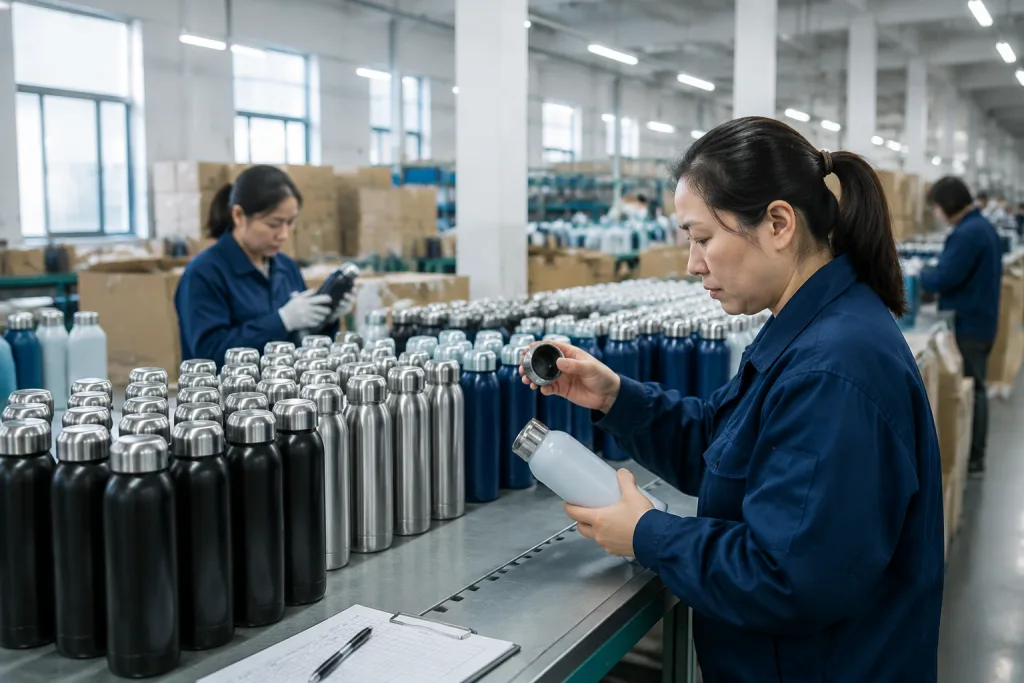
- 304 stainless steel inner walls with 0.4-0.5 mm thickness are the normal baseline for retail-grade thermos bulk orders
- A realistic MOQ is 1,000 pieces per color for standard models and 5,000-10,000 pieces for new mold development
- Vacuum retention, leak testing, and AQL inspection matter more than small FOB price differences of USD 0.20-0.40
- Outdoor retail buyers usually need better coating, carton strength, and compliance documents than one-off promotional buyers
A thermos flask custom project looks simple until the first price sheet lands. One supplier thermos quote uses 201 stainless steel at 0.38 mm wall thickness, another uses 304 stainless, one includes laser engraving, another leaves carton drop testing and mold fees off the PI. We saw a PO last month with “powder coating” typed as “power coating”; QC pulled the sample anyway, and the buyer flagged the coating scratch after 30 rubs with 3M tape. If you are buying for an outdoor retail line or a promotional thermos campaign, those line items decide whether the bottle survives winter use, retail returns, and margin pressure.
At our Hangzhou, Zhejiang factory, we run the brief through four checks: shell thickness and weld quality, heat retention target in hours, logo process with real artwork size in mm, and order structure by SKU and carton count. China can make cheap bottles. That is the wrong question to ask. Cheap without control means 12 days saved on sampling can turn into 18 days lost when the line stops for lid leakage or mixed-color cartons. A good custom thermos brief tells the thermos manufacturer what must not change, where trade-offs are allowed, and which AQL 2.5 points we inspect before shipment.
Start With The Selling Use
The first decision is not the logo. It is where the buyer expects the flask to earn its money. A customized thermos for an alpine store and a conference giveaway should not share one spec just because both say 500 ml on the PO. Outdoor retailers need a bottle that works with gloves, side pockets, cold mornings, and 30 cycles of dish-rack abuse; promotional buyers usually push us hardest on Pantone match, logo size, and ship date. We had one buyer flag a 2 mm gap between the silicone boot and the body because it looked cheap on shelf. Fair point.
For a retail custom thermos line, we ask for two use cases first: drinking style and carrying style. Hot coffee buyers usually want a narrow mouth, stronger heat retention, and a cap that does not hold milk odor after 24 hours. Iced drink buyers ask for a 45 mm or wider mouth so normal ice cubes fit without fighting the rim. Transport is where the math gets exposed: leak rate, cap thread feel, and whether the powder coating survives keys, tent poles, or a 6 kg backpack rubbing against it. QC pulled the sample on our torque tester last month because the cap felt gritty after 200 open-close cycles.
A bulk thermos built only for desk use can pass basic leak testing and still annoy an outdoor buyer. The wrong question to ask is, “Does it leak?” Ask what happens after wet hands, a rattling cup lid, and a one-meter drop onto concrete. The body may feel too slick, the base may dent, or the lid may click inside the carton for 18 days at sea. We have seen this go sideways: distributors in Europe and North America turn those small defects into return reasons for thermos programs.
Define the channel before you define the bottle. If you sell through retail, ask for carton drop test data, barcode placement, spare lid availability, and REACH documentation. If you run a thermos promotional program, focus on decoration yield and color consistency, then check whether the packing line can hit 1,200 pcs per shift without scuffing the coating. A thermos distributor ordering mixed SKUs should also confirm the thermos supplier can hold repeat colors across production batches; our spectrophotometer limit is usually Delta E under 1.0, and buyers notice when batch two drifts.
Choose Steel And Wall Construction
Most thermos flask custom orders we run use double-wall stainless steel with vacuum insulation. The usual retail build is 304 stainless steel inside and 201 or 304 outside. For anything touching drinks, I push buyers to keep 304 on the inner wall; we check it with an XRF gun during incoming material inspection. The outer wall can be 201 for a cost-sensitive promotional thermos, and the math can work at 3,000 pieces, but outdoor retailers often choose 304 outside too because wet shelves, salt air, and dishroom handling punish cheaper steel fast.
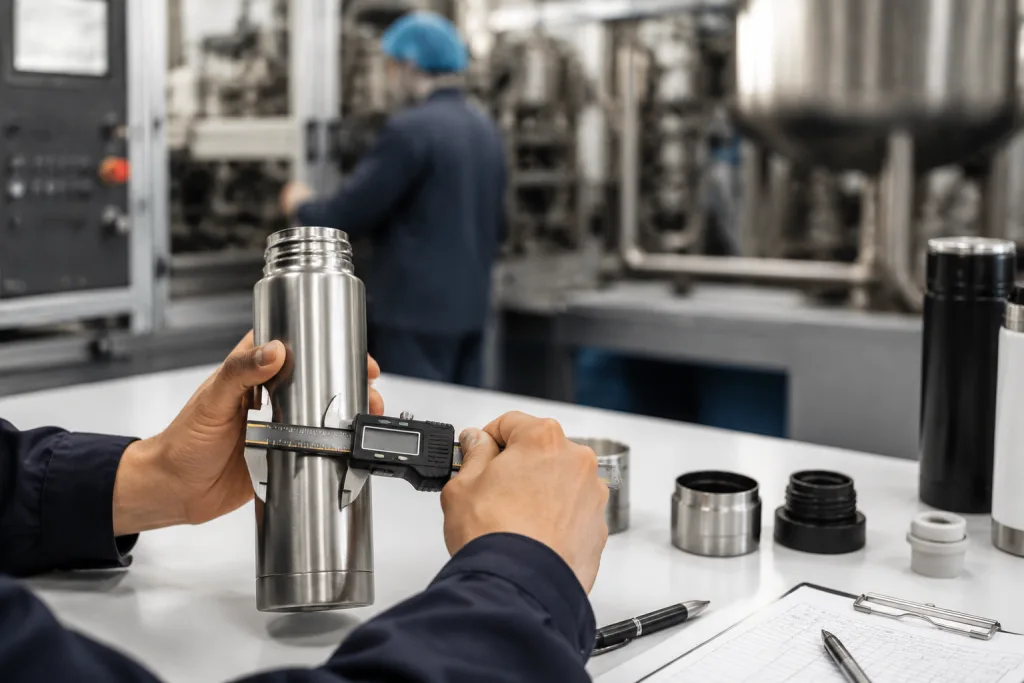
Wall thickness is where low quotes hide trouble. A typical 500 ml to 750 ml factory thermos body uses around 0.4-0.5 mm stainless steel before forming. We have seen buyers ask for 0.35 mm to save USD 0.18 per piece, then QC pulled the sample after polishing because the shoulder had small waves and two dents near the bottom seam. Thin gauge feels light in the hand, but it dents, deforms during vacuum processing, and makes the line chase scrap. Heavier construction costs more in steel and adds carton weight, but it protects your brand when the flask is sold as outdoor gear instead of a throwaway gift.
You should decide between standard mold and private mold early. A standard customizable thermos can usually start at 1,000 pieces per color, with logo, color, and packaging changes; our PO team still sees “Pantone 186C” typed as “186G” at least twice a quarter, so color confirmation matters. A new private mold commonly starts at 5,000-10,000 pieces, plus tooling cost that may run from USD 1,500 to USD 8,000 depending on lid complexity and body shape. For a first thermos custom order, standard mold is the safer move unless the silhouette carries the brand.
Do not let a thermos vendor sell a special shape before the lid engineering is clear. This is the wrong question to ask first. A beautiful body with a weak cap thread will leak, and we have seen this go sideways when the buyer approved the body render before anyone checked the 2.5 mm silicone ring compression. Ask for exploded drawings, silicone ring material, lid drop test method, and spare parts policy. A good thermos factory in Zhejiang should be able to explain the seal stack, not just send lifestyle photos.
Set Insulation Targets Honestly
Vacuum insulation is easy to print on a carton and much harder to hold on the line. For a 500 ml stainless thermos, we set the normal pass mark at hot water above 60°C after 6 hours, tested from a 95°C fill at room conditions. QC uses a calibrated probe, not a finger check. Premium builds can beat that, mainly when the mouth is 35-42 mm and the body volume is larger. Wide-mouth bottles lose heat faster because the cap area is bigger. No magic there.
For cold retention, buyers often ask for 12 or 24 hours. Fair request. The wrong question is “how many hours?” until the test method is locked. Was ice used at 50% volume? Was the ambient temperature 23°C or 30°C? Did someone open the bottle every 2 hours? We had one PO last year that said “24H cold” on page 1 and “no ice test” in the artwork note; the buyer flagged it before deposit, luckily. For North American outdoor retail, write the test condition into the purchase order, not only the product page.
Vacuum failure is usually not visible when goods leave China. A bottle can look clean under the light box and still lose heat because of poor welding, oil contamination, or micro leakage around the bottom seal. That is why we run vacuum performance sampling during production and final inspection; QC pulled 32 samples from a 5,000 pcs run last month after the first 2 pieces dropped below 60°C at 6 hours. For larger thermos bulk orders, a buyer can specify 100% vacuum detection plus AQL visual inspection. Common AQL levels are 2.5 for major defects and 4.0 for minor defects, with tighter plans for retail launches.
There is a price trade-off. Better vacuum processing, tighter welding control, and higher rejection rates raise FOB cost. On a 500 ml customized thermos, the gap between a weak build and a stable build is often USD 0.30-0.70 per piece. We have seen this go sideways when a buyer saved USD 0.18 and then rejected 9 cartons after a hot-water retest. The math does not work if the bottle carries your brand name for several seasons.
Decoration Is A Production Risk
Logo decoration looks like a design choice, but on the line it is a production risk. Laser engraving, silk screen printing, heat transfer, UV print, embossing, and powder coating each behave differently on stainless steel. If the buyer wants a simple one-color mark, silk screen is usually the cleanest route. For a rugged outdoor series, we often push laser engraving because it does not peel. Full-wrap artwork is a different story; heat transfer or water transfer needs more setup checks, and QC pulled the sample twice before release on one 500 ml run.
Powder coating sells well for outdoor retail because it adds grip and a stronger hand feel. Our target coating thickness sits around 60-90 microns. Go thinner and scratches show fast; go thicker and cap fit or base assembly starts to drift. For matte black, olive, sand, and navy, approve a physical color chip under daylight and indoor light. Pantone on coated metal is not paper printing. The math does not work that way.
Promotional buyers usually want a fast logo turnaround. That is fine if the artwork comes as clean vector files and the logo does not wrap hard over a curve. For thermos promotional orders tied to event dates, skip complex gradients and multi-position printing unless you have time for pre-production samples. We have seen that go sideways on a PO where the buyer flagged a tiny font change after the screen plate was already made. A rushed approval causes more pain than a slightly higher unit price.
We still recommend one pre-production sample after final artwork, even when the blank sample is already signed off. It adds about 5-7 days, but it catches the real problems: logo size, coating color, cap fit after coating, retail box layout, and barcode position. On one order, the barcode was 3 mm too low and the scanner failed at packing. Outdoor retailers and distributor buyers should treat that sample as the contract reference.
Price The Whole Export Order
Do not compare a thermos flask custom quote by FOB unit price alone. That is the wrong question to ask. We price the whole export order: carton quantity, carton size, gross weight, inner box, retail packaging, testing, inspection, and freight mode. Last month QC pulled a 750 ml stainless flask sample packed 24 pcs per carton; the carton hit 17.8 kg gross and the buyer’s warehouse flagged it because their manual handling limit was 15 kg. Another thermos supplier looked cheaper by USD 0.18 per piece, but the oversized carton and 250 gsm gift box paper would have cost more in claims later.
For standard stainless thermos models, we run a normal MOQ of 1,000 pieces per color and 3,000 pieces per mixed order. At our Hangzhou, Zhejiang facility, monthly capacity for stainless vacuum bottles is about 600,000 units across standard lines, with normal production lead time of 25-35 days after deposit and sample approval. Before Q4, powder coating and gift box packing can move the schedule to 40-50 days; on the line, one color change on the spray booth can burn half a shift if the buyer adds a new Pantone after PP sample sign-off.
FOB pricing for a 500 ml to 750 ml manufacturer thermos project often ranges from about USD 3.20 to USD 7.50 depending on steel grade, lid design, coating, packaging, and order quantity. Cheap quotes usually hide in 0.40 mm body walls, loose lid tolerances, shorter inspection time, or 300 gsm paper where the retail plan needs 400 gsm. Sometimes the math works for a 6-week promotion. For a retail outdoor product with a warranty promise, we have seen this go sideways after the first drop test at 1.2 m.
Check Incoterms before the PI is signed. FOB Ningbo or Shanghai is common for Zhejiang and nearby China factories. If you need DDP, Amazon FBA preparation, or pallet labeling, say so early. FNSKU labels, suffocation warnings, master carton marks, and pallet height limits change packing labor and timeline; one PO came in with “FNSK” missing the “U,” and our packing team stopped the job before 3,000 labels were printed wrong. Good thermos suppliers ask these questions before production, not after the container is booked.
Check Compliance Before Deposit
Compliance feels boring until customs holds 3 pallets, a retailer asks for files, or Amazon flags the listing. For stainless drinkware going into Europe, ask for LFGB food-contact testing, REACH coverage for paint and plastic parts, plus BSCI or Sedex status if the buyer sells to chain stores. For the United States, check FDA food-contact expectations and any state rules tied to the sales channel. Kids items need a harder look at ASTM and CPSIA, especially coatings, straw tips, and small removable parts; QC once pulled a lid sample because the silicone plug measured 6.8 mm and the buyer’s checklist treated it as a small-part risk.
One report does not cover every custom thermos. This is the wrong question to ask: “Do you have LFGB?” A plain 304 stainless bottle report usually will not cover a powder-coated body, a new PP lid color, a silicone ring from another supplier, or a printed logo area touched by the mouth. If your order uses a new coating, colored plastic lid, or special silicone gasket, confirm the exact model, material code, and tested color on the report before deposit. If it does not match, set aside testing time and cost; a typical third-party food-contact test may take 7-10 working days after samples arrive, and we usually lose 2 more days just sending sealed samples from Hangzhou to the lab.
Factory audits matter if you sell through established retail chains. A thermos manufacturer with BSCI, ISO 9001, or similar documentation is easier to onboard, but check the audit scope, factory name, address, and expiry date against the PI. We have seen this go sideways when the PO named a trading company in Ningbo, while the line doing welding, vacuum processing, coating, and final packing sat in Zhejiang under a different license. Not fatal. Just verify who controls production before money moves.
Ask for a document list before paying the deposit: business license name, China factory address, audit certificates, material declarations, test reports matched to the lid and coating, plus the inspection standard such as AQL 2.5. A reliable thermos factory will not be offended; we run this paperwork on export orders every week, and a buyer once flagged a one-letter typo in the factory address before their compliance team would release the 30% deposit. Normal B2B work.
Use Samples To Lock Decisions
Samples are not souvenirs. They are buying tools. For a thermos flask custom project, we run 3 sample stages when the schedule has room: an existing blank sample for quick hand check, a decorated pre-production sample with the real artwork, then a sealed golden sample for QC. The blank sample checks grip diameter in mm, stated capacity, lid thread feel, and insulation. The decorated sample checks logo position, Pantone color, powder coating, and whether the print scratches under 3M tape. The golden sample sits in our QC cabinet with the PO number written on the hang tag, and the line uses it as the mass production standard.
For outdoor retailers, abuse the sample before approving it. This is where we’ve seen projects go sideways. Fill it with boiling water and check exterior heat with an infrared thermometer after 10 minutes. Put it in a backpack sideways for 8 hours. Open and close the cap 100 times. Drop it from 80-100 cm onto a wooden floor. Wash it repeatedly. QC pulled one sample last month because the silicone ring twisted after the 37th cap cycle. These checks do not replace lab testing, but they catch problems a catalog photo will never show.
Once the sample is approved, freeze the specification. Changing color, lid, carton, or logo after material purchasing can add 7-15 days and can leave us with 2,000 unused lids or sprayed bodies in the wrong shade. If you need mixed colors, write the color ratios on the PO, not in a chat screenshot. We once had a buyer flag “blue” after ordering navy on the proforma, and the math did not work. If you need a distributor thermos range with several capacities, approve each capacity separately because a 500 ml cap and a 1,000 ml cap may behave differently even when they look related.
The best supplier thermos relationship is not built on blind trust. It is built on clear samples, written specifications, and inspection points both sides can check with a ruler, scale, or AQL 2.5 report. Simple wins. That is how we ship repeatable thermos customized production from China without turning every reorder into a new argument over gloss level, carton marks, or a logo that moved 3 mm.
Send Your Thermos Spec And Target Price
We will check the model, MOQ, decoration route, compliance needs, and realistic FOB range before you commit to sampling.
Frequently asked questions
What MOQ should I expect for a thermos flask custom order?
For standard stainless thermos models, expect 1,000 pieces per color as a realistic MOQ. If you need mixed colors, many factories ask for 3,000 pieces total so coating and packing are efficient. A new body mold or special lid normally starts at 5,000-10,000 pieces, plus tooling. Small promotional thermos runs below 500 pieces are possible only when using existing stock colors and simple logo decoration, but the unit price can rise by 20-40% because setup cost is spread across fewer units.
How long does a customized thermos order take from China?
For a standard model with custom logo and color, plan 25-35 days for mass production after deposit and approved pre-production sample. Sample development usually takes 5-10 days for standard decoration and 15-25 days if a new lid or mold is involved. Ocean freight to Europe or North America adds roughly 25-40 days depending on port and season. If your thermos bulk program is for Q4 retail, start at least 90 days before the required warehouse date.
Which logo method is best for outdoor retail thermos products?
Laser engraving is the safest for outdoor use because it will not peel or crack, and it works well on powder-coated stainless steel. Silk screen is cheaper and better for bold color logos, but abrasion resistance depends on ink and curing quality. Heat transfer can handle more complex artwork, though it has higher rejection risk on curved bottles. For a retail custom thermos, we usually test the logo with tape pull, rub testing, and dishwasher-style washing before approving bulk production.
What is a fair FOB price for bulk thermos bottles?
A normal FOB China price for a 500 ml to 750 ml stainless vacuum thermos is often USD 3.20-7.50. The range depends on 304 versus 201 steel, wall thickness, lid design, coating, logo method, retail box, and order quantity. If a quote is 15-25% lower than the market, ask what changed. It may be thinner stainless steel, weaker coating, no pre-production sample, limited vacuum testing, or cheaper carton material. Low FOB is not useful if retail returns eat the margin.
How do I compare thermos suppliers without visiting the factory?
Ask every thermos supplier for the same checklist: material grade, wall thickness, capacity tolerance, insulation test method, MOQ, lead time, packaging spec, AQL standard, audit documents, and recent food-contact reports. Request a video of production lines and a live call from the sample room or packing area. A serious manufacturer thermos partner should answer technical questions without hiding behind sales language. For larger orders, hire a third-party inspection company in China for pre-shipment inspection at AQL 2.5/4.0.