Key Takeaways
- Pantone-matched powder coating usually starts at 1,000 units per color and 30-35 days after sample approval
- Laser engraving is durable, but it will not reproduce full-color promotional thermos artwork
- A practical custom thermos tolerance is Delta E 1.5-2.0 for controlled coating runs
- For outdoor retail, 304 stainless steel with 0.45-0.55 mm outer wall is the safer baseline
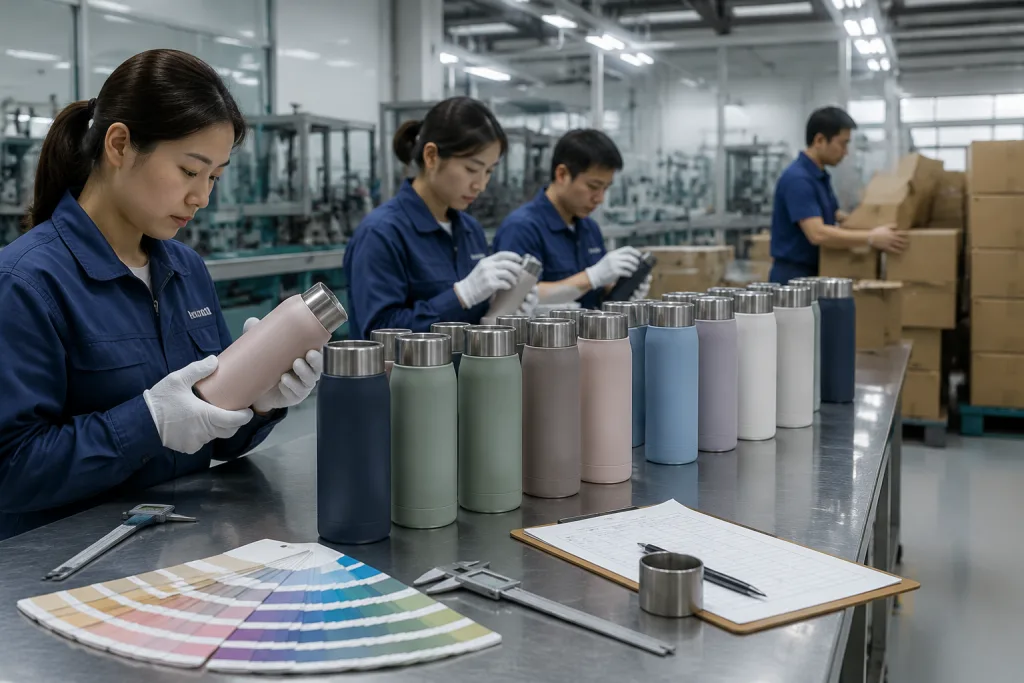
A thermos flask custom Pantone request looks easy on the PO until the approved red sample reads Pantone 186C by the window, then the 3,000 pcs bulk lot looks closer to 188C under 6500K warehouse LEDs. QC pulled the sample with a BYK color meter, and the buyer flagged it before cartons left Ningbo. Color is not just decoration. For outdoor retailers and promo brands, it decides shelf blocking, brand compliance, and whether the reorder comes back next quarter.
Our Hangzhou, Zhejiang team gets 12–15 of these questions every week from Europe and North America: powder coat vs spray paint, laser logo vs silkscreen, 500 ml vs 1 L, FOB China vs DDP, and what ΔE tolerance the line can hold without slowing output. The wrong question is “Can you match my Pantone?” The better one is “What finish, inspection light, MOQ, and approval sample will keep bulk color close enough for my buyer?” Here is the head-to-head view we use when quoting a custom thermos program.
Pantone Color Is A Production Spec
If you ask for thermos flask custom Pantone, you are writing a production spec, not choosing a nice shade from the Pantone book. The spec needs coating material, surface prep, curing temperature, gloss level, substrate, and color tolerance. On our line, Pantone 186 C on paper will not read the same as Pantone 186 C sprayed on a curved 304 stainless bottle with matte powder at 180°C. Normal issue. The wrong question is “Can you match this Pantone?” The right question is “What sample and light box reading will decide pass or fail?”
For stainless thermos orders, we run color checks against two standards: the Pantone reference and the approved sprayed metal chip, then we lock the pre-production sample as the commercial standard. QC keeps one signed sample in the sample room, and we ask the buyer to keep one in their office too. Last year a buyer flagged a “wrong red” on arrival, but the retained sample under a D65 light box matched within Delta E 1.8. That saved a 12-carton argument from turning into a full claim when the thermos bulk shipment landed 60 days later.
For most custom thermos coating, Delta E 1.5-2.0 is a workable target under controlled light. Pushing Delta E below 1.0 sounds strict on a PO, but the math often does not work once you count powder waste, line stoppage, and rejected bodies pulled after oven curing. Bright orange, neon green, metallic gold, and low-gloss navy need tighter trial spraying than black or white. We have seen low-gloss navy go sideways because the buyer approved a flat lab chip, then expected the same depth on a 500 ml curved body.
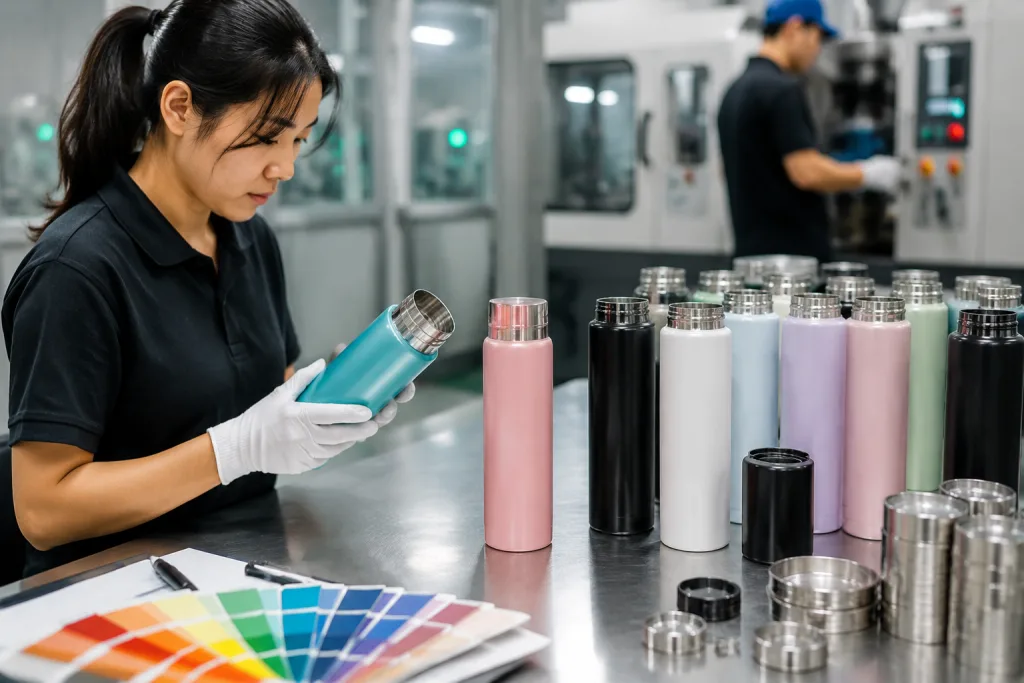
At BottleForge Industrial in Zhejiang, our practical MOQ for a new Pantone powder coat is usually 1,000 units per color, with a 7-10 day color sample and 30-35 day mass production lead time after approval. We ship about 280,000 units/month across standard shapes when lids are simple and retail packaging is clean. If the lid has silicone inserts, handle parts, or a 4-color gift box, the line slows. QC pulled samples every 2 hours on a recent 3,000 pcs run because the buyer’s PO typed “Pantone 186 U” while the artwork file said “Pantone 186 C.”
Powder Coat Versus Spray Paint
For a customizable thermos, coating is where 8 out of 10 first-time buyers underestimate the risk. Powder coating is our safer pick for outdoor retail: better abrasion resistance, dry-grip hand feel, and fewer complaints after repeated dishwasher-style wash cycles. We run 35-45 µm powder thickness on most 500 ml and 750 ml bottles, checked with a digital coating thickness gauge before logo printing. Spray paint gives room for gradients and metallic looks on low-volume promotional thermos orders, but cheap primer is where the math doesn't work. QC pulled a sample last month with edge scratches around the base ring after only 20 rub cycles.
Here is the head-to-head view we use when discussing a thermos custom project with a buyer who needs thermos flask custom pantone matching:
| Spec | Powder coating | Spray paint |
|---|---|---|
| Typical MOQ | 1,000 units/color | 500-1,000 units/color |
| Outdoor durability | Better for hiking and camping retail, especially on dark matte colors | Acceptable for office gifts and event giveaways |
| Pantone accuracy | Good, but texture and gloss can shift the visual color by 1-2 shades | Good for smooth gloss colors when the wet paint mix is controlled |
| Logo options | Laser, silkscreen, pad print | Silkscreen, heat transfer, decal |
| Scratch risk | Lower, especially on 304 stainless bodies with proper pre-treatment | Medium, depends on primer and curing time |
| Cost impact | Usually +USD 0.25-0.60/unit | Usually +USD 0.20-0.50/unit |
If you sell through outdoor retailers, choose powder coating unless the design needs a glossy automotive finish. Simple call. If you run a 500-unit beverage sponsor campaign or a trade show giveaway, spray paint can pass if the bottle will sit on desks, not bounce around in backpacks. For distributors thermos programs, consistency beats novelty. We have seen this go sideways when one PO says “matte Pantone 426C” and the artwork file says “gloss black”; the buyer flagged it after the pre-production sample, and the line lost 2 days. A matte black powder coat with laser engraving will take more carton handling and shelf testing than a glossy full-wrap design.
Ask your thermos supplier to confirm adhesion testing before mass production. A simple cross-hatch tape test helps, but for retail we prefer ASTM D3359-style adhesion checks plus rub tests on printed areas. It costs less than USD 0.03/unit when we batch it with normal QC, and it catches weak coating before cartons leave China. On our side, QC cuts the 1 mm grid with a cross-hatch cutter, applies 3M tape, then checks whether coating lifts at the logo edge or bottom curve.
Body Sizes And Use-Case Fit
A thermos body that works for one buyer can be dead stock for another. Outdoor retailers ask us for 6-12 hour heat claims, lids that open with winter gloves, and color boxes that survive shelf handling; last March QC pulled a 750 ml sample after the gift box corner crushed at 80 cm in a drop test. Promo buyers push back on unit price, logo setup time, and master cartons for pick-and-pack orders. Same stainless shell. Different result.
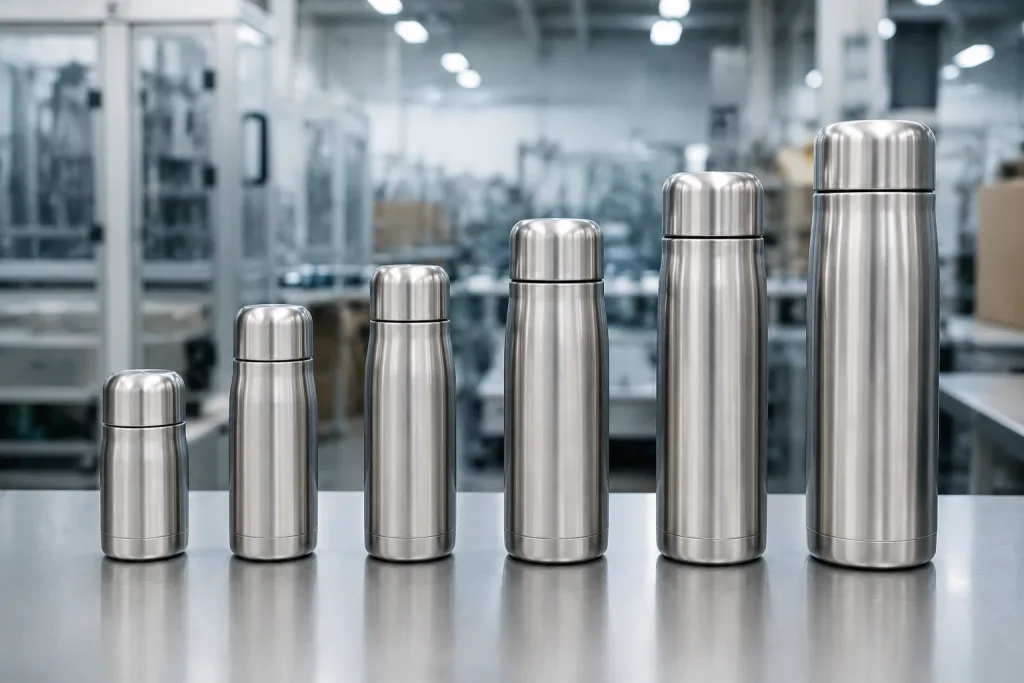
For a customized thermos range, we usually line up four sizes on the bench and check them with a digital caliper before quoting:
| Capacity | Best fit | Common spec | Buyer note |
|---|---|---|---|
| 350 ml | Commuter gift, kids, short trips | Approx. 0.32-0.38 mm inner wall | Works when the target is a promotional thermos under a tight budget |
| 500 ml | Outdoor retail and corporate gift sets | 304 stainless, vacuum insulated | Best balance for MOQ, carton cube, and ocean freight |
| 750 ml | Hiking packs, camping stores, sports clubs | 0.45-0.55 mm outer wall | Looks stronger on shelf; buyers notice the hand weight |
| 1,000 ml | Field work crews, long hikes, distributors | Large cap or cup lid | Check carton weight and 1.2 m drop test before mass production |
For thermos bulk orders, we ship 500 ml and 750 ml most often because the math works. They do not fit standard cup holders as cleanly as slim tumblers, but the insulation story is easier to prove with a 95°C hot-water test and a probe reading after 6 hours. If you are building a retail line, do not open with too many colors. Three Pantone colors across two sizes already means six SKUs, six barcodes, and six inventory positions; we have seen a PO delayed 9 days because one Pantone code was typed as 548C instead of 546C.
A practical first order for a new outdoor brand is 3,000-5,000 units total: two capacities, two colors, one shared lid, and one carton structure. Simple sells. If a thermos vendor pushes eight shapes on the first order, this is the wrong question to ask; the line may run smoothly for them, but your warehouse may sit on slow-moving 1,000 ml stock for 18 months.
Logo Methods Compared Side By Side
Color gets attention on the shelf, but the logo method decides whether the bottle still looks sellable after 6 months in a backpack or car cup holder. For a thermos flask custom Pantone order, we lock the logo process at the same time as the coating, because matte powder, gloss paint, and bare 304 stainless steel take artwork in different ways. QC pulled one 750 ml sample last month where the buyer approved Pantone 3435 C, then changed from laser to white silkscreen after the PO was signed. The line lost 2 days.
| Logo method | Best use | Limitation | Typical setup |
|---|---|---|---|
| Laser engraving | Outdoor retail and premium gift bottles where scratch resistance matters | No full-color artwork, and the final logo tone comes from the exposed metal | USD 45-80/logo |
| Silkscreen | One or two color brand marks under 70 mm wide on straight body areas | Curved walls can blur thin lines below 0.25 mm | USD 35-60/color |
| Pad print | Small logos on lids, caps, buttons, or narrow plastic parts | The math does not work for large body graphics | USD 40-70/plate |
| UV print | Colorful short-run designs, names, and event artwork | Higher unit cost and slower output on the line | USD 60-120/file |
| Heat transfer | Wrap designs, gradients, and photo-style graphics | Needs 3M tape pull and wash testing before bulk packing | USD 80-150/design |
If you are buying for outdoor retail, laser engraving on powder coat is the safe call. It cuts through the coating and exposes the stainless base, so there is nothing to peel. But this is the wrong question to ask if your brand guide demands a white logo on a green bottle; laser cannot give you Pantone white. We run silkscreen for that, then ask QC to check 50 cycles of rub testing and confirm whether the carton label says hand wash or dishwasher safe.
For promotional brands, full-color UV or transfer printing can work on a 500 ml customizable thermos. Be straight about the use case. A bottle handed out at a 3-day event does not need the same abrasion result as one sold at USD 29.99 in a specialty outdoor store. We have seen this go sideways when the buyer approved a 500 pcs event sample, then reordered 8,000 pcs for retail without changing the artwork test standard.
Compliance And Inspection Buyers Need
A manufacturer thermos quote should not stop at FOB price and carton size. Ask for material declarations and market-specific test items before you approve the PI. For Europe and North America, we usually attach a BOM showing 304 stainless for drink-contact parts; 316 appears on premium projects, maybe 1 order out of 20. Lid parts are commonly PP, Tritan, silicone, or TPE, and QC should match the resin code against the supplier COA before mass production. We had a buyer flag a PO typo once: “Trian” instead of “Tritan.” Small word. Big delay.
For EU programs, REACH and LFGB-style food contact testing are common buyer requests. For the US, FDA food-contact compliance and California Proposition 65 screening depend on the retailer and sell-in state. If the product is children-facing, ask about CPSIA and ASTM expectations at sampling stage, not after 5,000 lids are molded. This is where the math doesn’t work: changing lid material after final artwork approval can add 12 days vs 18 days if a new mold insert or gasket hardness is involved. Our lab desk uses a Shore A durometer on silicone rings, and QC pulled the sample if the gasket reads outside the agreed range.
Factory audits are a separate topic. BSCI, ISO 9001, and Sedex are not product safety tests; they help distributors thermos buyers screen supply chain risk before they place a 3,000 pcs MOQ order. Our Zhejiang facility works with AQL inspection plans such as Critical 0, Major 2.5, Minor 4.0 for normal consumer drinkware orders. For a high-value retail launch, you may tighten Major to 1.5, but expect more inspection time and rework on the line. We run this with calipers, a barcode scanner, a 3M tape test on coating, and a Pantone book under D65 light when custom color matters.
During pre-shipment inspection, check vacuum performance, coating defects, logo position, barcode scan, carton drop resistance, and packaging language. For vacuum testing, 8 out of 10 manufacturers thermos lines we see use a 95°C hot water test with temperature drop checks after several hours. Set the pass standard before production. We’ve seen this go sideways at the loading dock in China when the buyer expected 6 hours of data and the factory recorded only 3; by then the cartons are taped, the truck is booked, and nobody wants to reopen 160 cartons.
Cost, MOQ, And Lead Time Tradeoffs
Price talks go faster when every cost driver is on the table. A basic 500 ml stainless thermos manufacturer quote might start around USD 3.20-4.80 FOB China for a standard color and simple logo, depending on steel gauge, lid design, coating, packaging, and order quantity. A retail-ready custom thermos with Pantone powder coat, laser logo, color box, manual, barcode label, and stronger carton can land around USD 4.60-7.20 FOB. Cheap has a bill. Last month QC pulled a 500 ml sample with a 0.38 mm outer wall instead of 0.42 mm; the price looked good, but the drop-test dented the shoulder on the first 1.2 m fall.
The MOQ structure is usually split by body, color, and logo. You may hear “MOQ 1,000 units,” but that can mean 1,000 per model, 1,000 per Pantone color, or 1,000 per logo version. Get it written on the PI. For a thermos promotional program with 10 end-customer logos, the logo MOQ may bite harder than the bottle MOQ, because we still need screen setup, laser positioning, and line changeover for each artwork. We’ve seen this go sideways when a buyer approved 1,000 pcs total, then sent 10 logos at 100 pcs each.
Lead time also has layers. A normal sequence is 5-7 days for blank sample, 7-10 days for Pantone color sample, 3-5 days for logo sample after color approval, then 30-35 days for mass production. Add 3-7 days if the packaging needs retailer approval. Sea freight to North America or Europe can add 25-45 days port to port, not counting customs or inland trucking. On the line, a Pantone change is not just “change paint”; we clean the powder booth, check the color under a D65 light box, and run 20-30 pcs before QC signs the first-piece sample.
If you need delivery for a fixed event date, tell the thermos suppliers the event date, not just the PO date. Air freight can rescue a late order, but it can add USD 1.50-4.00 per unit depending on size and carton density. The math doesn’t work on low-margin giveaways. For thermos customizable retail programs, calendar discipline is cheaper than emergency freight; one buyer flagged a PO typo from “Oct. 12” to “Oct. 21” after cartons were packed, and that 9-day slip forced 38 cartons onto air instead of sea.
How To Brief A Zhejiang Factory
A tight brief makes you look like a buyer, not a price shopper, and it cuts 2–3 quotation rounds. When you contact a thermos factory in Zhejiang or another China cluster, send capacity, Pantone code, finish, logo method, logo size, packaging, certification needs, target market, order quantity, and delivery deadline. If the email says only “please quote customized thermos,” the sales team has to guess; last month we saw one RFQ with no Pantone and the buyer rejected the lab dip after QC pulled the sample under a D65 light box.
For outdoor retailers, write the use case in factory language: hot retention target, leakproof standard, lid type, carry handle, cup lid, powder coat texture, and shelf packaging. For promotional brands, send the campaign date, AI or PDF artwork files, logo version count, carton labeling, and whether each unit needs a mailer box. If you sell online, add FNSKU, suffocation warning, master carton weight limit, and drop-test expectations; we ship 500 ml bottles in 12 kg master cartons when Amazon buyers cap weight, because the math does not work after the warehouse flags crushed color boxes.
A good RFQ line might read: “500 ml vacuum insulated stainless thermos, 304 inner and outer, matte Pantone 5535 C powder coat, laser logo 45 x 30 mm, color box, EU market, REACH and food-contact test support, 3,000 units, FOB Ningbo, target ship date June 20.” Good line. It gives the thermos supplier enough information to quote without padding risk into the price. On the line, our laser operator checks that 45 x 30 mm mark with a digital caliper before mass production, not after 3,000 bodies are coated.
The best suppliers thermos buyers keep a comparison sheet. Track unit price, MOQ, lead time, steel grade, wall thickness, coating method, logo process, test support, audit status, packaging, and payment terms; split the quote into body, lid, coating, logo, and box cost if the order is above 5,000 units. Lowest price is not automatically wrong, but if one manufacturers thermos quote is 18% lower than the others, ask what changed. We have seen this go sideways: missing 8–12 g of steel, coating under 35 μm, or lids that pass one shake test and fail after QC runs 20 pieces at AQL 2.5.
Send Your Pantone Thermos Brief For A Factory Quote
Share capacity, Pantone code, logo file, MOQ, market, and deadline. We will reply with practical options, not a vague catalog quote.
Frequently asked questions
What MOQ should I expect for thermos flask custom Pantone colors?
For a new Pantone powder coat, plan on 1,000 units per color as a practical MOQ. Some thermos suppliers will accept 500 units if the color is close to an existing powder, but the unit price usually rises by USD 0.30-0.80. If you need three colors, treat that as three coating setups, not one order. For retail launches, 3,000-5,000 units total is often more efficient because you can spread sample, testing, packaging, and inspection costs across more units. Always confirm whether the MOQ is per model, per Pantone color, or per logo version.
Can a stainless thermos factory match Pantone exactly?
A good thermos factory can match Pantone closely, but “exactly” is the wrong standard for coated stainless steel. Pantone books are printed references, while bottles are curved metal surfaces with different gloss and texture. For production, use an approved metal sample as the control. A Delta E target of 1.5-2.0 is realistic for many powder-coated colors under controlled lighting. Very bright, fluorescent, metallic, and ultra-matte colors are harder. Ask the supplier to keep a signed sample in China and send one to your office before mass production starts.
Which logo method is best for an outdoor promotional thermos?
For outdoor use, laser engraving is usually the safest logo method because it does not peel, crack, or wash off. It works especially well on matte powder-coated stainless thermos bottles. The tradeoff is that it cannot reproduce Pantone logo colors; the mark appears as exposed stainless or a darker engraved tone. If your campaign requires full-color artwork, use silkscreen, UV print, or heat transfer, but request rub testing and adhesion checks. For a 1,000-3,000 unit promotional thermos order, logo setup charges normally range from USD 35 to USD 150 depending on process.
What stainless steel grade should I specify for a custom thermos?
For most custom thermos programs, specify 304 stainless steel for both inner and outer walls. It is the standard balance of corrosion resistance, food contact suitability, and cost. Some premium products use 316 stainless for the inner wall, but it may add USD 0.20-0.60 per unit and is not always necessary. Also ask for wall thickness, not just grade. A practical outer wall range is 0.45-0.55 mm for many retail thermos bodies. Very thin walls can reduce cost, but they dent more easily during shipping and store handling.
How long does a thermos bulk order take from China?
A normal thermos bulk timeline is 7-10 days for Pantone color sampling, 3-5 days for logo sample approval, and 30-35 days for mass production after final approval. Packaging approval can add another 3-7 days. Ocean freight from China to Europe or North America often takes 25-45 days port to port, depending on route and season. If you need delivery for an event, build the schedule backward from the in-hand date. Air freight is possible, but for stainless thermos cartons it can add USD 1.50-4.00 per unit.