Key Takeaways
- A realistic MOQ is 1,000 pieces per color for standard thermos bodies and 3,000-5,000 pieces for new tooling
- Expect 7-10 days for pre-production samples and 30-45 days for mass production after approval
- Use 304 stainless steel, 0.45-0.55 mm inner wall, and AQL 2.5/4.0 inspection for most retail orders
- Logo, coating, lid structure, carton drop test, and leak testing should be locked before paying the 30% deposit
You are buying a stainless thermos for an outdoor retail line or a promo drop, not grabbing a stock bottle and hoping the logo prints clean. Wrong question. The first question is not “what is your best price?” It is which details must be locked before mold work, pre-production samples, mass production, AQL 2.5 inspection, and sea freight start burning budget. Last month QC pulled a powder-coated sample with a 0.4 mm lip burr under the lid thread; small issue, big headache if 10,000 pcs are already packed.
Here is a real order path we run often: a 10,000-piece thermos flask custom made program, 750 ml capacity, powder-coated 304 stainless steel, supplied FOB Ningbo from Zhejiang, China. BottleForge Industrial in Hangzhou runs about 600,000 stainless drinkware units per month, with practical MOQ starting at 1,000 pieces per color for standard bodies. On the line, we check body diameter with a digital caliper before coating because a 1 mm drift can make the gift box insert fail, and yes, buyers have flagged that after seeing the first carton photos.
Start with the use case
The buyer case is clear: you sell outdoor gear in Germany and Canada, and the bottle has to survive two jobs—cold trail days at -5°C and weekday commuting in a backpack. If the first email says only “send best price,” the quote will come back thin. We see it every week. Last month QC pulled a pre-production sample where the PO said “black bottle,” but the buyer meant RAL 9005 matte powder coating, not semi-gloss spray paint; that one typo would have changed the unit price by USD 0.28.
Start with a working specification. For this order, we would run a 750 ml vacuum flask with straight-wall body, 304 stainless steel inside and outside, screw lid with drinking cup, leakproof silicone seal, matte powder coating, and one-color logo. The product must hold hot water above 55°C after 12 hours when tested from 95°C fill temperature at 20°C room temperature. That is a fair benchmark for a mid-range retail customized thermos, and our lab checks it with a calibrated probe after the sample sits on the stainless test bench for the full 12 hours.
If you need stronger performance, say it before we open the mold drawing. A copper-plated vacuum layer can improve insulation by roughly 10-20%, but it adds cost. A thinner body lowers weight; it also dents faster when the carton drop test hits the bottom corner from 60 cm. A wide-mouth design is easier to clean and fill with ice, but the lid seal needs a better silicone ring, usually 1.5 mm thicker than the standard one. A promotional thermos for one event can accept simpler packaging; an outdoor retail thermos cannot. We’ve seen this go sideways when the buyer approved a light gift box, then the retailer flagged crushed corners after sea shipment.
For a thermos flask custom made project, we ask buyers to confirm five items before price: capacity in ml, lid style with photo reference, steel grade, surface finish, and packaging structure. Without those, a thermos supplier in China can quote USD 3.20 while another quotes USD 5.10, and both may be technically correct because they are not quoting the same product. This is the wrong question to ask if you only compare unit price; the line needs the same BOM, same logo size in mm, and the same MOQ before the math means anything.
Build the quote sheet
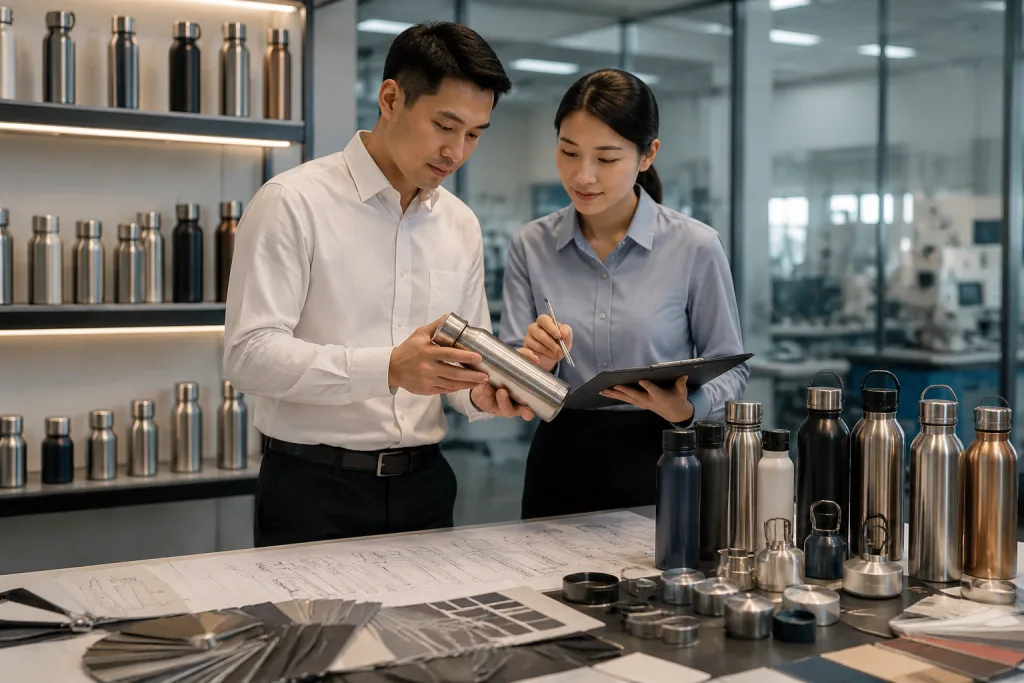
Once the use case is fixed, build a quote sheet that makes every thermos manufacturer price the same spec. For a 10,000-piece run, a clean FOB Ningbo sheet can read: 750 ml standard mold, 304 stainless steel, 0.50 mm outer wall, 0.45 mm inner wall, double-wall vacuum insulation, powder coating, one-side laser logo, color box, and 24 pieces per master carton. We run this format on the line because vague specs turn into useless quotes.
With current Zhejiang factory conditions, that spec usually sits around USD 4.20-5.60 FOB Ningbo, depending on lid structure, coating pass rate, carton thickness, and inspection load. A plain bulk thermos with no retail box can come in lower. A premium custom thermos with molded handle lid, gradient coating, copper lining, and FSC paper gift box can go above USD 6.50. QC pulled the sample with a coating pinhole once, and that one defect changed the cost math fast.
Ask the supplier thermos team to break the price out instead of hiding everything in one unit number. You want line items for bottle body, lid, logo, coating, individual packaging, export carton, sample cost, mold cost if any, and inspection handling. That is the right question to ask. If you drop a second logo position, you should know whether it saves USD 0.08 or nothing. We’ve seen buyers argue over a PO typo for the logo side and lose half a day fixing it.
Payment terms belong on the quote sheet too. A normal setup is 30% deposit and 70% balance before shipment after passed inspection. For repeat distributor thermos programs, some factories will take balance against bill of lading copy, but not on the first order. Confirm Incoterms at the same time. FOB Ningbo or FOB Shanghai is standard for Zhejiang, China. DDP to the US or EU can be quoted, but duties, anti-dumping exposure, and importer responsibility need a hard answer before we run the order.
Approve samples before deposit
For a thermos custom order, the sample is not a souvenir. It is the contract you can hold in your hand. Before the 30% deposit, approve either a stock sample with red-line changes marked on the body and lid, or a pre-production sample made with the actual powder coating, logo process, lid set, insert card, and export carton. We had one PO where “mat black” was typed instead of “matte black”; QC pulled the sample before deposit, and that typo saved a 10,000-piece headache.
For our 10,000-piece case, we run this sequence: digital artwork proof within 24-48 hours, blank body sample if needed within 3-5 days, then decorated pre-production sample within 7-10 days after artwork and color confirmation. If you need Pantone-matched powder coating, build in 3-4 extra days because coating chips and curved 304 stainless bodies do not read the same under a D65 light box and warehouse LED lighting. The buyer usually asks, “Can you just match the PDF?” Wrong question. Match the approved physical chip.
Check the sample like a buyer, not like a consumer. Fill it with hot water, invert it for 30 minutes, shake it, open and close the lid 50 times, put it in a backpack side pocket, then photograph the logo under daylight. Simple test. Measure capacity to the usable fill line with a 1,000 ml measuring cylinder, not to the absolute brim. We normally allow ±5% capacity tolerance on stainless bottles unless the buyer specifies tighter; last month one 500 ml sample measured 486 ml to the safe fill line, and the buyer flagged it before we opened mass tooling.
Logo method matters. Laser engraving is durable and clean for outdoor brands, but it shows the stainless base color. Silkscreen gives stronger color, but it can scratch if the powder coating and ink system are not matched; our line checks this with a 3M tape pull and 500 g rub test. Heat-transfer printing works for full-color artwork, but it needs rub testing before approval. For a distributor thermos moving through 6-8 resellers, laser logo plus neutral packaging is safer than heavy campaign graphics. We have seen campaign cartons go sideways when one reseller rejects another reseller’s slogan.
Do not approve a sample by saying “looks good” in a chat message. Send a written approval sheet with sample photos, Pantone number, logo size in mm, carton mark, barcode position, and any defects you reject. If the barcode is 12 mm too close to the carton seam, say it before deposit.
Lock materials and compliance
“Stainless steel” is too loose for a PO. For food-contact drinkware, write 304 stainless steel for the inner wall at minimum, and put it on the spec sheet, not only in the email thread. Some low-cost thermos suppliers switch the outer shell to 201 stainless steel to save around USD 0.18 to 0.35 per 500 ml bottle, but for outdoor retail we run 304 inside and outside unless the buyer is chasing a sharp promo price. 316 stainless steel is available. The math usually does not work for thermos bulk programs unless the bottle is aimed at marine, saltwater, or high-corrosion use. QC has caught this before with a handheld XRF analyzer when the PO said “304 body” but the sample outer shell read as 201.
Ask for food-contact compliance by sales market, not by habit. For Europe, the usual file is LFGB or EU 1935/2004-related food-contact testing, plus REACH screening for coating and plastic parts where relevant. For the US, buyers often ask for FDA food-contact material confirmation and a California Proposition 65 review, especially on powder coating and printed logos. If the item is for children, ASTM and CPSIA checks come into the discussion because coatings, silicone straws, and small plastic sliders can get flagged. We once had a buyer push back on a lid because the lab photo showed a removable plug under 6 mm wider than the approved drawing.
Insulation is built on the line, not bought from the steel mill. The vacuum layer depends on laser welding quality, vacuum pumping time, and sealing control. For mass production, we require 100% leak testing and vacuum performance spot checks. On a 10,000-piece customized thermos order, a sensible test plan is a 100% air-pressure leak test at the production line, then random hot-water insulation testing from each production lot. We run the leak station at 0.6 MPa, and QC pulled samples after 6 hours in the hot-water rack when one batch dropped 4°C faster than the golden sample.
Factory audits matter when a promotional brand has to answer its end client. BSCI, Sedex, ISO 9001, or customer social compliance audits do not make the thermos hold heat better, but they reduce procurement risk when someone asks where the bottle was made. BottleForge Industrial is based in Hangzhou, Zhejiang, and we ship with China export paperwork for EU and North American buyers, including commercial invoice, packing list, certificate of origin when needed, and test reports matched to the shipped SKU. Small detail, big headache: we have seen a shipment held because the PO had “matte balck” while the test report said “matte black,” so our merchandiser now checks SKU names against the carton mark before booking the vessel.
Set artwork and packaging rules
About 6 out of 10 thermos manufacturer disputes we see start with artwork, not steel. A logo file that looks sharp on screen can break up on a curved powder-coated body once the laser head follows the radius. For this 750 ml order, suppose the outdoor retailer wants a 55 mm wide mountain logo on the front and a 28 mm batch mark near the base. That works for laser engraving; QC pulled the sample and checked it with a 0.02 mm vernier caliper against the approved drawing. If the buyer asks for a wraparound trail map, don’t force it onto a tapered bottle. Use transfer print, or pick a straight body with less than 1.5 mm taper from shoulder to base.
Send vector artwork in AI, EPS, or PDF format, with fonts outlined and thin lines no less than 0.25 mm. Define logo size in millimeters, position from the bottom edge, and orientation relative to the lid opening. If there are multiple colors, give Pantone C references, not “forest green” or “dark blue”; we had one PO typo read “Panton 5535” and the buyer flagged it after the pre-production sample. For powder coating, confirm gloss level as matte or glossy, and state the target if your brand team has one, such as 12 GU at 60°. Matte coating looks premium but shows oil marks on black bottles. Glossy coating wipes cleaner, though it can look less technical.
Packaging should match the sales channel. A retail custom thermos needs a color box with barcode, product name, capacity, material statement, care instructions, importer details, and warning text printed at no less than 6 pt. A promotional thermos for a conference may only need a white box with one campaign sticker, usually 60 x 40 mm on the short side. For Amazon or marketplace stock, confirm FNSKU labels and suffocation warning text before production, then lock carton weight limits and outer carton dimensions on the packing spec. We’ve seen this go sideways when the buyer sent labels 2 days after mass packing; the line had to reopen 1,200 boxes by hand.
Cartons are not decoration. For a 750 ml stainless thermos, 24 pieces per master carton is common, but carton weight may reach 13-16 kg depending on packaging. We run at least 5-ply export cartons for sea freight, with 48 mm BOPP tape and edge-crush strength checked before loading. If your warehouse uses conveyor systems, ask for carton drop testing from 76 cm on corners, edges, and faces. The math doesn't work if a thermos vendor saves USD 0.12 on weak cartons and you take 3% damage claims plus retailer chargebacks.
Inspect the production order
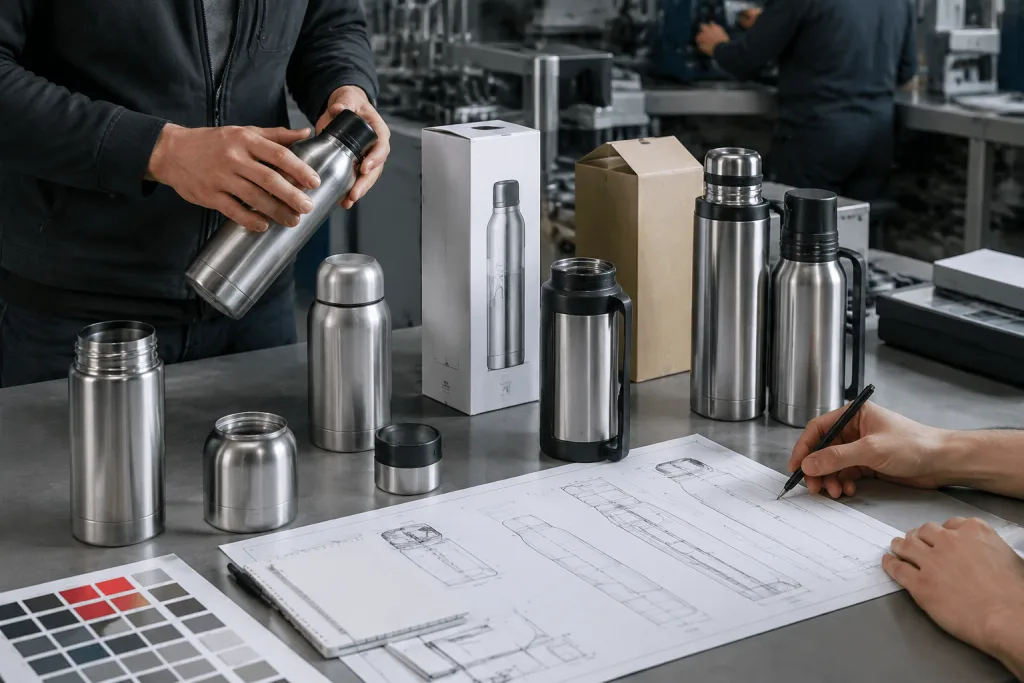
Do not let mass production start until 4 files are frozen: the signed sample, BOM, artwork proof with Pantone code, and packaging dieline. For a 10,000-piece thermos flask custom made order, normal production time is 30-45 days after deposit and sample approval. Before Q4, we usually quote 37-60 days because powder coating booths and gift box printing lines get booked; last October one buyer pushed for 30 days, but the math didn't work after the PO showed matte black instead of gloss black.
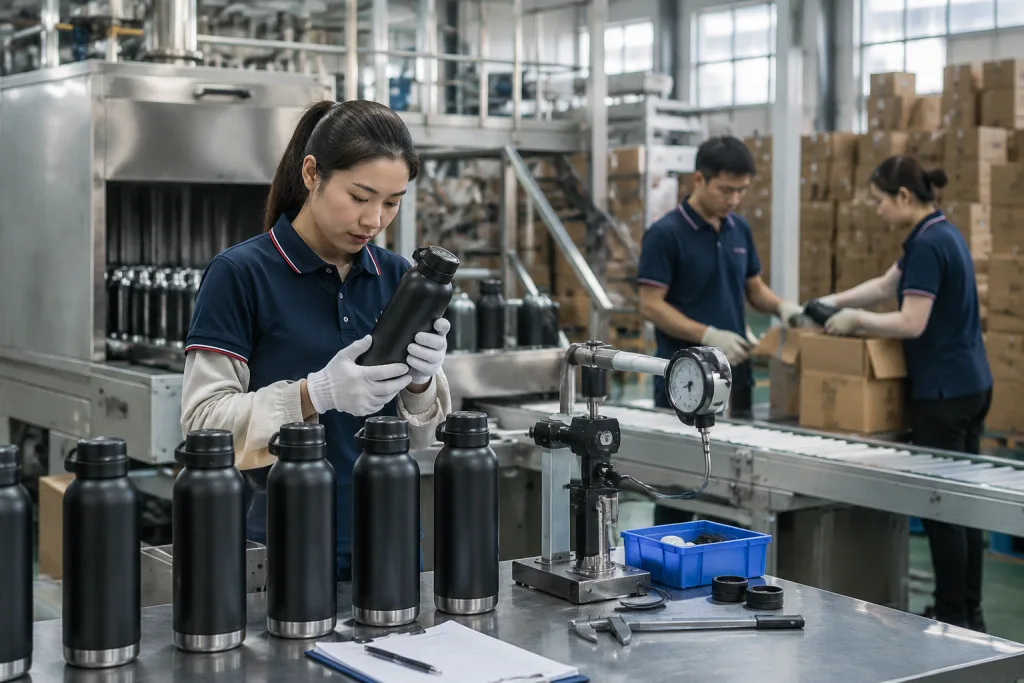
QC starts on the line, not at final inspection. We run incoming checks on steel thickness with a digital caliper, then check lid fitting, silicone gasket hardness on a Shore A tester, coating adhesion, and logo position against the artwork jig. A common powder coating adhesion test is cross-hatch tape testing. For logo durability, use alcohol rub or dry rub tests based on the decoration method. For lids, QC pulled the sample and checked thread smoothness, gasket seating, and whether the cup lid rattles after a 1.2 m carton shake test.
For final inspection, use AQL instead of vague “good quality” wording. For most bulk thermos retail orders, we suggest AQL 2.5 for major defects and AQL 4.0 for minor defects, with critical defects not allowed. Major defects include leakage, poor vacuum insulation, sharp edges, wrong logo, wrong capacity, cracked lid, or serious coating peeling. Minor defects include dust points under the agreed 0.5 mm limit, light scratches inside the signed limit board, or slight color variation within tolerance. This is the wrong question to ask: “Can you just check them well?” Put the defect table on the PO.
On 10,000 pieces, an inspector may sample 200 pieces under general inspection level II, depending on the chosen standard. Add functional testing: leak test on at least 50 sampled units, insulation test on 8-12 units, barcode scan test, carton drop test, and carton quantity check. If you are a thermos distributor shipping to several retailers, ask the factory to sort cartons by SKU and color at pallet level, with pallet labels printed at least 80 mm high. It sounds basic, but mixed cartons are a real warehouse headache; we have seen one “BLK” versus “BLK-M” typo on a PO turn into 36 cartons opened and re-taped before loading.
Ship without last-minute surprises
Inspection passed? Good. The job is not closed yet. We still need shipping marks exactly as the PO shows them, a packing list with SKU-level quantities, carton dimensions measured with a tape at the line, gross weight from the floor scale, HS code confirmation, and booking details. Stainless vacuum flasks commonly move under HS code 9617, but ask your customs broker to confirm the final classification in your import country. We have seen one buyer lose 2 days because the PO said “matte balck” and the forwarder copied that typo onto the carton mark.
For 10,000 pieces of 750 ml thermos customized product, sea freight is the right answer unless the launch date is already tight. Depending on box size, the order may take roughly 18-25 CBM; our last 750 ml single-color run packed 24 pcs per master carton, and QC pulled the sample carton at 13.6 kg gross weight. From Ningbo to major European ports, transit can be around 30-40 days port to port. To the US West Coast, 15-25 days port to port is common; inland delivery adds more time. Air freight only makes sense for urgent launch quantities. The math does not work on a full order, because freight can exceed the product cost.
Before balance payment, review the inspection report, final carton photos, pallet photos if used, and export documents. If your order includes 2 destination labels, confirm the label placement on the long side and short side if your warehouse requires both; the buyer flagged this on a Costco-style inbound once, and the relabeling took 6 workers half a day. If it is a thermos promotional order tied to a fixed event date, ship 2-3% extra units when budget allows. Small shortages happen through inspection rejection, retailer samples, and transit damage.
The best supplier thermos relationship is boring: the sample matches production, cartons match the packing list, test reports match the SKU, and your warehouse does not call you angry. That comes from precise specification, not luck. On our line in Zhejiang, China, a caliper check on the logo position and a 1-hour vacuum retention spot check catch more problems than a pretty catalog page. A manufacturer thermos partner can produce a strong stainless program, but you still need to control the order like a technical purchase, not a quick merchandise buy.
Send your thermos spec before you request pricing
Share capacity, logo, finish, packaging, market, and quantity. We will return a practical FOB quote and sampling plan.
Frequently asked questions
What MOQ should I expect for a thermos flask custom made order?
For standard stainless thermos bodies, a realistic MOQ is 1,000 pieces per color and 3,000 pieces per order if you need several colors. If you need a new mold, private lid, or unusual capacity, expect 3,000-5,000 pieces minimum because tooling, welding fixtures, and packaging setup need volume. For promotional brands testing a campaign, we usually suggest using an existing 500 ml, 750 ml, or 1,000 ml body first. That keeps sample time near 7-10 days and mass production around 30-45 days after approval. A thermos factory may accept 500 pieces, but the unit price and logo setup cost will usually be worse.
How much does a custom stainless thermos cost in bulk?
For a 750 ml stainless custom thermos with 304 inner wall, powder coating, laser logo, and color box, a practical FOB China range is about USD 4.20-5.60 at 10,000 pieces. A simple thermos bulk order with plain carton packaging may be lower, while copper lining, molded handle lids, 316 steel, gradient coating, or premium gift boxes can push the price above USD 6.50. Ask suppliers thermos teams to quote the same wall thickness, steel grade, coating, lid, and packaging. Otherwise you may compare a retail product with a cheaper promotional thermos that will not pass the same QC standard.
Which logo method is best for outdoor retail thermos flasks?
Laser engraving is usually the safest choice for outdoor retailers because it is permanent, clean, and resistant to rubbing. It works best on powder-coated stainless bodies and usually adds around USD 0.05-0.15 per piece depending on logo size and production speed. Silkscreen is better if you need a specific logo color, but it requires adhesion testing on the coating. Heat transfer can handle full-color artwork, but it is more sensitive to scratches and curved surfaces. For a distributor thermos program where products pass through several channels, we often recommend laser branding plus a retail box sticker for market-specific information.
What QC tests should be written into the purchase order?
Write the tests into the PO before deposit. At minimum, include 100% line leak testing, random insulation testing, AQL 2.5 for major defects, AQL 4.0 for minor defects, coating adhesion test, logo rub test, lid torque or open-close check, barcode scan test, and carton drop test. Define hot retention clearly, for example water filled at 95°C, room temperature 20°C, and measured after 6 or 12 hours. For a 10,000-piece thermos customized order, final inspection may sample around 200 units under general inspection level II. Critical defects like leakage, wrong logo, food-contact contamination, or sharp metal edges should be zero tolerance.
Can one thermos supplier handle retail and promotional packaging?
Yes, but you need to separate the packaging rules by channel. A retail SKU usually needs a printed color box, barcode, importer details, material statement, care instructions, and sometimes multilingual warnings. A promotional thermos may need a white box, event logo, or bulk carton pack to reduce cost. For marketplace shipments, add FNSKU labels, carton labels, and weight limits. The same thermos manufacturer can pack 6,000 units for retail and 4,000 units for a promotional campaign, but this must be shown in the packing list and carton marks. Mixed packaging instructions given after production starts create delays and mispacked cartons.