Key Takeaways
- Set thermos flask custom color MOQ at 1,000 pcs per color for stable coating cost
- Request 2 coated color samples plus 1 logo sample before approving bulk thermos production
- Use AQL 2.5 for major defects and AQL 4.0 for minor visual coating defects
- Plan 35-45 days production after deposit and approved pre-production sample
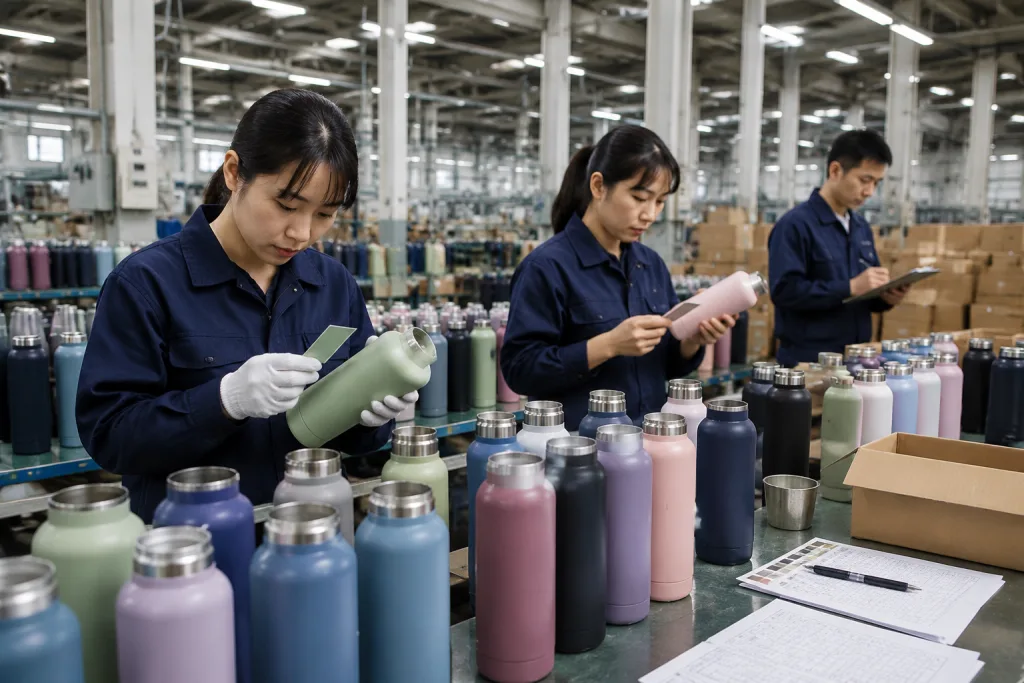
Color sounds simple until a retail buyer rejects 8,000 bottles because the navy reads purple under 4,000K store lights. We’ve seen this go sideways. For thermos flask custom color, the Pantone code is only one line on the job sheet; the real control points are 304 stainless surface prep, powder thickness at 60–80 μm, logo curing, carton rub protection, and whether Batch 2 matches the approved sample from Batch 1.
At our Hangzhou, Zhejiang factory, we run stainless vacuum flasks for distributors, outdoor retailers, and promo brands that need the same color in the warehouse as they approved on the desk. No showroom tricks. A normal custom thermos project moves from RFQ to color chip, then pre-production sample, then bulk shipment after QC pulls the sample under the light box. The tighter your PO line items are—finish code, logo size in mm, carton packing, AQL 2.5—the fewer arguments you get later in China or at your receiving dock.
Start RFQ With Color Discipline
Your RFQ decides whether the thermos supplier quotes a real production job or fills the gaps with guesswork. For thermos flask custom color orders, don’t send one lifestyle photo and write “make it like this.” We need capacity, body shape, lid type, finish, Pantone reference, logo method, packing, test requirements, and shipment term. Last month QC pulled a 750 ml sample where the PO said “army green,” the artwork file showed Pantone 5743 C, and the buyer expected a softer olive. That quote was cheap. The math didn’t work.
For outdoor retail, the common stainless thermos sizes are 500 ml, 750 ml, 1,000 ml, and 1,200 ml. A 750 ml vacuum flask normally uses 304 stainless steel inside, 201 or 304 outside depending on price level, and a wall thickness around 0.4-0.5 mm. If you need better dent resistance, ask for 304 outer wall and confirm the gauge before sampling; our line checks it with a digital thickness gauge, not by hand feel. Small detail. Big difference.
RFQ line items you should write clearly:
- Model: stainless vacuum thermos flask, 750 ml, double wall, copper-coated vacuum optional; attach a line drawing if the shoulder curve matters
- Color: Pantone 5743 C matte powder coating, tolerance ΔE under 1.5 if measured; say whether you accept ΔE 2.0 for repeat orders
- Logo: 1-color silkscreen, 60 mm wide, one position, or laser engraving; confirm logo distance from bottom in mm
- Material: 304 inner stainless steel, 304 or 201 outer shell, BPA-free PP lid; ask the factory to state the steel grade on the PI
- MOQ: 1,000 pcs per custom color, 3,000 pcs total order preferred; mixed colors below MOQ usually raise coating cost
- Testing: LFGB or FDA food contact, REACH for coating, drop test from 1.0 m; tell us if the test report must show your brand name
- Term: FOB Ningbo or Shanghai, carton-packed, export master carton; include carton drop marks if your DC requires them
For a thermos factory in Zhejiang, China, a clean RFQ can be priced in 24-48 hours. A loose one can burn 7 days and still give you a quote your purchasing team cannot compare. If you ask three thermos manufacturers, make all three quote the same steel grade and coating spec, then pin down carton spec and inspection level. We’ve seen this go sideways when one supplier quotes 201 outer shell with thin powder coating while another quotes 304 outer shell with AQL 2.5 inspection.
Price The Finish, Not Just Bottle
Custom color changes add more cost than 7 out of 10 first-time buyers budget for. The base stainless flask might be USD 4.20-5.80 FOB for 750 ml at 3,000 pcs, but matte powder coating, metallic coating, rubberized paint, and gradient finish sit in different price buckets. A promotional thermos order often pushes us for the lowest unit price; last month one buyer asked us to “just use the same black” across 2 SKUs, but the PO had Pantone 426C on one line and matte black on the other. Outdoor retailers usually pay closer attention to scratch resistance and how the bottle looks after 18 days of sea freight, carton compression, and warehouse handling.
Powder coating is still the safest choice for most customized thermos programs. It gives firm adhesion, a dry outdoor grip, and better wear resistance than thin spray paint. Normal powder thickness is roughly 60-90 microns. Too thin, and the steel edge shows early. Too thick, and lids may feel tight or the bottom may sit unevenly; QC pulled one 750 ml sample where the base ring rocked 1.5 mm on the granite table. For high-wear retail lines, we run matte powder coating with a cross-hatch adhesion test at 3M tape pull and a 24-hour room-temperature water soak check.
Metallic colors and soft-touch finishes look strong in catalog photography, but they need tighter approval. Metallic powder can shift between sample and bulk because particle distribution changes by spray angle; on the line, a 15-degree gun angle change can make champagne gold look warmer. Soft-touch coating feels premium, but it shows oil marks and scuffing faster. If you are buying distributor thermos inventory for 25 accounts, picking the finish only by photo is the wrong question to ask. We’ve seen this go sideways when the buyer flagged fingerprints during AQL 2.5 inspection.
Quotation line items to confirm before sample payment:
- Unit price by quantity: 1,000 / 3,000 / 5,000 pcs, with the same lid, coating, and carton spec
- Custom color surcharge: included or separate, per color, with Pantone code written on the PI
- Logo setup: USD 45-80 per screen or laser fixture, plus logo size in mm
- Sample cost: USD 80-150 per color sample, refundable or not, and whether freight is included
- Carton size, gross weight, and estimated CBM per 1,000 pcs, checked against the packing test carton
- Payment: 30% deposit, 70% before shipment after passed inspection, not before QC signs the report
A serious thermos vendor will separate these details. If a supplier thermos quote only says “customized bottle USD 4.65” with no finish specification, it is not a purchasing document. It is a future dispute, and the math does not work once rework, replacement cartons, and 12 days of schedule loss hit the order.
Approve Samples In The Right Order
Sampling should not look like a gift box of nice bottles. For thermos flask custom color, we approve one variable at a time. First approve the bottle construction if it is a new mold or new lid; our line usually checks lid fit with a 0.20 mm feeler gauge before we talk about paint. Then approve the color chip or coated metal sample. Then approve the logo on the final surface. If you approve body, color, and logo on one rushed sample, the math doesn't work: when the buyer flags a shade change, nobody knows whether the coating, curing temperature, or logo layer caused it.
A practical sample sequence is simple. Step one: request an existing blank sample in the same model, usually 3-5 days if stocked. Step two: request a coated color sample on the same body or a flat stainless plate, normally 7-10 days; we run plates when the spray booth is full because it saves 2 days vs waiting for the flask line. Step three: request a logo sample after color approval, another 5-7 days. If you need a full pre-production sample with final carton and insert, expect 10-15 days, and send the barcode file early because one PO typo in the EAN code can burn a whole week.
Sample PO line items should include:
- 2 pcs blank flask for structure check, stock color acceptable
- 2 pcs thermos flask custom color sample, Pantone 5743 C matte finish, sprayed on the same 304 stainless body if the model is already tooled
- 1 pc final logo sample, silkscreen white logo, 60 mm width, checked against the AI file and centerline mark
- 1 set retail packaging sample, kraft box or color box with barcode, packed with the final insert so drop-fit is clear
- Sample delivery by DHL or FedEx to your design office, with tracking sent before pickup
When the sample arrives, check it like a buyer, not like a fan of your own design. Fill it with hot water and measure temperature after 6 and 12 hours; QC pulled one sample last month that missed the 12-hour reading by 4°C because the vacuum point was weak. Check lid leakage upside down for 30 minutes. Rub the logo with a wet cloth for 50 cycles. Compare color under daylight and office LED, then take one look under warm retail lighting if your customer sells in shops. If you sell to outdoor stores, put it in a backpack side pocket and scratch it against a zipper. Not a lab test. It still tells you whether the coating will survive real use.
For China production, keep one signed physical sample with the factory and one with you. Photos help, but a physical “golden sample” stops arguments during bulk inspection; we have seen AQL 2.5 checks go sideways when the inspector only had a WeChat photo and the buyer expected a softer matte finish. Sign the base with a marker, tape over it, and record the sample weight in grams on the approval sheet.
Lock The Bulk PO Details
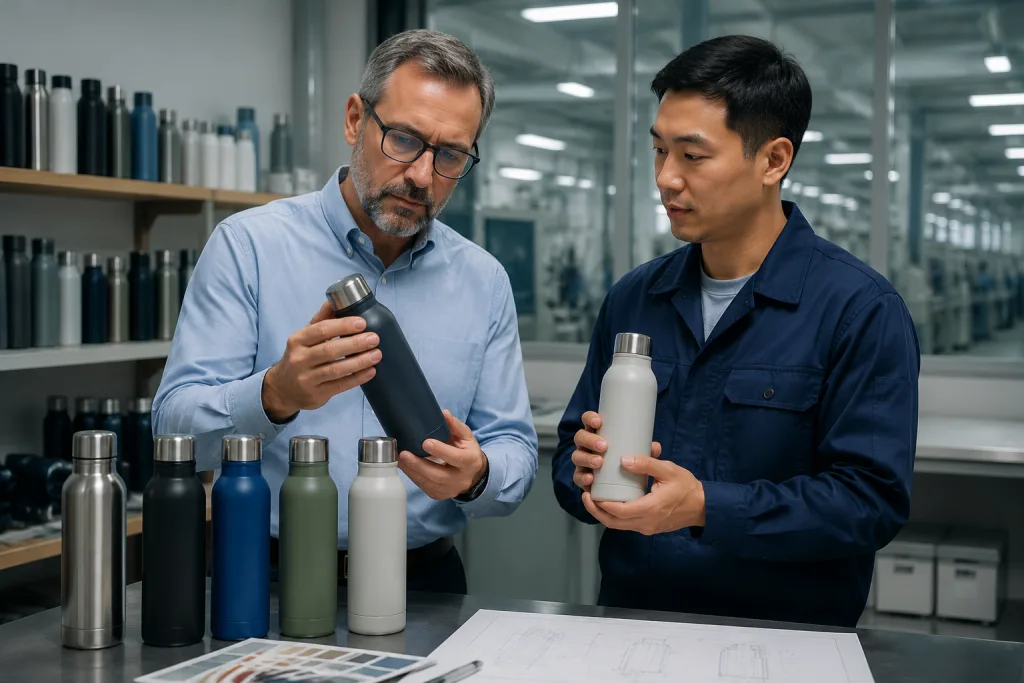
After the sample is approved, the bulk PO should read almost like an inspection checklist. Boring is good. We have seen 6 promotional brands lose control at this step: the sample looks right, then the PO says “custom thermos, black, logo printed.” That is the wrong question to ask the factory to answer. On our line, the merchandiser will enter the model code, Pantone number, logo file name, carton mark, and AQL requirement into the production sheet; if one field is vague, QC has nothing solid to hold against the golden sample. Your PO should repeat the exact model, capacity, steel grade, color, finish, logo, packaging, inspection standard, shipment term, and delivery date.
Our Zhejiang plant capacity for stainless vacuum bottles is about 450,000 units per month across standard models, but custom color capacity depends on coating line scheduling. For 3,000-10,000 pcs of one customizable thermos model, we normally quote 35-45 days after deposit and approved pre-production sample. Add 7-10 days if you require a new color box, instruction sheet, barcode label, or FNSKU labeling for marketplace inventory. Last month QC pulled a 750 ml sample from the powder coating line and measured a 0.18 mm paint build near the base; that small detail still affected lid fit on the retail insert, so schedule padding is not decoration.
Bulk PO line items should read like this:
- Product: 750 ml stainless steel vacuum thermos flask, model BF-750T
- Material: 304 inner wall and 304 outer wall, PP lid with silicone seal
- Color: Pantone 5743 C matte powder coating, approved sample dated May 12
- Logo: white silkscreen, 1 position, artwork file BF-logo-v3.ai
- Quantity: 5,000 pcs, MOQ 1,000 pcs per color, no mixed unapproved colors
- Packing: 1 pc/polybag/color box, 24 pcs/export carton, drop-tested carton
- Inspection: AQL 2.5 major, 4.0 minor, before balance payment
- Trade term: FOB Ningbo, shipment by sea, buyer forwarder nominated
If you are a thermos distributor selling to several accounts, split the PO by color and barcode, not by total quantity. The warehouse will not forgive a clean total if 1,200 olive bottles carry the charcoal barcode. We have seen this go sideways: one PO typo changed “5743 C” to “5473 C,” and the buyer flagged it only after carton labels were printed. For distributors thermos programs, barcode discipline matters as much as color discipline.
Inspect Color Before Final Payment
Bulk inspection is not optional for thermos customized orders. Color and coating problems get expensive once the goods leave China. In Zhejiang, a third-party QC visit usually runs USD 250-350 per man-day, and one inspector with a 3M tape, barcode scanner, and caliper can catch problems before the balance is paid. Cheap insurance. The math does not work if you end up air-freighting replacement lids or giving a 12% credit on a container of scratched flasks.
Use AQL sampling and write the defect list before inspection day. Major defects should include leakage, vacuum failure, sharp edges, wrong material, wrong logo, wrong color, broken lid, and barcode mismatch. Minor defects can include small dust spots, tiny coating bumps, light carton marks, or print position variation within tolerance, such as a logo sitting 1.5 mm off center when the approved limit is 2 mm. For a retail-grade manufacturer thermos order, AQL 2.5 for major and 4.0 for minor is a normal starting point. For premium outdoor retail, you can tighten minor defects to AQL 2.5, but expect more rejects and slower packing; we have seen packing stretch from 12 days to 18 days when QC pulled too many coated bodies from the line.
Inspection PO or QC booking should specify:
- Inspection timing: 100% goods finished, at least 80% packed
- Sample reference: signed golden sample and approved color plate
- Tests: leak test, vacuum retention spot check, coating adhesion, logo rub test
- Visual checks: color consistency, dents, scratches, dust under coating, lid fit
- Packing checks: carton drop test, barcode scan, carton mark, pallet requirement
For color, do not rely on a phone photo from the factory thermos packing area. That is the wrong question to ask. Ask for inspection under neutral light and compare against the approved sample, preferably beside a D65 light box if the order is color-sensitive. If your company uses a spectrophotometer, define ΔE tolerance in the PO. For 7 out of 10 outdoor and promotional thermos orders we ship, visual match against the signed sample is still the practical standard, but it has to be written down. We once had a PO typo that said “mate black” instead of “matte black”; the buyer flagged it only after the pre-shipment photos.
A good thermos supplier will not be offended by inspection. We prefer it. It puts the rules on the table before balance payment, not after the goods arrive in Rotterdam, Hamburg, Los Angeles, or Toronto. On our side, QC pulls the sample, checks the carton mark against the PO, and signs off with the inspector before the container booking is released.
Plan Repeat Orders And Variants
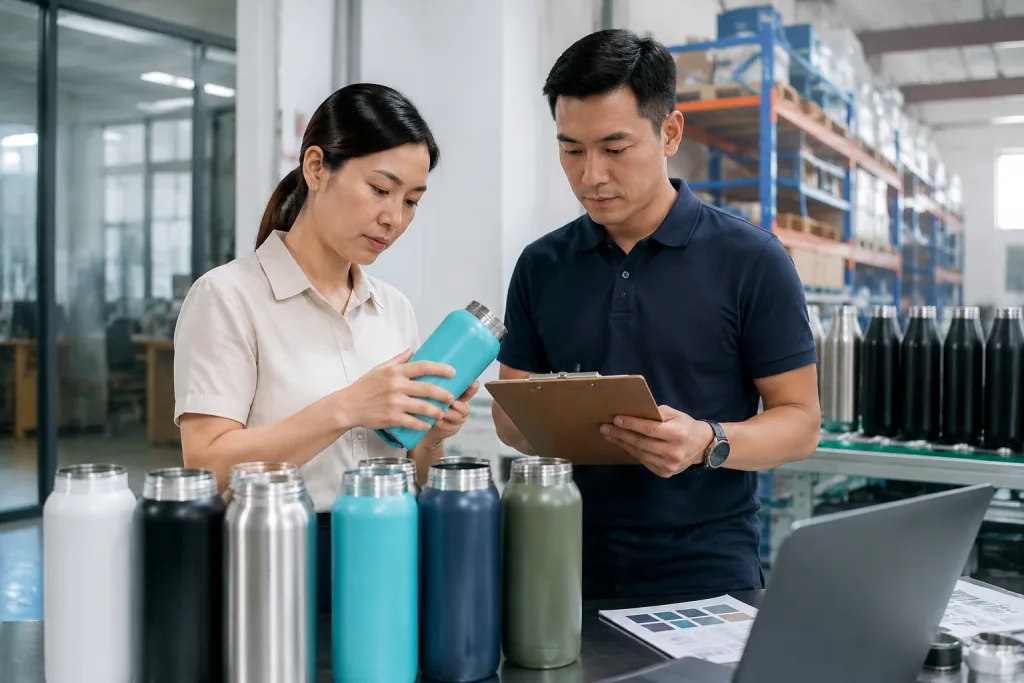
The first order proves the supplier. The repeat order proves your system. If the first thermos custom color sells well, most buyers add color No.2 within 60-90 days, then a holiday promotional thermos or a retailer-exclusive SKU. Documentation pays here. We keep approved Pantone chips, powder-coating supplier notes, AI/PDF artwork, EAN/UPC barcode lists, carton marks, and inspection reports in one shared folder named by PO number. Small thing, big trouble avoided. Last March, QC pulled a sample with the right bottle color but the old logo because the buyer’s only correct file was buried in a sales rep’s WeChat history.
For repeat thermos bulk orders, ask the thermos factory to confirm whether the same powder batch or same coating formula is still on hand. Exact repeat color is easier within 3-6 months; after 12 months, the resin batch or pigment lot may shift by 0.5-1.0 Delta E. That does not mean the color will fail, but ask for a new coated confirmation sample if the SKU sits on a brand wall display next to last season’s stock. We run the check under a D65 light box, not under the office ceiling lamp. This is the wrong question to ask: “Can you make it close?” The right question is whether the line can match the approved panel within your visual tolerance.
Outdoor retailers should also plan spare lids and gasket support before the repeat PO is released. A 5,000 pc bulk thermos order should include at least 1-2% spare lids or seals if your after-sales policy is serious, which means 50-100 extra sets in a labeled inner carton. Promotional brands may skip spare parts for one-time campaigns, but distributor thermos programs need replacements in the warehouse. The math doesn’t work when a USD 0.18 silicone gasket forces your sales team to open sellable stock. We’ve seen this go sideways after a buyer flagged “leaking lid” photos from 27 stores, and the actual issue was missing spare gasket inventory, not bottle quality.
Repeat order PO line items to add:
- Reference the previous PO number and approved sample date, including the signed color panel photo from QC
- Confirm same color formula or request one new color confirmation sample before mass powder coating
- Add 1-2% spare lids, seals, or straws if applicable, packed in separate cartons with part codes
- List each SKU by color, barcode, carton mark, and ship-to warehouse, and check for PO typos like “mat black” instead of “matte black”
- State whether mixed pallets or single-SKU pallets are required, with pallet height in mm if your DC has limits
If you source from China regularly, build a short approved vendor file for each thermos suppliers relationship. Include BSCI audit status if needed, ISO 9001 certificate, food-contact test reports, and past inspection scores such as AQL 2.5 findings by defect type. We ship cleaner repeat orders when the buyer keeps this file current. The best supplier thermos relationship is not based on charm. It is based on repeatable specifications, fair payment, and fast correction when the line finds a problem, like a 2 mm lid gap during assembly check.
Send Your Thermos Color RFQ For Review
Share capacity, Pantone target, logo artwork, MOQ, and packing needs. We will return a practical FOB quote and sampling plan.
Frequently asked questions
What is the normal MOQ for thermos flask custom color orders?
For most stainless vacuum flask models, plan on 1,000 pcs per custom color and 3,000 pcs total order for efficient pricing. Some stock-shape promotional thermos projects can start at 500 pcs per color, but the unit price is usually higher and color options are limited. If you need powder coating matched to Pantone, the coating line setup, powder waste, and QC time make very small runs inefficient. For outdoor retail, 1,000-2,000 pcs per color is a healthier starting point because you can inspect consistency across cartons and still keep FOB pricing reasonable.
How accurate can a factory match my Pantone color?
A good thermos manufacturer can usually get close to a Pantone target, but stainless curved surfaces, matte texture, and lighting affect perception. If you need measurable control, define ΔE tolerance, commonly under 1.5 or 2.0, and approve a coated metal sample before bulk. Do not approve from a PDF or phone photo. Powder coating on a round 750 ml flask will not look exactly like ink on paper. For best results, send Pantone C reference, finish type, and one physical color standard if your brand has one.
Should I choose powder coating or spray paint for a custom thermos?
For outdoor retailers, powder coating is usually the safer choice. It is thicker, commonly 60-90 microns, and handles backpack abrasion better than basic spray paint. Spray paint can be useful for glossy, gradient, or special effects, but it needs stricter rub and adhesion testing. For promotional brands with a short campaign life, spray paint may be acceptable if the target price is tight. For repeat retail SKUs, matte powder coating with cross-hatch adhesion testing and logo rub testing is the more dependable specification.
How long does sampling and bulk production usually take?
If the model exists, a blank sample can ship in 3-5 days. A custom coated color sample usually needs 7-10 days, and a final logo sample adds another 5-7 days. After you approve the pre-production sample and pay the deposit, bulk production normally takes 35-45 days for 3,000-10,000 pcs. Add time for custom color boxes, FNSKU labels, lab testing, or peak-season capacity. Sea freight from Ningbo or Shanghai to Europe or North America is separate and can add 25-45 days port to port.
What should I check before paying the balance?
Book inspection when 100% of goods are finished and at least 80% are packed. Use AQL 2.5 for major defects and AQL 4.0 for minor defects unless your retailer requires stricter terms. Check leakage, vacuum retention, coating adhesion, logo position, barcode scanning, carton strength, and color match against the signed golden sample. Also confirm carton marks, quantity by SKU, and pallet instructions. Paying the balance before these checks removes your leverage, especially when goods are still in China and corrections are possible.