Key Takeaways
- For thermos flask bulk, 1,000 pcs per SKU is a realistic starting MOQ for custom color and logo work
- 304 stainless steel is usually enough for outdoor retail; 316 only makes sense for saltwater, acidic drinks, or premium positioning
- Laser engraving costs about USD 0.18–0.45 per unit, while full wrap powder coating can add USD 0.60–1.20
- Use AQL 2.5 for major defects and AQL 4.0 for minor defects on bulk thermos inspections
If you buy thermos flask bulk for an outdoor retail line or a promo campaign, finding a supplier is not the hard part. China has thousands. The real risk is freezing the spec too early: a bottle that passes under sample-room lights, then shows 0.4 mm body dents after carton drop testing, leaks after 300 open-close cycles, or lands USD 0.80 over target when the full quote finally includes coating, spare lids, and export cartons. We’ve seen this go sideways.
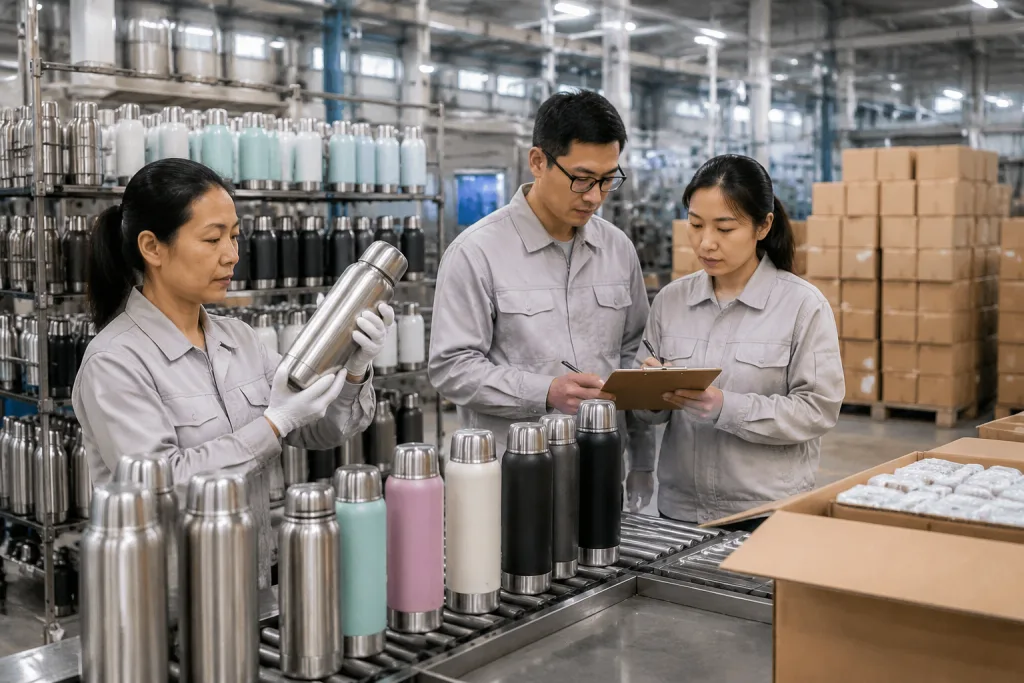
At BottleForge Industrial in Hangzhou, Zhejiang, we run a custom thermos brief around four hard calls: capacity tied to the selling channel, stainless grade and wall construction, decoration method with artwork limits, and inspection standard. Our Zhejiang production network handles 450,000 stainless drinkware units/month, with typical MOQ from 1,000 pcs per SKU and 35–45 days lead time after artwork approval. On the line, QC pulled a 500 ml sample last week with a 0.7 mm mouth ovality issue; small gap, big leak claim if nobody catches it before packing.
Start with the use case
A thermos flask bulk order should start with the drinking occasion, not the catalog photo. Outdoor retailers ask us for drop resistance, one-hand lids, and insulation they can print on a hang tag without arguing with returns. Promotional buyers push harder on logo area, gift-box fit, and a ship date that survives the PO chain. Same 500 ml custom thermos request. Different build. Last month QC pulled a 500 ml sample from the line because the push-button lid felt fine on the desk but stuck after 300 open-close cycles on the test jig.
For hiking and camping channels, 500 ml, 750 ml, and 1,000 ml are the practical sizes, but they do different jobs. A 500 ml flask fits most car cup holders and a daypack side pocket around 75 mm wide; 750 ml feels like better value on a retail shelf; 1,000 ml is heavy, so we use it for winter sports, fishing, or jobsite buyers who accept the weight. For corporate promotional thermos projects, 350 ml and 500 ml sell better because freight, carton size, and giveaway budgets stay under control. We once had a buyer flag a 750 ml promo quote because the carton jumped from 12 kg to 17 kg gross, and the math did not work for air freight.
The first trade-off is weight versus dent resistance. A common 500 ml vacuum flask uses 0.4 mm inner wall and 0.5 mm outer wall stainless. You can cut weight by moving the outer wall down to 0.4 mm, but the bottle will show handling dents faster, especially after bulk packing and repacking at the warehouse. If the item will sit in a retail aisle at USD 19.99–29.99, keep the stronger outer wall. If it is a one-time event giveaway, the lighter gauge can pass. We’ve seen this go sideways when a buyer approved 0.4 mm outer wall from a showroom sample, then found 23 dented pieces during AQL 2.5 inspection after a 1.2 m carton drop test.
Do not approve a shape until you check carton efficiency. A tapered bottle can look premium but waste 8–15% carton volume compared with a straight-wall design. On a 10,000 pc thermos bulk shipment, that difference can mean several extra CBM and a real FOB-to-landed-cost surprise. This is the wrong place to guess. We run the carton layout in CAD before mold confirmation, and one recent PO had “500ml slim” typed in the artwork file while the buyer’s carton mark said “500 ml wide mouth,” which would have changed the master carton by 40 mm.
Choose steel and vacuum construction
Most stainless thermos orders we run use food-grade 304 stainless steel for both the inner liner and outer shell. It handles coffee, tea, water, and sports drinks without pushing the FOB price out of line. For a 500 ml double-wall vacuum flask, a normal FOB Ningbo or Shanghai range is roughly USD 3.20–5.80, with the spread coming from lid structure, powder coating thickness, color box spec, and order quantity. On the line, QC checks liner wall thickness with a digital caliper; if the buyer asks for 0.5 mm outer steel but prices against 0.4 mm, the math doesn’t work.
316 stainless steel is not automatically better for every buyer. This is the wrong question to ask. It costs more, typically adding USD 0.25–0.60 per unit on mid-size flasks, and the buyer still has to sell that upcharge at retail. Use it when your marketing promise needs stronger corrosion resistance: marine retail with salt exposure, acidic beverage programs, or premium outdoor positioning. If the item is a distributor thermos for general corporate gifting, 304 is normally the smarter spec. We’ve had POs where “316” was typed once in the artwork note and “304 stainless” stayed in the product spec; QC pulled the pre-production sample until the buyer confirmed which steel they actually wanted.
The second decision is insulation performance. A reliable manufacturer thermos should use copper-plated vacuum insulation when the claim is serious: hot above 60°C after 6 hours, or cold below 10°C after 12–24 hours, depending on capacity and test method. Ask the thermos factory to state the water fill temperature, ambient temperature, testing duration, and pass criteria. “Keeps hot 12 hours” means little without the test setup. In our test room, we log 95°C fill water, 20–25°C ambient, full-capacity fill, and closed-lid testing; one 500 ml sample passed 6 hours but failed 12 hours by 4°C after the vacuum tail weld looked weak under inspection.
Lid design affects performance more than buyers expect. A stainless cap with a plastic inner thread gives better insulation than a thin flip-top sports lid. Flip lids sell better for commuters, so there is a trade-off. For outdoor retail, we often suggest a screw cap for 750 ml and 1,000 ml models, and a leak-tested push-button or flip lid for 350 ml and 500 ml daily-use bottles. We run lid leakage checks by filling the bottle, tightening to the set torque, then laying it sideways for 30 minutes; the buyer flagged one “easy-open” lid because the silicone ring jumped out after 200 open-close cycles.
Practical rule: if your return risk is leakage, simplify the lid. If your sales risk is boring shelf appeal, upgrade the finish and packaging before adding moving parts.
Decoration changes the economics
A custom thermos is not a plain flask with a logo slapped on Friday afternoon. Decoration changes the MOQ and scrap rate before it changes the look. Laser engraving is still the safer call for smaller runs and outdoor brands: no peeling, clean edges on powder coating, fast setup on our 20W fiber laser. We run a simple aluminum positioning jig, and if the logo sits 0.2 mm off-center, QC pulls the sample before mass production. For most logos, laser engraving costs USD 0.18–0.45 per unit after a small tooling or programming charge.
Silkscreen works when the logo is simple and the cup wall is smooth. One-color jobs often land at USD 0.08–0.20 per unit, but the math does not work well on rough powder coating; we have seen white ink break at the edge after the 3M tape test. Heat-transfer and water-transfer printing give richer graphics for a thermos promotional campaign, but expect higher MOQ and more Pantone checking under a D65 light box. Full-wrap artwork needs a curved 3D mockup. A flat PDF hides the seam problem.
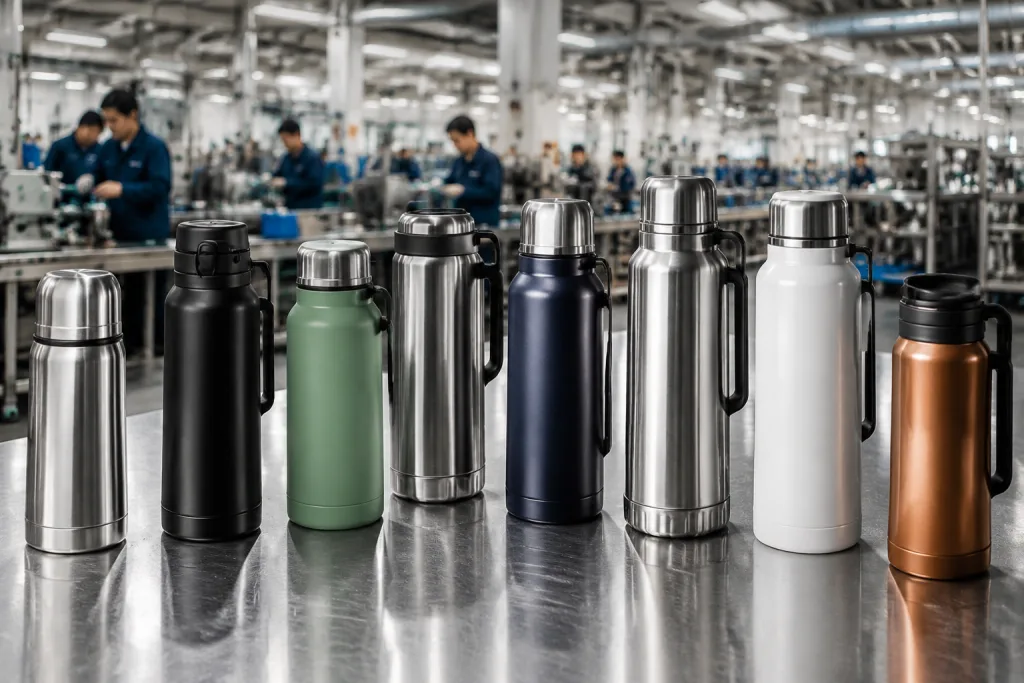
Powder coating is the standard finish for outdoor retail because it gives better grip and looks stronger on shelf. Matte black and navy are easy because we coat those almost every week; olive and white are still normal, but we check powder stock before quoting. Custom Pantone coating can require 2,000–3,000 pcs per color, depending on the coating supplier thermos line and factory schedule. If your campaign has 8 colors at 500 pcs each, this is the wrong question to ask. Use stock colors plus customized thermos logo, or raise the total MOQ so the line changeover makes sense.
For promotional brands, gift boxes change the quote faster than buyers expect. A white box is cheap and packs well. A 350 gsm printed retail box may add USD 0.18–0.45 per unit, and our carton test usually checks 5-layer K=A board before we ship. A rigid gift box can add more than USD 1.00 and increase carton volume by 20–35%. We have seen this go sideways when the PO says “white box” but the approved sample shows a printed sleeve; lock the packaging cost before sample approval, not after.
Set a realistic order structure
MOQ is where 6 out of 10 new buyers read the thermos manufacturer quote wrong. A factory may say the MOQ is 500 pcs, but on our line that usually means stock body, stock color, laser logo or 1-color print, and a lid already sitting in the parts bin. A true thermos customizable project with special color, new lid, custom retail box, and color-matched silicone usually starts at 1,000–3,000 pcs per SKU. New mold development is a separate cost file; the math does not work below 5,000–10,000 pcs after CNC sample, mold trial, and first AQL 2.5 inspection.
If you are a distributor thermos buyer testing a new outdoor channel, do not over-customize the first order. Pick one proven body and two colors, then lock one decoration method and one box format. Simple wins. It keeps sampling to 7–10 days instead of 12–18 days because QC only needs to pull one body fit sample, one logo position check, and two powder coating panels measured against the Pantone card. For example, 2,000 pcs total split into 1,000 black and 1,000 forest green is much easier to run than five colors at 400 pcs each; we have seen that split go sideways when one low-volume color fails adhesion tape test.
Lead time depends on decoration and season. For standard thermos custom work, 7–10 days for pre-production samples and 35–45 days for mass production is normal after deposit and artwork approval. Around China holiday periods or peak Q3 promotional schedules, add 7–14 days of buffer. Shipping by sea to Europe or North America can add 25–45 days port-to-port, before customs and inland delivery. The buyer often asks, “Can you cut 10 days?” Wrong question. Ask whether the logo film, color chip, and carton marks are approved; one PO typo on “matte balck” held a 3,000 pcs job for 2 days while sales, printing, and QC checked which finish the buyer wanted.
Payment terms are part of the order structure. A common setup is 30% deposit and 70% balance before shipment, FOB Ningbo or Shanghai. Larger repeat buyers can discuss different terms after 3 clean orders with no overdue balance and no inspection dispute. If a thermos vendor offers unusually low prices with vague payment, material, or inspection terms, slow down. We ship 304 stainless, not promises. Cheap uncertainty gets expensive when QC pulls the sample and finds a 0.3 mm wall-thickness gap, loose silicone fit, or cartons marked for the wrong SKU.
Inspection should be agreed early
Put quality control for bulk thermos orders directly on the purchase order. “Factory standard” is too loose. We have seen this go sideways when a buyer approved a sample with a 0.3 mm logo shift, then rejected 48 cartons after packing because the PO never named the tolerance. At BottleForge Industrial in Zhejiang, we run incoming 304 stainless checks with a micrometer, line checks during polishing and coating, then a final random inspection before balance payment.
For export orders to Europe and North America, the checkpoint sheet should cover food-contact compliance, appearance defects, logo position, coating adhesion, capacity, insulation, leakage, odor, carton strength, and barcode readability. Retail is rough. If you sell through retail or online fulfillment, cartons must survive conveyor drops and warehouse re-labeling; QC pulled one 1,000 ml flask carton last season after the corner split at 9.8 kg gross weight. A five-ply export carton is standard for heavier 750 ml and 1,000 ml stainless flasks; light three-ply cartons fail too often on distributor shipments above 300 cartons.
Use AQL language in the purchase order. A practical inspection level is AQL 0 for critical defects, AQL 2.5 for major defects, and AQL 4.0 for minor defects under ANSI/ASQ Z1.4 or ISO 2859-1 sampling. Critical defects include sharp edges on the mouth rim, leaking lids after a 30-second inverted test, unsafe materials, or wrong food-contact components. Major defects include poor vacuum performance after the 6-hour hot water test, wrong logo color versus Pantone, visible dents under a 60 cm inspection distance, or coating adhesion failure after 3M tape pull.
Ask for compliance documents before mass production, especially if you need REACH, LFGB, FDA food-contact support, Prop 65 review, BSCI audit status, or ASTM packaging considerations for the US market. Not every supplier’s thermos quote includes the same documents; we have had buyers flag this only after the goods were packed and the math did not work, because unpacking 2,400 pcs for re-checking cost 12 days vs 18 days including lab re-submission. If compliance is mandatory for your retailer, put it into the RFQ and sample approval stage, not a late email after the pallets are wrapped.
Compare quotes without fooling yourself
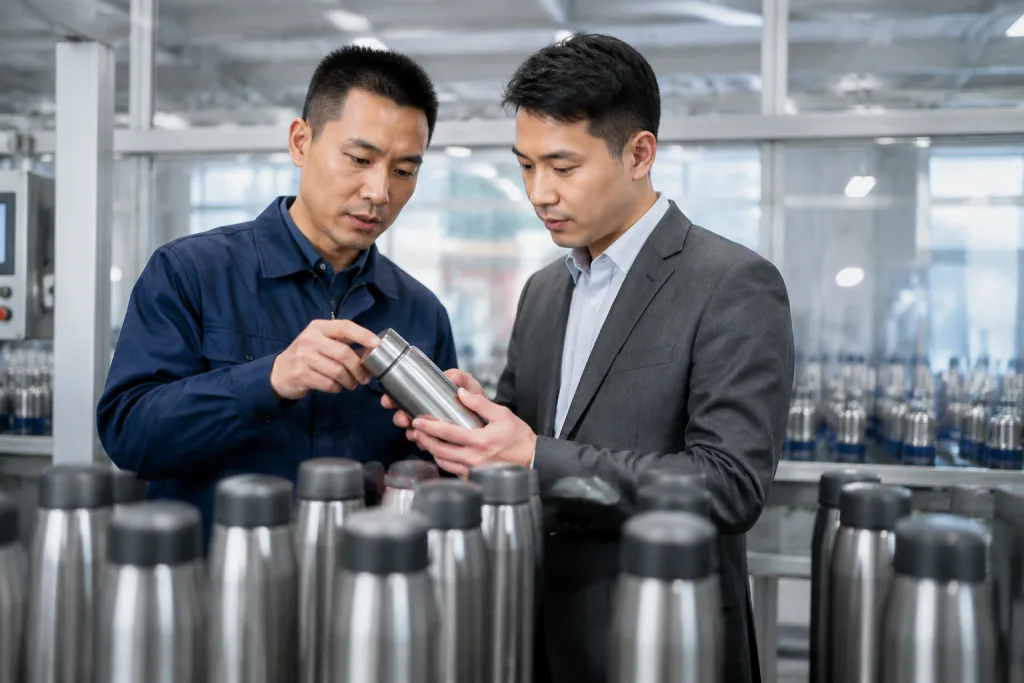
Compare the spec first, then the unit price. A USD 3.95 quote and a USD 4.35 quote may be two different bottles. One quote may cover copper plating, 0.5 mm outer wall, powder coating, retail box, plus 100% leak test on the air-pressure bench at 0.6 MPa. The cheaper one may hide 0.4 mm steel, skip the copper layer, pack in a plain white box, and run only spot checks; we have seen QC pull 8 leaking lids from 200 samples when the gasket groove was 0.2 mm off.
Ask each thermos manufacturer for a quote sheet with capacity, steel grade, wall thickness, lid material, coating type, decoration method, packaging, MOQ, sample cost, sample days, production lead time, HS code, FOB port, carton dimensions, gross weight, and compliance support. Do not accept “same as your sample” as a spec. If you are buying for Amazon or a third-party logistics program, add FNSKU labeling size, master carton marks, and carton drop-test requirements; one buyer flagged a PO because “black lid” was typed as “blank lid,” and the line stopped for 6 hours while sales confirmed it.
For outdoor retail, landed cost beats FOB unit price. This is the wrong question to ask if your team only chases the lowest EXW number. A bottle that is 38 g heavier may add freight, but it can cut dent complaints after the carton drop test from 1.8% to under 0.6% in our checks. For promotional thermos programs, timing often beats a USD 0.10 saving; missing a trade show slot because production runs 18 days instead of 12 days makes the math look silly.
A good manufacturers thermos partner will push back when your brief fights the cost target, lead time, or MOQ. That is not bad service. It is how we ship a clean order instead of winning a messy inquiry. The best thermos factory conversations sound like this: 5,000 pcs, 500 ml, 304 stainless, matte powder coating, laser logo, printed box, AQL final inspection, FOB Ningbo, delivery by a fixed date. If the buyer asks for 2,000 pcs with 6 colors and individual barcode stickers, we will say the math does not work before the deposit hits.
Send your thermos flask bulk brief for review
Share capacity, quantity, logo method, target price, and delivery date. We will flag the cost and production risks before quoting.
Frequently asked questions
What is a realistic MOQ for thermos flask bulk orders?
For a standard stainless model with stock color and one logo, 1,000 pcs per SKU is realistic. Some thermos suppliers may accept 500 pcs, but usually only for existing inventory or limited decoration. If you need custom Pantone powder coating, printed retail packaging, special silicone color, or a thermos customized lid, expect 2,000–3,000 pcs per color or SKU. For a new mold, the commercial MOQ is usually 5,000–10,000 pcs because tooling, testing, and setup costs must be recovered. If you are testing a new outdoor or promotional channel, keep the first order simple: one body, one lid, two colors, and one logo method.
How much should a 500 ml custom thermos cost from China?
A 500 ml double-wall 304 stainless steel custom thermos typically falls around USD 3.20–5.80 FOB Ningbo or Shanghai. The lower end usually means a simple screw lid, stock color, plain box, and basic logo. The higher end may include copper-plated vacuum insulation, powder coating, laser engraving, printed retail box, better carton packing, and stronger QC. 316 stainless steel, flip lids, handles, tea filters, or full-wrap artwork can push the price higher. Always compare wall thickness, lid material, packaging, and inspection terms before treating one thermos vendor as cheaper than another.
Which logo method is best for a promotional thermos?
For most promotional thermos projects, laser engraving is the safest choice because it is durable, clean, and quick to run. It usually costs USD 0.18–0.45 per unit depending on logo size and surface. Silkscreen is cheaper for simple one-color logos, often USD 0.08–0.20 per unit, but it can scratch faster on textured coating. Heat-transfer printing is better for multi-color campaign graphics, but it adds sampling time and needs tighter artwork control. If your item is meant for outdoor retail, choose laser or high-quality transfer printing. If it is a short-term giveaway, silkscreen may be enough.
What tests should I require before shipping bulk thermos orders?
At minimum, require leakage testing, insulation testing, capacity check, coating adhesion, logo accuracy, odor check, carton inspection, and random appearance inspection under AQL. A common final inspection setting is AQL 0 for critical defects, AQL 2.5 for major defects, and AQL 4.0 for minor defects. For insulation, define the test clearly: fill temperature, ambient temperature, test duration, and pass temperature. For export to Europe or North America, ask about REACH, LFGB or FDA food-contact documents, and BSCI audit status if your retailer requires social compliance. Put these requirements in the PO before production starts.
How long does thermos bulk production usually take?
For a standard thermos bulk order, plan 7–10 days for sample preparation and 35–45 days for mass production after deposit and artwork approval. Custom Pantone coating, new packaging, complex transfer printing, or peak-season scheduling can add 7–14 days. Sea freight to Europe or North America often adds 25–45 days port-to-port, plus customs and inland delivery. If you have a trade show, retail launch, or holiday promotional deadline, work backward from the required delivery date and include sample revisions. The most common delay is not factory production; it is late artwork approval or unclear packaging requirements.