Key Takeaways
- A realistic 500 ml thermos flask bulk price is usually USD 3.20–6.80 FOB China at 1,000–5,000 units
- Vacuum loss, lid leakage, coating adhesion, and logo failure are the four expensive QC problems
- Specify 304 interior steel, leak test pressure, AQL level, carton drop test, and logo artwork tolerance before deposit
- Custom thermos MOQ is commonly 1,000 units per color, while new mold work adds 20–30 days
A cheap thermos flask bulk price is easy to quote and hard to protect. The wrong question is “How low can you go?” We’ve seen outdoor retailers and promo brands pay for it later: lids seep after a 76 cm carton drop test, powder coating chips where the cup holder rubs, logos print warm grey because the PO said “white” but no Pantone code, and 1,200 units land with weak heat retention. By then, the launch date is fixed.
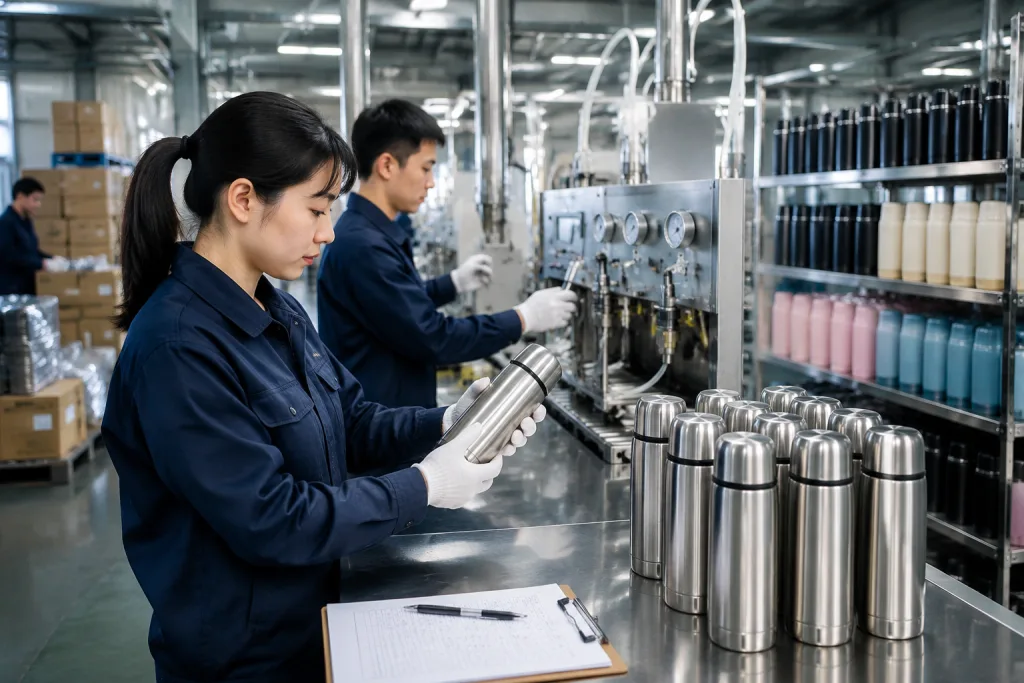
At our Hangzhou, Zhejiang factory, we run a bulk thermos order as a failure-prevention job, not a catalog transaction. China has 600+ thermos manufacturers, but the gap shows up in the written spec, the QC checkpoints, and how fast the supplier thermos team reports bad news. Our stainless thermos line runs about 320,000 units/month, with custom MOQ from 1,000 units per SKU and normal lead time of 35–45 days after sample approval. On the line, QC pulled the sample with a digital caliper and torque tester before packing, because a 0.3 mm lid mismatch can turn into wet cartons by the time we ship.
The price fails before production
Most thermos flask bulk price fights start before the order sheet is even clean: buyer and factory are pricing two different bottles. A 500 ml stainless thermos can be USD 2.85, USD 4.40, or USD 7.20 FOB Ningbo or Shanghai, and all three can be honest quotes. The gap sits in 304 stainless or 201 outer shell, 0.38 mm vs 0.50 mm sheet before stretching, cap parts count, powder coat vs spray paint, 5-ply carton strength, AQL 2.5 inspection, and whether we run a real custom thermos sample or just send a nice photo from last year’s line.
For outdoor retail, comparing a thin giveaway flask with a trail bottle is the wrong question to ask. A workable spec is 304 stainless steel inner wall, 201 or 304 outer wall depending on shelf price, 0.4–0.5 mm body wall thickness before forming, copper-plated vacuum where needed, food-contact silicone, and carton packing that survives parcel drops. QC pulled a 500 ml sample last month with a 0.32 mm outer wall; it looked fine on the table, then dented after one 80 cm drop test. For promotional thermos programs, a lighter spec can work. Just price it on purpose.
Here is where we’ve seen this go sideways: the thermos vendor quotes low to win the order, then asks for changes after the 30% deposit lands. The lid moves from push-button to screw cap, the coating becomes single-pass paint, or the carton drops from 5-ply to 3-ply. Small words, big damage. One buyer flagged it only after their PO said “matte black powder coating,” while the vendor’s PI had a typo: “paint black.” You still get a bulk thermos, but not the bottle your customer signed off.
Spec around it: ask every thermos manufacturer for a line-item quote. Require capacity, steel grade, lid material, finish, logo method, individual packaging, master carton quantity, AQL standard, FOB port, payment terms, and sample cost. We usually ask for MOQ, sample lead time such as 7 days vs 12 days, and carton size in cm on the same sheet, because freight math breaks fast when 24 pcs becomes 30 pcs per carton. If a manufacturers thermos quote is 15–25% below the pack, assume something has been removed unless they can explain the process advantage in writing.
Vacuum failure ruins the promise
A stainless thermos sells one promise: keep drinks hot or cold. If the vacuum is gone, the lid style, powder coat, and logo print do not matter. We’ve seen vacuum loss come from a pinhole at the laser weld, oil left on the inner wall before sealing, a soft tail plug, or cartons dropped hard enough to shock the base. QC pulled one 500 ml sample last month that looked perfect under the light box, but it dropped from 95°C to 54°C in 6 hours. Bad vacuum hides well.
For a standard 500 ml customized thermos, we run a simple target: 95°C water should stay above 68°C after 6 hours at 20°C ambient temperature. Premium outdoor SKUs can be tighter, but this is the wrong question to ask if the test method keeps changing. Lock the details: preheat or no preheat, fill volume in ml, starting temperature, ambient temperature, and whether the probe reads from the center or near the wall. One buyer once sent us a competitor report showing 72°C after 6 hours; the fine print used preheating for 10 minutes, while their PO to us said no preheat. The math doesn’t work.
Factories in Zhejiang and other China drinkware clusters usually check vacuum after pumping, then again after final assembly. On our line, operators use a vacuum detector, hot water screening, and batch heat-retention samples marked by carton number. For large thermos bulk orders, we run 100% vacuum-presence checks during production, then pull batch samples for the 6-hour retention test. No factory can park 30,000 pcs in a lab for 6 hours each. We catch the gross failures first, then use sampling to confirm the batch is stable.
Spec around it: write your heat retention requirement into the purchase order. For example: 500 ml, start at 95°C ±2°C, ambient 20°C ±2°C, result not lower than 68°C after 6 hours, sample size per agreed AQL. Also state that visible rattling, base swelling, or condensation on the outer wall is a major defect. We’ve seen this go sideways when the PO only says “good heat preservation”; the factory then follows its internal 3-hour screen and the buyer flags the issue after arrival. By then, arguing costs more than writing one clean line in the PO.
Lids leak in boring places
Lid leakage is boring until 1,200 customers write the same one-star review. We usually find it at the silicone gasket, thread fit, flip hinge, push-button valve, or straw port; QC pulled one sample last month that passed upright for 5 minutes, then left a wet ring on kraft paper after 20 minutes sideways. That is how bottles travel in a backpack. Outdoor retailers should write leak testing into the spec sheet as a functional requirement, not a nice-to-have.
There are two risks, and they behave differently. Liquid leakage means water escapes through the seal right away; air leakage is sneakier, because the lid looks fine at room temperature, then hot filling and pressure change push liquid through the valve 12 minutes later. A factory thermos lid with 6 moving parts gives the line more places to fail than a simple screw cap. The math doesn't work if you save USD 0.18 on the lid and then air-ship 300 replacement lids after the buyer flags wet cartons.
For a customizable thermos with a screw lid, we normally use silicone hardness around 50–60 Shore A, depending on geometry, and we check it with a Shore A durometer at incoming inspection. Threads should engage smoothly without cross-threading; if the operator needs to force the cap past the first 2 turns, the mold needs attention. The gasket should be removable only if your cleaning instructions support it. For promotional brands, a lid that looks premium but uses weak 1.5 mm hinge pins is a false economy, because replacing lids after shipment costs more than specifying the right lid before the PO is signed.
Spec around it: require 100% assembled leak check for water bottles intended for bag carry. We run fill to rated capacity, close lid, invert for 3 minutes, then lay horizontally and roll through 360 degrees on the stainless test bench. For random QC, add a 30-minute side-rest test; one drop on the tissue paper counts. Classify any visible leakage as a critical or major defect under AQL 0/1.5 depending on your risk tolerance. For kids or hot-liquid products, use stricter rules.
Coating chips expose weak process control
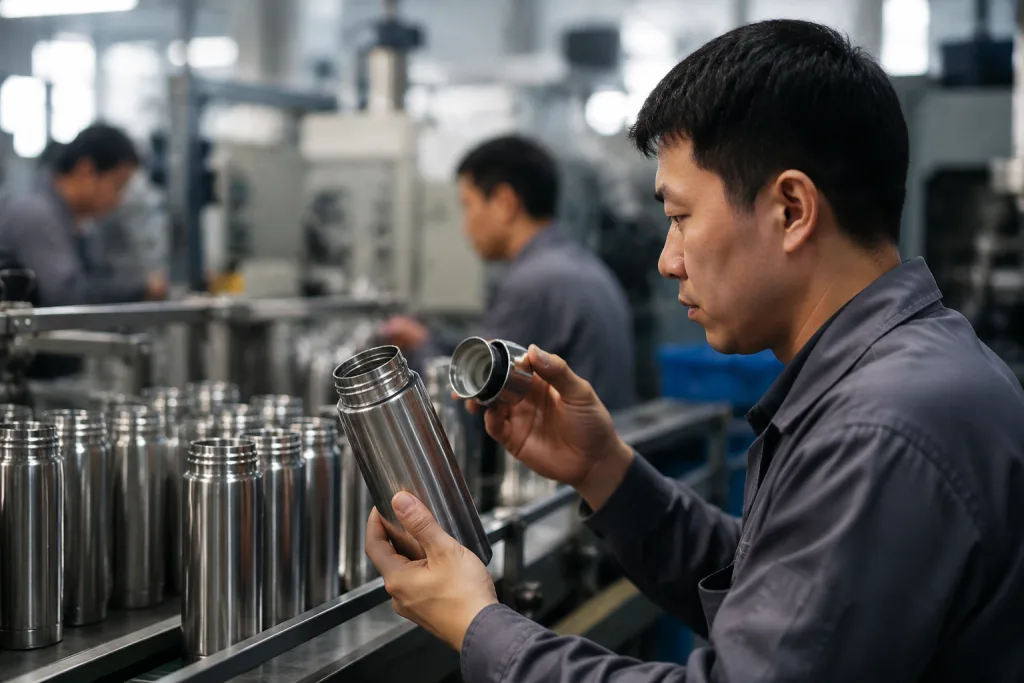
Powder coating and spray painting fail when pretreatment is rushed. We run the bodies through alkaline wash, clean-water rinse, and a 160°C drying tunnel before the line lets them near powder. One bare-hand touch leaves a thumbprint the coating will not forgive. QC pulled 32 samples last month after the buyer flagged chips on the bottom ring; the film looked fine at packing, then cracked after 7 days of shelf handling because the curing oven drifted 18°C from left to right.
Outdoor bottles get beaten up. They ride in cup holders and scrape camp tables for a living. A conference giveaway has lower coating pressure; an outdoor retail SKU needs adhesion and abrasion checks written into the PO. Use a cross-hatch tape test, often aligned with ASTM D3359 methods, and tell the factory the pass level you expect. This is not paperwork. It stops arguments when the line says “acceptable” and your warehouse says “returns.”
The thermos flask bulk price moves with finish. Basic spray paint may add USD 0.25–0.45 per unit. Durable powder coating may add USD 0.45–0.90 depending on color, line efficiency, and order quantity. Rubber paint, gradient finish, glitter, or ceramic-like coating adds cost because the defect rate jumps; we have seen matte rubber black lose 6% at final inspection from dust dots alone. Dark matte colors hide scratches better than glossy white, but packers leave oil marks if they handle bottles without fresh gloves. White and light beige need cleaner benches and 2 mm more carton clearance around the divider.
Spec around it: define finish type, Pantone or RAL color, gloss level if relevant, coating thickness target, and adhesion requirement. Add a carton rub check: packed bottle against divider or paper sleeve after vibration simulation. If your thermos custom order uses retail gift boxes, test the exact box insert, not a padded sample from the showroom shelf. We ship 5,000 units in a 20GP, not one foam-wrapped hero sample; the math goes sideways when the insert edge rubs the coating for 28 days at sea.
Logo work breaks brand trust
Logo defects look small on the line until the customer opens the carton. Laser engraving at 0.03 mm too shallow, silkscreen ink bleeding at the edge, pad print sitting 1.2 mm off center, heat-transfer film lifting after tape test, or a wrong Pantone chip can make a customized thermos feel like a cheap giveaway. We have seen QC pull 8 bottles from a 50-piece logo check because the buyer’s “navy” printed closer to royal blue. For promotional brands, the logo is the product. Outdoor retailers push back just as hard because a crooked mark makes the bottle feel cheap.
Laser engraving holds up well on powder coating, but the final shade depends on the coating thickness and the stainless surface under it. Silkscreen is a good fit for a simple one-color mark on a straight cylindrical area, as long as the artwork is adjusted for the curve. Heat transfer handles full-color graphics, but we run adhesion testing and set clear artwork limits before mass production. A tapered body is where this goes sideways: a 90 mm wide logo can look stretched near the shoulder even when the file is correct. The rotary fixture matters.
A practical logo tolerance is often ±1.5 mm placement for standard bottle printing, though a fresh fixture can hold tighter. For color, do not approve from a phone photo. Ask for a physical pre-production sample or a signed color card under D65 light if the brand color matters. About 7 out of 10 thermos supplier sales teams will say “no problem” because the artwork file looks simple. Production is different. Fixture wear, operator speed, ink viscosity from a Zahn cup, curing time, and coating texture all change the result.
Spec around it: lock the logo method, artwork size in millimeters, print location from a fixed reference point, Pantone number, and acceptable tolerance. Require a golden sample signed by both sides, not just a WeChat approval. For thermos customizable orders over 3,000 units, ask the factory to send first 20 mass-production logo units by video or courier before the full run continues. We once caught a PO typo that moved the logo 15 mm lower than the signed sample. That pause costs less than reworking an entire distributor thermos order.
Packaging fails after the QC table
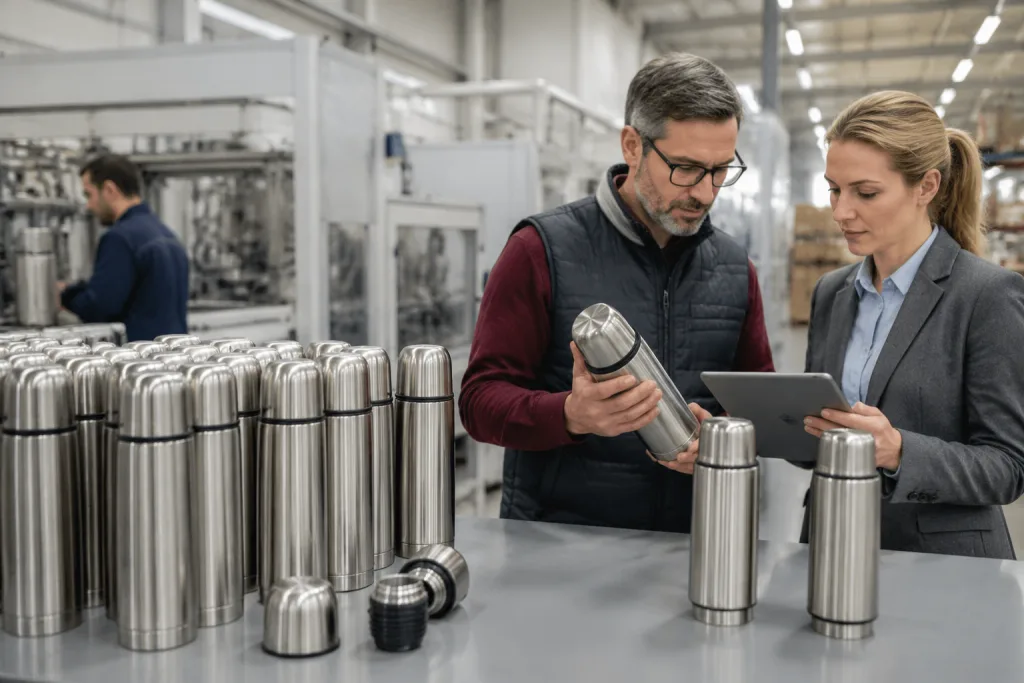
A bottle can pass AQL 2.5 and still reach the buyer with a dented shoulder because the carton was treated like decoration. We’ve seen this go sideways. A 500 ml stainless thermos is heavy enough to bruise the next bottle in the box, but light enough for a courier hub to throw 1.2 meters into a cage. Export cartons get compression, damp containers, fork arms, and Amazon or distributor relabeling. If your thermos distributors sell online, packaging is not artwork; it is part of the product spec. QC pulled one sample last month where the bottle passed vacuum and coating checks, then failed after three corner drops because the inner tray had 4 mm of play.
For wholesale cartons, we usually run 24 or 30 pieces per master carton for 500 ml flasks, depending on gift box size and the buyer’s warehouse weight rule. Keep gross weight practical, usually under 15 kg if workers lift by hand. The math doesn’t work when a buyer asks for 36 pieces in a thin carton just to cut freight by a few cents. A 5-ply export carton is safer than a thin 3-ply carton on 32-day sea routes to Europe or North America. For retail boxes, paper thickness, insert shape, and bottle movement beat pretty artwork. If the bottle rattles inside the gift box by even 6 mm, the coating and lid will pay for it; our line checks this with a quick shake test before carton sealing.
For marketplace programs, add barcode, FNSKU label placement, suffocation warning for polybags if used, and carton label format. For outdoor retailers, specify hangtag tear strength, instruction leaflet size, and spare gasket policy where relevant. A thermos supplier that only packed for domestic China wholesale often misses North American parcel abuse and European pallet stacking rules. The buyer flagged this on one PO because “label on short side” was typed as “label on shot side,” and the warehouse rejected 420 cartons until we relabeled them with a Zebra printer.
Spec around it: run a drop test on packed retail units and master cartons. A common starting point is ISTA-style drops from 76 cm for smaller cartons, adjusted by weight. Define acceptable results: no functional damage, no visible dent on saleable surfaces, no broken lid, and retail box scuffing within agreed limits. Also confirm pallet quantity, carton dimensions, and HS code before shipment. Freight surprises are part of the real thermos flask bulk price. This is the wrong place to be vague: write the carton size in mm, gross weight in kg, and pallet stack height before we book space with the forwarder.
Compliance gaps delay the shipment
Compliance gaps usually show up after the sample passes the “looks good” test. Bad timing. For stainless drinkware shipping to Europe or North America, ask on day 1 for food-contact material declarations, LFGB or EU food-contact testing where required, FDA-related material suitability for the U.S., California Proposition 65 risk screening if selling there, REACH for coatings and components, and ASTM or CPSIA checks for children’s items. Not every SKU needs the full stack, but every market needs a test map before we cut the PP lid mold or approve the 0.5 mm coating sample.
Factory audits matter too. BSCI, Sedex, ISO 9001, or customer-specific audits may be required by larger retailers. We have seen orders sit for 14 days because the buyer’s audit team asked for dormitory photos after the pre-production meeting. If your thermos manufacturer cannot support the audit calendar, the cup can be technically correct and still miss the shelf date. Our Hangzhou, Zhejiang team asks about destination market, retail channel, and age grading before tooling or decoration starts because changing silicone, coating, or packaging after failed testing can add 10–20 days.
For pricing, lab tests are not free. A basic food-contact test package may cost several hundred dollars per material set; broader retail compliance can cost more. Spread over 5,000 units, it may be USD 0.05–0.20 per unit. Spread over 500 units, it hurts. This is why MOQ matters. The math does not work when a buyer asks us to absorb three new reports on a 600-piece trial order. A supplier thermos quote that ignores compliance is not cheaper; it is missing a line item.
Spec around it: list target countries and channels in the RFQ. Ask which certificates are existing, which are model-specific, and which need new testing. Confirm whether reports are under the factory name, trading company name, or previous customer name. QC pulled one lid report last quarter where the silicone grade matched, but the coating code on the body was off by one letter. For thermos suppliers in China, a valid report should match the material, coating, and lid components you actually buy. A mismatched report is paper, not protection.
Send your thermos spec before you chase price
We will check the risky parts, quote FOB China clearly, and suggest fixes before your bulk thermos order reaches production.
Frequently asked questions
What is a realistic thermos flask bulk price for 500 ml stainless models?
For a 500 ml double-wall stainless steel model, a realistic thermos flask bulk price is usually USD 3.20–6.80 FOB China at 1,000–5,000 units. The lower end is normally a simple screw lid, standard color, 304 inner/201 outer steel, and basic white box. The middle range adds powder coating, better lid tooling, and one-color logo. The higher range may include 304 inner and outer steel, copper-plated vacuum, retail packaging, laser logo, and stricter AQL inspection. If you receive a quote below USD 3.00 for a custom thermos with retail packaging, ask what was removed. Freight, duty, testing, and local warehousing are not included in FOB pricing.
What MOQ should outdoor retailers expect for a customized thermos order?
For most customized thermos projects, expect MOQ from 1,000 units per SKU or color. Some factory thermos models can run 500 units if you accept existing colors and simple laser engraving, but the unit price will rise because setup time is the same. For a new powder color, 1,000–2,000 units is more practical. For a new lid mold or body shape, MOQ may move to 3,000–5,000 units because tooling, testing, and line adjustment need volume. At our Zhejiang facility, standard custom-logo stainless thermos lead time is usually 35–45 days after sample approval, plus 7–10 days for sampling.
How do I compare quotes from different thermos manufacturers fairly?
Put every thermos manufacturer on the same RFQ sheet. Include capacity, body diameter, steel grade, wall thickness, lid type, silicone grade, coating method, logo process, packaging, test requirements, AQL level, FOB port, payment terms, and requested lead time. Ask for carton size and gross weight, not only unit price. A thermos suppliers quote that excludes retail box, compliance testing, or 100% leak test may look USD 0.30–0.80 cheaper but cost more later. Also compare sample quality. A clean pre-production sample with signed specs is worth more than a low spreadsheet number from a thermos vendor that cannot explain its QC process.
Which logo method works best for promotional thermos programs?
For promotional thermos programs, laser engraving is the safest durable option on powder-coated stainless bottles, especially for one-position logos. It usually adds about USD 0.10–0.35 per unit depending on size and order volume. Silkscreen is good for simple one- or two-color logos and can be cheaper at volume, but curved surfaces require controlled fixtures. Heat transfer is better for full-color graphics, yet adhesion must be tested because peeling damages brand trust quickly. For thermos custom artwork, define logo size in millimeters, placement tolerance such as ±1.5 mm, Pantone color, and whether the logo must survive dishwasher exposure or only hand-wash use.
Can one thermos supplier handle both retail and distributor thermos orders?
Yes, but only if the thermos supplier understands that retail and distributor thermos orders have different failure points. Retail needs better packaging, barcode control, shelf appearance, compliance paperwork, and sometimes retailer audit support such as BSCI or Sedex. Distributor thermos orders may need mixed cartons, neutral packaging, fast repeat production, and stable spare-lid supply. Ask the supplier for monthly capacity, normal reorder lead time, and how they store approved samples. A manufacturer thermos partner in China should be able to keep the same steel grade, coating, lid, and logo standard across repeat orders. If they change subcontractors without notice, your second shipment may not match the first.