Key Takeaways
- Pantone-matched stainless thermos MOQ usually starts at 1,000-3,000 units per color
- Powder coating is tougher than wet paint but has a wider visual tolerance on textured finishes
- Approve color under D65 light and keep one sealed master sample for every production run
- Plan 30-45 days for custom color mass production after sample approval
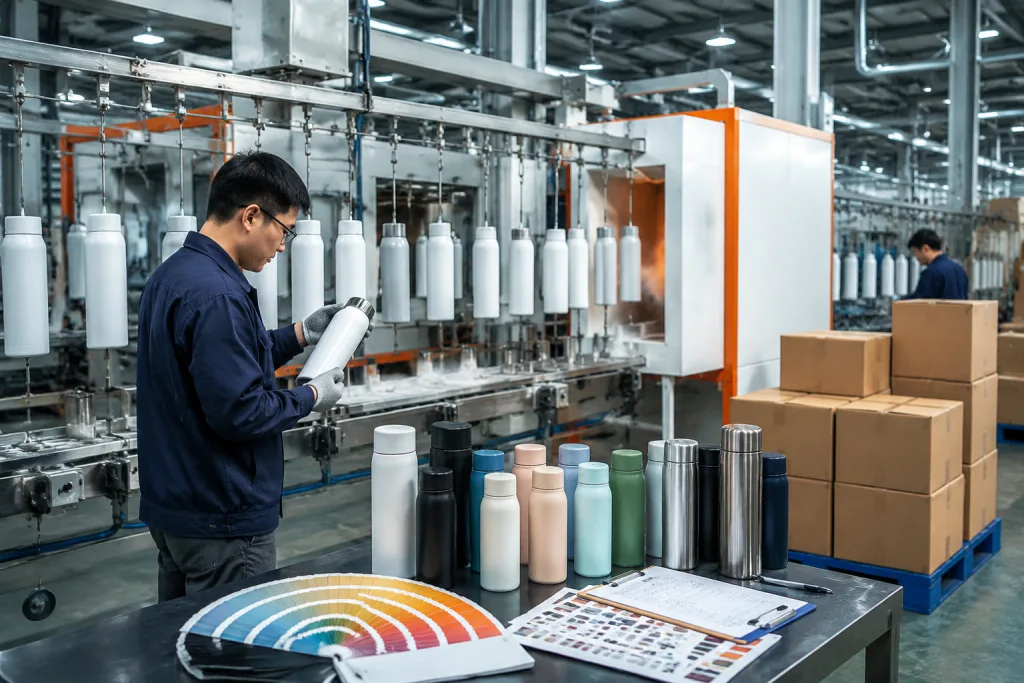
A Pantone callout looks simple on a spec sheet. On the line, it runs through powder coating thickness, wet paint viscosity, 304 stainless surface prep, logo contrast, carton side marks, and the argument we had last March when a buyer approved PMS 5483 C in the office, then flagged it under 6500K warehouse lamps.
If you buy bulk thermos programs for outdoor retailers or promo brands, asking “can you match this Pantone?” is the wrong question. Most factories can get close. The real calls are tolerance, finish type, MOQ, test method, and who signs the gold sample before China mass production starts; QC pulled one 750 ml sample last week because the ΔE reading was 2.8 when the PO said max 1.5. Our Hangzhou, Zhejiang team treats color as an engineering control, not a decoration note.
Start With Four Buying Decisions
For a thermos custom Pantone project, lock four buying decisions before you ask any thermos supplier for a quotation: color system with the exact code, coating method with target finish, logo process with artwork size, and inspection tolerance with approval rules. If those points are loose, a supplier thermos quote that looks USD 0.18 cheaper per piece can turn into 12 days of resampling after QC pulls the first color plate from the line.
Color system means the exact Pantone code, finish expectation, and viewing condition. Coated Pantone C references are used more often on stainless drinkware than U references, because most bottle shells are judged after spray coating, not on paper. If your brand book lists only RGB, CMYK, or a web hex code, ask your designer for a Pantone equivalent before factory sampling. We cannot mix 20 kg of paint from “#1F4E3D” and expect repeat color on the second batch.
Coating method is the trade-off buyers feel after shipment. Powder coating holds up better against retail shelf rub, backpack clips, and car cup holders; our cross-hatch tape test usually catches weak adhesion before packing. Wet paint can match certain glossy finishes or soft gradients closer, but the math doesn't work if the buyer wants a low unit price and no scratch complaints. Pay for the better topcoat, or choose powder.
Logo process changes how the color is perceived. A white silk screen printed at 42 mm wide on forest green looks cleaner than the same artwork laser-engraved through the coating to show 304 stainless underneath. For promotional thermos orders, the end client often cares more about the logo sitting straight than a Delta E reading. We have seen this go sideways when the PO said “front logo,” but the artwork file named it “back print.”
Inspection tolerance is where experienced buyers save money. You can demand a tight color tolerance, but you will pay through 2 extra lab dips, higher rejection, and output dropping from 3,000 pcs/day to around 2,100 pcs/day on the spray line. For most customized thermos programs, a signed physical sample plus D65 light booth review is more practical than chasing a perfect lab number on every batch. QC should judge the cup at 45 cm viewing distance, not with a phone flashlight at midnight.
Choose The Right Stainless Platform
Start with the bottle body, then talk Pantone. A clean coating cannot save a loose lid, 0.32 mm steel, or a vacuum that drops too fast. For outdoor retailers, we run 18/8 stainless steel, also called 304 stainless, on the inner wall and any drinking-contact part. That is the safe base for a manufacturer thermos going into Europe and North America; our incoming QC checks it with an XRF gun before the coils go to forming.
Wall thickness changes with capacity and price target. A common 500 ml customized thermos uses roughly 0.4 mm inner stainless and 0.5 mm outer stainless before forming, while larger 750 ml or 1,000 ml outdoor bottles need more metal around the shoulder and base. Cheap quotes have a reason. If a thermos vendor comes in 8-12% below the pack, ask for finished body weight on the PI, not just capacity. We have seen a 20-30 g saving per unit show up as base dents after the 1.0 m carton drop test.
Define vacuum performance before color sampling. A typical double-wall stainless thermos should keep water above 60°C for 12 hours when tested from 95°C fill at room temperature, depending on capacity and lid design. Wide-mouth bottles lose heat faster than narrow-mouth bottles; our test rack usually shows a 500 ml wide-mouth sample running 2-4°C lower at the 12-hour mark. Straw lids and flip lids sell well, but the math does not work if the buyer expects them to match a plain screw stopper.
For outdoor retail, I would not approve a thermos customizable platform without drop testing from 1.0 m, lid torque checks, leak testing after dishwasher-style thermal cycling, and salt spray review on coated accessories if used. For promotional brands, you may accept lighter testing, not zero testing. QC pulled one sample last month with water inside the polybag after 3 hot-cold cycles, and the buyer flagged it before we even reached Pantone approval. A leaking thermos promotional order creates claims faster than a slightly imperfect color.
Pantone Matching Has Real Limits
Stainless steel is not paper. A Pantone book is ink on coated stock; our thermos shell is 304 stainless, washed, sprayed, baked at about 180°C, cooled on a rack, sleeved, packed, shipped, then checked under office lights or a retail shelf. Same code, different surface. The wrong question is “Can you match Pantone exactly?” Better ask what ΔE tolerance we agree to before the PO is signed.
Powder coating is still our default for a durable custom thermos. We run it because it survives bag scratches better, and the matte hand-feel sells well for outdoor and corporate buyers. Here is the catch. Matte powder scatters light, so Pantone 431C on a curved bottle can read 1 to 2 shades darker than the book. Metallic, neon, and pale colors give the line more trouble; white, cream, sand, and light gray also show black specks fast if the spray booth filter is late by even 1 shift. QC pulled 12 light-gray samples last month for tiny contamination near the shoulder radius.
Wet paint can land closer on some glossy Pantone targets, and it gives more room for pearl, gradient, or clear-coat effects. The math doesn’t work for every order. For a three-month event giveaway, wet paint may pass buyer expectations. For outdoor retail at USD 18-35 retail, powder coating is usually the safer call because returns hurt more than a small color shift. We had one buyer push for glossy wet paint on a 5,000 pcs camping flask order; after the 48-hour cross-hatch tape test, the buyer flagged edge wear around the base and moved back to powder.
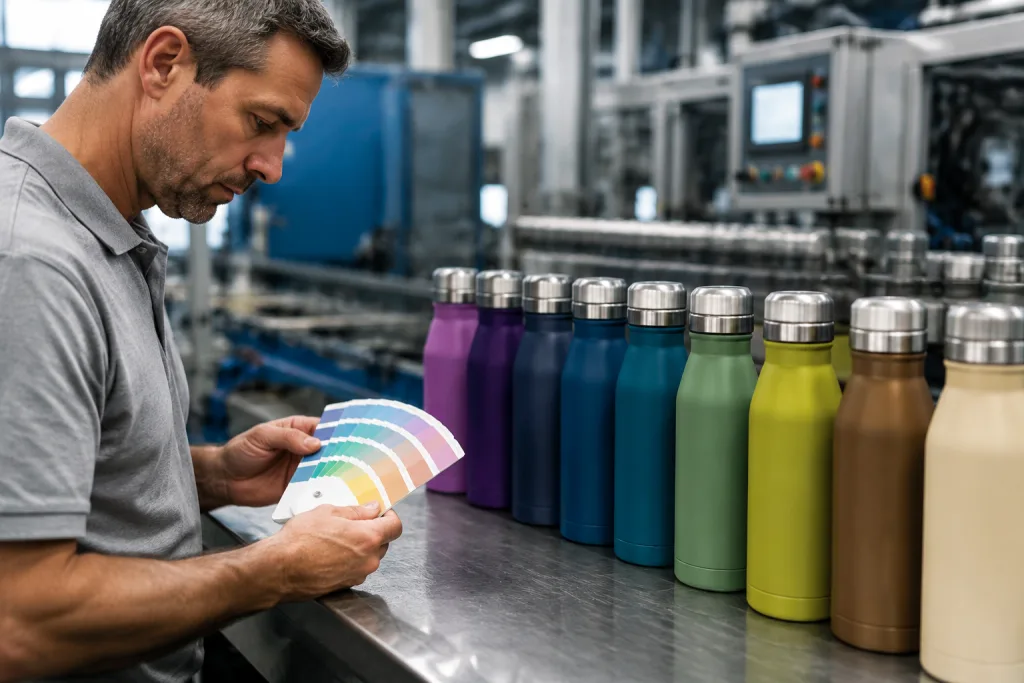
Ask your thermos suppliers for a sprayed color chip or pre-production sample on the actual stainless body, not just a flat panel. Curves, weld areas, and bases show color depth differently, especially around the 2 mm roll at the bottom. At BottleForge Industrial in Zhejiang, China, we keep one signed master sample in the QC room and one with the production line leader. Old-school, yes. It stops email fights when a PO says “Pantone 7501C” but the buyer’s attachment is named “7502 final final.pdf.”
Do not approve Pantone color from a phone photo. Put the sample in your hand, check it under D65 light if you can, and write the tolerance on the approval sheet.
Logo Method Changes The Color Brief
I’ll rewrite the prose only, keep the HTML exactly intact, and tune it to sound like a factory sales engineer wrote it.A thermos custom Pantone brief is not finished until the logo method is locked. We see this on the line all the time: the same matte bottle looks premium with one logo and flat with another.
Silk screen printing is still the workhorse for promo thermos orders because the cost stays low and solid logos print clean. For a single-color mark, MOQ can start at 500 units on stock colors, but a custom Pantone body coating usually puts the real order size at 1,000-3,000 units per color. Multi-color work adds screen setup cost and registration risk on a curved shell. If your artwork has 0.2 mm lines, QC pulled the sample before mass run, and so should you.
Laser engraving fits outdoor retail and distributor sets better. It cuts through the coating and shows stainless steel, so there is no ink to wear off. The tradeoff is contrast. Laser on black, navy, olive, or red looks sharp; on silver, pale yellow, or light beige, the mark can disappear. We’ve had buyers flag this on a PO typo alone, and that’s the wrong question to ask after production starts. For weak contrast colors, we usually push a deeper etch or a printed logo.
Heat transfer and UV printing handle more complex artwork. They work when a promo agency wants a full-color crest or campaign graphic. They also bring more checks: adhesion, scratch resistance, and edge lift. For North America, we run ASTM-style adhesion and rub tests; for Europe, REACH expectations for inks and coatings come into the file. A good thermos factory does not separate the logo from compliance -- the logo is part of the spec.
MOQ, Price, And Lead Time
Most buyers ask for price first. Fair enough. For thermos custom Pantone work, this is the wrong question to ask unless MOQ, lead time, and packing are already fixed. A manufacturer thermos quote for 500 units in six colors ties up the coating booth six times; 6,000 units in one color runs cleaner on the line and the math changes fast. Last month QC pulled a pre-production sample because the PO said Pantone Black 6 C, with two spaces after Pantone, while the artwork file showed Black 7 C.
From China production, custom powder-coated stainless thermos orders usually start at 1,000 units per Pantone color when the body mold and lid are existing. Better pricing shows up around 3,000-5,000 units per color because coating setup, line cleaning, and QC time are spread across more bottles. For a 500 ml to 750 ml stainless bottle, FOB China pricing may sit around USD 4.20-8.50 depending on steel weight, lid design, coating, logo, and packaging. Low quotes usually cut something: 0.4 mm steel becomes 0.35 mm, the powder layer gets thinner, inspection time is rushed, or the 5-layer export carton becomes soft after one wet warehouse day.
Our Hangzhou, Zhejiang facility can produce about 450,000 stainless drinkware units per month across thermos, tumbler, and sports bottle lines. For custom thermos programs, we run 7-10 days for a color sample after artwork confirmation, then 30-45 days for mass production after approval and deposit. Peak season before Q4 can add 10-15 days. On the floor, the color sample is checked under a D65 light box before we send photos, because a warm office lamp can make one Pantone look like another.
If you are a thermos distributor or distributors thermos buyer planning catalog stock, do not split into 6 colors on the first PO. We have seen this go sideways: 1,000 units each in slow colors sit in the buyer’s warehouse while the best shade sells out in 18 days. Start with two proven Pantone colors, then reorder the winner with cleaner volume. For promotional campaigns, confirm the event date before pushing for a rare color; air freight on a thermos customized order can wipe out the margin faster than any factory discount can save it.
Quality Control Before Shipment
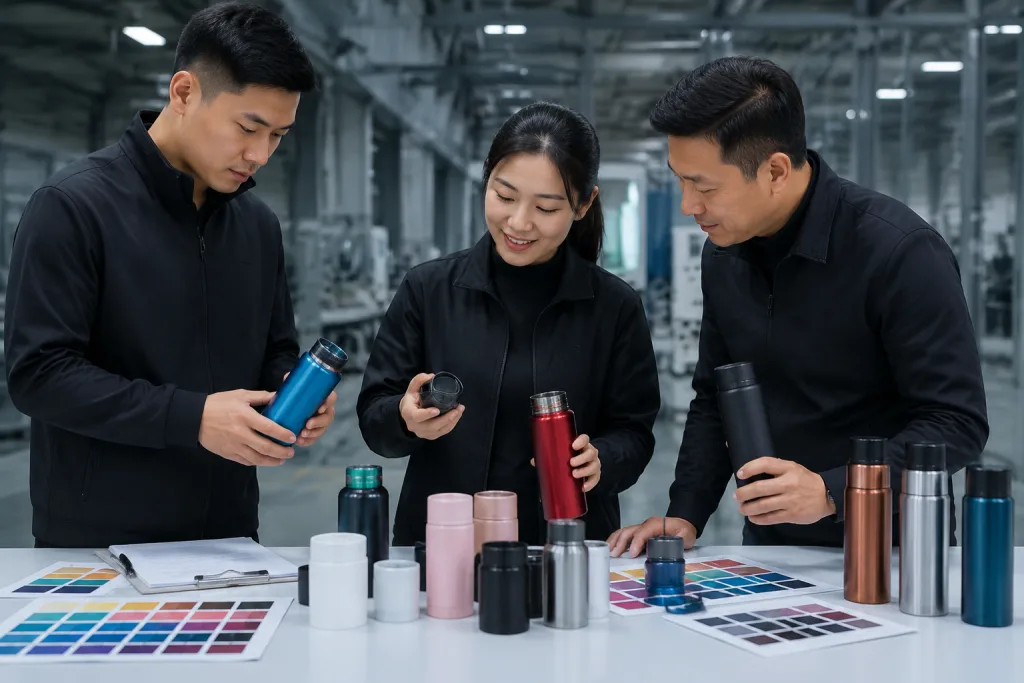
Color approval is only one checkpoint. On our line, QC starts with 304 stainless thickness checks using a digital caliper, then moves to vacuum retention, coating adhesion, logo position, leak testing, carton drop testing, and final AQL inspection. Photos look good in a WeChat thread, but outdoor retailers usually ask for signed records: steel batch, Pantone drawdown, leak test sheet, and carton drop result. We’ve seen this go sideways when a buyer approved color chips but never asked for the vacuum test data.
For final inspection, about 8 out of 10 importers we ship for use AQL General Inspection Level II with 2.5 for major defects and 4.0 for minor defects. Critical defects, such as sharp edges, contamination inside the bottle, serious leakage, or unsafe lid failure, should stay at zero tolerance. For thermos bulk orders, define the coating defect chart before production starts. QC pulled one sample last March with a 1 mm dust point near the base; the buyer accepted it. A 15 mm scratch across the front logo area is a different case, and the math doesn’t work if the PO only says “no obvious defects.”
Ask for cross-hatch adhesion testing on coated bodies with 3M tape, boiling water and ice water cycling at least 3 rounds, lid open-close cycle checks, and 100% leak testing if the lid mold is new. For stainless contact materials, confirm LFGB or FDA food-contact requirements depending on destination. For European outdoor retailers, REACH and packaging waste rules can affect ink, powder coating, and polybag material. For chain stores, BSCI or similar social audit documents may be required; one buyer flagged our file because the factory name on the audit used “Hang Zhou” with a space, while the PO used “Hangzhou.” Small typo. Big delay.
Approve packaging early. A color-matched customizable thermos can pass color QC and still fail receiving if cartons crush in transit or barcodes scan poorly. For Amazon-style or distributor warehouse programs, specify FNSKU, carton marks, inner carton quantity, master carton weight under 15-18 kg where possible, and pallet pattern if needed. We run a scanner check on the printed barcode before mass packing, then weigh the loaded master carton on the floor scale; if it reads 19.6 kg, the warehouse team will complain before your customer does.
Select A Supplier You Can Control
The right thermos vendor is not always the lowest-price thermos supplier. It is the one you can pin down with a 2-page spec sheet, 48-hour sample comments, and production photos that show the line, not just the finished cup. When we compare thermos manufacturers for a Pantone job, we check whether color matching, powder coating, 304 stainless forming, lid assembly, and export paperwork sit under one person’s control. Last month QC pulled a beige sample with 0.8 mm black specks near the shoulder, and that told us more than any sales brochure.
Ask direct questions. Do they run coating in-house, or does a truck take semi-finished bodies to a coating shop 12 km away? Can they keep your Pantone master sample for reorders in a sealed sample cabinet? What is their normal scrap rate for matte powder coating: 3%, 6%, or “we never count it”? Can they separate your distributor thermos cartons by SKU, color, and country label? Can they provide pre-shipment inspection photos by defect category, with AQL 2.5 notes, instead of only clean desk photos taken under a ring light?
A trading company makes sense for mixed-category sourcing, but a thermos factory or factory-backed exporter is easier to manage for repeat stainless programs. We’ve seen this go sideways when the person quoting the thermos custom order has never stood beside the coating oven or checked a lid gasket with a caliper. You want someone who knows what happens when a gasket shrinks by 0.5 mm, an oven holds 205°C for 9 minutes instead of 185°C, or a Pantone beige picks up black dust from the previous production run.
For outdoor retailers and promotional brands sourcing from China, the strongest position is boring and it works: one approved specification sheet, one signed sample, one inspection standard, one packing instruction, and one accountable manufacturers thermos partner who answers when the buyer flags carton marks. The math doesn’t work if you leave color, logo position, inner box paper, and country label to be fixed after production starts. We run the PO against the sample before the first 500 pcs hit the line; catching a typo like “Panton 468C” on day one beats sorting 80 cartons at the warehouse.
Send your Pantone thermos brief for review
Share target color, quantity, logo, and market. We will check feasibility, MOQ, lead time, and risk before sampling starts.
Frequently asked questions
What MOQ should I expect for a thermos custom Pantone order?
For an existing stainless thermos body, expect 1,000-3,000 units per Pantone color as a realistic MOQ from China. Some suppliers thermos sellers may accept 500 units, but they often use wet paint, charge higher setup fees, or combine your run with other coating work. If you need three colors, plan the MOQ per color, not just total order quantity. Pricing usually improves at 3,000-5,000 units per color because powder coating setup, oven time, and QC labor are spread across more pieces. For stock color bottles with only logo customization, MOQ can be lower, sometimes 300-500 units, but that is not a true thermos custom Pantone production run.
Can you match any Pantone color on stainless steel?
Most standard Pantone C colors can be matched closely on stainless steel, but not every color behaves the same. Very light colors, neon tones, metallic effects, and deep matte shades have more variation after coating and baking. Powder coating is durable but may look darker or softer than the Pantone book because it has texture and sits on a curved metal body. Wet paint can sometimes match glossy colors more closely, but it is less scratch resistant. The practical method is to approve a sprayed sample on the real thermos body under D65 light, then use that physical sample as the production standard.
How long does a customized thermos project take?
A normal customized thermos timeline is 7-10 days for digital artwork, coating sample, and logo sample after you confirm the Pantone code and product model. After sample approval and deposit, mass production usually takes 30-45 days for 1,000-10,000 units. Add 5-7 days if you need special packaging, retail sleeves, FNSKU labels, or multiple carton versions. Ocean freight to North America or Europe is separate and can take 25-40 days port to port depending on route. Before Q4, Chinese factories often become full, so build in another 10-15 days instead of relying on air freight.
Is powder coating better than wet paint for outdoor retail thermos bottles?
For outdoor retail, powder coating is usually the better choice. It resists scratches, hand oils, backpack abrasion, and cup holder wear better than standard wet paint. A good powder-coated thermos should pass cross-hatch adhesion testing and basic rub testing before shipment. Wet paint is useful when you need a glossy finish, gradient, or a closer match to a difficult Pantone color, but it needs stronger topcoat control and still may show wear faster. If your bottle will retail at USD 18-35 and carry a warranty expectation, choose powder coating unless the design brief absolutely requires a wet-painted effect.
What should I include in an RFQ for a custom thermos?
A strong RFQ should include capacity, body style, stainless grade, lid type, Pantone code, finish requirement, logo method, artwork size, MOQ by color, packaging, compliance market, and target ship date. Add performance requirements such as 12-hour heat retention above 60°C, leak testing, and AQL level. If you are buying for a distributor, include SKU labels, carton marks, pallet requirements, and barcode format. If you are buying a promotional thermos, include the event deadline and whether air freight is acceptable. The more precise the RFQ, the less room a thermos manufacturer has to quote a cheap but unsuitable version.