Key Takeaways
- A real thermos custom made order usually starts at 1,000 units MOQ and 35-45 days after sample approval.
- For 18/8 stainless, specify 0.4-0.5 mm inner and outer wall thickness, not just capacity and finish.
- A proper promo-grade bottle should pass 100% vacuum leak testing and AQL 2.5 final inspection.
- Expect FOB China pricing around USD 3.20-6.80 per piece depending on lid, coating, and print coverage.
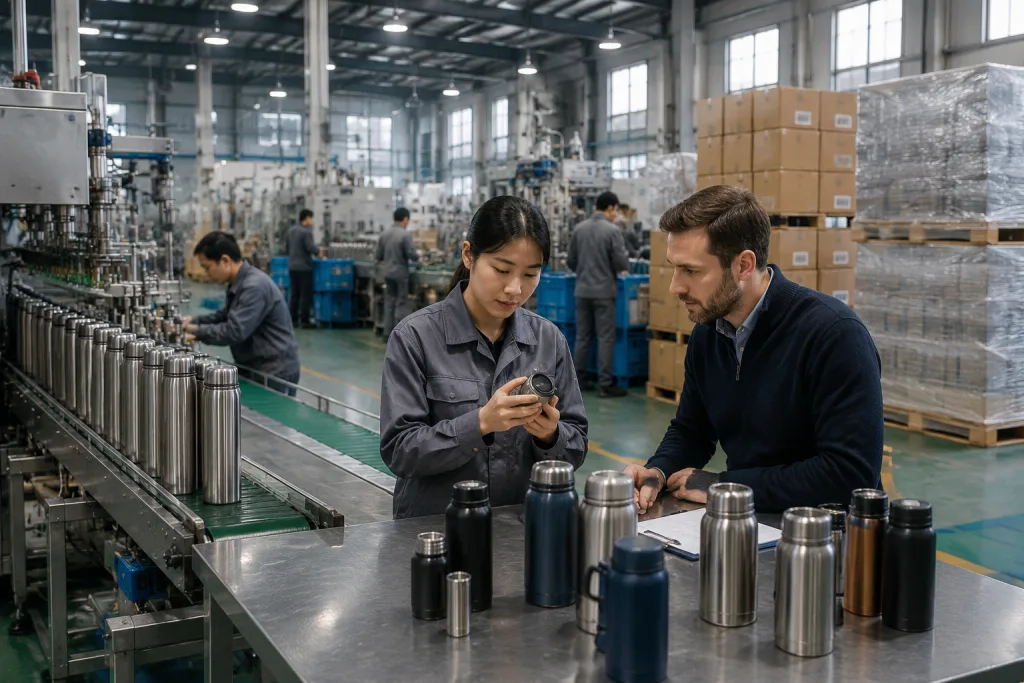
You are not buying a mug with a logo. You are buying a thermal unit that has to survive cartons at 180 kg per pallet, warehouse drops, and rough end-customer handling without leaking or dumping heat early. For thermos custom made orders, the usual misses are plain: the lid thread does not match, the coating scuffs at the carton rub points, the vacuum hold is never checked, or the artwork looks clean on a screen and ugly on 18/8 steel.
If you are an outdoor retailer or a promo brand, the order only works when you spec the stainless thermos in a way a factory team can build on the line. In Zhejiang, China, we see the same pattern every week: a buyer starts with “600 ml matte black bottle,” QC pulls the sample, and then the PO typo shows up on the lid print. A clear spec, a sample sign-off, and a QC plan solve it; a fast quote from a weak supplier does not. That math does not work.
Start with the actual use case
I’ll rewrite the section in-place, keep the HTML structure unchanged, and make the copy sound like a factory-side sales engineer with more concrete detail.The fastest way to burn cash is to ask for a custom thermos before you know where it will be used. A 500 ml promo thermos for a Canton Fair booth is not the same job as a 750 ml insulated bottle for trail retail. One gets judged on print hit rate and landed cost; the other gets judged on heat retention, grip, and lid life. We’ve seen buyers mix those up, then wonder why the sample misses the brief.
We start with four points: capacity, lid type, finish, and the drink temperature window. A 500 ml thermos custom order for outdoor retail may need a screw lid with a carry loop and 12-hour hot retention at 20°C ambient. A promo brand can take a lighter build if the only goal is shelf impact and a lower FOB. This is the wrong question to ask: “What do you have in stock?” A real thermos supplier asks where it will be used, how it ships, and what the buyer will reject on QC.
- Outdoor retail: prioritize heat retention, dent resistance, and lid torque; we test leak-free closure after 500 open-close cycles.
- Promo campaigns: prioritize print area, color match, and carton cost; one PO typo on Pantone can derail the whole run.
- Distributor thermos programs: prioritize repeatability across 3-5 SKUs; the line needs the same cap fit, carton count, and AQL 2.5 every time.
Lock the stainless steel spec
I’ll rewrite the section in-place, keep the HTML exactly as-is, and strip the AI-sounding phrasing while adding a few factory-floor details and sharper buyer guidance.Once the use case is clear, lock the metal spec. For stainless thermos production, 18/8 stainless steel is the normal baseline. The buyer should care about wall thickness, not just the phrase “food-grade stainless.” We run 0.4-0.5 mm for the inner wall and 0.4 mm for the outer wall on most 500-750 ml SKUs. Go thinner and you save grams, but dent risk goes up and the bottle feels cheap. Go too thick and the bottle gets heavy fast, which hurts hiking retail.
For vacuum insulation, ask for a documented vacuum leak test and a heat-retention target written into the PO. A solid thermos line in Zhejiang can usually hold a 24-hour hot retention claim in the 60-68°C range, depending on the lid and fill temperature, but the supplier has to state the test conditions. QC pulled the sample last week and the buyer flagged the missing start temp. Without initial fill temp, ambient temp, and lid closure method, the claim is marketing, not engineering.
For outdoor buyers, a brushed steel body is practical, but powder coating or matte paint sells better at retail. Ask for coating thickness and adhesion testing. A durable powder coat sits around 60-80 microns, and a basic cross-hatch adhesion check should be part of sample approval. We’ve seen this go sideways when a PO typo called for “matt black” and the line sprayed the wrong sheen. This is where real production shows up and pretty pictures stop helping.
Choose the lid before the logo
I’ll rewrite just the prose, keep every HTML tag intact, and make it read like a factory-side sales engineer wrote it.Buyers fixate on the artwork and ignore the lid. That is the wrong order. The cap is where leaks show up, where hand feel gets judged, and where returns start. If you want thermos custom made for retail, settle one question first: one-handed opening, direct sip, or pour into another cup. We run the line by that choice, because it changes the lid tooling, gasket shape, and carton height. Last week QC pulled a sample with a 1.5 mm neck shift, and the logo landed off-center.
A plain screw cap costs less, but a flip lid or push-button lid can add USD 0.30-1.20 a unit, depending on part count. On a bulk thermos promotion, that can split a USD 3.80 piece from a USD 5.20 piece. The math doesn’t work any other way. For a custom thermos going into outdoor retail, that extra dollar usually pays back because the lid gets opened all day. Ask the thermos factory for cycle testing on the cap, especially when the lid has springs or a latch. We use 5,000 open-close cycles for promo work, and 10,000 cycles if the SKU is sitting on shelf longer.
Do not approve artwork until the lid, gasket, and mouth finish are locked. If the neck changes, your print placement can move 2-4 mm.
That is why we ask for a revised 3D drawing and a real pre-production sample, not a screenshot. A buyer once sent a PO with “same bottle, new lid,” and the lip radius on the drawing was off by 0.8 mm. The cap fit on paper, then failed at the line.
Treat artwork like production, not decoration
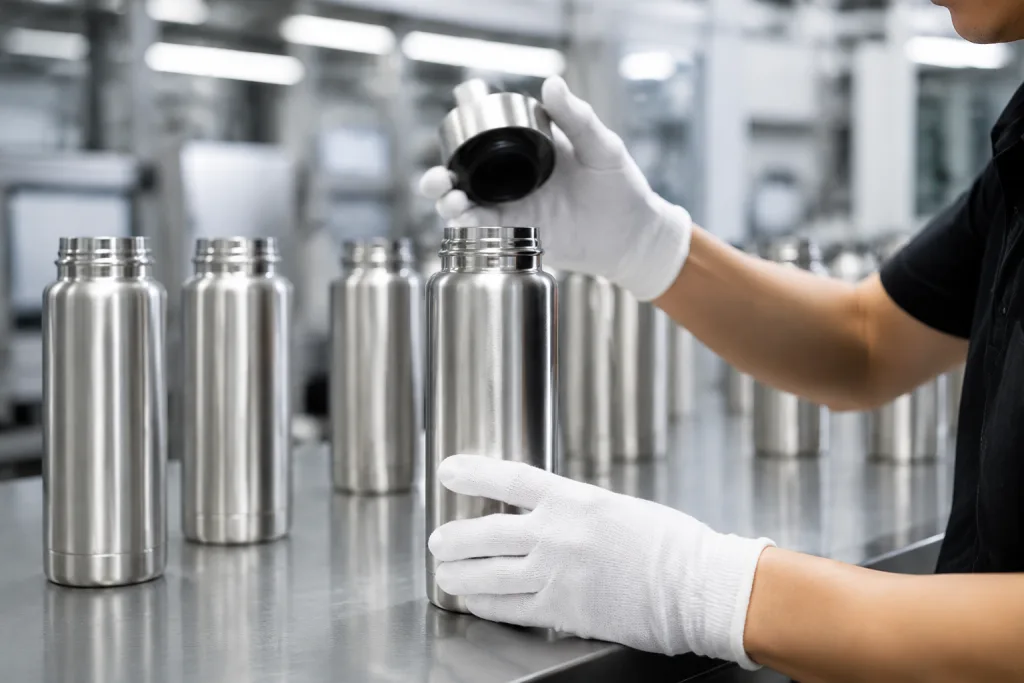
I’ll rewrite the section in place, keep the HTML untouched, and make the copy sound like a factory-side sales engineer.For a customized thermos, print method is a sourcing decision, not just a design pick. Silk screen works well for a 1-color logo and stable volume. Laser engraving gives a cleaner metal look. UV print carries more color, but it opens more failure points if surface prep is off. If you are ordering thermos promotional units for a 5,000-piece event run, a single-color silk screen on a powder-coated body usually gives the best margin. If you are building a distributor thermos line for retail, laser engraving cuts down on the “logo rubbed off” complaint we hear after 3 months on the shelf.
Ask for the print size and position in millimeters. A logo that looks centered on a flat mockup can drift once the shoulder radius kicks in. We always want approval on the actual blank bottle, not only a PDF. On our line, QC pulled a sample at 42 mm off the base and the buyer flagged it before we packed 2,000 pcs, which saved a headache. For China production, especially in Zhejiang, a digital proof usually takes 24-48 hours and a physical sample takes 7-10 days if the tooling is already there. If a vendor tells you to skip sample approval, the math does not work.
- Silk screen: lowest cost for a 1-color logo, good for 1,000+ piece thermos bulk orders.
- Laser engraving: durable, premium, and a solid fit for custom thermos retail.
- UV print: broader color range, but it needs tighter surface control and cleaner pre-treatment.
Sample, test, and sign off
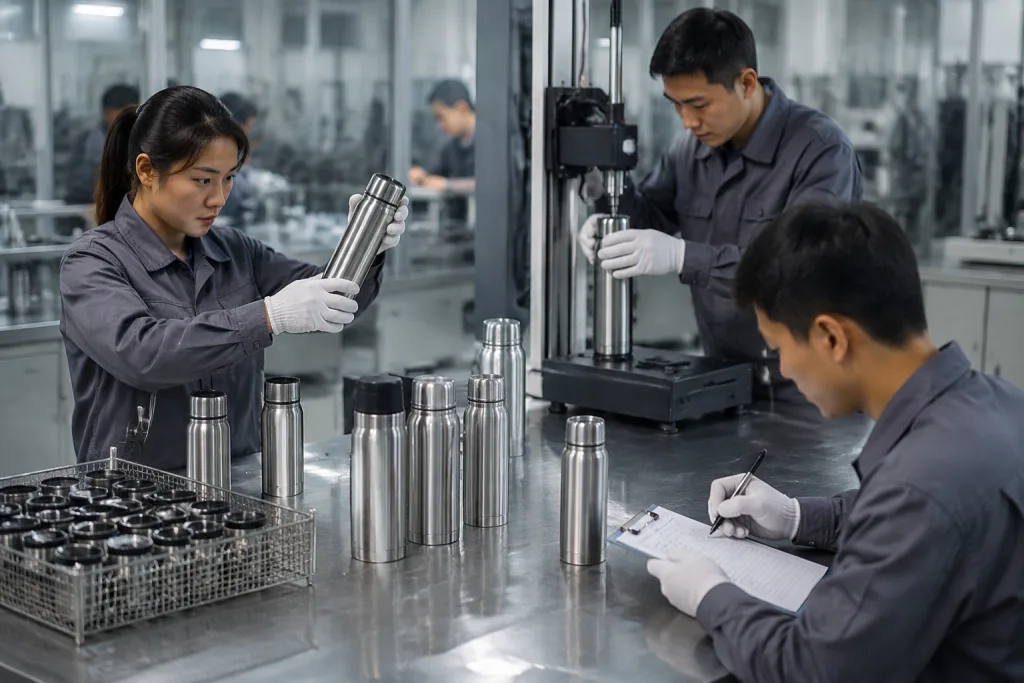
I’ll rewrite the prose only, keep the HTML tags intact, and make it read like a factory-side sales engineer wrote it. Next I’m tightening the language, adding a few concrete shop-floor details, and keeping the original structure.Your sample is not a souvenir. It is the contract before the contract. A serious thermos partner sends a pre-production sample with the same wall thickness, coating, lid, and artwork that will run on the line. On our side, QC pulled the sample and we check the lid torque first, then the vacuum, then the print position. Fill it, invert it, shake it, and leave it overnight with hot water and tea residue if that is your real use case. Check the seal after pressure swings; air freight and winter trucking expose weak lids fast.
Use a short QC checklist: thread fit, vacuum performance, odor, coating rub resistance, logo position, and carton drop behavior. For final mass production, ask for AQL 2.5 or tighter on major defects, and define what counts as major: leak, crack, bad vacuum, wrong color, or unreadable logo. A buyer once flagged a 1.5 mm logo shift on the PO, and that saved a shipment. A factory thermos line in Hangzhou or broader Zhejiang should show its in-process checks, from incoming steel inspection to spot checks after polishing and coating. If they cannot show that workflow, the math does not work.
Ask for a retention test report with temperature points at 1, 6, 12, and 24 hours. That gives you numbers you can put in front of buyers and distributors who need to defend a SKU with retail chain accounts. We run these tests with a data logger on the bench, not just a hand touch on the cup body.
Plan pricing, MOQ, and freight early
I’ll rewrite the prose in place, keep the HTML untouched, and make the pricing/MOQ/freight copy sound like a factory-side sales note.Thermos custom made pricing stays predictable if the spec is fixed on day one. For a 500-750 ml stainless bottle, FOB China usually lands around USD 3.20-6.80 per piece, depending on lid structure, coating, and print method. A plain stainless body with a one-color logo sits near the low end. Add a powder coat, a specialty lid, or a gift box, and the number climbs fast. If the buyer wants a color-matched cap, we run a tooling or color-match charge.
MOQ usually starts at 1,000 units for a standard custom thermos program. Some thermos suppliers will split colors or prints across a bigger run, but only when the total volume makes sense. Our Zhejiang factory runs about 300,000 units per month across stainless drinkware lines, so the real constraint is spec stability and finish load on the line. For a first order, budget 7-10 days for sample sign-off, 25-35 days for production, and 5-12 days for export packing and freight booking. QC pulled the sample twice on one run because the coating shade drifted 1.5 mm at the cap seam, and that kind of miss burns schedule. If the shipment goes to a U.S. fulfillment center, lock FNSKU labels, carton marks, and pallet rules before production starts. Waiting until the cartons are sealed is how small orders turn into rework.
For bulk thermos orders, get the carton quantity, carton size, and gross weight before you place the PO. The buyer flagged a 12 kg carton limit once, but the packing sheet showed 14.8 kg, and the math did not work. That is the difference between a clean landed-cost model and a margin problem.
Send your thermos spec for a clean quote
We can review your capacity, lid, print, and packaging, then quote a thermos custom made run with MOQ, lead time, and FOB pricing.
Frequently asked questions
What MOQ should I expect for thermos custom made?
For most stainless custom thermos projects, a normal MOQ is 1,000 units per design. If you want mixed colors or multiple logos, the factory may still accept the order, but the total quantity usually needs to stay at 3,000 units or more. Very simple stock-lid promo runs can sometimes start lower, around 500 units, but that is less common once you add custom coating or special packaging. In Zhejiang, China, the most efficient runs are still 1,000-5,000 units because printing, coating, and packing all become more stable.
How long does a custom thermos order take?
A realistic timeline is 35-45 days after sample approval for first production, then 5-12 days for export booking and freight handoff. If tooling is already available and the print is simple, some orders move faster. If you need a new lid, special color, or extra testing, add 7-15 days. A good thermos factory should give you a sample in 7-10 days and keep the total project moving. For seasonal promo buyers, I would not leave less than 8 weeks from artwork lock to warehouse arrival.
What material should I ask for in a stainless thermos?
Ask for 18/8 stainless steel as the baseline, with 0.4-0.5 mm wall thickness for the inner wall and about 0.4 mm for the outer wall. That is a practical balance between weight and durability. If a supplier thermos quote only says “food-grade stainless” without thickness, you are missing a key quality detail. For premium retail SKUs, ask for coating thickness too, usually 60-80 microns for powder coat. That helps the bottle survive transport and daily use.
Can I order promotional thermos bottles with my logo and gift box?
Yes, and that is a common program for outdoor retailers and brands. A thermos promotional order can use one-color silk screen, laser engraving, or UV print, plus a printed gift box or mailer box. Expect the gift box to add cost and sometimes 3-7 days of production time. If you need retail-ready packaging, define carton count, barcode placement, and whether you need FNSKU labels for Amazon or other fulfillment channels. The earlier you lock packaging, the fewer surprises you get at export packing.
How do I check quality before mass production?
Approve a physical pre-production sample, then test leak resistance, lid fit, coating rub, and temperature retention before you release the PO. Ask for a QC plan with AQL 2.5 or tighter on major defects. You should also request a retention report with actual readings at 1, 6, 12, and 24 hours, plus carton drop checks if the order will move through retail warehouses. For a China supplier, this is normal practice when the buyer is serious. If they skip it, they are asking you to accept avoidable risk.