Key Takeaways
- For thermos custom color, expect MOQ from 1,000 to 3,000 pcs and a sample lead time of 7-12 days
- A typical stainless thermos bulk FOB China price lands around USD 2.80-6.50 depending on 304 steel, coating, and lid style
- Ask for coating thickness, color delta, and scratch testing; a 20-30 micron powder coat performs better than a thin decorative spray
- A clear PO should list SKU, color code, logo method, packaging, carton marks, and AQL 2.5/4.0 inspection terms
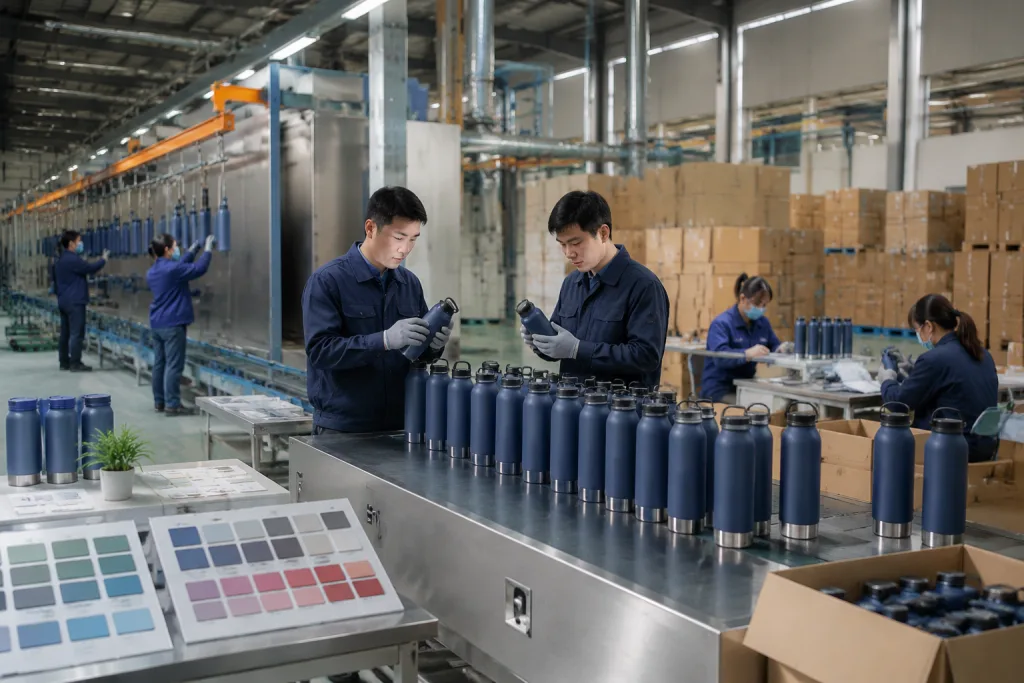
If you are buying a stainless thermos in a custom color, do not treat color as decoration. On a thermos, the coating changes cost, lead time, scratch resistance, and sometimes the approval path for food-contact compliance. We run a 60 mm spray line and QC checks each batch before packing. Outdoor retailers want a shelf-ready finish. Promotional brands want a clean logo area and a price that still works at 3,000 to 10,000 pieces. Different job, different spec. China factories in Zhejiang handle those jobs differently.
At BottleForge Industrial in Hangzhou, we see the same pattern every week: a buyer sends a loose brief, then loses two weeks fixing avoidable problems. The buyer flagged a PO typo on the Pantone code once, and that one line held the order. A better process is simple. Start with the RFQ, lock the PO line items, approve the color sample, then release bulk. If you handle those four steps properly, your thermos custom color order stays on schedule instead of turning into a costly rework.
Start With the RFQ Brief
I’ll rewrite the section in-place, keeping the HTML structure and the listed numbers/specs intact while stripping the AI-ish phrasing.Good sourcing starts with a brief a factory can quote without chasing you for a second email. If you want a thermos custom color order to move fast, send one clean message with capacity, body material, lid type, finish, logo method, packaging, target market, and annual demand. A Zhejiang thermos team can usually turn that into a quote in 24-48 hours. Send “nice matte blue” and the line stalls.
For a bulk thermos order, say whether the bottle is for outdoor retail or a thermos promotional campaign. We’ve seen that choice change the whole spec: retail buyers push harder on finish, box structure, and color match, while promo orders can sometimes live with a looser tolerance if the budget is tight. Put the size on the RFQ too — 500 ml, 750 ml, or 1 L — because the same custom thermos can shift 15-25% on price from capacity alone. The math does not work if the buyer leaves that out.
- Capacity: 500 ml / 750 ml / 1,000 ml
- Steel grade: 304 inner and outer, or 316 for premium lines
- Finish: powder coat, spray paint, metallic, or gradient
- Logo: silk screen, laser engraving, or heat transfer
- Packaging: color box, window box, master carton
If you already know your target landed cost, put it in the brief. A supplier thermos quote is cleaner when we run the numbers backward from a real target instead of guessing in the dark. QC pulled a sample with a 1.2 mm coating mismatch last week, and that came from a buyer who sent a tight cost ceiling on day one.
Define Color Before Sampling
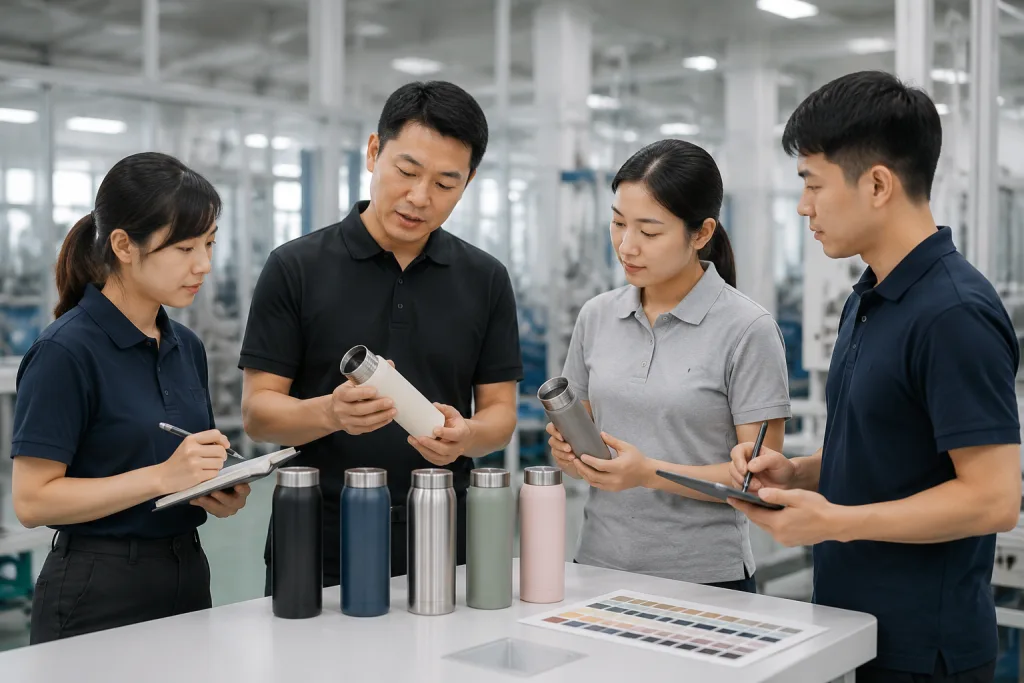
I’ll rewrite the section in-place, keeping the HTML tags unchanged and tightening the copy to sound like a factory-side sales engineer.Color is where a lot of thermos custom jobs go off track. “Custom color” by itself means nothing. Define it one of three ways: Pantone code, a physical sample, or a factory swatch with a clear delta limit. For a customized thermos, Pantone works for planning, but a real sample wins because powder on stainless steel does not read like ink on paper.
Ask the thermos factory which coating process the line will run. A powder-coated stainless thermos usually carries 20-30 microns of coating, and that holds up better than a cheap 10-15 micron decorative paint layer when the buyer starts asking about chip resistance. If the buyer wants matte black, forest green, or sandstone beige, get a sample panel or a full bottle sample on the same substrate and the same curing temperature. We’ve seen the math go sideways when a shade is approved on paper and then shifts under shop lights.
Outdoor retailers should ask about UV fade and abrasion, not just shade name. Promotional brands should care about lot-to-lot repeatability across 5,000 or 20,000 units. We usually push a color tolerance target of ΔE 1.5 to 2.0 for premium retail work, then relax it a bit for promo thermos orders when budget matters more than perfect match.
Do not approve color from a phone screenshot. That is how a distributor ends up filing a thermos complaint later, especially when the second production lot comes out one shade off.
For China sourcing, one factory thermos line may run three coating systems in parallel. Ask which line will make your order and whether the finish is matte, satin, or gloss. That changes the look, the hand feel, and how fast scratches show up.
Lock the Sample Order
I’ll rewrite the prose in-place, keep the HTML exactly as-is, and tighten the sales-engineering tone with concrete factory details and cleaner buyer language.The sample stage tells you fast whether the project is real or just a nice brief. A custom thermos sample is not a freebie. It is a small engineering job. We normally quote USD 50-150 per design, and the price moves with lid complexity, logo setup, and whether the cap needs a new insert on the line.
At this stage, your PO line items need to be exact. Write them out: sample quantity, color code, logo position, packaging style, target approval date, and courier account. Skip the details, and the buyer flagged it later because the sample was close but not the same. QC pulled the sample against the artwork sheet before we ship, and that check catches a lot of headaches.
Good sample lead time is 7-12 days for a simple stainless thermos and 12-18 days if you want a new lid or a special coating. If a factory promises 3 days for a fully customized thermos with new tooling, the math does not work. A real thermos manufacturer will tell you what can run now and what needs more time on the press.
- Sample quantity: 1-3 pcs per color
- Sample fee: USD 50-150
- Lead time: 7-18 days
- Approval file: photo set plus physical sample
- Change control: one free revision only, if agreed
This is the point where you decide whether the project is thermos customized enough to justify new tooling. For a logo only, silk screen or laser is enough. For a new cap or base, ask if tooling amortization goes into the bulk order or gets billed separately. We have seen this go sideways when the buyer assumed the mold was included; one typo on the PO later, and nobody wants to own the extra cost.
Write the Bulk PO Line by Line
I’ll rewrite the section in-place, keeping the HTML structure and the specific terms/numbers intact while making it read like a factory-side sales engineer wrote it.Once the sample is signed off, write the bulk PO cleanly. No soft wording. A purchase order for a thermos bulk run should read like a line-side checklist, not a sales brochure. Every item needs a number, a code, or a clear finish callout. If the buyer says “blue thermos custom color,” we still need the Pantone number, the gloss or matte target, and the logo method. That is the only way to stop a claim later.
For a promotional thermos order, keep the PO short but complete. For an outdoor retail line, we run tighter. A good PO should list SKU, volume, body material, inner coating spec, outer coating spec, color code, logo placement, packaging spec, carton quantity, inspection standard, and delivery terms. We had a buyer flag a PO that said “navy” with no code; QC pulled the sample, and the gap was obvious. If you are buying from China on FOB terms, write the port name clearly. If you need DDP to North America or Europe, state that too.
Here is the structure we recommend:
- Product: stainless steel thermos, 750 ml
- Color: Pantone matched matte navy, ΔE target 2.0 max
- Material: 304 inner and outer
- Logo: one-color silk screen on front, 1 position
- Packaging: 1 pc/color box, 24 pcs/master carton
- Inspection: AQL 2.5 major, 4.0 minor
- Incoterms: FOB Ningbo or FOB Shanghai
For a custom thermos supplier, this level of detail is standard. It protects both sides. It also keeps the distributors thermos channel clean, because reshipment, barcoding, and retail-ready packing get handled before the goods leave Zhejiang. We’ve seen this go sideways when the carton spec was missing by 2 mm and the pallet plan had to be rebuilt. A good factory won’t push back on detail. They want it.
Check the Factory QC Points
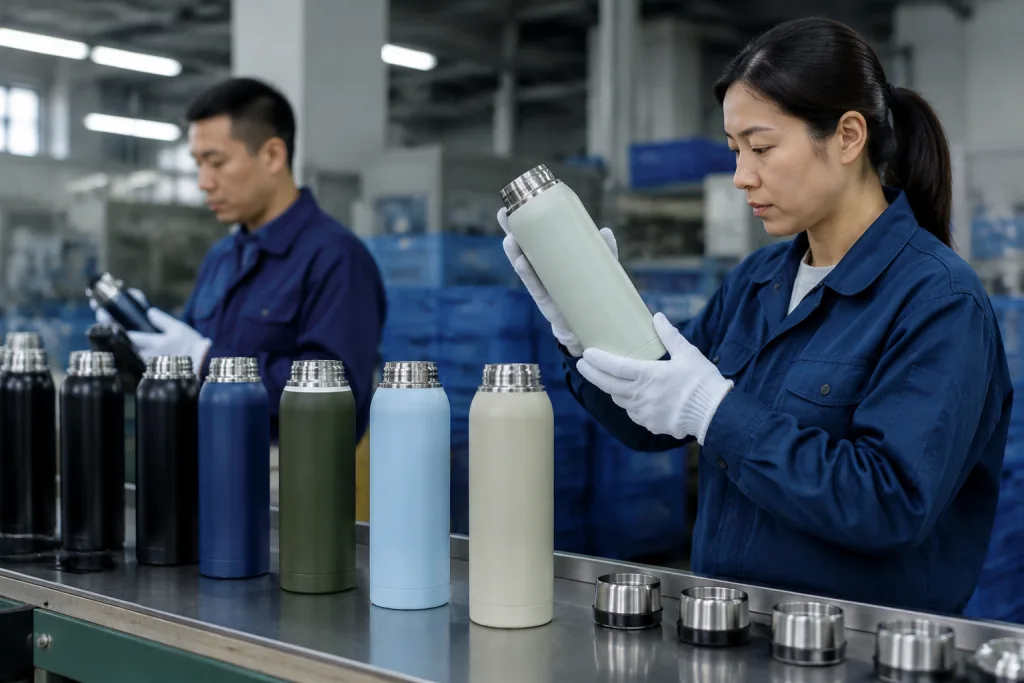
I’ll rewrite the four paragraphs in-place, keep the HTML tags untouched, and tighten the sales-engineer tone with specific QC details and factory-floor language.Color is only one part of quality. On a stainless thermos, the real risk is batch drift. One run looks clean, the next shows coating orange peel or a lid torque that slips 0.3 N·m under hand test. A solid thermos factory checks the body, lid torque, vacuum performance, print adhesion, and carton strength before shipment.
Ask for QC checkpoints that match your channel. Outdoor retailers want abrasion resistance and steadier thermal retention; promo buyers care more about appearance and on-time dispatch. This is the wrong question to ask if you only want a pretty sample. A factory thermos order should cover incoming material checks, in-process inspection, and final AQL sampling. We run AQL 2.5 for major defects and 4.0 for minor ones on standard export orders.
Thermal performance belongs in the spec sheet. A 304 stainless vacuum thermos can usually keep hot water above 60°C for 6-12 hours, but that depends on wall structure, lid seal, and fill conditions. Do not promise a number to your buyer unless the test method is written down. Ask whether the manufacturer thermos team tests with ASTM or an internal standard, and keep that method fixed across reorders.
Check packaging compression too. QC pulled the sample and the bottle passed, but the carton failed after the 60 cm drop test because the inner spacer was loose. For export, a 5-layer master carton and correct inner spacing are not optional if you want fewer claims after arrival. We’ve seen this go sideways on a PO with one typo in the carton mark, and the line had to stop for rework. In Zhejiang, a clean finish means little if the shipment lands dented.
Plan Reorders and Price Steps
A one-time order and a repeat order should not carry the same unit price. First run pays for setup, PPS samples, and color matching on the powder-coat line. On a 3,000 pcs first bulk, ask us to quote the next steps at 5,000 pcs and 10,000 pcs before you place the PO, because the margin usually comes back on the reorder. We see this go sideways when a distributor waits until only 420 pcs are left in the warehouse, then asks for a fresh quote and a 12-day ship window. The math does not work.
For China production, a practical stainless thermos price range is USD 2.80-3.80 for a simple promotional thermos and USD 4.20-6.50 for a stronger retail spec with powder coat, upgraded lid, and a better box. Custom finishes and special lids push the cost up fast; premium inner polish adds another check at the polishing station, usually with the Ra meter before assembly. Put the PO lines in plain language: base bottle cost, logo cost, packaging cost, tooling charge, and color surcharge. Last month QC pulled a sample because the PO said “matte sand beige,” but the approved swatch card was marked “matte stone beige.” Small typo. Big argument.
If you work with a supplier thermos partner in Hangzhou or elsewhere in Zhejiang, ask for monthly capacity and the real slot for your bottle. A well-run factory may ship 150,000 to 300,000 units per month across several bottle lines, but your order still waits behind the coating queue and carton packing load. Repeat bulk is often 25-35 days after deposit and sample confirmation. New color projects can stretch to 35-45 days, especially when the spray booth is changing from dark powder to white or cream. We run into this every spring before Canton Fair shipments.
Practical rule: if your sales team needs a fast promo launch, choose a stock body with custom color and logo. Fast means fewer moving parts. If your brand wants a hero product, spend the time on a fully customized thermos with the right lid, finish, and packaging, then lock the gold sample in a sealed bag before mass production. That is the line between a commodity bottle and something buyers reorder without asking for a cheaper substitute.
Send your thermos color brief today
Get a clear RFQ, sample plan, and bulk quote from our Zhejiang factory team for your next thermos custom color program.
Frequently asked questions
What MOQ should I expect for thermos custom color?
For a standard stainless thermos, MOQ usually starts at 1,000 to 3,000 pcs per color, depending on coating setup and lid type. If you choose a stock body with a custom logo, some thermos suppliers can go lower, around 500 pcs, but custom color usually needs a larger run because the coating line must be set up and cleaned separately. For mixed colors, many manufacturers will require 1,000 pcs per color or charge a split-run fee. If your brand is testing demand, ask for one color first and keep the next shade for the reorder.
How long does a custom thermos sample take?
A simple customized thermos sample usually takes 7-12 days. If you need a new lid, a special coating, or a color match against a physical swatch, expect 12-18 days. Fast claims of 3-5 days are often just pre-existing stock with a logo print. A real sample should include the same stainless grade, coating process, and lid seal that will be used in mass production. That is the only sample worth approving before you place the bulk PO.
What should be on the PO for a bulk thermos order?
Your PO should list SKU, capacity, steel grade, color code, finish type, logo method, packaging, carton quantity, inspection standard, Incoterms, and delivery date. For thermos bulk orders, also specify whether the inner and outer shells are 304 or 316, the color tolerance target such as ΔE 2.0, and the AQL standard, usually 2.5 major and 4.0 minor. If you leave out the finish or packaging line, you will usually pay for changes later.
What is a realistic FOB China price for a promotional thermos?
A simple promotional thermos from China often lands around USD 2.80-3.80 FOB for 500-750 ml, depending on the lid, coating, and logo count. A more premium outdoor retail spec with better powder coat and upgraded packaging can reach USD 4.20-6.50. The price moves with steel thickness, coating quality, vacuum performance, and whether your order is a stock body or a fully custom thermos. For clean budgeting, ask the thermos factory to separate bottle, decoration, and packaging costs.
How do I check if a thermos manufacturer is reliable?
Ask for factory photos, monthly output, test methods, compliance documents, and recent export experience. A reliable thermos manufacturer should be able to show BSCI or similar social audit records, REACH paperwork for Europe, and a clear QC process with AQL sampling. If you are buying for the US or EU, also ask how they handle carton marks, barcode labels, and retail packaging. A real factory thermos partner in Zhejiang will answer those questions directly and give you a lead time that matches actual production capacity, not a fantasy schedule.