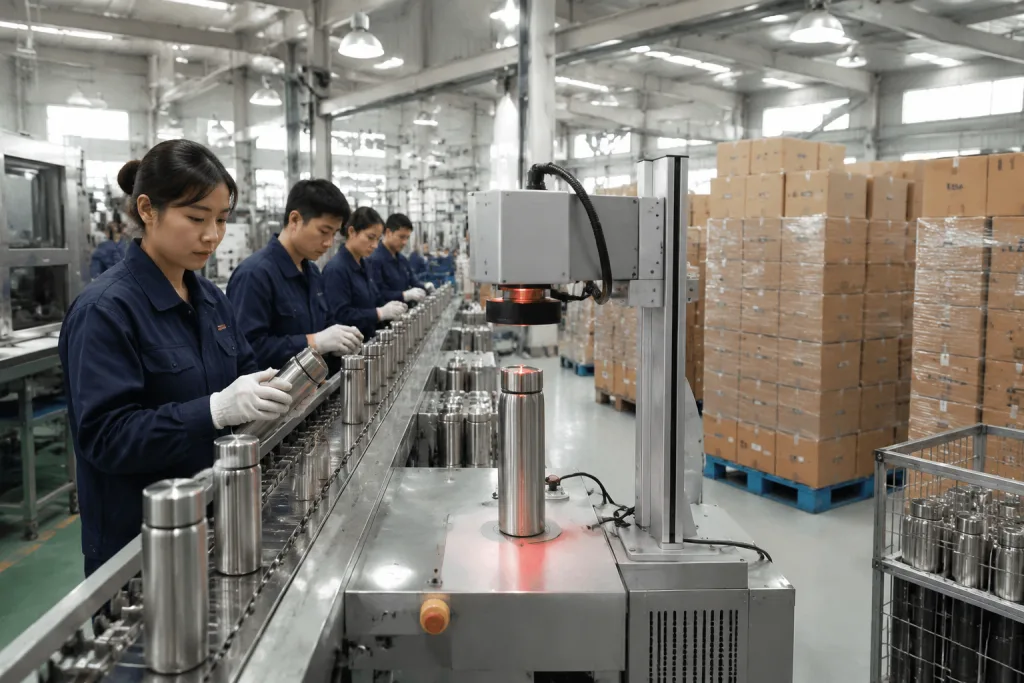
Key Takeaways
- Most bulk thermos programs start at 3,000-5,000 pcs MOQ, with factory thermos lead time around 25-35 days after sample approval
- 304 stainless inner and outer walls are the safer spec for retail; 201 steel can lower cost by 8-15% but raises corrosion risk
- A reliable custom thermos usually targets 6-12 hours hot retention and a lid leak rate below 1% at AQL 2.5
- FOB China pricing for a basic 500 ml stainless thermos often sits around USD 3.20-5.80 depending on finish, lid, and packaging
If you are trying to thermos buy in bulk, the first trap is easy to spot: the seller sends a sample that looks fine, then the production lot shows thin walls, weak vacuum retention, or a lid that starts leaking after two weeks on a shelf. We have seen that story go sideways. On stainless drinkware, the spec sheet beats the sales pitch every time. A 0.4 mm wall, a 201 vs 304 liner, a 72-hour heat hold, or a 5,000-piece MOQ changes your margin and your return rate faster than any shiny mockup.
We build stainless thermos products in Zhejiang, China, and the buyers who do best read every line like they are signing off a drawing. They ask for the steel grade, the lid seal, the AQL, and whether the print survives 3,000 dishwasher cycles or at least one rough retail season. QC pulled the sample on our bench last week with a caliper at 0.4 mm, and that is the level that keeps orders clean. If you buy for outdoor retail or promotions, you need a thermos that ships on time, prints cleanly, and still holds up after someone drops it in a truck bed.
Read the steel grade first
I’ll rewrite the prose only, keep the HTML tags intact, and tighten the sales-engineering tone with concrete factory detail and cleaner trade language.The first line on any thermos spec sheet should be steel grade. That choice hits durability, unit price, and how the bottle behaves after 3 months in a humid warehouse. For a serious thermos buy in bulk program, 304 stainless is the default for the inner liner and often the outer shell too. We run a magnet check on the line, then QC pulls a sample for salt-spray review. If a seller pushes 201 stainless across the board, the unit price may drop 8-15%, but the math gets ugly fast in coastal markets and long shipping lanes.
Gauge matters as well. A common retail build sits at 0.4 mm to 0.5 mm wall thickness. Go thinner and the bottle starts feeling soft in hand; dents show up after carton drops, and the buyer flagged it on one PO because the outer box had a 6 mm crush mark. Go thicker and weight climbs, which hurts pallet count and landed cost for distributor thermos programs. For outdoor retail, a heavier bottle can earn its keep. For promo orders, 0.4 mm with clean forming and no sharp weld bead is usually the right call.
If you are comparing a factory thermos quote with another supplier thermos quote, ask for the material callout in writing: inner 304, outer 304, lid PP or Tritan, silicone ring grade, and whether the base is welded or pressed. We’ve seen a buyer lose a week because the PO typo said “3040” instead of 304, and the factory had to stop the line and recheck the MTC. Zhejiang factories know this question. In China, the good ones answer with specs, not adjectives.
Vacuum performance is the real value
I’ll rewrite the section in place, keep the HTML exactly as-is, and tighten the sales-engineer tone with concrete factory-floor details and fewer AI-style fillers.Heat retention is where a custom thermos shows whether the line is under control. Do not accept “keeps hot for hours” as a spec. Ask for the test condition: starting water temperature, ambient temperature, fill ratio, and pass/fail threshold. For a 500 ml stainless thermos, 72°C or higher after 6 hours is a solid bench mark, and a better build can still hold 60-65°C after 12 hours when QC runs the same setup. For cold retention, ice performance shifts more with the cap than with the shell.
The vacuum gap and neck geometry matter more than most buyers expect. A narrower neck can improve retention, but it also slows pouring and makes cleaning harder. Fine for office desks. Bad for field use. If your brand sells to outdoor retailers, the spec has to survive real use, not just a lab sheet. Ask for the retention report and confirm whether the sample and mass production come off the same line. We’ve seen a 2 mm neck change turn a clean 12-hour result into a buyer complaint on the first batch.
Buyers who chase decoration first usually miss the part customers remember after one winter: the lid and the vacuum.
For thermos bulk orders, give us a retention target, not just a model. A promo thermos for giveaways may only need 6 hours. A retail custom thermos for camping can justify a higher-cost vacuum chamber if the end customer expects overnight warmth. That is the right question to ask. We once had a PO typo on “450 ml” instead of “500 ml,” and the buyer flagged it before the tooling ran, which saved a bad shipment.
Lid style changes sell-through
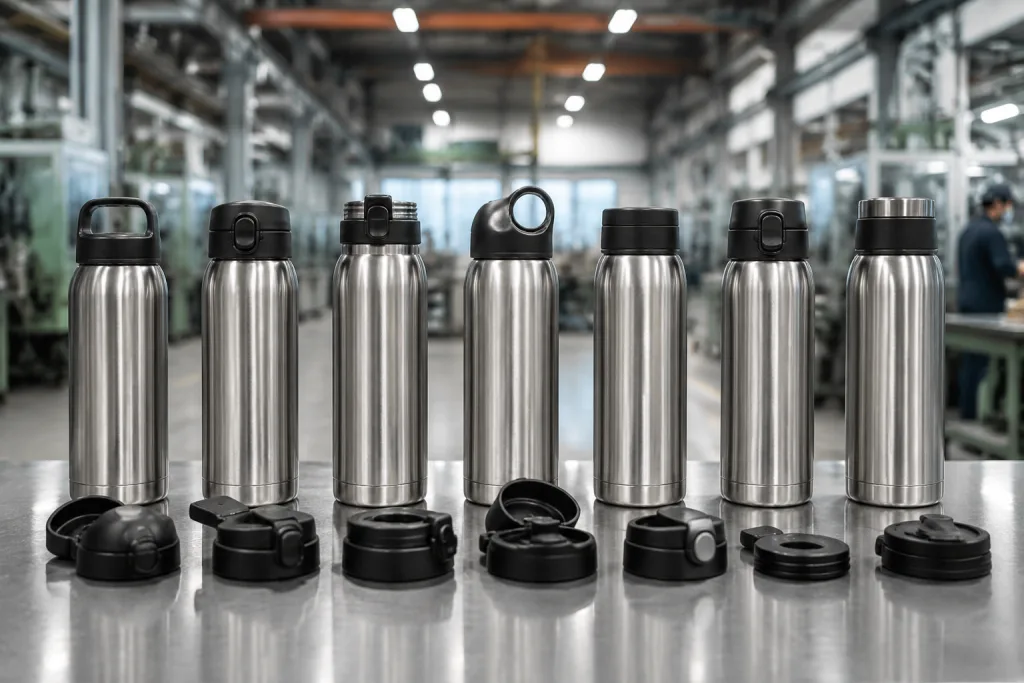
I’ll rewrite just the prose, keep the HTML structure intact, and make it sound like a real factory-side sales engineer.The lid is not a small detail. It decides leak resistance, drinking feel, wash time, and how buyers judge the bottle on the shelf. For bulk thermos orders, a screw cap with a silicone gasket is still the safest base. We’ve seen the wrong lid turn into returns fast when the cartons go through distributor channels and the boxes get tossed around.
For a thermos customizable enough to cover different channels, we usually run one wide-mouth body with a screw lid, then add a tea filter, handle, or strap when the buyer wants a different price point. That keeps the mold count down and the line moving. One buyer once flagged a PO typo on the lid color code, and QC pulled the sample before packing. A good thermos supplier should tell you the gasket material, usually food-grade silicone, and the leak test method, often inverted at room temperature and sometimes under pressure.
- Leak resistance: target less than 1% failure at AQL 2.5
- Thread quality: no cross-threading after repeated open-close cycles
- Cleaning: fewer hidden cavities means fewer complaints
- Branding space: flat lid tops help with logo placement
If you need thermos custom work for a promotion, keep the lid simple. This is the wrong question to overcomplicate. A fancy lid costs more to mold, more to assemble, and more to inspect. On our line, one extra spring can add 12 seconds per unit, and that math does not work when you ship 20,000 pieces.
Decoration must survive distribution
I’ll rewrite the section in-place, keep the HTML structure untouched, and tighten the prose so it sounds like a factory-side sales engineer.A custom thermos can look premium on day one and then come back from one truck run with chipped art if the decoration method is wrong. The choice comes down to the logo, the finish, and where it sells. Silkscreen suits bold one-color art and lower cost. Laser engraving leaves a cleaner permanent mark and fits premium outdoor retail. Powder coating gives a tougher hand feel, but we always ask whether the logo goes on before or after coating. For a promotional thermos, the cheapest logo is not the cheapest program once you add rejects and color drift.
Surface prep is where suppliers cut corners. If the shell is not cleaned right before printing, the ink lifts and the first rub exposes bare stainless. Ask your thermos factory what ink system they run, what cure temperature they use, and whether they can hold Pantone within Delta E 2-3 on larger logo panels. We had one buyer flag a PO typo on a color code, and QC pulled the sample from the line before packing; that saved a lot of grief. For distributor thermos orders moving across 2 or 3 warehouses, steady color beats fancy effects.
We get the cleanest result on stainless thermos programs when the buyer matches decoration to use case:
- Laser engraving: best for premium branding that has to stay visible after rough handling
- Silkscreen: best for clean logos and lower unit cost
- UV print: useful for multi-color graphics, but it needs tighter inspection
- Pad print: works on caps and small curved surfaces
If you are sourcing from a manufacturer thermos plant in Zhejiang, ask for rub-test samples before mass production. We run the test with a standard abrasion cloth, and a good factory thermos line should show the after-image, not just the fresh print.
Price depends on the full build
Buyers ask for thermos bulk pricing and expect one clean number. Wrong question. A 500 ml stainless bottle with 304 steel, a basic screw lid, single-color print, and simple carton packaging may land around USD 3.20-4.20 FOB China at 5,000 pcs. Change the lid to a push-button style with a silicone seal, add laser engraving, a rigid gift box, or copper-plated vacuum, and the quote can move into USD 4.80-5.80 or higher. At 1,000-2,000 pcs MOQ, we usually see 10-20% added because the coating jig, print screen, and pre-production sample cost get spread across fewer bottles.
For outdoor retailers, packaging and freight efficiency hurt more than buyers expect. We measured one 750 ml custom thermos gift box at 92 mm wide; it cut a 40HQ load from about 18,000 pcs to 12,600 pcs. The math doesn't work. For promotional brands, the hidden cost is color and logo complexity. Two extra print passes may add only a few cents, but they slow the line, and QC pulled the sample last month because the second Pantone layer shifted 1.5 mm on the logo. A good thermos supplier should break out shell cost, lid cost, coating, decoration, and packaging instead of burying everything inside one soft quote.
In China, especially across Zhejiang supply chains, honest pricing usually comes from factories that own shelling, vacuuming, and finishing, or at least control those workshops with fixed capacity. If a supplier cannot tell you monthly output, ask again. We run lines where a serious model can reach 80,000-150,000 units per month depending on lid mix and coating type, and that scale decides whether your price stays stable after the first PO. We have seen this go sideways when a buyer approved USD 0.18 cheaper from a trader, then the second shipment slipped 12 days vs 18 days because the vacuum oven schedule was never locked.
Quality control should be written down
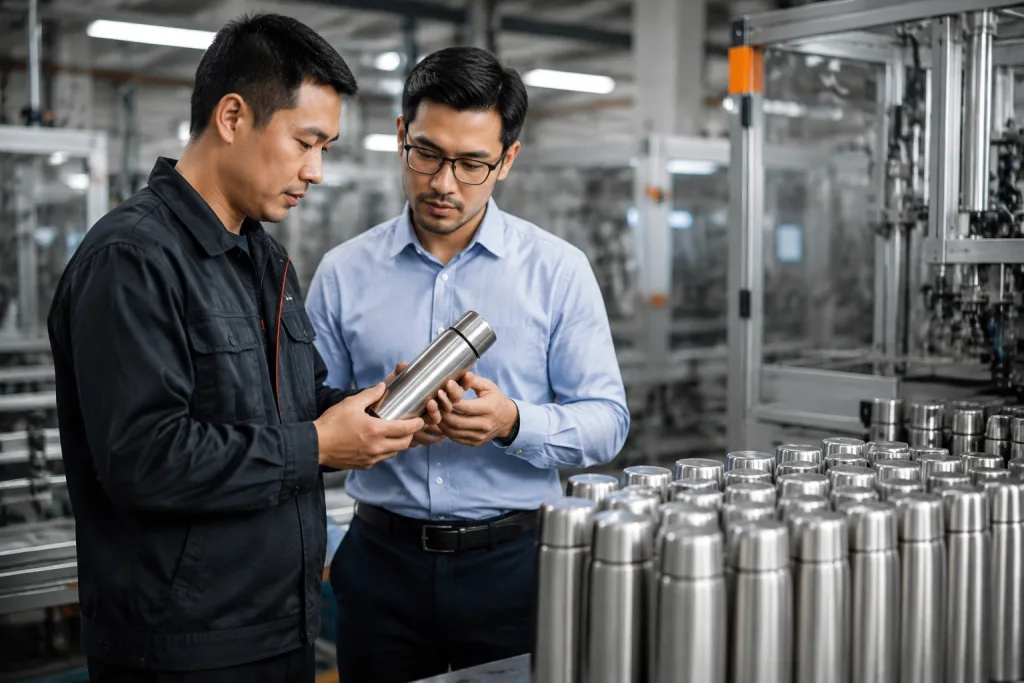
If you are placing a custom thermos order, QC is not optional paperwork. It protects your margin when 1,200 cartons land in Rotterdam or Los Angeles and the warehouse team cuts open carton No. 1 with a dull box knife. A workable QC plan starts with a signed pre-production sample, then we run inline checks at about 30% packed, then final inspection under AQL. For most bulk thermos orders, AQL 2.5 is a fair standard for major defects, with separate pull tests on leaks, dents, finish, and logo position within ±1.5 mm. We have seen this go sideways when a buyer approved a glossy logo by photo, then flagged the real shipment because the pad print sat 3 mm too low on the cup body.
Write the checkpoints in plain language: raw material certificate, first article approval, vacuum retention test, leak test, drop test, carton compression check. Make it boring. On our line, QC pulled 20 pcs from a 500 ml batch last month and used a 0.01 g scale to check cap gasket fit after the leak test; two lids failed because the silicone ring was twisted. For a thermos distributor program, label accuracy also matters because mixed SKUs create expensive fulfillment errors. If you sell via Amazon or similar channels, lock box dimensions, FNSKU placement, and carton pack counts before mass production starts, not after the buyer notices a PO typo like “24pcs/ctn” while the master carton is already printed for 36 pcs/ctn.
Certificates matter too. Depending on your market, you may need REACH-compliant materials, LFGB for Germany, FDA-related declarations for the U.S., and factory social compliance such as BSCI if your retail customer requests it. The wrong question is “Can you send certificates?” The better question is whether the plant can match the certificate to the material lot, the 304 stainless coil, the liner polish record, and the production date on your order. A proper thermos manufacturers audit should show whether the plant can hold these standards batch after batch, not just make one clean sample for the meeting room.
Good QC is boring. That is exactly why it saves money.
MOQ and lead time drive planning
Buyers often underestimate how MOQ and lead time hit sell-through. On our line, MOQ usually starts at 3,000-5,000 pcs per color or per design for stainless thermos orders, especially with custom packaging or a non-standard lid. Add 3 colors and 2 logo versions, and a thermos custom project reaches 10,000+ pieces before the buyer has noticed the carton count. We run this every month in Hangzhou; the ERP screen shows the pain first. That volume is normal in China. It still needs planning. A lower MOQ is possible, but the math often does not work because the unit cost rises and your per-SKU margin gets thinner.
Lead time matters just as much. Typical sample development takes 7-12 days, and QC pulled the sample last week because a laser logo was 1.5 mm off center. Mass production for a confirmed bulk thermos order often takes 25-35 days, plus transit time. If the order needs new tooling, add 20-30 days. Outdoor retailers who miss seasonal windows pay later through discounting. Promotional brands face a tougher clock: event dates do not move, so a 6-day schedule slip becomes a buyer complaint, not a production excuse.
Because we build in Zhejiang, we see timing stretch when a buyer asks for a custom thermos with special print, unique color, and upgraded packaging in the same PO. One buyer flagged the gold lid after pre-production because the Pantone code on the PO had one digit wrong. Small typo. Big delay. The more variables you change, the longer the critical path. If you want a stable thermos supplier relationship, freeze the core model early and leave decoration as the only moving part where possible.
Send your thermos spec, get a real quote
We can quote your bulk thermos project with steel grade, lid, print, MOQ, and lead time locked down before you place the order.
Frequently asked questions
What MOQ should I expect for thermos buy in bulk?
For a standard stainless thermos program, expect 3,000-5,000 pcs MOQ per design or color. If you want a custom lid, unique coating, or gift box, some thermos suppliers will push the minimum to 8,000 pcs because tooling and setup spread across fewer units. Smaller test orders may be possible at 1,000-2,000 pcs, but unit price usually rises by 10-20%. In Zhejiang, factories with stronger production control can sometimes mix colors within one model, but that still needs clear carton planning and inspection rules.
How much does a custom stainless thermos cost FOB China?
A basic 500 ml custom thermos with 304 stainless, simple screw lid, and one-color logo often falls around USD 3.20-4.20 FOB China at 5,000 pcs. A better finish, laser engraving, or premium packaging can move the price to USD 4.80-5.80 or more. If you choose 201 steel or a very simple promotional thermos build, the number can drop, but you are trading away durability and retail appeal. Always ask for a full quote with shell, lid, print, and carton separated.
What compliance documents do I need for Europe and North America?
For Europe, buyers usually ask for REACH-compliant materials, sometimes LFGB depending on the country and channel, plus food-contact declarations for the lid and gasket. For North America, FDA-related material statements are common, and some retailers ask for Prop 65 screening if coatings or inks are involved. If you work with a distributor thermos program, ask for factory audit records too, such as BSCI, and confirm the production lot matches the approved sample. A serious thermos manufacturer should be able to provide these before shipment.
How do I compare two thermos suppliers fairly?
Compare the full build, not just the unit price. Check steel grade, wall thickness, lid type, leak test standard, retention test result, decoration method, and packaging size. A supplier quoting USD 0.40 less may be using thinner steel, a simpler gasket, or weaker quality control. Ask both suppliers for the same test conditions and the same AQL standard, ideally AQL 2.5 for major defects. If one thermos supplier cannot define the test method, the quote is not apples to apples.
Can I start with a small distributor thermos order?
Yes, but expect trade-offs. A small thermos bulk order of 1,000-2,000 pcs is possible for stock models or simple branding, yet the factory will charge more per unit because setup cost is fixed. If you need a truly custom thermos with new tooling, a small start usually delays pricing by a few rounds of sampling. Many buyers test with one design first, then expand into a thermos customizable range with color variants once the sell-through is proven. That is usually safer than launching five SKUs at once.