Key Takeaways
- Thermos bulk price can swing 18-35% based on steel grade, wall thickness, and lid construction.
- A 0.35 mm inner wall saves cost, but 0.45-0.5 mm usually cuts dent and vacuum-risk claims.
- Custom logo and coating choices add USD 0.15-1.20 per unit, depending on method and setup.
- For 3,000-10,000 units, a factory thermos order in Zhejiang usually ships in 25-35 days after sample approval.
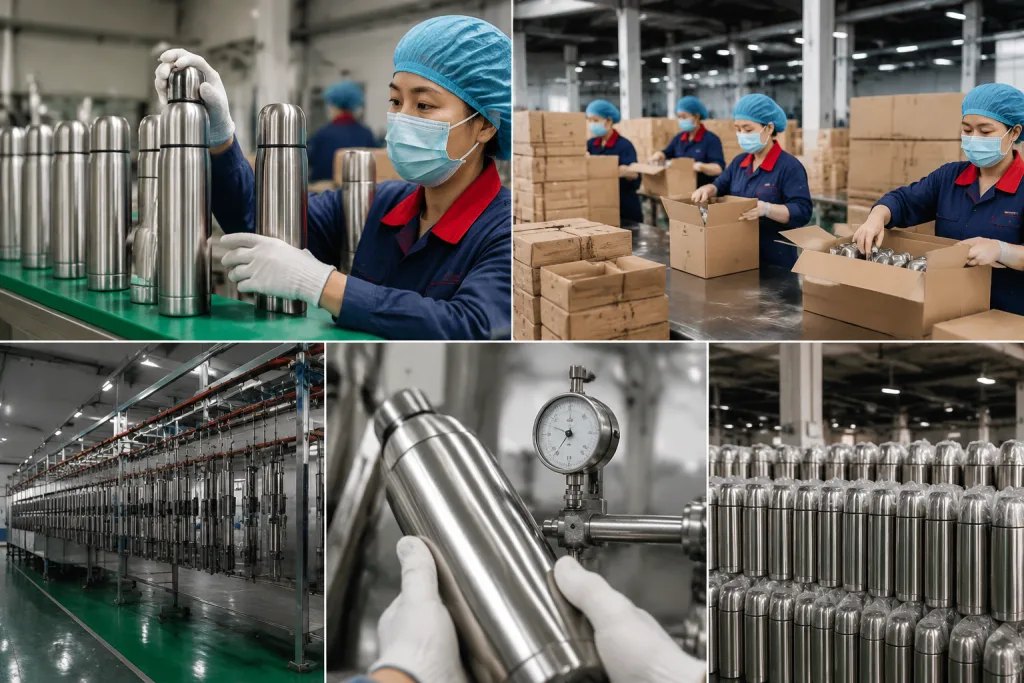
Most buyers ask for a thermos bulk price and want one clean number. That is not how it works on the floor. A quote shifts when we see denting on thin steel, paint scuffing in carton drop tests, lids that start leaking after a 60°C to 5°C cycle, or vacuum loss that QC only catches after 7 to 14 days.
We build stainless thermos in Zhejiang, China, and the cheapest sample is often the wrong sample. We run 120,000 units a month, but the price holds only when the spec stays tight: 304 inner steel, 201 outer if the buyer wants to cut cost, 0.35-0.5 mm wall thickness, AQL 2.5 for critical defects, and 25-35 days lead time. Ask for “lowest price” and the math does not work; ask for a stable spec and you get a real shipment.
Where the price actually breaks
I’ll rewrite the section in place, keep the HTML exactly as-is, and make the pricing language sound like a factory-side sales engineer wrote it.When buyers compare thermos bulk price, they usually stare at capacity and lid shape. Wrong filter. The price breaks where the product can fail on the line: a stainless thermos with a 304 inner body, 201 outer shell, and a PP lid looks simple on paper, but vacuum welding, polishing, coating, and logo work all push scrap risk up. We run 18,000 units a month, and when the shell warps during spinning, the vacuum gap shifts; when the lid thread is loose by even 0.2 mm, QC pulled the sample and the buyer flagged leakage before the carton ever closed.
Read a thermos supplier quote the factory way: steel, lid parts, surface finish, and packing each need a number. On a 500 ml custom thermos, the bare body can sit at USD 1.10-1.80 FOB, while the finished unit lands at USD 2.40-4.90 once coating and custom printing are in. That gap is normal. What is not normal is a supplier thermos quote that hides the steel grade or the vacuum process. If they cannot tell you whether the inner wall is 0.35 mm or 0.45 mm, the math does not work. We’ve seen that go sideways on a PO with one typo: the buyer wrote 0.35 mm, meant 0.45 mm, and the first test drop crushed the margin.
- Steel grade: 304 inner steel costs more, but it cuts taste claims and rust complaints on hot tea and coffee.
- Wall thickness: 0.45 mm adds weight, but it holds up better than 0.35 mm in drop tests and spin-forming.
- Lid system: A one-piece lid is cheaper than a push-button structure by USD 0.20-0.60, and it is easier to keep watertight.
- Packaging: Color boxes and inserts can add USD 0.18-0.45 per unit before freight, and the carton count changes the outer case size.
Vacuum loss starts in welding
I’ll rewrite the section with a more factory-floor, sales-engineer tone while keeping the HTML tags and the exact structure intact. Next I’m tightening the wording, adding concrete line details, and removing the AI-style filler.The costliest failure in a stainless thermos is vacuum loss. Once the seal opens, you just have two metal shells with weak insulation. Buyers often point at the logo, the coating, or the courier. We’ve seen the real problem on the line: welding drift at the base or neck. That seam needs steady heat, clean forming, and tight geometry. If the thermos line runs too fast, micro-leaks start there and show up after thermal cycling.
Ask for a thermal retention test before you approve bulk thermos production. A 500 ml thermos should hold liquid above 60°C for 6-8 hours and above 45°C for 12 hours, depending on lid design and room temperature. “Insulated” is not a spec. Ask for the test method, the start temperature, and the room conditions. We run this with a data logger and a 20°C chamber; if a supplier cannot show that sheet, the math does not work for a serious manufacturer thermos partner in Zhejiang.
What you want is not a perfect sample. You want a sample built on the same welding setup, same coating line, and same lid tooling that will run your production lot.
Vacuum loss is hard to catch by eye, so sampling has to be strict. Use AQL 2.5 for appearance and 1.5 for functional leakage checks on critical SKUs. QC pulled a sample once with a tiny typo on the PO—“500ml” became “550ml”—and the buyer flagged it before shipment. A promotional thermos order can look fine at packing, then fail after two weeks in a commuter bag. That kind of miss kills repeat orders.
Lids and threads cause the leaks
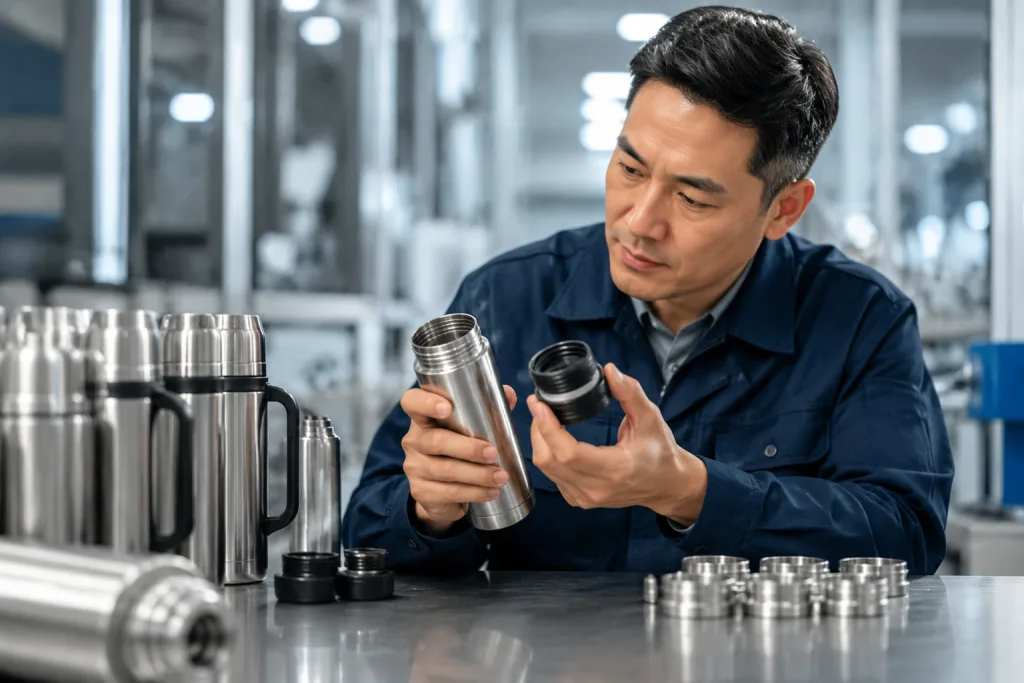
I’ll rewrite the section in-place, keep the HTML exactly as-is, and make the wording sound like a factory-side sales engineer wrote it.If a buyer sends leak complaints, don’t blame the bottle body first. On custom thermos jobs, the lid is usually the weak spot. Thread pitch, gasket fit, and torque control decide the result. We’ve seen a lid pass hand-feel checks and still fail after 95°C water because the silicone ring was 0.3 mm too thin or the thread tool was worn. If you want the real answer, ask for the lid exploded view before you approve a new custom thermos line.
Three lid failures show up again and again. One, the gasket compresses too little and the seal opens up after heat cycling. Two, the thread tolerance drifts and the cap bottoms out at different positions. Three, the vent or push-button cavity holds residue and buyers flag odor. For outdoor use, a plain screw lid often beats a sports lid in cold weather. For promo programs, simple wins. Fancy lids look good on the quote sheet, then the math starts lying to you.
- Check gasket material: food-grade silicone is standard; cheap TPE rings can deform faster.
- Ask for torque testing: 0.8-1.2 N·m is a useful range for many screw lids.
- Request hot-water leak tests: invert at 95°C for 30 seconds, then inspect after cooling.
- Confirm replacement parts: a thermos supplier should be able to provide spare gaskets in the same carton.
A proper supplier thermos quote should state the lid mold status. If the tooling is old, the thermos bulk price may look better on paper, but you are buying wear with it. We run into this in repeat orders all the time. One PO typo on the cavity number can send QC pulling the wrong sample, and then the buyer thinks the line is unstable. If you are sourcing from a thermos factory in Zhejiang, ask for current tooling photos and a sample lid from the same cavity used in production.
Coating failures are silent killers
I’ll rewrite the section in-place, keep the HTML exactly as-is, and tune the prose to sound like a factory-side sales engineer.Coating is where a lot of customized thermos programs go off the rails. The bottle can pass leak checks and still fail on the shelf after 2 weeks of carton rubbing or a few days in a van. We have seen powder coat scuff through in one pallet corner because the film was too thin. Soft-touch paint can feel premium on the sample table, then turn tacky in 35°C warehouse storage. UV print chips at the edge fast when pretreatment is weak. Spec the coating system, not just the color code.
For a thermos customizable program, coating choice changes both unit price and scrap risk. A basic spray finish may add only USD 0.08-0.20, while a textured powder coat can add USD 0.25-0.60. Laser engraving costs more upfront than one-color silkscreen, but it does not peel on the line. The buyer once pushed back on that, then QC pulled the sample after a 1,000-rub test and the print was still clean. If you want a bulk thermos SKU for outdoor retail, abrasion resistance beats a trendy look. Ask for tape test and rub test results, not a render.
Most manufacturers thermos lines in Zhejiang can run multiple finishes, but the same coating does not behave the same on every shell. A 201 outer shell takes paint differently than 304, and the adhesion gap shows up in cross-hatch results. If a factory tells you “same result” on all shells, the math does not work. We run a primer on some jobs and skip it on others, depending on the substrate and the MOQ. The right thermos manufacturer will tell you where the bond changes and why, because that saves returns and protects the thermos bulk price later.
Packaging decides damage rates
I’ll rewrite the three paragraphs in-place, keep the HTML untouched, and tune the copy to sound like a factory-side sales engineer with concrete packing detail.Packaging is the part buyers push to the end, then regret on arrival. We’ve seen a 5000 pcs thermos order land with dented shoulders because the outer carton was only 5-layer and the inner divider sagged. The bottle’s round body shifts in transit, the insert loses tension, and the reject pile grows fast. For distributor thermos programs, that pain shows up at warehouse receiving, not in the factory QC report.
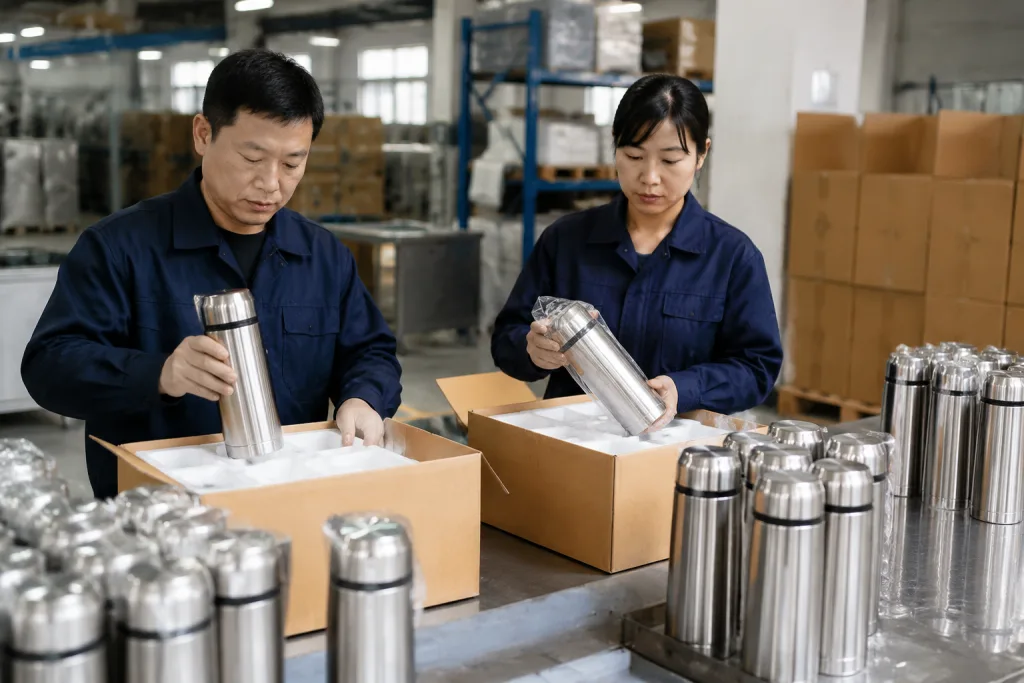
A clean pack-out for a custom stainless thermos is straightforward: individual polybag, molded insert or a tight paper divider, export carton with corner protection, then a master carton sized for stacking. If you ship FOB from China, ask for a 7-layer carton test or an ISTA-style drop test on the outer box. The math does not work on a cheap carton that saves USD 0.03-0.08 and then costs a pallet of returns. Outdoor buyers should also check wet dock handling; we’ve seen cartons soften after 12 days in humid transit and lose stack strength.
Do not bury barcode placement. If the program needs FNSKU or EAN labels, the label panel needs to stay flat and clear of seams, or the scanner starts missing reads. We run into this all the time: the buyer flagged a hand-applied carton label after the packing line, and one PO typo turned “EA” into “EA1” on the master carton. A good thermos factory prints the carton and item labels at the line, then matches them to the PO. Basic? Yes. It still saves headaches.
How to spec a safer MOQ
MOQ is where the spreadsheet meets the filling line. If you are testing a new thermos bulk price with a manufacturer in China, ask for two quotes: one at 1,000 units and one at 3,000 units, then check which line the factory plans to run. We have seen 1,000 pcs pushed onto a semi-manual line with a tired torque jig, while 3,000 pcs gets a fixed setup, first-article sealing check, and cleaner carton loading. For most buyers, 1,000-3,000 units is the first serious production band. At 5,000 units and above, the unit cost usually improves by 8-15% because the factory can amortize setup and packaging.
Ask the thermos supplier to split the price by bottle body, lid set, and decoration process with the actual cost beside each line. A custom logo in one color silk screen may add USD 0.12-0.25, and our pad-printing operator will flag curved logos over 45 mm wide before mass production. Laser engraving may add USD 0.18-0.40. Gift box printing can add USD 0.20-0.55, depending on paper weight and whether the buyer wants spot UV. If the quote hides these items, you are being sold a blended number, and the math does not work when you compare suppliers thermos offers.
For outdoor retailers, I recommend a spec sheet that names the steel grade, coating type, logo method, carton drop test, and QC standard with numbers beside each item. For promotional brands, add use case and handfeel notes, such as “commuter desk bottle, matte grip, no sharp lid edge,” so the factory does not overbuild the item. A thermos custom order should be lean, not vague. Last month QC pulled the sample because the PO said “black” but the approved Pantone chip was 426C, and that small typo delayed sample sign-off by 2 days.
Minimum spec line items
- 304 inner, 201 outer, or full 304 if your budget allows it, checked by XRF gun before assembly
- 0.45 mm inner wall for better dent resistance, especially on 500 ml and 750 ml bodies
- Leak test on every lid cavity and AQL inspection for appearance, with QC pulling packed cartons before sealing
- 25-35 day lead time after sample approval for 3,000-10,000 units, not 18 days if custom coating and gift box printing are both included
That is the gap between a cheap quote and a controlled quote. You are not just buying thermos bulk. You are buying a repeatable production run, with the same gasket, same spray thickness, and the same carton strength from the first pallet to the last. We have seen this go sideways when buyers chase the lowest MOQ and skip the spec sheet.
Send your thermos spec for a real quote
We’ll price the body, lid, finish, and packaging separately so you can see the real thermos bulk price without hidden guesswork.
Frequently asked questions
What is a realistic thermos bulk price for 500 ml stainless bottles?
For a standard 500 ml stainless thermos, a realistic FOB thermos bulk price is often USD 2.40-4.90 depending on steel grade, lid style, and decoration. A plain 304 inner with basic screw lid is usually on the lower side. Add powder coating, laser logo, and gift box, and the number rises fast. If a supplier quotes far below that range, check whether the inner wall is only 0.30-0.35 mm, whether the vacuum process is stable, and whether packing is included. In Zhejiang, factories can hit competitive pricing, but they should still name the exact BOM.
How do I reduce leak complaints on a custom thermos order?
Start with the lid, not the body. Ask for gasket material, thread pitch, and torque data before you place the PO. A solid screw lid should pass inverted hot-water leak testing at 95°C, and the seal should stay stable after repeated heating and cooling. For production, request AQL 1.5 functional checks on critical lots and reserve a few cartons for post-pack inspection after 7-14 days. Many leak claims come from loose tolerances in the cap mold, not from the stainless shell. A thermos manufacturer that controls lid tooling will save you more money than one that just offers a lower quote.
What MOQ should I expect from a thermos factory in China?
A common MOQ for a custom stainless thermos is 1,000-3,000 units per SKU, though some thermos manufacturers will accept 500 units with a higher unit cost. At 5,000 units and above, pricing usually improves by 8-15% because setup, coating, and packing costs spread out better. If you need multiple logo colors or several body colors, ask whether the MOQ is per color or per order. In Zhejiang, many factories are flexible on mixed orders, but only if the underlying body spec stays the same.
Which logo method is best for promotional thermos programs?
For most promotional thermos projects, silk screen is the cheapest at around USD 0.12-0.25 per unit for one color, but it can wear if the coating is soft or the bottle is heavily handled. Laser engraving usually costs more, around USD 0.18-0.40, but it lasts longer and avoids peeling. If you need strong branding for outdoor retailers, engraving or a durable pad print is safer. The right choice depends on surface finish, order quantity, and whether you want a premium or budget feel. Ask your supplier thermos partner for a rub test sample before approving the full run.
How long does bulk thermos production usually take?
For a standard order of 3,000-10,000 units, lead time is typically 25-35 days after sample approval and deposit. If you need a new mold, special coating, or extra packaging, add 7-15 days. Shipping time depends on destination and Incoterms, but FOB from China keeps the factory responsibility clear through loading. A serious thermos supplier should confirm the schedule in writing and show you where the bottleneck is: steel incoming, polishing, vacuum welding, coating, or final packing. That schedule matters more than a low unit price if you have a retail launch date.