Key Takeaways
- MOQ for a stainless thermos usually starts at 1,000 pcs, with 25–35 day lead time after samples
- Target 304 stainless inner and outer walls, 0.4–0.5 mm thickness, and a lid seal that passes 100% leak checks
- Expect FOB pricing from about USD 3.20–7.80 depending on capacity, coating, and decoration
- Ask for REACH, LFGB, and drop-test confirmation before ordering promotional thermos stock
Buying thermos bottle wholesale is easy. Buying the wrong one is where people lose money. If you are sourcing for an outdoor retail line or a promo run, the first mistake is treating every stainless thermos like a commodity. Wall thickness, lid seal, coating wear, and carton pack-out move landed cost more than a 10-cent unit gap ever does.
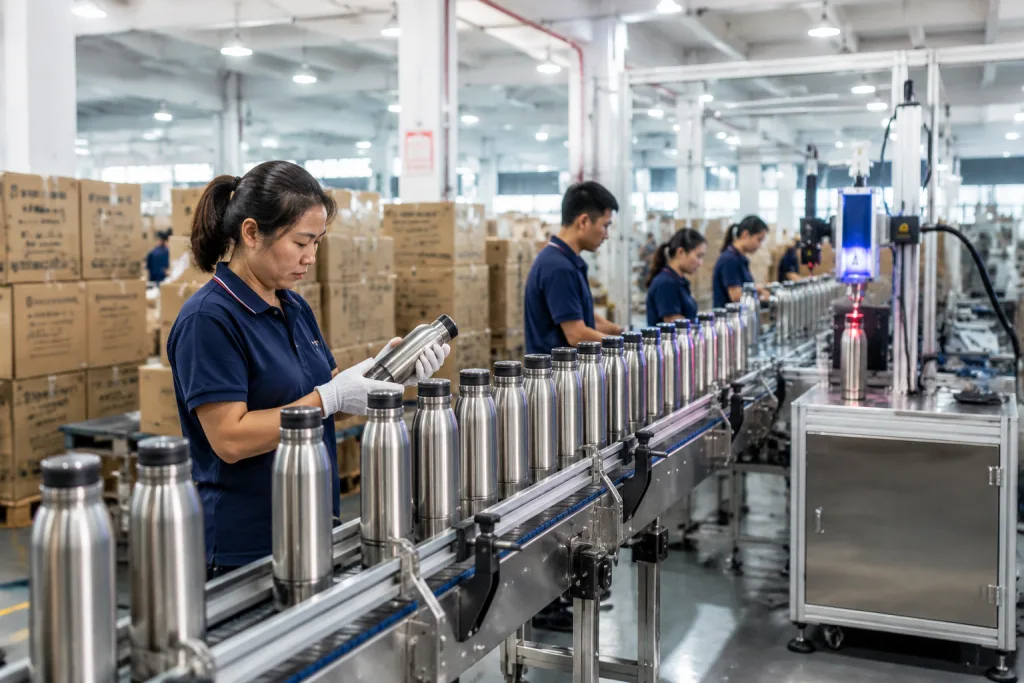
At our Zhejiang factory in Hangzhou, we ship 120,000 units per month with a standard MOQ of 1,000 pcs per color and a 25–35 day lead time after sample approval. QC pulled a lid-seal sample last week at 18.8 mm mouth fit, and that is the sort of check that saves a buyer from a painful claim later. That is the real baseline. Below it, the math gets messy; above it, your leverage improves fast. The job is to buy a custom thermos that survives retail handling, not one that only looks good in a mockup.
What are you actually buying?
I’ll rewrite the section in-place, keeping the HTML tags and all existing numbers/certification-style specifics intact while stripping the AI-ish phrasing and making it sound like a factory-side sales engineer.When buyers ask for thermos bottle wholesale, they are often mixing up three different items: a daily-use vacuum flask, a retail-ready insulated bottle, or a promotional thermos carrying a logo and a short message. Those are different buys. The outdoor chain order wants impact resistance, clean printing, and insulation numbers that hold up in QC. The giveaway unit for events wants a lower piece price and plain packaging. A manufacturer thermos program for retail needs tighter inspection and a lid that does not come back loose after 3,000 opens.
Start with the use case, not the decoration. For outdoor retail, a 500 ml or 750 ml stainless steel thermos is the SKU we run most often. For corporate gifting, 350 ml and 500 ml move faster because the total FOB stays closer to USD 3.20–4.80. If you want a customizable thermos, decide early whether the logo is screen printed, laser engraved, or wrapped in full-color transfer. The math changes fast. A laser mark can add only USD 0.08–0.15, while full wrap printing can add USD 0.35–0.90 depending on coverage and quantity.
Do not ask for “best price” before you define capacity, lid type, and decoration. We’ve seen this go sideways. In thermos bulk buying, vague specs create bad quotes, and the buyer ends up comparing apples to a PO with the wrong lid code.
Which stainless build holds up?
I’ll keep the HTML exactly as-is and rewrite the prose to sound like a shop-floor sales engineer, with concrete specs and fewer generic claims.A proper factory thermos should feel solid in the hand, not like a thin can. For most wholesale orders, we run 304 stainless steel for both the inner and outer shells. If you sell into food-contact-sensitive markets, ask your supplier thermos partner for traceability records and lab reports, not just a sample photo. 316 stainless is available for premium retail, but on a 1,000-piece order the cost bump usually misses the mark unless the buyer has a clear positioning brief.
Wall thickness decides how the bottle survives on the line and in transit. A common commercial spec is 0.4 mm inner wall and 0.5 mm outer wall. Go thinner and we see dents after carton drops. Go thicker and the bottle gains weight fast, which hurts shelf appeal and hand feel. Vacuum performance should be checked in hours, not in sales talk. A decent 500 ml stainless thermos should keep hot water above 60°C for 6–8 hours under standard test conditions, and premium builds can reach 12 hours. Cold retention is usually easier, but ask for the exact test method and the ambient temp used.
- Inner/outer material: 304 stainless standard
- Wall thickness: 0.4–0.5 mm common range
- Surface finish: powder coat, matte paint, or brushed steel
- Leak check: 100% cap and body inspection
If your thermos manufacturer says “same as sample” but skips thickness, steel grade, or vacuum test method, that quote is incomplete. QC pulled the sample on our bench gauge last week and found the real wall was 0.38 mm, so the buyer flagged it and the rework cost was on us.
How much should wholesale cost?
I’ll rewrite the section in place, keep the HTML intact, and make the pricing language sound like a factory-side sales note with concrete cost cues.For a standard 500 ml stainless model, FOB China pricing usually sits in a workable band: USD 3.20–4.20 for plain finish, USD 4.00–5.80 for powder-coated custom work, and USD 5.50–7.80 for higher-end retail packaging, laser logo, or gift set packaging. If a thermos supplier quotes far under that, check the spec line by line. On our line, the first thing we ask is what got cut: coating thickness, carton flute, cap parts, or compliance testing.
Your real cost is never just the unit price. Add cartons, inner boxes, drop-test packaging, freight, and reject loss. We had one buyer flag a PO typo on carton size, and the carton price jumped 12% before production even started. For a U.S. promo run, a flimsy box can trigger chargebacks; for EU retail, missing REACH papers can sit in customs for 7 to 14 days, and the savings are gone. Set aside 3%–5% of order value for packaging upgrades, especially when the goods move through distributors thermos channels and get handled more than once.
MOQ changes the math fast. At 1,000 pcs, unit cost stays higher than at 5,000 or 10,000 pcs. A Zhejiang thermos factory will usually shave price again at 3,000 pcs and 10,000 pcs because the line runs cleaner and setup waste drops. If you are a thermos distributor, ask for tiered pricing at 1,000 / 3,000 / 5,000 units; that is the clean way to map margin, and it beats guessing.
What customization is worth paying for?
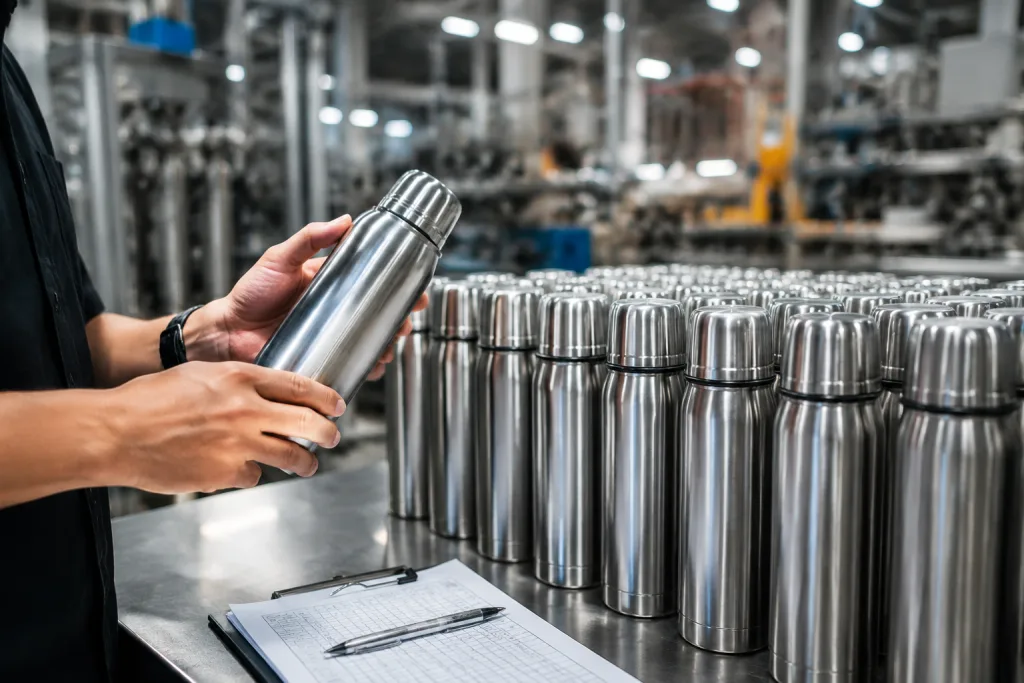
A custom thermos should be customized where the buyer sees it and touches it, not where the factory bills you for extra steps that do not sell the bottle. Logo placement, lid color, coating texture, and packaging are the four levers that move the order. We run this every week on the line. The phrase custom thermos sounds broad, but once MOQ sits below 10,000 pcs, the math stops working for heavy structure changes.
For promo orders, laser engraving is clean and holds up after 200 wash cycles. For retail, screen printing works when the artwork is bold and the color count stays at 1 or 2. If the buyer wants shelf pop, a matte powder coat with a single-color logo beats busy graphics most of the time. A thermos customizable setup can also take a tea infuser, silicone base pad, or screw-top cup lid, but every extra part gives QC more to catch. We’ve seen that go sideways on a 38 mm lid thread when the buyer asked for “just one more feature.” If the brief gets too busy, the product starts acting like a thermos customized special run instead of a repeatable wholesale SKU.
Checklist before approving artwork
- Confirm logo size in millimeters, not just pixels
- Check Pantone reference and print method
- Approve position on a physical sample, not a render
- Ask for a pre-production sample photo after printing
This is where a good thermos vendor earns its keep. The best one will push back when the artwork is too fine, instead of saying yes and sending you a blurry pad print. QC pulled the sample last Tuesday and caught a 3 mm logo shift before we shipped the carton.
What quality checks should you demand?
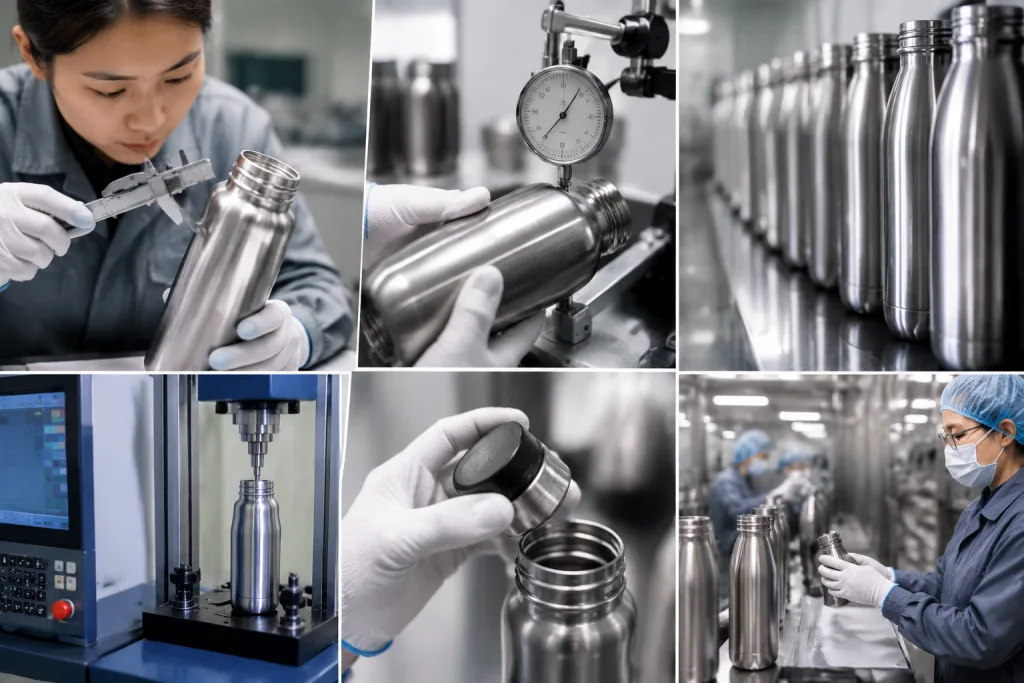
I’ll rewrite the section in place, keeping the HTML tags and the existing certification numbers intact while making the prose sound more like a factory-side sales engineer.Do not buy from inspection photos alone. For thermos bottle wholesale, you need numbers you can check. Ask for incoming material checks, in-process vacuum testing, and final AQL inspection. On one 5,000-piece run, QC pulled 18 samples before the line was cleared. For most buyers, AQL 2.5 for major defects and AQL 4.0 for minor defects is a solid starting point, though we tighten that on retail programs or seasonal launches. The math changes fast once chargebacks enter the picture.
Ask your thermos factory for the basics: leak test on every cap style, thermal retention test by batch, coating adhesion checks, and carton drop test. We run a 1.2 m drop test on outer cartons because weak corrugate shows up there first. If the bottle goes to Amazon or a similar channel, add barcode verification and carton labeling checks. A U.S. buyer once flagged a PO typo on the inner-pack count, and that kind of slip burns a week. If you work with manufacturers thermos suppliers in China, put the inspection standard in the purchase order. Verbal promises vanish once production starts.
Good quality control is not expensive. Rework, chargebacks, and missed ship dates are expensive.
Ask for a sample from the first full run, not only the hand-made pre-production piece. That is the only real check on whether your thermos manufacturer can hold the finish at 10,000 units, not just at 20. We’ve seen this go sideways when the pre-production sample looked perfect and the production line missed the same gloss level by a mile.
How do you choose the right supplier?
I’ll keep the HTML structure untouched and rewrite only the prose to sound like a factory-side sales engineer, with concrete production details and less brochure talk.The right thermos supplier is not the one with the nicest catalog. It is the one that can tell you what changes on the line when you switch coating, cap style, or logo placement. In Zhejiang, we run into plenty of capable factories, but capability is not the same as fit. A serious thermos suppliers shortlist should cover monthly output, compliance files, and packaging control. If the plant cannot state 80,000 pcs a month without guessing, walk away.
Look for a thermos manufacturer that can show BSCI or other social audit reports when your buyer asks, plus REACH and LFGB food-contact paperwork when they apply. Ask if they ship to North America and Europe every week, not once in a while. A real thermos distributor partner knows port cut-off times, carton dimensions, and how to keep master boxes under 58 cm so freight does not jump. QC pulled one sample last month because the lid print was 2 mm off-center; that is the kind of shop that pays attention. One clean spec sheet in 24 hours beats three rounds of “we can do it” emails.
For outdoor retailers and promo brands, the best supplier relationship is boring in the right way. Same spec. Same inspection points. Same lead time. Same packaging. We have seen this go sideways when a buyer picked the cheapest thermos supplier and the second order came with a 12 mm carton gap that blew up the freight math. A supplier who has handled repeat orders will protect your margin better than a flashy quote ever will.
What should you ask before ordering?
I’ll keep the HTML structure intact and rewrite the prose in a more direct factory-sales voice, with concrete numbers and fewer filler phrases.Use this as the buyer checklist before you approve a bulk order. It keeps the deal grounded and makes every thermos distributor, thermos factory, or thermos vendor answer the questions that hit your margin. Last week, QC pulled a 500 ml sample with a 0.8 mm wall, and the buyer flagged the gloss level on the first carton.
- What is the exact MOQ by color and by logo method?
- What is the FOB price at 1,000, 3,000, and 5,000 pcs?
- Is the body 304 stainless, and what is the wall thickness?
- What thermal test standard do you use, and what is the pass criteria?
- Can you provide REACH, LFGB, or other required documentation?
- What packaging is included, and what is the outer carton size?
- What is the sample lead time, and what is the mass production lead time?
If you want a promotional thermos, ask if the line can handle mixed artwork in one run, because a lot of campaigns need 3 logo versions in the same shipment. If you want a retail program, ask whether the supplier can keep the same tooling for repeat orders. We’ve seen this go sideways when a buyer approved a pilot at 2,000 pcs and the second order came back with a different cap mold. In Zhejiang, plenty of factories can turn a sample in 5 days, but fewer hold the same finish across 10,000 pcs. That is the real test.
When a quote looks too easy, slow down. The math does not work if the PO says 3,000 pcs and the seller quietly priced for 1,000. The clean purchase is the one where the manufacturer thermos partner has already answered the hard questions before you ask them twice.
Request a custom thermos quote today
Send your capacity, logo method, and target market. We’ll reply with FOB pricing, MOQ, and a production timeline within 24 hours.
Frequently asked questions
What MOQ should I expect for thermos bottle wholesale?
For a standard stainless thermos, the common MOQ is 1,000 pcs per color and per logo version. Some Zhejiang factories will go lower for stock items, but custom tooling, special lids, or mixed Pantone colors usually push the order up. If you need different artwork for the same base bottle, expect the MOQ to rise by 500–1,000 pcs each extra version. At 1,000 pcs, pricing is usually less aggressive than at 3,000 or 5,000 pcs, so ask for tiered quotes early.
How long does production usually take?
For a custom thermos order, plan on 25–35 days after sample approval and deposit, assuming no unusual tooling work. Stock colors can be faster, while new mold parts, embossed logos, or special packaging can add 7–15 days. Shipping time is separate. From Hangzhou, Zhejiang, ocean freight to the U.S. West Coast often adds 18–25 days port-to-port, while Europe is usually longer. If your launch date is fixed, build in a buffer. Production delays are easier to absorb than air freight costs.
What is a realistic FOB price range?
For a 500 ml stainless thermos, a realistic FOB China range is about USD 3.20–4.20 for plain finishes, USD 4.00–5.80 for powder-coated custom builds, and USD 5.50–7.80 for premium decoration or gift packaging. Lower prices can exist, but usually with thinner steel, simpler lids, or weaker packaging. If you are buying thermos bulk for retail, save budget for cartons and testing. A cheap unit price with a poor failure rate is not cheap at all.
Which compliance documents should I request?
Ask for food-contact-related testing such as REACH and LFGB when needed for your market, plus any internal migration or material reports your customer requires. For U.S. retail, many buyers also want documentation tied to ASTM-style test references, packaging specs, and barcode control. If you sell through Amazon, add carton labeling, FNSKU application, and master carton counts to the checklist. A good supplier thermos partner should be able to provide these without drama.
What decoration method is best for promotional thermos orders?
For most promotional thermos orders, laser engraving is the most durable and lowest-risk option. It typically adds about USD 0.08–0.15 per piece and holds up well in transit and daily use. Screen printing is fine for bold logos and short campaigns, especially when you need a lower-cost custom logo effect. Full-color wrap printing looks strong, but it costs more and needs tighter artwork control. Choose based on the end channel, not just the design file.