Key Takeaways
- For most stainless thermos bulk orders, practical MOQ starts at 1,000 units per color and 3,000 units for custom shapes.
- 304 stainless steel is the normal baseline; 316 inner wall adds about USD 0.25-0.60 per unit depending on size.
- Laser engraving is safest for outdoor retail; full-wrap powder coating needs tighter AQL checks for scratches and color shift.
- Normal production lead time from Zhejiang, China is 30-45 days after sample approval and deposit.
If you buy thermos bottle wholesale bulk for outdoor retail or a promo drop, finding a thermos supplier in China is the easy part. The risk starts when 3 quotes describe 3 different bottles. One factory may quote 201 stainless for the inner tank, another quotes 316; one includes laser logo, another adds mold fee, color box, and 5-layer carton cost after QC pulled the sample. We see this go sideways.
At BottleForge Industrial in Hangzhou, Zhejiang, we run into this almost every week. A custom thermos order should be locked by structure, capacity, logo method, and compliance before anyone argues over FOB Ningbo. Last month a buyer flagged a PO typo on “500ml” vs “550ml”; that 50ml gap changed the body height by 12 mm and pushed sampling from 12 days to 18 days. The math doesn’t work if the spec is loose.
Start With Four Buying Decisions
Before you ask ten thermos manufacturers for a price sheet, decide the bottle’s job. A bank giveaway thermos and a retail thermos for a hunting or ski shelf should not share the same spec sheet. Same silhouette, different BOM. We had one buyer send a PO marked “camping bottle” with a 300 g target weight; the math didn’t work once QC pulled the 500 ml sample and checked the wall thickness with a micrometer.
Your first decision is insulation performance. A basic double-wall vacuum bottle can hold hot liquid for 8-12 hours in normal room testing. A retail-grade manufacturer thermos with copper coating, tighter vacuum control, and a better lid seal can reach 18-24 hours for hot retention. That usually adds USD 0.35-0.90 per unit. Worth it, if the bottle goes outdoors. On our line, we run the vacuum test before powder coating because one weak weld at the base can turn an 18-hour claim into a 9-hour complaint.
Your second decision is material. For most thermos bottle wholesale bulk programs, 304 stainless steel for both inner and outer walls is the sane starting point. If the product will hold tea, coffee, acidic drinks, or sit in premium outdoor retail, 316 stainless for the inner wall is worth pricing. I would not recommend 201 stainless inside for North American or EU retail unless you are chasing the lowest gift price. We have seen this go sideways during salt spray checks, and the buyer flagged rust spots around the mouth after only 48 hours.
Your third decision is branding. A thermos custom project can use laser engraving, silkscreen, pad printing, heat transfer, UV print, or an embossed metal badge, but do not pick from a catalog photo only. Laser rarely peels, but it gives you metal color rather than Pantone color. Silkscreen is cheap on smooth coating and weak on textured powder coating. Full-color transfer looks sharp on a render, then fails when the artwork has 1.2 mm legal text. QC pulled the sample last month because the registered trademark symbol filled in after the second bake.
Your fourth decision is packaging and logistics. Retail cartons, Amazon-ready FNSKU labels, master carton drop tests, and pallet dimensions should be settled before the supplier thermos quote is final. Packaging can add USD 0.20-1.20 per unit, and it often changes the final shipping cube more than buyers expect. We ship one 40HQ at about 12,000-18,000 pcs depending on bottle size and carton style; a 2 mm thicker gift box can kill half a pallet position. Check it early.
Choose Capacity Around Real Use
Outdoor retailers and promotional brands often open with a size because the buyer knows the numbers: 500 ml for desk and subway use, 750 ml for a day pack or jobsite lunch bag, 1,000 ml for cold-weather outdoor kits. That is the wrong question to ask first. Ask how the user carries it. We run a quick carton mockup on the packing table before quoting, because a 500 ml customized thermos slides into a 90 mm gift box, while a 1,000 ml bottle pushes carton volume up fast and adds wrist weight the end user will feel.
For stainless vacuum construction, wall thickness matters. A standard wholesale bottle often runs 0.4 mm inner and 0.5 mm outer 304 stainless steel. Premium outdoor bottles move to 0.5 mm inner and 0.6 mm outer, mainly once capacity reaches 750 ml or 1,000 ml. More steel gives better dent resistance, but it raises unit cost and shipping weight. We have seen this go sideways: QC pulled a 750 ml sample after a 1.2 m drop test, and the thinned outer shell had a flat spot near the shoulder. If your customers throw gear into pickup beds or rental vans, saving USD 0.18 on the outer wall is bad math.
Lid selection is a practical trade-off. A screw cap with silicone gasket is simple, reliable, and easy to test with a 3-minute inverted leak check. A push-button lid looks convenient, but it has a spring, button seat, gasket groove, and more places for claims to start if the click feels loose. For a distributor thermos line, we suggest keeping one lid family across 500 ml, 750 ml, and 1,000 ml sizes. Spare parts stay clean. QC can use the same torque check and gasket visual standard on the line.
Do not over-customize the shape unless volume supports it. Existing molds from a thermos factory are faster and cheaper, often cutting sampling to 12 days instead of 18 days for new body tooling. A private mold for a truly customizable thermos body can cost USD 2,500-8,000 depending on geometry, lid tooling, and surface requirements. For a first order under 5,000 units, use an existing mold, then customize powder coating, laser logo position, lid color, and the color box dieline. We ship the first SKU, read the repeat order data, then talk tooling.
Branding Options Have Failure Modes
Custom branding is where 7 out of 10 thermos promotional programs lose money quietly. The unit price may look fine on the quote sheet, but we have seen reject rate move from 1.5% to 6% when the decoration method does not match the coating, artwork, or handling on the line. QC pulled one 500-piece sample batch last April because the PO said “logo 42 mm,” while the artwork file measured 48 mm.
Laser engraving is our safest choice for outdoor retail orders. It burns off the surface coating and shows the stainless steel underneath, so the mark does not peel in warehouse handling or after 30 cycles in a dishwasher test. Clean and permanent. It suits 1,000-unit orders, but bright color is the wrong question to ask here; contrast matters more. On matte black, navy, forest green, and white powder coating, laser usually looks sharp under a 20W fiber laser.
Silkscreen printing keeps cost down for one- or two-color logos. It works best on smooth painted bodies and simple artwork with open spacing. On rough powder coating, we run 3M tape testing and a 95% alcohol rub test before approving mass production. If your logo has thin lines under 0.25 mm, expect trouble; the mesh screen will not forgive it, and the buyer will flag broken strokes during AQL inspection.
Heat transfer and UV printing fit colorful artwork and retail patterns with gradients. They need tighter handling during production because one scratch before final packing can make the bottle unsellable. We put EVA sleeves between bodies on the conveyor, not loose bottles in a plastic tray. For a thermos customized with full-wrap artwork, ask your thermos manufacturer for a signed pre-production sample, not just a digital mockup; we have seen this go sideways when the mockup ignored the 3 mm seam gap.
Embossed badges and silicone patches can make a custom thermos feel premium, but they add assembly work and another failure point. Adhesive quality, temperature resistance, and edge lift all need checking with real parts, not a nice photo from the sample room. For cold-weather outdoor products, we test bonded parts after 24 hours at low temperature and then inspect for peeling with a 1 kg pull check on the badge edge.
If you are comparing thermos suppliers, ask each one to quote the same logo size, the same print positions, the same Pantone colors, and the same coating finish. Otherwise the cheapest thermos vendor may be leaving decoration risk out of the price. The math does not work if Supplier A includes 2-position printing and Supplier B only quoted a 30 mm front logo.
Price The Whole Landed Program
FOB unit price is only one line on the sheet. For thermos bottle wholesale bulk buying, price the landed program before you approve the supplier: bottle, logo process, color coating, retail box, inner carton, master carton, AQL 2.5 inspection, China inland trucking, sea or air freight, duty, and your warehouse handling. We run this in a 12-column Excel sheet because buyers often miss the carton cube; one 58×39×44 cm master carton can change the freight math fast.
Here is a Zhejiang benchmark we would actually use on a quotation call. A 500 ml 304 stainless double-wall vacuum bottle with powder coating and laser logo usually sits around USD 3.20-4.80 FOB at 3,000 units, depending on lid build, steel gauge, surface finish, and box style. A 750 ml outdoor bottle is often USD 4.20-6.50 FOB. A 1,000 ml premium customized thermos with 316 inner wall, copper coating, and retail box can go above USD 7.00 FOB. Not a promise. It is the range where serious discussions start; last month QC pulled a 500 ml sample with a 0.18 mm thinner outer wall than quoted, and the buyer flagged it before PO release.
MOQ needs straight talk. For standard colors and existing molds, 1,000 units per color works in our Hangzhou-area production network. For custom Pantone powder coating, 2,000-3,000 units per color is the safer number because the coating line needs setup, color matching, and scrap allowance; our line usually burns 25-40 bottles before the color meter and visual board both pass. For private mold development, plan at least 3,000-5,000 units for the first run so tooling cost does not punish the SKU. Asking for 500 pcs with a new mold is the wrong question to ask; the math does not work.
Our typical stainless thermos capacity is 180,000-220,000 units per month across mixed bottle models, with standard lead time of 30-45 days after sample approval. Before Q4 holiday campaigns, add 7-15 days. We ship faster on repeat orders when the artwork, box dieline, and gasket spec are locked; we lose days when a PO says “mat black” instead of “matte black” and the buyer has to confirm the finish again. If a thermos factory promises 20 days for a new color, retail box, and complex print in peak season, ask which step they are skipping.
Set Quality Standards Before Sampling
A sample is not a quality system. It is one bottle that passed on one day. Your purchase order needs measurable acceptance criteria, especially when we ship thermos bulk to 80 retail doors or a 50,000 pcs national promo job. We have seen this go sideways when the PO only says “same as sample,” then QC pulled the sample and found the production lid gasket was 0.3 mm thinner.
Start with material confirmation. Ask for stainless steel grade declarations for the inner wall, outer wall, and lid components. For EU buyers, REACH and LFGB-related food contact documentation may be required depending on market and importer obligations. For the US, 7 out of 10 larger buyers ask for FDA food-contact compliance statements and, for kids-related products, CPSIA or ASTM checks. Do not assume every thermos supplier knows your retail channel rules; the buyer flagged this last month when the PO said “304 stainless” but the lid spring material was left blank.
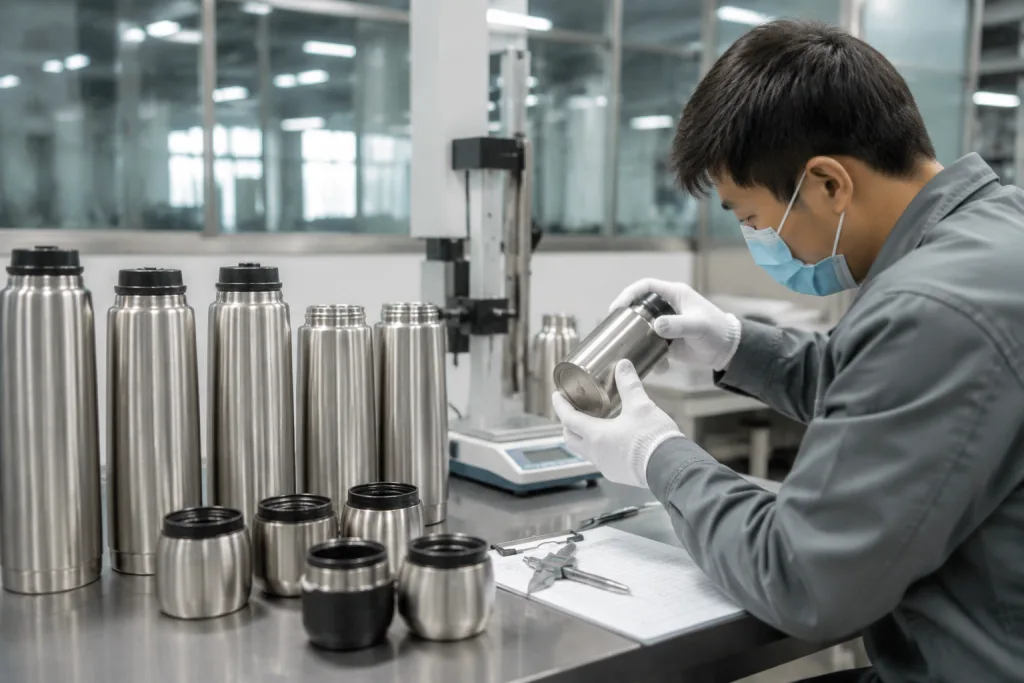
Define performance tests before the first sample leaves the line. A common hot-retention check is filling with water at around 95°C, closing the lid, and measuring temperature after 6, 12, and 24 hours at room temperature. Leak testing should include inverted storage and side placement for at least 30 minutes. Vacuum failure checks can be done through temperature loss and surface condensation review. We run this with a calibrated probe and a 1,000 ml measuring jug; if the spec says “keeps hot longer,” the math does not work during inspection.
Cosmetic inspection should use AQL, not feelings. For most distributor thermos orders, AQL 2.5 for major defects and 4.0 for minor defects is a practical starting point. Major defects include leakage, sharp edges, wrong logo, severe dents, lid failure, and coating peel. Minor defects include small dust points, light scratches within agreed limits, and slight color variation. Set viewing distance at 30-40 cm under normal light, or every 0.2 mm speck becomes a warehouse argument; we have had a buyer reject 12 cartons because “black” looked closer to Pantone 433C than the approved swatch.
For packaging, run carton drop tests if the shipment will move through parcel networks or Amazon FBA. A nice retail box that collapses during ocean freight is still a failed product. If you need FNSKU labels, suffocation warnings, barcode placement, or bilingual warnings, give the factory exact files before mass production starts. Small files matter. One PO typo changed “carton mark: 24 pcs” to “42 pcs,” and the line had to reprint 600 outer cartons after final packing.
Audit The Supplier Behind The Quote
About 70% of buyers start by searching for thermos manufacturers, thermos distributors, or thermos vendor options, then get 12 look-alike catalogs by Friday. Catalogs prove almost nothing. Ask who runs the vacuum line, who signs the QC report, and whose name is on the packing list. A trading company can still do a good job, but paying factory pricing for someone who only books capacity is the wrong question to ask. We have seen this go sideways when QC pulled the sample and the carton showed a different factory code than the PI.
Ask blunt questions. Where is the vacuum forming done? Is powder coating in-house or sent to a coating shop 8 km away? Who owns the molds, and is the 450 ml body shared with another buyer? How many units did the line produce last month, 80,000 or 300,000? What share shipped to Europe or North America? Can they provide BSCI, ISO 9001, or other audit records if your customer requests them? A serious thermos factory will answer cleanly, even when polishing, laser logo, or carton work sits outside the main gate. If they need 3 days to answer who owns the mold, the math does not work.
For outdoor retailers, check coating durability and lid spare parts before you argue over USD 0.08. Powder coating changes with phosphating time, curing temperature, and how workers stack bottles after the oven. We run a 3M tape test and a 500 g cross-hatch scratch check on coated samples, because a bottle that looks clean on day one can look tired after 7 days in a retail display bin. Lid gaskets cause quieter trouble. Ask whether silicone rings are food-grade, whether replacement gaskets are packed 1:20 or sold loose, and whether lids fit across 500 ml and 750 ml sizes. One buyer flagged a 0.6 mm gasket gap only after the leak test tray showed 4 failures out of 80 pcs.
For promotional brands, reply speed matters almost as much as welding machines. Campaign dates do not move. If a supplier thermos team takes 4 days to confirm a 38 mm logo during sampling, they will not move faster when 10,000 units are sitting on the line. You need a thermos manufacturer that returns technical answers within 24 hours on working days, with artwork position, Pantone code, and print area marked on the same PDF. Cheerful messages are cheap. We ship when the details are locked.
BottleForge Industrial is based in Hangzhou, Zhejiang, close to several stainless bottle production clusters in China. That puts us within a 2-hour drive of forming, polishing, coating, printing, and carton suppliers, so we can check a 304 stainless body, a powder-coated sample, and a 5-layer export carton without pretending every operation sits under one roof. The honest supply chain is easier to control than the fake all-in-house story. Last month, one PO came in with “matt black” on page 1 and “matte black” on the carton mark page; we caught it before the line printed 200 cartons wrong.
Build A Low-Risk Order Path
I’ll rewrite the section in-place, keep the HTML intact, and tune the prose to sound like a factory-side sales engineer.The safe path for a new thermos promo or retail run is staged, not slow. We start with the platform: capacity, lid, steel grade, coating, and the FOB target. Then we run a real decorated sample. After that, we sign off the packaging artwork and carton marks. Mass production starts only after the signed sample matches the purchase order.
Sampling usually takes 7-12 days for existing molds with standard coating and laser logo. A custom Pantone coating, full-wrap print, or a new lid insert can stretch that to 15-25 days. One buyer once missed a ship date because they treated the sample as a formality. If your launch date is fixed, count back from delivery. Ocean freight to North America or Europe takes 25-40 days port to port, and customs plus inland delivery can add 7 more days. Air freight is faster, but the math does not work on a heavy stainless bottle.
A sane first order for a new SKU is 1,000-3,000 units in one or two colors. That gives you enough to test demand, shelf presentation, and buyer feedback without tying up cash in the wrong body shape. QC pulled a sample from a 1,500-unit run last month and found a 0.8 mm lid gap on one lot; that is why we push small starts. Once sell-through is proven, move to 5,000-10,000 units and improve coating, packaging, and freight costs.
Do not load the order with too many variants. Three capacities, four colors, two lid types, and two packaging versions give you 48 SKU combinations before you sell a single bottle. Every extra combo pushes MOQ, warehouse handling, and forecast risk. We’ve seen this go sideways. For most outdoor retailers, one hero size with two colors is cleaner. For promotional thermos buyers, one body and three brand colors usually beats a tangled lineup.
The goal is not the cheapest thermos supplier. The goal is a bottle your customer reorders. If the spec is clear, the sample is real, and the quality standard is written before production, thermos bottle wholesale bulk buying stays controlled instead of turning into guesswork.
Send Your Thermos Brief Before You Quote
Share capacity, logo method, MOQ, market, and packaging needs. We will return a practical FOB quote and production path.
Frequently asked questions
What MOQ should I expect for thermos bottle wholesale bulk orders?
For existing stainless thermos molds, a realistic MOQ is 1,000 units per color if you accept standard coating colors and simple laser engraving. For custom Pantone powder coating, plan on 2,000-3,000 units per color because the coating line setup and color matching create waste. Private mold orders usually need 3,000-5,000 units to make tooling costs reasonable. If a thermos supplier offers 200 units with full customization, check whether they are using stock inventory, simplified decoration, or a much higher unit price.
Is 304 stainless steel enough for an outdoor custom thermos?
Yes, 304 stainless steel is the normal standard for most outdoor and promotional thermos programs. It is food-safe, corrosion-resistant, and cost-effective. For premium retail bottles, acidic drinks, tea, or coffee-heavy positioning, 316 stainless steel for the inner wall is a worthwhile upgrade. It commonly adds about USD 0.25-0.60 per unit depending on capacity and steel market pricing. I would avoid 201 stainless steel for the inner wall if you sell in Europe or North America, especially under a long-term retail brand.
Which logo method is best for a promotional thermos?
For durability, laser engraving is usually the safest choice, especially on powder-coated stainless bottles. It does not peel, handles outdoor use well, and works at 1,000-unit MOQ. For colorful campaign artwork, heat transfer or UV printing gives a stronger visual effect, but it needs stricter scratch control and sample approval. Silkscreen is economical for one- or two-color logos, but line thickness should stay above about 0.25 mm. Always approve a physical sample, not only a render, before mass production.
How long does production take after I approve the sample?
For a standard customized thermos using an existing mold, normal mass production takes 30-45 days after sample approval and deposit. Add 7-15 days during peak season if the order includes custom colors, retail packaging, or complex print. Sampling usually takes 7-12 days for standard decoration and 15-25 days for Pantone coating or special artwork. Ocean freight to Europe or North America often adds 25-40 days port-to-port, so promotional buyers should not start sourcing six weeks before an event.
What quality checks should I require before shipment?
Use written AQL inspection criteria. A practical starting point is AQL 2.5 for major defects and 4.0 for minor defects. Major defects include leakage, wrong logo, lid malfunction, sharp edges, coating peel, severe dents, and failed insulation. Minor defects include small dust points, light scratches within the approved limit, and slight color variation. Require leak testing, hot-retention testing, carton drop checks, barcode verification, and packaging inspection. For EU or North American retail, also request food-contact documentation such as REACH, LFGB-related files, or FDA statements where applicable.