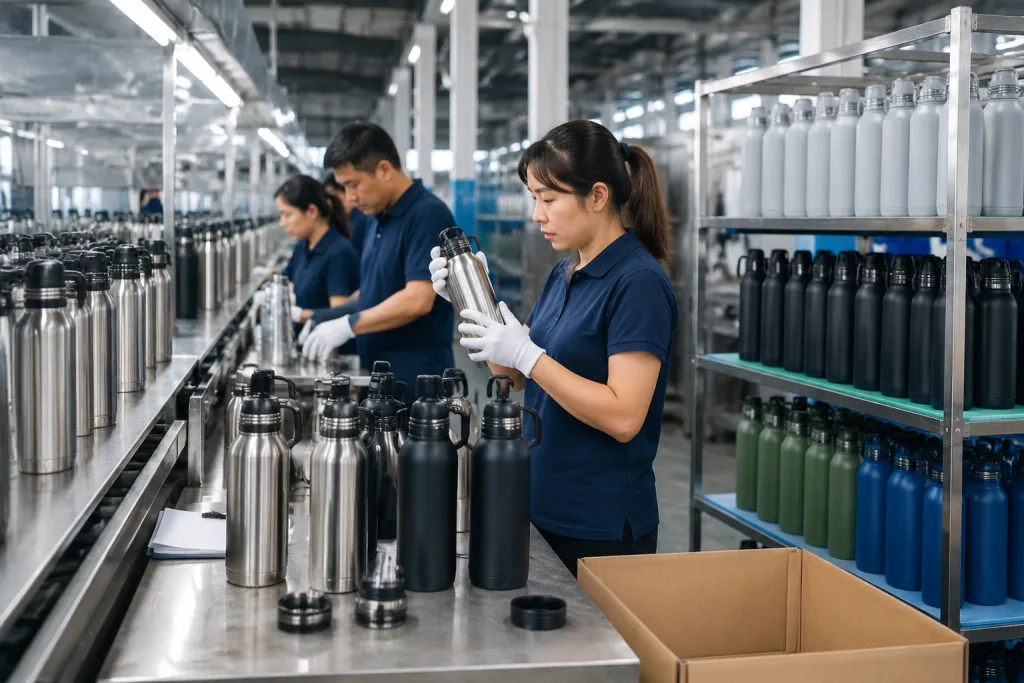
Key Takeaways
- Start bulk thermos projects at 1,000-3,000 pcs per color for sensible factory pricing
- Specify 304 inner stainless, 201 or 304 outer shell, and 0.4-0.5 mm wall thickness
- Allow 25-35 days for mass production after sample approval and deposit
- Use AQL 2.5/4.0 inspection plus heat-retention, leak, and coating adhesion tests
If you sell outdoor gear or run promo gifts, a thermos is not just another bottle SKU. A lid leak at 45° tilt, heat loss after 6 hours, or a logo that rubs off after 20 dishwasher cycles lands in your inbox, not ours. We see this on 500-piece trial orders: the buyer asks for the cheapest lid, QC pulls the sample on the torque tester, then the complaint comes back two months later. Quote sheets make 8 suppliers look the same. They are not.
We manufacture stainless drinkware in Hangzhou, Zhejiang, and these are the questions serious buyers ask before paying a 30% deposit. Use them to compare a thermos supplier in China and check whether your custom thermos project fits the real line setup: MOQ, mold cost, 304 stainless body thickness, carton drop test, logo method, and delivery date. The wrong question is “Can you make it?” Almost every factory says yes. Ask what we run, what we reject, and what will fail in your sales channel.
First question: what are you selling?
Before you compare thermos bottle vendors, get blunt about your sales model. An outdoor retailer buying a winter hiking flask is not carrying the same risk as a promotional brand shipping 5,000 units for a January trade show. Same shape on the table. Different job. On our line in Zhejiang, QC pulled two 500 ml samples last month that looked identical at 2 meters away; one needed a 1.2 mm thicker mailer box for e-commerce drops, the other only needed a clean logo for a 10-day event deadline.
For retail, you need a product story the buyer can defend on the shelf: 304 stainless steel inner wall, copper-coated vacuum layer, powder coating, retail box, barcode, plus a 2-year warranty statement if your market expects it. For promotional thermos orders, the math usually sits in logo accuracy, color matching, ship date control, and unit cost. A distributor thermos program sits between both: the SKU must repeat, but mixed colors and neutral packaging matter because 6 downstream customers may reorder from the same mold. We run this check before tooling talk; skipping it is the wrong question to ask when the buyer is already pushing back on USD 0.18 for a better lid gasket.
Here is the practical checklist we use at BottleForge Industrial in Zhejiang:
- Channel: retail shelf needs barcode position and rub-test coating; e-commerce needs mailer protection; corporate gift needs clean logo placement; outdoor club needs grip and leak checks; wholesale distribution needs repeatable cartons.
- Capacity: 350 ml for kids or coffee bags, 500 ml for daily office use, 750 ml for hiking, 1,000 ml for jobsite orders, or food-jar style with a wider mouth.
- Target FOB: a 500 ml vacuum bottle may land around USD 3.20-6.80 FOB China depending on lid, coating, and packaging.
- Branding: laser for stainless logos, silk screen for simple colors, pad print for curved lids, heat transfer for gradients, or full-body wrap when the artwork covers the bottle.
- Compliance: LFGB or REACH for Europe, FDA food-contact expectations for North America, and CA Prop 65 if needed.
If a thermos vendor gives one price without these questions, you are getting a generic quote, not a buildable plan. We have seen this go sideways: the PO said “Pantone 186C” but the artwork file named “186U,” the lid failed a 30-minute inverted leak test, and the master carton crushed at 18 kg during our pre-shipment stack check. Generic pricing looks fast on day 1. It costs time later when the coating cannot match your Pantone color within Delta E 1.5.
Can the factory build your spec?
A real thermos factory should talk construction first, shape second. We run most stainless vacuum bottles as double-wall stainless steel with a vacuum gap, welded bottom, and sealed evacuation point; QC checks the bottom weld with a 0.8 MPa air leak fixture before polishing. For outdoor retail, we normally recommend 304 stainless steel for the inner wall. The outer wall can be 201 stainless for cost-sensitive promotional thermos projects, or 304 stainless when the buyer is selling coastal, camping, or premium gift channels.
Ask the thermos manufacturer for wall thickness and weight tolerance. On our 500 ml bottle line, the common shell thickness is 0.4-0.5 mm, with finished weight usually controlled within ±8 g after lid assembly. Going thinner saves a few cents. The math often does not work, because 0.32 mm bodies dent faster in courier drop tests and the buyer flags it when cartons arrive with oval shoulders. For wide-mouth food jars or 1,000 ml bottles, lid thread quality and gasket compression matter as much as the stainless grade; we check thread fit with a go/no-go gauge before the first carton is sealed.
Heat retention claims need numbers on paper. Our usual check is 95°C water in, lid closed for 6 hours, then the probe should read above 60°C, depending on volume and opening size. Simple test. A narrow 750 ml bottle usually beats a wide-mouth food jar because the mouth loses heat faster, not because the steel is magic. Cold retention is easier to claim, but hot retention exposes weak vacuum performance fast; QC pulled one 1,000 ml sample last month that dropped to 54°C after 6 hours, and that batch did not move to packing.
Use this buyer question: “Can you send the test method, not just the result?” A serious manufacturer thermos team in China should provide a temperature curve, leak test method, coating adhesion test, salt spray expectation for exposed metal parts, and lid cycle test if the cap has a push button or flip mechanism. We have seen this go sideways when a PO says “24 hours hot” but the approved sample sheet only records a 6-hour test, so we now stamp the test condition beside the item code before pre-production approval.
Good stainless thermos sourcing is less about chasing the lowest FOB price and more about locking the exact construction that price includes.
At our Hangzhou facility, monthly output for stainless vacuum drinkware is about 480,000 units across thermos bottles, travel tumblers, and sports bottles. That capacity only helps when your customized thermos specification is documented before production starts. We want the drawing, Pantone number, lid structure, carton drop standard, and MOQ on one sheet; one buyer once typed “mat black” on the PO, and the line stopped for 2 days while sales confirmed whether they meant matte black or matching black.
What MOQ is actually sensible?
MOQ is where 7 out of 10 first-time buyers get annoyed. A catalog supplier thermos listing may say 100 pcs, but a factory thermos order with custom color, custom logo, and retail packaging does not run cleanly at that level. The line has to set powder guns, hangers, curing oven temperature, carton marks, and barcode labels before one sellable carton is packed. For existing stainless thermos molds, our practical MOQ is usually 1,000 pcs per model and 1,000-3,000 pcs per powder-coated color. For a fully new mold, expect 8,000-20,000 pcs annual demand to justify tooling. Below that, the math doesn't work.
Separate these MOQs before you push the price:
- Product MOQ: the minimum bottle quantity the production line can run without wasting shells, lids, and inner cartons; QC pulled one 500 pcs trial last year because mixed lid gaskets added 3.2% assembly defects.
- Color MOQ: the minimum for powder coating or spray painting in one Pantone or RAL color; one buyer flagged a 0.6 mm coating chip near the bottom seam, so we now check the first 30 pcs after the oven.
- Packaging MOQ: custom printed boxes often start at 1,000-2,000 pcs, but specialty gift boxes may need 3,000 pcs; printers charge again when the PO has “mat black” instead of “matte black,” and yes, we have seen that typo delay cartons by 4 days.
If you need a bulk thermos order for a seasonal campaign, don't over-customize the first run. Use an existing mold, standard lid, one body color, and laser engraving or one-color screen print. Sampling stays closer to 7 days instead of 14 days, and scrap is easier to control. A thermos bulk order with four colors and two lid versions sounds flexible, but it creates eight production combinations that must be counted, packed, and inspected separately. We've seen this go sideways at final inspection when the buyer's carton list says 48 pcs per master carton and the warehouse packed 36 pcs.
For distributors thermos programs, build a core line first: 500 ml for office use, 750 ml for outdoor retail, and 1,000 ml for sports or travel channels, each in two stable colors. Then reserve logo customization for your clients. Fast quotes win. You look quicker than thermos suppliers who quote every project from zero, and your margin is safer because we can reorder lids, silicone rings, color boxes, and spare cartons without rebuilding the whole SKU. On our side, the ERP also likes repeat SKUs; one wrong suffix on a PO, such as “750B” instead of “750BK,” can send the wrong black lid to packing.
For promotional brands, ask whether the MOQ can be split across logo positions or names. Usually, one logo artwork per 500 pcs is manageable with laser engraving, because the fixture only needs a position check and a 20 mm test mark on the sample body. For screen printing, changeover cost makes tiny splits expensive, often USD 25-60 per artwork setup. This is the wrong question to ask if your order is only 1,000 pcs and you want 12 names; ask which 2 names will sell first.
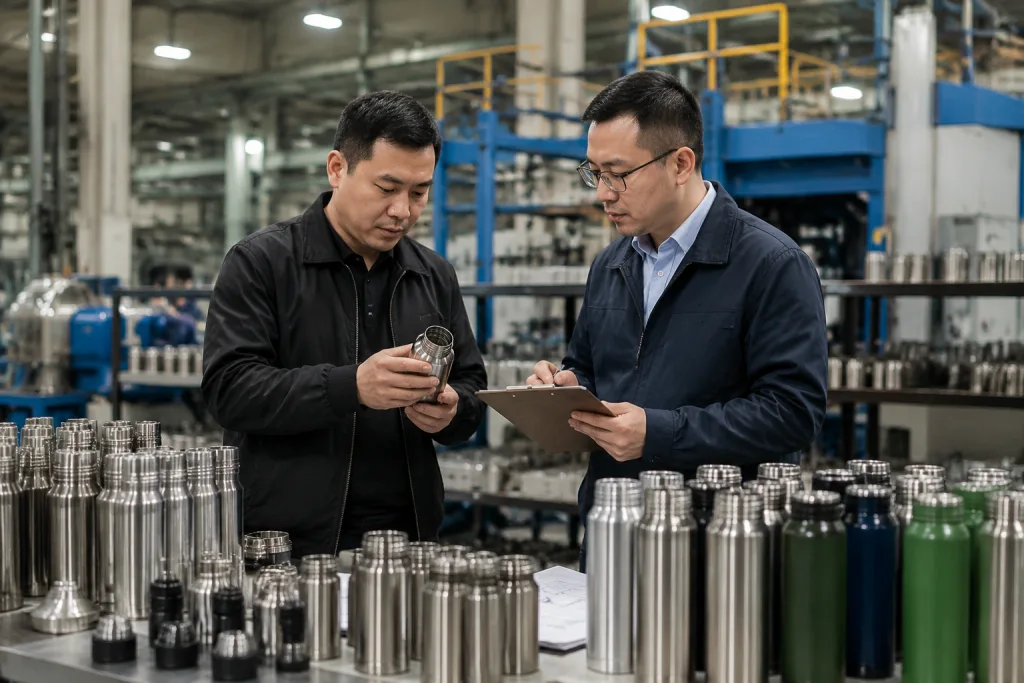
How should your logo be applied?
Logo method is a production decision, not decoration at the end. It changes cost, wear life, sample days, and after-sales risk. For an outdoor retailer, the mark has to handle backpack rub and bottle-cage scratches; on our line we test this with a 3M tape pull and a 500g rub check. For an event giveaway, the buyer often wants a loud logo for one campaign, but the math does not work if 3,000 bottles start peeling after 20 hand washes.
Laser engraving
Laser is our safest choice for stainless and powder-coated bottles. It burns through the coating or marks bare 304 stainless, so the logo will not lift like ink. Clean result. Low complaint rate. For a 35mm x 18mm side logo, we usually quote USD 0.08-0.25 per position, depending on logo size and order quantity. QC pulled one sample last month where the laser power was set too high and left a yellow edge on matte black coating; that is why we confirm wattage before mass production. The weak point is simple: laser cannot do full-color artwork.
Silk screen printing
Silk screen is good for simple logos and large side marks. It is cheaper than heat transfer for 1-2 colors, but curved thermos bodies need a proper fixture, not a loose hand setup. We run tape adhesion testing after curing, usually with 3M 600 tape and a 90-degree pull. If your brand color matters, send Pantone C or U references and expect a small shift between powder coating and ink; we have seen buyers flag a 1-level shade difference on a navy logo, and that is a fair pushback if the PO says “exact match.”
Heat transfer and full wrap
Use heat transfer for gradients, illustrations, or retail shelf graphics. It fits thermos customizable campaigns where the bottle needs to look like packaging, not just carry a logo. The artwork file must match the bottle curve, printable height, and seam area; for a 500ml bottle, that may mean a 210mm wrap with a 3mm safe gap at the back seam. Sample time is usually 7-10 days after artwork approval, not 3 days, because the film, fixture, and oven temperature all need checking. We have seen this go sideways when a buyer sent a flat AI file with no bleed.
Some buyers write thermos custom, thermos customized, customizable thermos, and thermos customizable as if they mean the same thing. On the factory side, that is the wrong question to ask. Tell us the decoration process, logo size in mm, position from bottom or lid seam, color code, tolerance, and dishwasher requirement. A PO that says “logo same as picture” is where trouble starts; one buyer even typed 60cm instead of 60mm, and QC caught it before plate making. If you want a customized thermos that lasts, specify the test, not just the look.
What compliance papers matter?
Compliance should follow the sales market, not the factory address in China. We ship the same 500 ml 304 stainless thermos to Germany and California, and the paper pack is not the same: EU buyers usually want food-contact files first, while a U.S. outdoor chain may ask for CA Prop 65 review before they even confirm artwork. For one REI-style buyer, the buyer flagged the missing gasket material line on page 3 of the report.
For Europe, buyers commonly ask for LFGB food-contact testing, REACH screening for coatings and plastic parts, and sometimes BSCI or Sedex factory social audit records. For North America, FDA food-contact expectations, CPSIA if the product targets children, and CA Prop 65 review may be requested. Kids' bottles are stricter. If the bottle is for kids, ASTM F963 can become relevant, especially for coatings, small parts, and packaging claims; our QC team once pulled a 38 mm straw cap because the lab asked whether it could detach under torque.
Do not accept “we have certification” as a complete answer. This is where deals go sideways. Ask whether the report covers the same materials: stainless body, PP lid, silicone gasket, coating, ink, straw if included, plus any decorative sleeve with its own glue layer. A test report for a bare stainless bottle does not cover a printed promotional thermos with soft-touch coating and a colored lid; the math doesn't work when the PO says matte black UV logo but the report says plain silver sample.
Quality inspection should be written into the purchase order. A normal plan is AQL 2.5 for major defects and AQL 4.0 for minor defects, with critical defects set to 0. Critical defects include sharp edges, leakage, broken vacuum, contamination, and unsafe lid failure. Major defects include wrong logo, poor coating adhesion, poor thread fit, and carton shortage. Minor defects include small cosmetic marks within agreed limits. On the line, we run a 24-hour hot-water hold test at 95°C and check lid fit with a go/no-go thread gauge before cartons move to sealing tape.
A serious thermos supplier should welcome a clear inspection standard because it prevents arguments. We prefer buyers to send their QC checklist before deposit, ideally with logo tolerance in mm and carton drop test height written down. Send it early. If you wait until the goods are packed, the only options left are discount, rework, or delayed shipment; last month a PO typo changed “Pantone 186C” to “168C,” and QC caught it only because the buyer's checklist had the swatch attached.
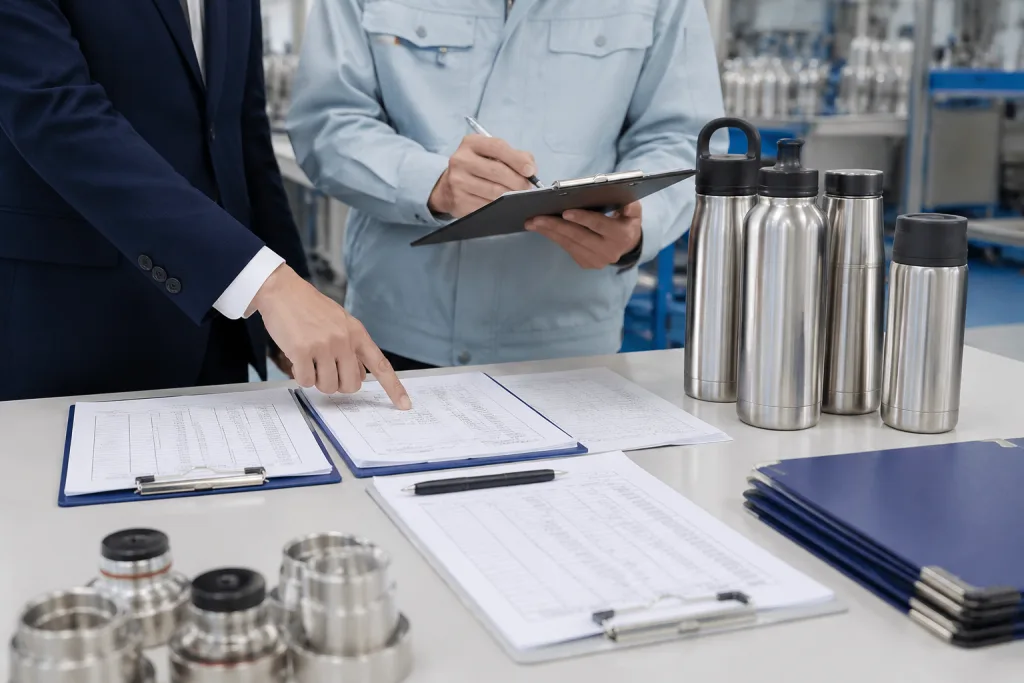
How do timelines really work?
Most schedule trouble starts with sample timing that looks fine on a PO but fails on the line. A standard sample from existing stock can ship in 3-5 days. A custom color sample usually takes 7-12 days because we still need to mix powder, spray 2-3 pcs, then check color under a D65 light box. A decorated pre-production sample with custom logo and packaging may need 10-18 days, especially if heat transfer or new box artwork is involved. Mass production normally takes 25-35 days after deposit and sample approval for standard stainless thermos bottles. Asking “can you ship faster?” is the wrong question to ask; ask which approval is blocking the first production slot.
For peak season, add buffer. China production before Lunar New Year and the late Q3 export rush gets crowded fast. Powder coating can lose 2 days when the oven is full, carton printing waits behind bigger runs, and lid assembly slows down when silicone rings arrive 0.3 mm out of spec. If you need delivery to a North American warehouse before Black Friday, working backward from vessel arrival is not enough. We run the calendar from sample approval to deposit transfer, raw material booking, production, inspection, inland trucking, customs declaration, sea freight, customs clearance, then final delivery. Miss one step. The math doesn't work.
FOB Ningbo or FOB Shanghai are common terms for Zhejiang-based drinkware factories. For air shipment, thermos bottles are bulky, so freight can destroy margin. A 500 ml stainless bottle in retail box may pack 24 pcs per carton, with carton weight around 9-12 kg; our warehouse team still checks it on a 150 kg platform scale before booking. Sea freight or rail to Europe is usually more sensible for thermos bulk orders unless a campaign deadline justifies the cost. We’ve seen buyers approve air freight for 3,000 pcs, then push back when the freight line costs more than the bottle line.
If you sell online, ask about Amazon FBA or 3PL carton rules early. FNSKU labels, suffocation warnings for polybags, carton weight limits, and master carton dimensions should be confirmed before packaging is printed. A thermos distributor shipping to multiple warehouses should also ask for mixed-pallet labeling and carton-side SKU marks. QC pulled one sample carton last month where the PO had “matte balck” on the side mark, and that typo would have gone onto 420 cartons. These details are not exciting, but they prevent expensive repacking at destination.
Buyer checklist before paying deposit
Run this checklist before you pay a deposit to any thermos bottle vendor. Most failed orders we see are not scams; they are loose specs. Last March, QC pulled a pre-production sample for a 500 ml bottle and the logo area was 6 mm too low because the PO only said “front center.” Cost us 3 days.
- Product drawing: capacity, total height, bottom diameter, mouth size, lid structure, straw or no straw, and a logo area marked in mm on the dieline.
- Material: 304 inner wall, outer steel grade, PP lid grade, silicone gasket spec, coating type, and wall thickness checked with a digital caliper.
- Performance: leak test method, vacuum test standard, 6-hour heat retention target, coating adhesion result, and drop test height with pass/fail rules.
- Decoration: artwork in AI or PDF, Pantone code, logo size in mm, placement tolerance such as ±1.5 mm, and one signed approval sample.
- Packaging: box type such as white box or retail color box, barcode, FNSKU, insert card, carton mark, carton size, and gross weight limit.
- Commercials: FOB port, MOQ, unit price, mold fee if any, sample cost, payment terms, and production lead time stated as calendar days, not “ASAP.”
- Compliance: LFGB, REACH, FDA-related food-contact reports, BSCI, Sedex, or retailer-specific documents matched to the selling market.
- Inspection: AQL levels, defect list with photos, third-party inspection date, and written agreement on who pays for reinspection if goods fail.
One last point: search terms cause trouble. A thermos vendor, thermos supplier, thermos manufacturer, thermos factory, thermos distributors, manufacturers thermos, suppliers thermos, distributor thermos, and supplier thermos may all show up in Google, but they do not run the same way. This is the wrong question to ask if you only compare the name. Trading companies work for 300-piece mixed orders across 5 styles. Direct factories make more sense for repeat programs where the line needs the same lid torque, carton mark, and coating batch every time. We have seen this go sideways when a buyer asked for “same as last order” but changed the FNSKU by one digit on the PO.
BottleForge Industrial is a Zhejiang, China manufacturer thermos partner for stainless vacuum bottles, travel tumblers, and related drinkware. We are strict on specs because vague orders burn steel, cartons, and line time. Send the target price, quantity, market, and artwork; we can usually reply within 24 hours on whether the job should use an existing mold, an adjusted component set, or a new development path. If the math does not work, we will say so before deposit, not after the 304 stainless has already been cut.
Send your thermos spec for a factory review
Share quantity, target price, market, logo artwork, and delivery window. We will recommend the most practical stainless thermos route.
Frequently asked questions
What MOQ should I expect for a custom stainless thermos?
For an existing bottle mold, expect 1,000 pcs as a realistic starting MOQ. If you need a custom powder-coated color, 1,000-3,000 pcs per color is more efficient because coating lines waste material during color changeover. Laser logo orders can sometimes split artwork every 500 pcs, but screen printing and heat transfer prefer larger artwork batches. A new mold is a different decision; tooling only makes sense when annual demand is around 8,000-20,000 pcs. If your first campaign is smaller, use a stock shape and customize the logo, sleeve, or retail box.
How long does a bulk thermos order take from China?
For standard stainless vacuum bottles, plan 3-5 days for stock samples, 7-12 days for custom color samples, and 10-18 days for decorated pre-production samples. After sample approval and deposit, mass production is usually 25-35 days. Add 3-5 days for inspection, booking, and inland transport to Ningbo or Shanghai. Sea freight to North America or Europe then adds several weeks depending on port and season. Before Lunar New Year and in late Q3, add at least 10-15 days of buffer.
Which logo method is best for outdoor retail bottles?
For outdoor retail, laser engraving is usually the most durable choice, especially on powder-coated stainless bottles. It costs roughly USD 0.08-0.25 per position and will not peel like weak ink. Silk screen is fine for larger one- or two-color logos, but you should require tape adhesion testing after curing. Heat transfer works for full-color graphics, but it needs better artwork control and more sample time. If the bottle will sit in backpacks, cup holders, and camp gear bins, durability beats bright decoration.
Can one supplier handle FBA or distributor packaging?
Yes, but specify it before production. For FBA, you may need FNSKU labels, carton weight limits, suffocation warnings on polybags, barcode placement, and outer carton dimensions that match your warehouse rules. For distributor programs, ask for carton-side SKU marks, mixed-color packing rules, pallet labels, and neutral retail packaging. A 500 ml thermos often packs 24 pcs per master carton, around 9-12 kg depending on box and lid. If labeling is added after arrival, repacking cost can exceed the factory labeling cost many times over.
What defects should I include in the inspection checklist?
Set critical defects at 0 tolerance: leakage, broken vacuum, sharp edges, contamination, unsafe lid failure, or wrong material. Use AQL 2.5 for major defects such as wrong logo, poor coating adhesion, loose lid fit, serious dents, incorrect carton quantity, and failed heat retention. Use AQL 4.0 for minor cosmetic marks within defined limits. Add practical tests: 95°C hot water retention for 6 hours, upside-down leak test for 30 minutes, tape adhesion on printing, and random carton drop checks for retail packaging.