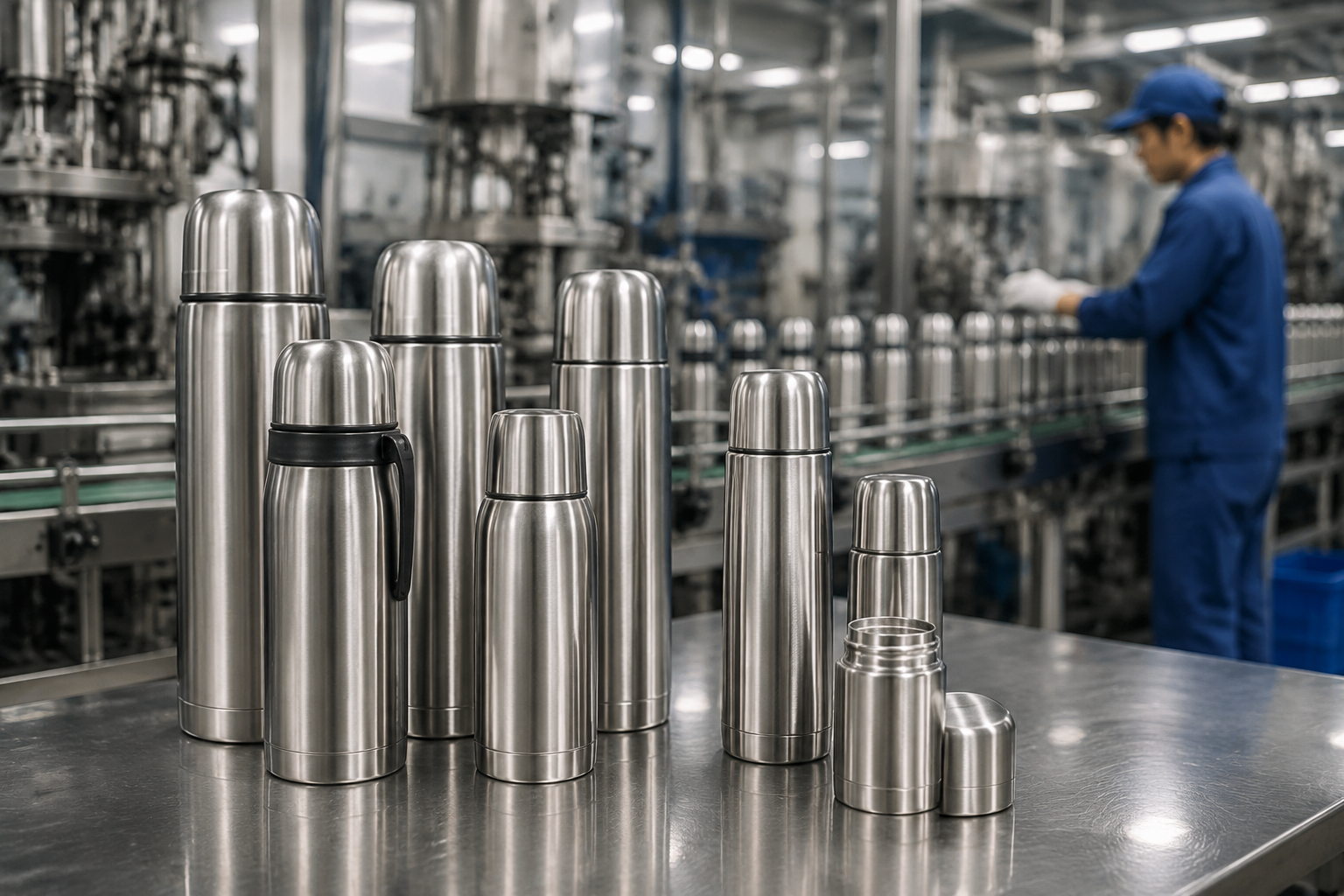
Key Takeaways
- Double-wall 304 stainless thermos units usually start around USD 2.40-3.80 FOB at 1,000 pcs, while powder-coated premium builds can add 10-18%.
- A real thermos factory should quote MOQ, lead time, and test method together; a common MOQ is 1,000 pcs and a normal lead time is 20-35 days.
- For outdoor retail, a 500-750 ml vacuum flask with a 0.4-0.5 mm inner wall is easier to sell than a thin promotional thermos built only for low cost.
- Ask for AQL 2.5 inspection, REACH paperwork, and vacuum-retention or thermal-hold test data before you place bulk thermos orders.
If you buy for outdoor retail or promotions, the hard part is not finding a list of thermos bottle suppliers. The hard part is sorting a decent factory thermos from a sample that looks clean in photos but leaks, dents, or blows your margin once freight, decoration, and carton packing land on the PO. We run this check on the line every week: one missed gasket on a 500 ml stainless bottle can turn a good order into a chargeback fast.
For stainless thermos programs, chasing the lowest unit price is the wrong question to ask. Match wall construction, lid style, finish, and test standard to the job. A 500 ml custom thermos for a hiking chain is a different order from a 750 ml promo bottle for a trade-show giveaway. China, and Zhejiang in particular, still wins because the real fight is lead time, print control, and repeatability, not sample cost. QC pulled the sample, the buyer flagged a 1.2 mm cap gap, and that was enough to kill the first run.
Spec table before you price
I’ll rewrite the section in-place, keep the HTML exactly intact, and tighten the sales-engineer tone with concrete factory details and cleaner supplier language.When you compare thermos bottle suppliers, use a spec table, not a clean sample photo. Same shell, different build. We’ve seen one 500 ml bottle quote swing 30% just because one plant used 304 inside and 201 outside, while another quoted full 304 and a tighter vacuum draw.
Start with the table below. For outdoor retail, we usually land on 18/8 stainless steel, double-wall vacuum insulation, and a powder coat that survives a carton rub test after 12 days in transit, not just a shelf shot. For promo orders, a simpler lid or thinner finish can work if the logo panel stays open and the landed cost stays inside target. The buyer flagged it, and they were right: every supplier thermos quote has to answer the same questions.
| Spec | Retail outdoor fit | Promotional fit |
|---|---|---|
| Capacity | 500-750 ml | 350-500 ml |
| Steel grade | 304 inner/outer | 304 inner, 201 outer possible only if price-driven |
| Wall thickness | 0.4-0.5 mm inner | 0.35-0.45 mm inner |
| Insulation | Double-wall vacuum | Double-wall vacuum |
| MOQ | 1,000-3,000 pcs | 500-1,000 pcs |
| FOB price | USD 2.80-5.20 | USD 2.20-4.20 |
If a thermos manufacturer won’t put steel grade, wall thickness, and print method on the same sheet, walk away. QC pulled the sample on our line last month because the outer tube was 0.33 mm instead of the agreed 0.4 mm, and that kind of miss turns into a refund fight later. In Zhejiang, the better factories ship a full build sheet because European and North American buyers check the numbers before they release a container.
Retail thermos versus promo thermos
I’ll keep the tags intact and rewrite the prose to sound like a real factory-side sales engineer, with concrete numbers and a few shop-floor details.Head-to-head, the split is not shape; it is performance versus decoration. A retail thermos has to hold heat, close with a hard seal, and keep the finish clean after 3 months in a bag. A promotional thermos needs a big branding panel, quick production, and a unit price that still works when a distributor ships 10,000 pieces at once.
For outdoor stores, we usually run a 500 ml to 750 ml customizable thermos with a silicone base, carrying loop, and powder coating. For marketing campaigns, a lighter customized thermos with a plain screw cap makes more sense; the logo stays readable, the budget stays under control, and QC can pack faster on the line. The buyer flagged it once on a 2-color print sample: one design trying to cover both jobs was the wrong brief.
- Retail priority: 6-12 hour hot hold and 24-hour cold hold under normal use
- Promo priority: low MOQ, fast logo setup, and simple packaging
- Retail decoration: laser or durable screen print with lower failure risk
- Promo decoration: one- or two-color print with faster setup
If you need a thermos custom program for both channels, split the specs. Keep the bottle body common and change the lid, coating, insert card, or carton. We’ve seen this go sideways when buyers ask one SKU to do everything; the math doesn’t work, and a 0.5 mm logo tolerance on the same tool is where margin gets eaten. That is the cleanest way for thermos suppliers to protect profit without retooling the whole line.
What the best factory quote includes
I’ll keep the HTML untouched and rewrite only the prose to sound like a factory-side sales engineer. I’m checking for any repo instructions, then I’ll patch the section in place.A proper factory thermos quote is not just unit price and carton count. It needs the steel grade, the test standard, and the master carton spec on paper. If you are comparing thermos manufacturers in China, a thin quote usually leaves out the points that later trigger chargebacks.
Ask for these items in writing:
- Material: 304 or 316 inner, 304 or 201 outer, with thickness in mm
- Decoration: silk screen, UV print, laser engraving, or powder coat, with setup charge
- Performance: thermal-hold result, leak test, drop test, and vacuum retention method
- Compliance: REACH, LFGB where needed, BPA-free statement for lids, and carton drop standard
- Commercials: MOQ, sample lead time, mass lead time, FOB term, and spare parts availability
In our Hangzhou, Zhejiang workflow, a stainless thermos run usually starts at 1,000 pcs MOQ, and sample approval to shipment lands in 20-35 days. The line can push about 250,000 units per month across several bottle families. That is the number that matters, because a good thermos factory should tell you fast whether your order is a normal run or the kind that ties up vacuum welding and slows everyone down.
“If the supplier cannot explain the lid seal and vacuum test in plain English, they are selling appearance, not a thermos.”
This is where a thermos vendor either saves the order or burns your time. We’ve seen buyers get stuck because the quote looked clean, then QC pulled the sample and found no test method behind the result. A serious supplier thermos team puts the test method next to the number.

Decoration options that survive use
I’ll keep the HTML structure fixed and rewrite the copy in a more field-tested sales voice. Then I’ll do a quick pass to make sure the numbers, tags, and heading structure stay intact.Your artwork choice changes the selling price, and the math shows it fast. A promo thermos with a one-color logo runs cheap and ships quickly, while laser engraving or full-wrap UV print usually adds USD 0.20-0.80 per piece depending on coverage and setup. We once had a buyer flag a PO that said “1c logo” but the artwork file had three colors; QC pulled the sample, and the line had to stop for a half day.
For outdoor retailers, powder coating is the safer daily finish. It hides scuffs, holds up on the rack, and feels like a product people keep, not a throwaway gift. For distributor thermos orders tied to seasonal campaigns, screen print still works if the logo is simple and the run is large enough to spread setup cost. If you are planning thermos bulk purchases, the problem is decoration complexity, not the stainless shell.
Good fit by channel
- Outdoor retail: laser logo, powder coat, matte colors, retail sleeve
- Corporate gifting: screen print, spot color logo, presentation carton
- Fast promo: one-location print, standard carton, no extra inserts
Do not load a thermos customizable program with every option on the table. Once you add wrap print, multiple colors, and a special coating, you are not buying a cheap giveaway anymore. You are buying a branded product, and the supplier thermos should quote it that way. We’ve seen this go sideways when a buyer pushed for a 280 mm wrap, then wanted the same landed price as a plain white bottle.
Quality checks that matter
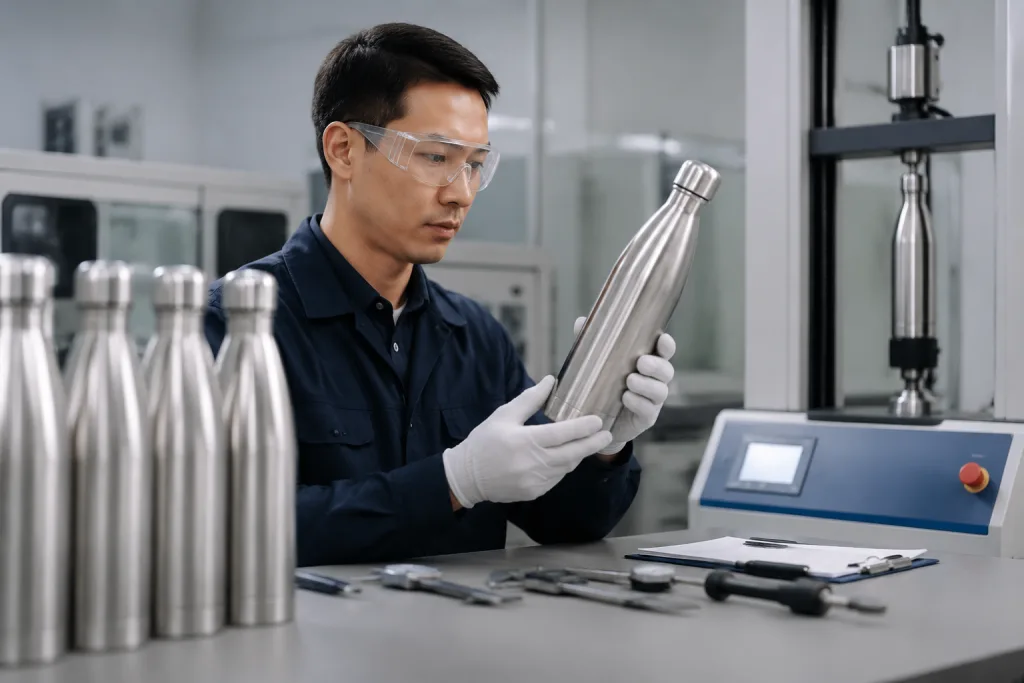
I’ll rewrite the section in-place, keep the HTML structure unchanged, and tighten the language so it sounds like a factory-side sales engineer.Quality is where thermos bottle suppliers separate themselves. A low price means nothing if the vacuum leaks or the lid starts rattling after 30 days in a backpack. For stainless thermos products, the basic checks are clear: leak test, thermal retention, drop test, lid torque, and coating adhesion. We run these on the line with a torque meter and a simple 1 m drop jig.
Ask for AQL 2.5 for major defects and AQL 4.0 for minor defects on a normal production run. That is the right bar for bulk thermos shipments. If you work with a thermos manufacturer that exports to Europe or North America, they should produce REACH documents and, when needed, LFGB support for contact materials. For a factory thermos program, that paperwork is part of the deal, not a side note. QC pulled a carton sample last month and found two dented bases on a 500 pcs run.
Here is the quality reality: a lot of thermos programs look fine in sample stage, then fail in mass production because the cap liner shifts or the weld seam goes unstable. We cut that risk by asking for one pre-production sample, one sealed sample, and one signed golden sample. If the supplier pushes back, the math does not work for a real thermos distributor relationship. We had a buyer flag a PO typo on the lid color code, and that one line saved a 3,000 pcs mistake.
Also check the carton spec. A 24-hour thermal claim means little if the outer box collapses in transit and the coating shows scratches on arrival. Good thermos suppliers treat packaging as part of product quality. We ship with an edge-crush target and a drop-tested master carton for that reason.
Choosing suppliers by use case
I’ll rewrite this section in-place, keep the HTML structure intact, and tune the copy to sound like a factory-side sales engineer.The cleanest way to pick thermos suppliers is to start with the channel, not the catalog. An outdoor retailer needs stable insulation, low return risk, and a bottle that can sit on a shelf at $19.99 to $29.99. A promo buyer wants fast logo work, low scrap, and enough perceived value that people keep the bottle instead of tossing it after the event.
For outdoor retail, we narrow it to manufacturers thermos teams that handle 304 stainless, powder coating, and a lid system tested in the 500-750 ml range. For distributors thermos programs, the smarter match is a thermos distributor setup with spare lids, replacement seals, and color control that does not drift batch to batch. For promo orders, a lighter thermos promotional spec with a simple cap and one-color branding usually beats a fancy build. The math does not work if the decoration cost eats the margin.
- Outdoor retail: prioritize thermal hold time and warranty exposure
- Promo brand: prioritize logo area and landed cost
- Distributor model: prioritize carton efficiency and reorder stability
- Seasonal campaign: prioritize lead time and decoration speed
On our line in Hangzhou, QC pulled the sample twice when the lid torque drifted by 0.8 N·m, and that is the kind of issue a buyer will flag after the first claim. The best thermos manufacturers will tell you which SKU fits each channel, instead of trying to force one bottle into every program. We have seen that go sideways fast, especially when a PO typo changes the cap color or the MOQ by 1,000 pieces.
Buying terms that protect margin
I’ll rewrite just this HTML section, keep the tags intact, and strip the AI-sounding phrasing while adding a few factory-floor specifics and sharper buyer language.Margin disappears when buyers skip the commercial details. A quoted USD 3.10 FOB can turn into USD 4.20 landed once you add print, master cartons, freight, duty, and breakage. We run that math on the packing table every week, and the wrong question is still “what’s your best price?”
Start with FOB terms, because that is where most Zhejiang factories can stay sharp. Then ask for carton counts, dimensions, net weight, and the exact packing style. If you sell on Amazon, you may need FNSKU labels, inner carton barcodes, or prep-specific packaging. If you sell through retail, you may need a hanging tag, a sleeve, or a recycled kraft gift box. Each one changes cost, and a 0.8 mm carton spec can move the quote more than the buyer expects.
For a thermos custom project, lock the sample approval step and put the logo placement and color tolerance in writing. QC pulled the sample at 10.2 mm off center once, and the buyer flagged it before we booked the line. A good custom thermos supplier should freeze the approved sample before mass production. If they will not, you are betting the full container on a handoff that will go sideways.
Do not ignore the reorder math. A supplier thermos relationship pays off when the factory can repeat the last run within tight color and print tolerance, not when it just looks fine on one sample. We have seen a 12-day repeat order beat an 18-day fresh setup because the die, carton, and artwork were already locked. That is how thermos bulk buying stays a program instead of a one-off.
Send your thermos spec and get a quote
We can match your use case, target price, and packaging plan with a factory thermos build that fits retail or promo channels.
Frequently asked questions
What MOQ should I expect from thermos bottle suppliers?
For a standard stainless thermos, a normal MOQ is 1,000 pcs per color or per design. Some thermos suppliers will accept 500 pcs if the model is already in production, but decoration changes can raise the floor fast. For a custom thermos with special coating, lid tooling, or gift packaging, 2,000-3,000 pcs is more realistic. If you want a distributor thermos program with repeat colors, ask whether the MOQ is per SKU or per shipment, because that changes your cash flow immediately.
How much does a custom stainless thermos cost FOB China?
For a basic 500 ml double-wall 304 stainless unit, FOB China often lands around USD 2.40-3.80 at 1,000 pcs. A better retail-grade finish, such as powder coat plus laser logo, can move it to USD 3.50-5.20. Promotional thermos orders with simpler lids may come in lower, but once you add multiple print colors or premium gift boxes, the quote climbs. In Zhejiang, the real spread comes from decoration, packing, and steel thickness, not from the bottle shape alone.
What tests should I ask a thermos manufacturer for?
Ask for leak testing, vacuum-retention or thermal-hold testing, drop testing, and coating adhesion checks. A practical production control setup also uses AQL 2.5 for major defects. For Europe, you should request REACH support; if the product touches food or drink in a stricter retail program, LFGB support is useful too. A serious thermos factory should explain the test method in writing, not just send a pass/fail result. If they cannot show this, treat the quotation as incomplete.
Is 304 stainless always enough for a thermos bottle?
For most outdoor and promotional use, yes, 304 stainless is the standard choice for the inner wall and often the outer wall too. It gives a good balance of corrosion resistance, cost, and availability from thermos manufacturers in China. In some premium or chemically sensitive cases, 316 inner steel is used, but that typically adds cost and is usually unnecessary for a normal beverage thermos. What matters more is wall thickness, weld quality, and vacuum integrity than chasing a fancier grade without a clear use case.
How long does production take in a Zhejiang thermos factory?
A typical custom thermos order takes about 20-35 days after sample approval, assuming the design is standard and packaging is straightforward. If you add new tooling, special coatings, or complex gift packaging, the lead time can move to 40-50 days. A capable thermos factory in Zhejiang should also tell you monthly capacity; for example, a mid-sized line may produce around 250,000 units per month across several bottle models. That helps you judge whether they can handle a rush reorder or peak-season demand.