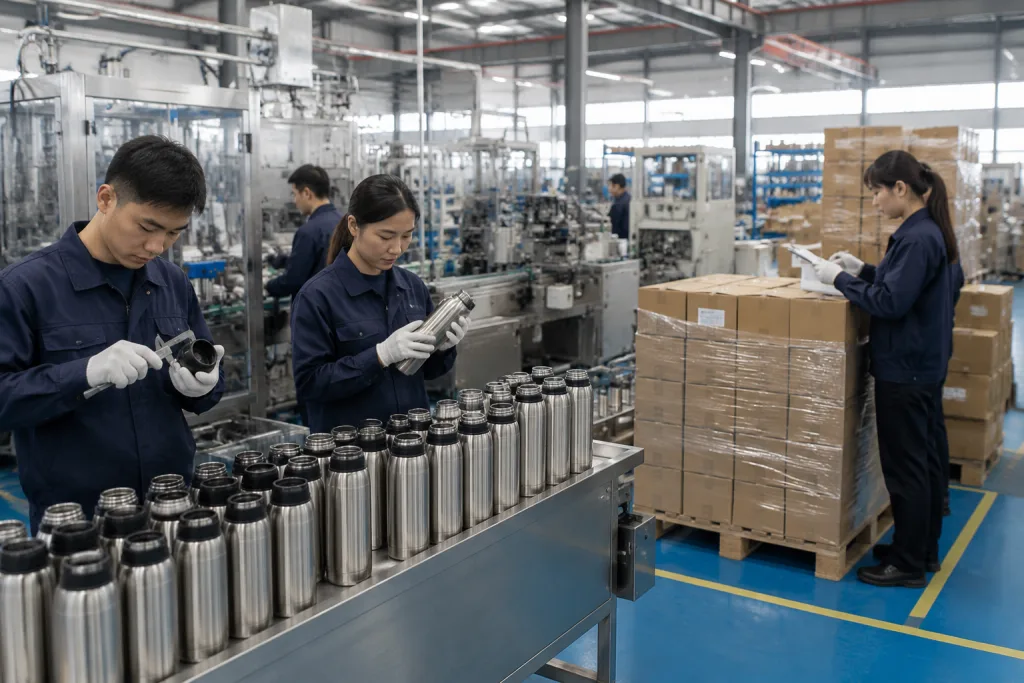
Key Takeaways
- A practical thermos bottle supplier RFQ needs 12–15 line items, not a vague “quote best price” email.
- Typical MOQ for a custom stainless thermos starts at 3,000 pcs per color and 5,000 pcs for full custom packaging.
- Sample lead time is usually 7–10 days; bulk production is commonly 25–35 days after approval in Zhejiang, China.
- A good PO should separate bottle spec, lid spec, decoration, packaging, and carton QC so disputes do not land on one line.
` tags, keep the HTML intact, and strip out the AI-ish phrasing while adding a few factory-floor specifics.
If you are buying insulated drinkware for outdoor retail or a promo program, the hard part is not finding a thermos bottle supplier. The hard part is finding one that can quote cleanly, turn samples in 7 days, and ship bulk without turning your PO into a pile of revisions, delays, and “please confirm” emails. A stainless thermos looks simple on a shelf. On a PO, it is not.
What usually trips buyers up is process: wall thickness, lid fit, logo method, coating durability, and carton packing all hit landed cost and rejection risk. At our Zhejiang factory, we run more than 300,000 units a month across stainless drinkware, and QC pulled a 0.5 mm wall sample last week because the buyer flagged a lid wobble at 2 mm. The math does not work if you skip RFQ, sample sign-off, and bulk PO line by line. That is how we ship from China without burning two freight cycles on avoidable mistakes.
Start with a usable RFQ
I’ll keep the HTML structure exactly as-is and rewrite only the prose, with tighter buyer-side language and a more factory-floor tone.Too many buyers send an RFQ that is thin enough to be useless. A thermos bottle supplier can quote from a photo and a target capacity, but then you end up comparing apples to a dented box of lids. We’ve seen that go sideways. Give the factory the commercial spec, not just the marketing brief.
Your RFQ should list capacity, target retail channel, lid type, finish, logo method, target carton count, and destination port. For stainless thermos sourcing, say whether you need single-wall accessory parts, double-wall vacuum insulation, or a premium 304 stainless interior with 201 outer shell to hold cost. If you’re buying a promotional thermos, say it on the first line; if you need a custom thermos for outdoor retail, hand feel and dent resistance matter more than shaving $0.12 off unit price.
A strong RFQ usually includes:
- Capacity: 350 ml, 500 ml, 750 ml, or 1,000 ml
- Material: 304 inside / 201 outside, or full 304 if your margin allows
- Finish: powder coat, spray paint, brushed steel, or matte
- Logo: silk screen, laser engraving, or heat transfer
- MOQ target: 3,000 pcs, 5,000 pcs, or 10,000 pcs
- Packaging: color box, egg crate, mailer, or bulk pack
Do it this way and the thermos supplier can quote FOB China with fewer assumptions and fewer surprise charges. On our line in Zhejiang, a clean RFQ usually cuts 3 to 5 days before sampling starts; QC pulled the sample faster, and the buyer flagged fewer PO typos on carton count.
Read the quote like a buyer
I’ll rewrite the section in-place, keep every tag and list structure intact, and make the prose sound like a factory-side sales engineer.A quote is not just a price. It is a stack of assumptions. If the supplier thermos quote comes in too low, check what got left out: lid tooling, coating thickness, vacuum test, carton strength, or print setup. On stainless thermos programs, a low number often means the factory priced a spec that is easier than the sample you actually want. We have seen that go sideways after the buyer flags the gap at PO stage.
For a standard 500 ml custom thermos, FOB China pricing usually sits around USD 2.10 to 3.80, depending on steel grade, lid parts, and decoration. A double-wall vacuum bottle with powder coating and laser logo lands above a plain painted body with one-color silk screen. If you need a thermos customizable enough for 4 retailer SKUs, ask the thermos manufacturers to split body, lid, and packaging costs. That gives you a margin sheet you can defend. The math does not work if everything is lumped into one line.
Watch for these commercial details:
- FOB port and validity period, usually 7 to 15 days
- MOQ by color or by design, not just by model
- Sample charge and whether it is refundable at bulk order
- Tooling fee for custom lid, handle, or base changes
- Packing surcharge for individualized retail boxes
Good quoting is about killing ambiguity. If the quote cannot survive one round of internal approval, it is not ready for a PO.
This is also where distributors thermos buyers should push for price breaks. A thermos distributor order of 5,000 pcs, 10,000 pcs, and 30,000 pcs should not carry the same unit cost. A serious thermos manufacturer in China will usually tier the price if the spec stays fixed. QC pulled the sample on our line at 1.2 mm wall thickness, and that is the kind of detail the quote should already reflect.
Approve samples before you scale
I’ll rewrite the section in place, keep the HTML structure untouched, and tighten the prose so it reads like a factory-side sales engineer wrote it.Sampling is where a bulk thermos order is won or lost. Buyers skip it to save 3 to 5 days, then the first carton hits the warehouse and the lid seeps after a shake test or the logo scuffs on the sleeve. That is not just a supplier miss. It usually means the spec was never nailed down on the sample table.
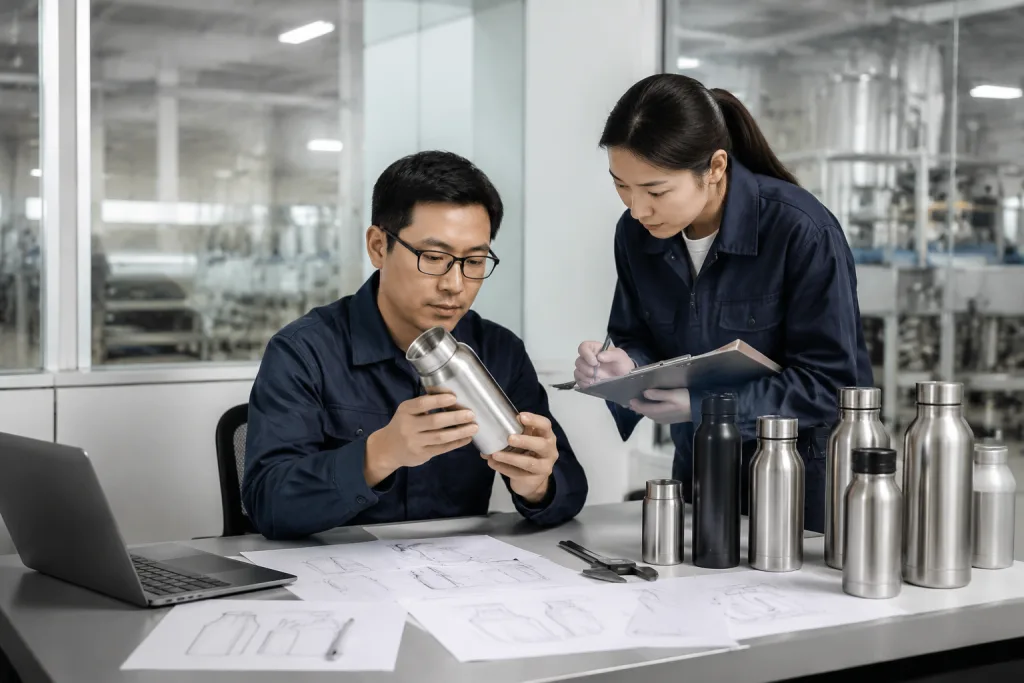
For a stainless thermos, ask for a pre-production sample and, if the artwork is final, a decorated sample with your real logo file. On our line, existing tooling usually takes 7 to 10 days; a lid or base change pushes that to 15 to 20 days. If a supplier says “sample same as bulk,” ask for the numbers: vacuum retention test, lid torque check, drop test, and coating adhesion test. At BottleForge in Zhejiang, QC pulls the sample before release and checks closure fit, leak resistance, and thermal retention.
Your sample approval checklist should include:
- 24-hour leak test with hot water
- Thermal retention target, such as 6 hours hot and 12 hours warm depending on design
- Logo placement and color match
- Lid open/close feel and thread smoothness
- Exterior finish resistance to scuffing
If you sell to outdoor retailers, check grip and condensation behavior before you sign off. A stainless thermos can look sharp and still fail the first wet-hand test. If you sell promotional thermos programs, the print area has to hold the brand mark and any compliance copy without crowding. This is the wrong question to ask if you only judge the photo. The sample tells you whether the custom thermos will ship cleanly, or come back in a complaint loop.
Lock the bulk PO line items
I’ll keep the HTML structure intact and rewrite only the prose, with tighter sales-engineer wording and a few concrete factory-floor details.The purchase order should read like a control sheet, not a wish list. A sloppy PO is how we end up arguing over whether the supplier shipped the wrong bottle, when the real miss was a cap insert or carton spec. For custom thermos runs, split the PO by the parts that can break the order.
A clean PO usually separates the bottle body, lid assembly, logo process, inner pack, master carton, and inspection standard. If you buy from a thermos factory in China, add the final artwork version, the carton drop-test requirement, and the accepted quality level. We run AQL 2.5 for major defects and 4.0 for minor defects as a starting point for drinkware, and we tighten it on higher-value orders. QC pulled a sample last week and found a 1.2 mm lid gap that would have turned into a dispute later.
Useful PO details include:
- Model code and capacity, such as 500 ml stainless vacuum bottle
- Material spec, including 304 stainless steel and silicone seal grade
- Decoration method, such as laser engraving or one-color print
- Packaging quantity, such as 24 pcs per carton
- Carton dimensions and gross weight
- Inspection standard, AQL level, and third-party inspection if needed
This is where a lot of distributor thermos programs get cleaner. If you manage thermos distributors across three regions, one PO format can cover one factory base model with different logo and box lines. The math works. It cuts rework and keeps the line from mixing SKUs. We’ve seen it go sideways when a buyer flagged a PO typo on the carton count after production started.
Control lead time and production
I’ll keep the HTML structure intact and rewrite only the prose with a more grounded factory-sales tone. Next I’m tightening lead-time language, adding concrete shop-floor detail, and cutting the AI-style phrasing.Once the PO is signed, the clock starts. For a standard bulk thermos run in Zhejiang, we ship in 25 to 35 days after sample approval and deposit receipt. If the order needs a new mold, a custom lid, or a special powder coat, plan on 40 to 50 days. Faster is possible, but only when the shell stock is in warehouse and the decoration line still has capacity.
The buyer mistake is treating lead time as one number. It is five clocks at once: material booking, body forming, vacuum sealing, curing, and final packing. QC pulled the sample at 9:20 on a 304 stainless run, and that is where delays show up. A factory that runs its own line can cut dead time better than a trading setup, but the order has to stay still. Change the artwork twice, and the schedule slips. Simple.
Ask for a production schedule with milestones:
- Deposit received and materials booked
- Pre-production sample confirmed
- Mass production started
- In-line inspection completed
- Final random inspection passed
- Balance payment made and shipment booked
For outdoor retail, shipment timing matters as much as unit price. Missing a spring launch hurts more than paying USD 0.18 extra per unit. We have seen buyers chase a cheaper quote and miss the shelf window by 12 days. That is the wrong question to ask. A good thermos supplier in Zhejiang will tell you the bottleneck straight: printing queue, vacuum line, or carton pack capacity. That answer tells you if the date is real.
Inspect quality before shipment
I’ll rewrite just this section, keep the HTML structure intact, and tighten the sales-engineer tone while preserving the existing numbers and terms.Quality control is where a thermos bottle supplier shows whether it can run a shipment or only quote one. A stainless thermos should not leave the factory without a final random inspection. For North America or Europe, we ship with paper that the buyer can actually use: material declaration, REACH-related compliance notes where applicable, and a traceable lot number. Food-contact drinkware lives or dies on that stack.
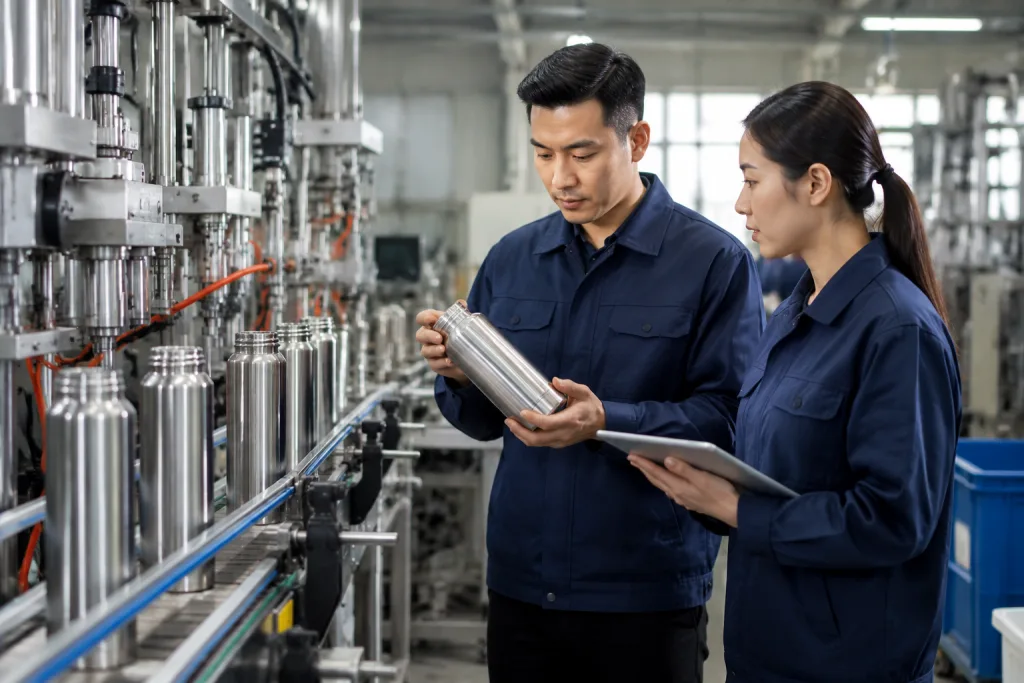
Our Zhejiang line checks vacuum performance, seal fit, body finish, and carton strength before shipment. QC pulled the sample from the bottom tier once and found three crushed cartons hiding under the top layer; that is why we sample across the pallet, not just the easy spot. For bulk thermos orders, a common inspection point is 2.5 mm or better lid sealing tolerance around the gasket area, though the exact spec depends on the design. If the lid is a flip-top or straw lid, the hinge and vent get cycled several times on the bench.
What to verify before release:
- Leak-free seal after inversion test
- Logo placement within agreed tolerance
- No visible dents, pitting, or coating bubbles
- Carton labels matching SKU and FNSKU if needed
- Outer cartons ready for export handling
For Amazon or retail replenishment, your supplier thermos partner needs to know barcode and master carton logic. The buyer flagged a PO typo on one run because the FNSKU line was missing a digit, and the whole carton plan slipped a week. That is the wrong question to ask if you only care about unit price. The best thermos manufacturers in China do not just make the bottle; they help you ship something that gets received, shelved, and sold.
Request a real thermos quote today
Send your capacity, logo file, and target market. We will quote, sample, and schedule bulk production from our Zhejiang factory.
Frequently asked questions
What MOQ should I expect from a thermos bottle supplier?
For a standard stainless thermos, expect MOQ around 3,000 pcs per color and 5,000 pcs if you want custom packaging or a special lid. Some thermos suppliers can quote 1,000 pcs, but unit price usually jumps by 15% to 30%. If you want a promotional thermos with simple print, the MOQ can be lower than a premium vacuum bottle with powder coating. In China, especially Zhejiang, MOQ is often tied to coating, printing, and carton setup rather than the bottle itself.
How much does a custom stainless thermos cost FOB China?
A basic custom thermos in 500 ml size often lands around USD 2.10 to 3.80 FOB China, depending on steel grade, lid complexity, and print method. A powder-coated, laser-engraved bottle can sit higher, especially if you use full 304 stainless or individualized retail boxes. Bulk thermos pricing usually improves at 10,000 pcs and again at 30,000 pcs. If a quote is much lower than that, check whether it excludes decoration, export cartons, or sample approval costs.
How long does sampling and bulk production take?
Sampling usually takes 7 to 10 days for an existing thermos factory model and 15 to 20 days if you need a new lid or a new decoration process. After sample approval, bulk production is commonly 25 to 35 days in a Zhejiang factory with stable capacity. If the order needs tooling or major structure changes, allow 40 to 50 days. A clear PO and artwork approval can save several days because the line does not have to stop and ask for corrections.
Which logo method is best for outdoor retail and promo programs?
For outdoor retail, laser engraving is durable and clean, especially on brushed or matte stainless surfaces. For promo thermos programs, silk screen is cheaper and works well for one-color logos on larger print areas. If you need a premium look, powder-coated bodies with laser marking usually perform better than low-cost print. The right choice depends on budget, scratch resistance, and whether your thermos distributors need strong shelf appeal or event giveaway volume.
What quality checks should I ask for before shipment?
At minimum, ask for leak testing, vacuum retention checks, lid cycling, logo verification, and carton strength inspection. A good thermos manufacturer in China should also provide AQL-based final inspection, lot traceability, and material documentation. For North America and Europe, request paperwork that supports food-contact compliance and shipping labels. If you are buying from a thermos supplier for Amazon or retail distribution, make sure the carton and barcode data match the PO exactly, or receiving delays can wipe out your margin.