Key Takeaways
- MOQ for most stainless thermos promotional orders starts at 1,000 pcs, with sample lead time of 5-7 days
- A practical FOB China price range is USD 3.20-6.80 per piece depending on capacity, finish, and print method
- For export to Europe and North America, ask for REACH, LFGB, FDA-aligned material declarations, and drop-test results
- A good thermos custom checklist covers 18/8 stainless, 0.4-0.5 mm shell thickness, seal performance, and carton drops
If you are buying thermos bottle promotional stock for outdoor retail or a brand campaign, the mistake is usually the same: buyers chase a low unit price and miss the use case. A 500 ml stainless bottle for office gifting, a 750 ml vacuum thermos for camping, and a powder-coated commuter flask do not move the same way. We see this every week on the line. In Zhejiang and across China, orders go better when the buyer starts with the end user, not the catalog photo.
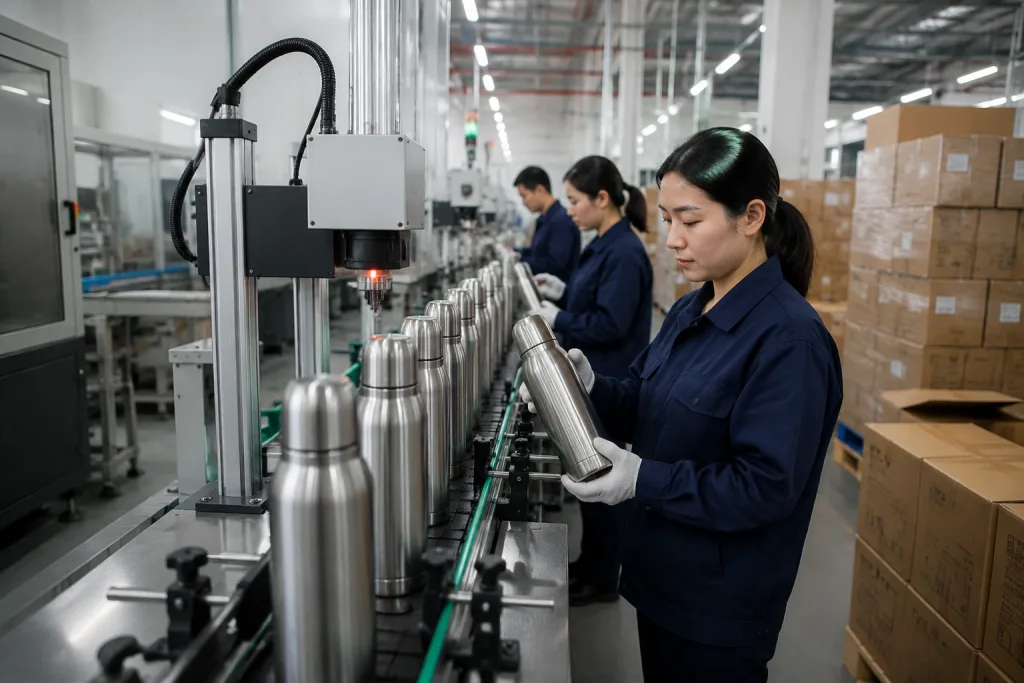
The right custom thermos order is not just logo placement. You need wall thickness, 304 or 316 stainless, cap sealing, carton packing, and compliance locked before production starts. One PO we got last month had the logo file right but the carton size typo was off by 12 mm, and QC pulled the sample before packing. A serious thermos factory should quote MOQ, lead time, and test standards straight. At BottleForge in Hangzhou, our monthly capacity is 600,000 units and the usual lead time for a standard promotional thermos order is 25-35 days after sample approval.
Start With the End User
I’ll keep the tags exactly as-is and rewrite only the prose, with a more factory-floor, sales-engineer tone. Then I’ll return the HTML only.When you buy thermos bottle promotional products, the first question is not “what is the cheapest model?” It is “who will use this bottle, where, and how often?” We have seen this go sideways on a 500 ml sample with a nice logo and a lid that was fine on a desk, then the buyer flagged it the first week because it was awkward with gloves. Outdoor retail needs a tougher body, a wider mouth, and a cap that opens cleanly in cold weather. Promo programs usually chase print area, gift box size, and a unit cost that stays inside a fixed campaign budget. Those are different jobs.
For bulk thermos purchases, the smart buyer locks down three points before asking for a quote:
- Capacity: 350 ml, 500 ml, 750 ml, or 1,000 ml
- Use case: hiking, commuting, team gifts, retail resale
- Decoration: laser logo, silk screen, UV print, or full-color wrap
If the bottle goes to outdoor consumers, a 500 ml double-wall vacuum bottle with a 65-70 mm mouth is easier to wash and easier to fill than a narrow-neck gift flask. If you sell through a distributor thermos channel, the buyer usually asks for case-ready cartons and fewer size variants. That is the wrong question to ask if you start with decoration first. A good thermos supplier keeps the line moving by adjusting caps, coatings, and cartons without turning the order into a custom tooling mess. QC pulled the sample, checked the lid torque, and the math only works when the structure matches the real channel.
In Zhejiang, the best orders are built around shelf behavior, not a pretty mockup. A thermos that looks good in a catalog but leaks in a backpack will burn the account. We run into that on the packing table all the time. So we ask for the application first, then we propose the structure.
What Stainless Build Actually Matters
I’ll rewrite the prose in place, keep the HTML exactly as-is, and make it read like a factory-side sales engineer. I’m also watching for the banned filler words and will keep one or two concrete production details per paragraph.Buyers often say “stainless thermos,” but the build decides whether the bottle lands as premium or generic. For export orders, 304 stainless steel is the base spec for both inner and outer shells. If the drink is acidic, or the buyer wants extra corrosion resistance, we move the inner liner to 316. For a normal customizable thermos, 304 works when the welding, passivation, and sealing are right. We had a PO last month with “304” typed as “3404” on the draft, and QC caught it before the line ran.
Wall thickness is where first-time importers usually miss the math. A common body spec is 0.4 mm to 0.5 mm stainless sheet. Go thinner and dents show up fast, along with heat-loss complaints; go thicker and the cost jumps, plus the bottle starts to feel clumsy in hand. For a thermos manufacturer quoting you, ask for the actual gauge, not a vague “premium material” line. On our bench, we check vacuum performance with heat-retention tests, not sales talk, and that is the real number that matters.
Useful technical checks include:
- Inner liner: 304 or 316 stainless
- Outer shell: 304 stainless or coated 201 only if budget-driven and disclosed
- Body thickness: 0.4-0.5 mm is common for export-grade bottles
- Finish: powder coat, satin, matte paint, or bare steel polishing
For thermos customized projects, coating is where margin gets eaten if you do not watch it. A powder-coated body gives better grip and wear resistance, but it still needs to pass adhesion after 48 hours of cure. If the thermos quote looks too cheap, check the coating thickness, steel grade, and vacuum step first. We’ve seen this go sideways more than once: a buyer chased the lowest price, then the sample came in with thin paint and weak pull on the magnet test. In China, a low quote is often a trading company quote, not a true factory number.
Pricing, MOQ, and Lead Time
I’ll rewrite this section in-place, keep the HTML tags untouched, and tighten the sales-engineer tone with concrete factory details and cleaner pricing language.Buyers ask for the number first, so here it is. For a standard 500 ml stainless promotional bottle with one-color print, FOB China usually lands at USD 3.20 to 4.60 at 1,000-3,000 pcs. Add laser engraving, a matte spray coat, or a gift box, and the quote moves to USD 4.80-6.80. A cup lid or display cap adds another step on the line, and the math changes fast. We’ve seen buyers push back on that, then approve the higher spec after QC pulled the first lid sample at the spray booth.
MOQ follows decoration and color count. A stock-body thermos promotional order can start at 500 pcs per color, but most thermos factory lines run cleaner at 1,000 pcs because the packing table and pad printer stay set up once. Sample lead time is usually 5-7 days for a standard model and 7-12 days for a new logo tooling sample. Mass production is commonly 25-35 days after approval. If a supplier promises 7-day production for a fully customized stainless thermos order, they are shipping stock, not customization. We’ve seen that go sideways when the buyer flagged a PO typo on the lid code and had to rebook the carton mark.
Here is the buyer rule that saves money: if you want thermos bulk pricing, keep the model count low. One bottle body, two lid options, and one decoration method will price better than five colors, three lids, and mixed packaging. The line runs faster when the carton size stays at 12 pcs, and the pallet math works. Outdoor retailers know this because SKU sprawl burns margin; promotional brands usually learn it after the first slow-moving shipment.
A serious manufacturer thermos partner should also quote breaks at 1,000 pcs, 3,000 pcs, 5,000 pcs, and 10,000 pcs. If you only get one number, that is not a production plan. It is a guess. We ship by quantity break, and the buyer should see the same ladder before they sign off.

Logo Methods That Hold Up
I’ll rewrite this section in a more field-tested B2B sales tone, keep the HTML exactly as-is, and make sure the wording sounds like someone who runs the line and ships these orders every week.Decoration is where a thermos custom order turns clean or sloppy. On stainless bodies, laser engraving holds up and stays crisp. Silk screen fits one or two solid colors when the tube is smooth. UV print gives stronger graphics, but curved metal can bite you if the jig is off by 1 mm. For a premium retail look, laser engraving on a matte powder coat is the move.
Before you sign off a custom thermos sample, check three things:
- Logo position against the seam and handle
- Color match under daylight, not just under the shop lamp
- Adhesion after abrasion and dishwasher testing
For promotional thermos orders, the logo has to survive use, not just the unboxing shot. We’ve seen buyers push back after the first wash, and the math does not work if 5% of a 10,000-piece run comes back. QC pulled a sample, ran a rub test with a cotton cloth, and the weak print lifted in 20 passes. If you are handling a distributor thermos program, ask for carton marks and barcode placement in the same proof. No one wants an FNSKU typo or a retail label mismatch after packing.
One practical point: the bigger the print area, the tighter the curvature check needs to be. A 500 ml bottle body and a 1,000 ml bottle body do not carry graphics the same way, and we’ve seen this go sideways when a buyer approved a flat PDF only. That is why thermos distributors who know retail ask for a physical pre-production sample, not just a screen mockup. In Zhejiang, the plants that handle this well usually keep print and coating in-house, so the line can adjust fast when the buyer flags it.
Checklist Before You Place Order
I’ll rewrite the section in-place, keep the HTML structure intact, and tune the prose to sound like a factory-side sales engineer.Use this checklist before you send a PO to any thermos supplier or thermos manufacturer. It strips out weak quotes fast. We had one buyer flag a PO typo on capacity, and the sample came back 500ml short because nobody checked the fill line.
- Steel grade: 304 outer and inner, or 316 inner if needed
- Capacity: confirm actual fill volume, not marketing volume
- Vacuum performance: ask for hot retention and cold retention data
- Lid seal: test for leakage in inverted position for 24 hours
- Finish: powder coat, paint, polish, or special texture
- Packaging: individual box, master carton, and drop-test target
- Compliance: REACH, FDA-aligned material statement, LFGB if Europe needs it
- Inspection: AQL 2.5 for major defects and 4.0 for minor defects is common
A factory thermos job also needs spare parts on the table. Ask if the lid gasket, straw, or silicone ring can be replaced. That matters for distributors thermos orders, because after-sales gets messy when the closure is a one-off. QC pulled the sample on one 38mm gasket last month, and the seal failed after two flips. For outdoor retail, ask about anti-slip base grip and whether condensation shows up under cold-water use.
Check carton strength too. A 5-layer export carton with corner protection is worth the extra cost. We ship to 3PL and Amazon prep centers, and weak cartons get crushed on the first fork pass. If your thermos supplier does not ask how the goods move after export, that is the wrong question to skip.
Choosing the Right China Partner
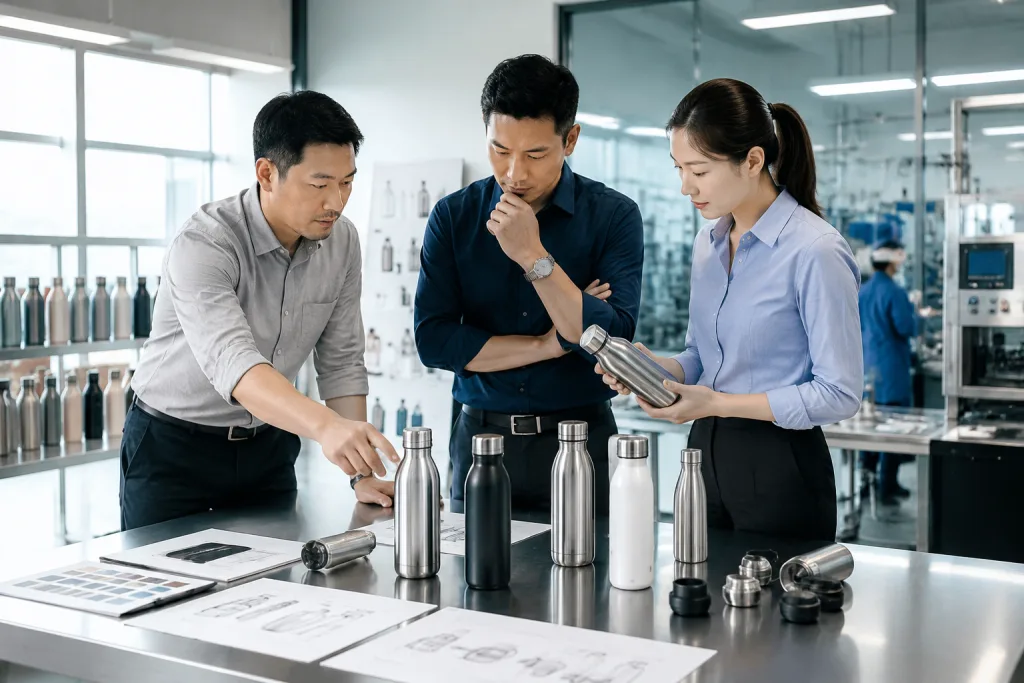
I’ll keep the HTML structure intact and rewrite the prose to sound like a real factory-side sales engineer, with tighter wording and a few concrete shop-floor details.There is a clear gap between a thermos factory, a trading company, and a real production partner. A factory thermos supplier in China should show line capacity, welding control, coating flow, and inspection records, not just a polished deck. A trading company can still work, but only if they keep a tight grip on the plant. For buyers in Europe and North America, fast email reply is the wrong metric. The real question is who can repeat the order six months later with the same color, the same seal, and the same lead time.
In Zhejiang, plenty of plants can run customizable thermos products at scale, but export work is another matter. We’ve seen a buyer flag a PO typo on cap color and save a full week; that sort of detail tells you who is paying attention. You want proof, not talk:
- Monthly output: for example, 600,000 units/month
- Quality system: incoming inspection, in-process checks, final AQL inspection
- Audit readiness: BSCI or similar social compliance if your chain requires it
- Testing access: thermal retention, dishwasher resistance, drop test, and packaging test
For a brand owner, the best thermos manufacturer is the one that can tell you where cost moves and where it does not. Logo size can change. Steel thickness should not. A lid mold can be adjusted. Vacuum quality cannot be cut just to win a lower quote. We run that math every week on the line, and it does not lie. That is the line between a solid supplier thermos relationship and a bad one.
If you are comparing manufacturers thermos options across China, compare the same spec first. Too many cheap quotes hide thinner steel, a weaker cap, or plain packing. QC pulled the sample with 0.35 mm wall instead of the agreed 0.40 mm last month; the price gap vanished fast. That is not savings. That is trouble pushed down the road.
How Outdoor and Promo Buyers Split
Outdoor retailers and promotional brands buy the same product category, but the spec splits fast. Outdoor buyers care about heat retention, dent resistance, and whether the shelf story holds up after 20,000 km on a truck route. Promo buyers care about lead time, landed cost, and if the logo still reads clean after QC pulls the sample from the box. Forcing one thermos model to do both jobs usually drives up reject risk.
For outdoor retail, a 500 ml or 750 ml vacuum bottle with a 0.4 mm powder coat, laser logo, and leak-proof lid usually sells better. For campaigns, a lighter custom thermos with one-color print and plain packaging often wins because the math stays under budget. We run this split all the time. That is the right question to ask: how will the bottle move, not how it looks under showroom lights. The best thermos distributors and thermos suppliers push for that answer early.
Promo thermos orders need the inserts, gift boxes, and shipping marks locked before the line starts packing. If the order goes through retail chains, set the carton count and master carton size up front; one PO typo on carton count can blow up loading. If the bottle is a branded gift, the unboxing matters. A clean inner box and one insert card make a mid-priced bottle feel thought through without adding much cost. We’ve seen this go sideways when buyers tried to save 0.15 USD and lost the whole presentation.
That is why a thermos distributor or brand owner should keep one mainline SKU and one seasonal SKU. Too many versions clog stock and slow reorders. One stable SKU plus one campaign SKU is enough for most programs, and the buyer flagged it after the third variant sat in warehouse for 12 days. Keep it tight.
Request your thermos quote with real specs
Send your capacity, logo method, target MOQ, and market. We’ll quote a production-ready promotional thermos plan, not a guess.
Frequently asked questions
What is a realistic MOQ for thermos bottle promotional orders?
For most stainless thermos promotional projects, 1,000 pcs is the practical starting point, especially when you want custom color or logo work. Some stock-body orders can begin at 500 pcs per color, but once you add new coating, mixed lids, or gift packaging, 1,000 pcs is more realistic. For a true custom thermos with new tooling, the MOQ may go higher depending on the lid structure. Ask the factory to separate body, lid, and print MOQs so you know where the cost pressure sits.
How much should I budget per piece FOB China?
For a 500 ml promotional thermos with one-color print, a normal FOB China range is USD 3.20-4.60 at 1,000-3,000 pcs. If you want laser engraving, premium powder coating, or gift packaging, plan for USD 4.80-6.80. Larger sizes, double-cap systems, or 316 inner liners raise the price further. A transparent thermos supplier should show you how the price changes at 1,000, 3,000, 5,000, and 10,000 pcs so you can see the curve before you commit.
Which compliance documents should I request from a thermos manufacturer?
For Europe and North America, ask for material declarations, REACH-related statements, and FDA-aligned food-contact documentation. If your market requires it, LFGB testing is worth requesting as well. For retail programs, also ask about AQL inspection records, drop-test results, and carton strength checks. A good manufacturer thermos partner in China should provide these without hesitation. If they cannot, you should treat that as a sourcing risk, not a paperwork delay.
Is laser engraving better than printing for custom thermos orders?
Laser engraving is usually the most durable option for stainless bodies. It will not peel and handles repeated washing well. Silk screen is fine for simple one- or two-color logos when you need lower cost and a clean look. UV print works for stronger graphics, but it needs careful surface prep and testing. For promotional thermos projects, I usually recommend laser on powder coat if the brand wants a premium feel, or silk screen if the budget is tight and the artwork is simple.
How do I choose between a thermos factory and a thermos supplier?
If you need direct control over steel grade, vacuum quality, coating, and lead time, a thermos factory is usually the safer choice. If you need easier communication, mixed-product sourcing, or smaller order coordination, a supplier thermos partner can still work well, but verify who actually makes the product. Ask for monthly capacity, usually in units/month, sample lead time, and inspection flow. In Zhejiang and the rest of China, the key difference is whether you are buying from the real production line or from an intermediary with no process control.