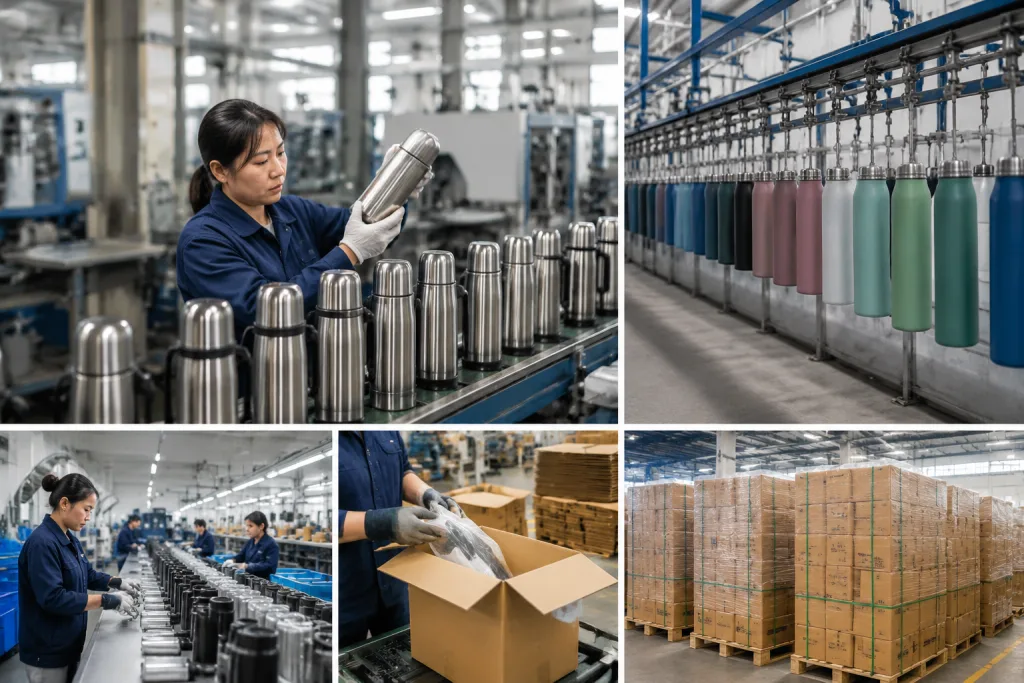
Key Takeaways
- Start with a written RFQ that names steel grade, MOQ, and target FOB; for a 500 ml thermos, expect USD 2.10-3.80 at 1,000 pcs depending on finish.
- A proper sample should show 18/8 stainless steel, 304 inner and outer shells, and at least 12-24 hours thermal retention data.
- For bulk, put logo method, carton pack, drop test, and AQL 2.5/4.0 in the PO; this cuts disputes fast.
- A Zhejiang thermos factory with 200,000+ units/month can usually ship production in 25-35 days after sample approval and deposit.
Most bad drinkware buys start the same way: a buyer wants a clean-looking thermos, a logo, a fair price, and a ship date that does not slip. Then the quote lands with no steel grade, loose insulation claims, and a sample that looks fine until QC pulled the lid and found the gasket sat 1.5 mm off-center. If you are buying thermos bottle promotional products for outdoor retail or a branded campaign, that is where margin gets burned.
The fix is strict, not complicated. We make the supplier state the steel spec, coating, decoration method, carton count, and test standard before the line starts. A Zhejiang thermos factory that knows its job will do that fast; if the PO typo says “3040 stainless” or skips the carton pack, the math does not work and the bulk order drifts away from the approved sample.
Start With the Use Case
I’ll rewrite the section in a more natural factory-sales voice, keep the HTML structure intact, and make sure the examples sound like someone who ships these every week.Do not ask a thermos factory for a price before you decide where the bottle will live. Outdoor retail buyers care about grip, coating wear, and lid use with gloves on. Promo buyers care about logo size, mailer weight, and whether the item survives a 90-day campaign without returns. Same stainless shell. Different job.
Build the RFQ around the use case first, then the spec sheet. For thermos bottle promotional products, we usually start with a 500 ml or 750 ml stainless thermos, double-wall vacuum insulation, 304 stainless inner and outer walls, powder coating, and a leakproof threaded lid. If the target is a lighter retail SKU, ask for 350 ml or 450 ml. If the buyer wants a trade-show gift with some weight in hand, 500 ml is the cleaner call. We run this math on the line every day, and the wrong size gets flagged fast in sampling.
- Outdoor retail: ask for abrasion resistance, dishwasher tolerance, and one-hand carry.
- Promo campaigns: ask for logo area, pack-in-box options, and unit weight.
- Gift sets: ask for gift box inserts and master carton drop tests.
Use the customer-facing use case when you talk to a thermos distributor or thermos vendor. The factory thermos team can then match the cap, coating, and decoration to the job instead of quoting a generic catalog bottle. We’ve seen buyers chase the cheapest option and then redo the PO after QC pulled the sample; that path costs time.
Write the RFQ Like a Buyer
I’ll rewrite the section in-place, keep the HTML structure unchanged, and tighten the buyer language so it reads like a factory RFQ note.A weak RFQ gets a weak quote. Clean RFQ, clean numbers. For custom thermos sourcing, state product type, capacity, material, color, logo method, target price, destination port, and packaging. Add the trade term too: FOB Ningbo, FOB Shanghai, or DDP to a U.S. warehouse. Freight changes landed cost fast, and we’ve seen buyers miss that by 12 days of back-and-forth.
Put the RFQ in line-item form. Body material: 18/8 stainless steel. Inner liner: 0.4-0.5 mm. Outer shell: 0.4 mm. Lid: PP or Tritan. Silicone ring: food-grade. Finish: matte powder coat or brushed steel. Logo: silk screen or laser engraving. If you want a customizable thermos for retail, give the Pantone code. If it is a promotional thermos for a brand campaign, say one-color, two-color, or full-wrap. A thermos quote that skips these specs is not a quote. QC pulled the sample, and the buyer flagged the missing lid material in the PO within 10 minutes.
PO line items to request in the RFQ stage
- Product name and capacity
- Material spec and wall thickness
- Decoration method and artwork position
- Packaging spec and carton quantity
- Target MOQ, sample fee, lead time, and FOB term
In Zhejiang, the better thermos manufacturers send a split quote: sample cost, tooling if any, then bulk price at 1,000, 3,000, and 5,000 units. That is the math that works. One quantity hides the breakpoints, and we’ve seen this go sideways when the buyer only asked for “best price.” On our line, the carton mark typo alone can slow a shipment, so spell it out before we run.
Price the Sample Correctly
I’ll rewrite the section in-place, keep the HTML tags untouched, and tighten the copy so it sounds like a factory-side sales engineer wrote it.Most buyers underpay attention to samples and then overpay in bulk. That is backward. A sample is where you check the bottle, the lid, the coating, and the thermal claim before any deposit moves. For a standard custom thermos, sample fees usually sit at USD 30-80 per style, and air freight to Europe or North America often adds another USD 20-45. If a supplier says the sample is free, ask where that cost lands later. We’ve seen that math show up in the bulk quote.
Your sample should prove the build, not just look clean on the desk. Ask for a hot-water test at 95°C, a 24-hour retention claim, and an inverted leak test for 24 hours. If the bottle is sold as a customized thermos for outdoor use, ask for a lid open-close cycle test of at least 5,000 cycles. On our line, the sample PO has to show logo position, finish code, and whether QC pulled a production-tooling sample or a hand-finished one-off. If the factory cannot state that clearly, it is not ready for scaled work.
Do not approve a sample if it only passes the visual test. That is how you end up with a nice-looking promotional thermos that leaks on day one of a trade show.
For buyers comparing thermos promotional items across several suppliers, use the same yardstick every time: leakproof performance, insulation hours, coating consistency, and cap fit. Otherwise the fastest reply wins, and the wrong supplier gets the order. We had one buyer flag a PO typo on the lid code after approval; that one mistake changed the whole sample story.

Lock the Bulk PO Terms
I’ll rewrite the section in-place, keep the HTML structure, and make the copy sound like a factory-side sales engineer wrote it.After the sample is signed off, the bulk PO needs to lock every detail. This is the point where a cheap custom thermos turns into a headache if the paper is loose. Put the exact capacity, steel grade, logo process, color, packaging, carton size, and tolerance in black and white. If the lid is black with a grey silicone seal, write that exact callout. If the box needs UPC or FNSKU labels, state it before the line starts.
For thermos bottle promotional products, bulk pricing tightens fast with quantity. A 500 ml stainless thermos can sit around USD 2.10-3.80 FOB at 1,000 pcs, USD 1.85-3.25 at 3,000 pcs, and less when the mold is already in house. We run into this all the time: powder coating and laser engraving stay stable as volume goes up, while multi-color silk screen starts eating time on the table. If you need a thermos customizable in several colors, split the SKUs; mixing colors in one run slows packing and the carton count slips.
Suggested PO structure
- Item 1: 500 ml stainless thermos, 304 inner/outer, matte black
- Item 2: 1-color logo, laser engraving or silk screen
- Item 3: Individual box, 24 pcs per master carton
- Item 4: AQL 2.5 major, 4.0 minor, full pre-shipment inspection
- Item 5: Lead time 25-35 days after deposit and artwork approval
If you are dealing with a thermos supplier or thermos manufacturer in China, ask for photo approval at three stages: blank bottle, printed bottle, packed cartons. QC pulled the sample on a 10,000 pcs order once, and the buyer flagged a wrong carton mark before shipment left the warehouse. That kind of check saves real money when the order goes to Europe or North America, because rework there is the wrong question to ask.
Audit the Factory, Not the Brochure
I’ll rewrite the three paragraphs in-place style, keeping the HTML untouched and tightening the sales-engineer tone. I’m also going to keep the factory-floor details concrete and strip the brochure language.Any supplier can send a polished PDF. Your job is to check whether the thermos factory can actually make what it sells. Ask for monthly capacity, the in-house process list, and audit records. A solid Zhejiang thermos factory should state output in units per month, what it coats or welds in-house, and whether it runs BSCI, ISO 9001, REACH, or FDA-aligned material controls. If the answers stay vague, the quote is weak no matter how low the price looks. We have seen that go sideways on a 5,000-piece order when the buyer only trusted the brochure.
For a normal export program, a factory thermos line can run 200,000 to 300,000 units per month across multiple bottle types. That matters when you are buying thermos bulk for a seasonal retail push. If your outdoor program needs 12,000 pieces in one color, a thermos distributor with no line of its own still needs a real thermos manufacturer behind it. The difference shows up in lead time, not just price. A PO typo on cup color once cost us 3 days of rework.
Check the critical points: neck welding, vacuum sealing, coating adhesion, lid torque, and carton compression. Ask for a cross-section photo if needed. On a standard stainless thermos, the outer shell usually sits around 0.4 mm, with the inner liner around 0.4-0.5 mm depending on the build. That is the kind of number a manufacturer thermos team can confirm in minutes, while a trading-only thermos vendor starts guessing. QC pulled the sample with calipers, and the buyer flagged it before packing.
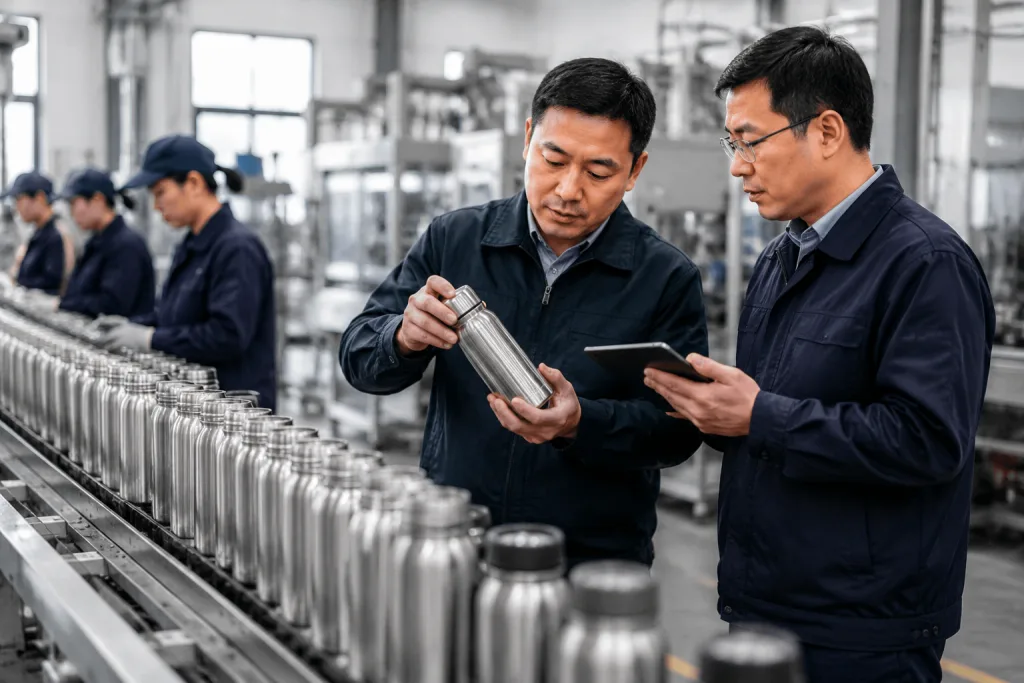
Control Bulk Quality Before Shipment
I’ll rewrite the section in place, keep the HTML untouched, and tighten the prose so it reads like a real export-sales note from the floor.Bulk control is where a clean plan turns into a clean shipment. We run a pre-production sample, an inline check, and a final inspection before we release payment. For thermos bottle promotional products, AQL 2.5 for major defects and 4.0 for minor defects is a common export standard, but the right tolerance still depends on your market and your claims. QC pulled one sample last week with a 0.8 mm logo shift, and that is the kind of miss that gets the buyer to slow the whole lot down. If the order goes to North America, get the food-contact declarations and REACH-compliant components on file before the line starts.
The final inspection needs to cover logo alignment, color consistency, dent-free bodies, lid seal fit, and packing count. A promotional thermos with one weak seal can trigger a return wave that costs more than the decoration charge. When we ship to Amazon or retail DCs, we check carton labels, barcode placement, and FNSKU application if the order calls for it. We had a PO last month with a barcode typo on one SKU, and the buyer flagged it before loadout; that saved a nasty rework on a 40HQ. That matters on thermos custom orders, where each SKU can carry a different finish and insert.
Keep shipment terms practical. FOB works best when your freight team already has a forwarder. If you need delivered pricing, ask the thermos supplier to quote DDP only after carton dimensions and CBM are confirmed. We see this go sideways when someone sends a quote off a 12.5 kg master carton but the packed case lands at 14.2 kg, and the math stops working fast. In China, a lot of thermos manufacturers will quote fast, but the clean shipment is the one where the PO already matches the packing list, not the one where everyone improvises at the port.
For outdoor retailers and promotional brands, the right thermos is not the cheapest one on paper. It is the one your thermos manufacturers can repeat at 5,000 units without changing the feel, the insulation, or the print. We run that kind of repeat order every week, and the 304 stainless wall thickness still has to stay where we set it. That is where reliable China sourcing beats random spot buying.
Send your RFQ and get a factory quote
Share your capacity, logo method, target price, and destination port. We can quote thermos bottle promotional products with sample and bulk terms from China.
Frequently asked questions
What is the usual MOQ for thermos bottle promotional products?
For a standard stainless thermos, MOQ is often 500 to 1,000 pcs per color or per logo version. If you want multiple Pantone colors, expect separate MOQs for each SKU. A factory thermos with in-house coating and printing can sometimes reduce MOQ to 300 pcs for a repeat design, but pricing usually rises 10% to 20%.
How much does a custom thermos cost at bulk level?
For a 500 ml custom thermos, bulk FOB pricing commonly lands at USD 2.10-3.80 at 1,000 pcs, depending on steel grade, finish, and logo method. Laser engraving is usually simpler than multi-color silk screen. If you need gift box packaging, add roughly USD 0.25-0.80 per unit, and more if the insert is molded.
How long does production take in China?
After sample approval and deposit, a thermos manufacturer in Zhejiang typically needs 25-35 days for standard bulk orders. If you add new tooling, special lids, or multiple colorways, allow 5-10 extra days. During peak season, some thermos manufacturers ask for 40-45 days, especially when shipping to Europe or North America by a fixed vessel booking.
What quality tests should I request?
Ask for leak testing, insulation testing, coating adhesion, and carton drop tests. A practical spec is 24-hour inverted leak test, hot water retention at 95°C, and AQL 2.5 major / 4.0 minor at final inspection. If the product is a promotional thermos for outdoor use, ask for lid cycle testing of at least 5,000 opens and closes.
Can I order mixed styles from one thermos supplier?
Yes, but mixed styles usually increase setup time and packing errors. A supplier thermos can often combine two or three variants in one order if the bottle body is shared. Expect separate line items for each logo, lid color, and carton label. If the design changes too much, the thermos distributor may treat them as separate production runs and charge separate MOQs.