Key Takeaways
- A 304 stainless body with 0.40-0.50 mm inner wall is a practical baseline for a custom thermos program
- For thermos bottle private label, a 3,000-unit MOQ and 20-30 day lead time are realistic for Zhejiang factories
- Vacuum loss, lid leakage, and logo abrasion are the three most common failure points in bulk thermos orders
- Ask for AQL 2.5/4.0 inspection, drop testing, and thermal retention data before approving any promotional thermos shipment
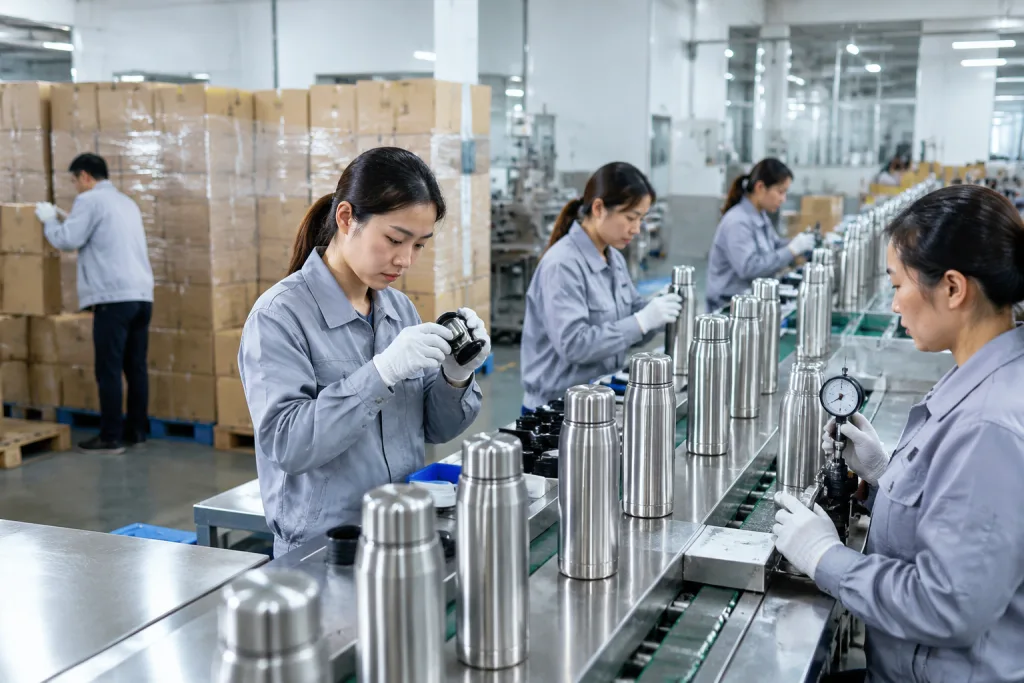
Most thermos bottle private label jobs do not fail because the bottle looks wrong on a mockup. They fail on the line: a loose lid, a dented shell, a thin vacuum gap, a weak logo transfer, or a supplier who said 15 days and shipped in 45. If you buy for outdoor retail or promo programs, you know the market punishes bad stainless thermos quality fast.
The better move is to spec for failure before you place the bulk order. Check how the factory controls stainless grade, wall thickness, sealing torque, coating adhesion, carton compression, and AQL sampling. At our Zhejiang factory in China, we run 300,000 units per month, MOQ is 3,000 pieces, and standard lead time is 20–30 days after artwork approval. QC pulled the sample on a 1.2 mm wall last week; that is the level that keeps a thermos custom program from turning into a refund case.
Why thermos programs fail
I’ll rewrite the prose only, keep the HTML structure intact, and tighten the sales-engineer tone with concrete factory details.The first mistake is assuming every stainless thermos bottle is the same once it passes a photo check. It is not. We’ve seen a buyer approve a clean-looking sample, then the bulk run changed the lid gasket, cut powder-coat cure time from 20 minutes to 12, and swapped the carton insert to save ¥0.18. The result was obvious: leaks, chipped logos, and returns that ate the margin.
If you are buying for outdoor retail or a promotional thermos campaign, treat every failure as a spec issue. Ask what can break at each step: steel forming, vacuum welding, powder coating, printing, assembly, packing, and transit. A good manufacturer thermos partner will give numbers, not soft talk. For stainless programs, we want material grade, wall thickness, neck diameter, torque range, and temperature retention at 6 hours and 12 hours. If the supplier thermos cannot show that, the math does not work. You are not sourcing a product; you are taking a swing in the dark.
Scale is why this matters in China. A factory in Zhejiang can make a custom thermos at a sharp price, but low cost only holds when the line is controlled. On our side, QC pulled the sample against an AQL 2.5 checklist and flagged a 1.2 mm dent near the shoulder before packing started. That is the difference between a reusable bottle and a warranty mess.
Steel grade and wall thickness
I’ll rewrite just the prose, keep the HTML structure intact, and make it read like a factory-side sales engineer note.Material issues start at the metal. For a private label thermos bottle, 304 stainless is the normal baseline. If the bottle goes into camping or gym use, ask for 304 on the inner liner and 201 or 304 on the outer shell; that choice changes corrosion resistance, weight, and cost. We run a 0.40-0.50 mm inner wall and 0.35-0.45 mm outer wall on a lot of export jobs. Go thinner and the body dents on the line; go thicker and you pay for weight without getting much back.
“Food grade stainless” is the wrong question to ask. Ask for mill certificates, lot traceability, and proof that the steel meets FDA contact expectations plus REACH for Europe. On one 5,000-piece run, QC pulled the sample and found surface contamination near the weld seam; that sort of thing can turn into pinholes during vacuum processing. We also check nickel consistency, because the buyer flagged it once after a third-party test came back off spec.
- Spec to request: 304 inner liner, 304 or 201 outer shell, 0.40-0.50 mm liner thickness
- Watch for: denting, orange staining, weld seam irregularity
- Test before mass order: salt spray and leak retention checks on random pieces
A small material upgrade usually beats a cheap quote. We’ve seen a 12-day production run save the buyer from an 18-day rework cycle later, and the math works out fast. A promo thermos that looks fine in week one but comes back with rust marks is not a bargain.
Vacuum seal problems
I’ll keep the tags intact and rewrite the three paragraphs so they sound like a factory-side sales engineer wrote them, with concrete numbers and a few line-floor details.The vacuum gap is the heart of the bottle, and it is the first place a bad run falls apart. If the evacuation is short or the weld seam is thin, the thermos can look fine on the shelf and still lose heat after 2 to 3 weeks. We have seen buyers flag this as “does not keep hot water hot.” The real issue is usually at the seam or during the vacuum bake on the line.
Ask for thermal retention data on the exact SKU, not a similar model from the same mold set. For a 500 ml stainless thermos, a fair target is above 65°C after 6 hours from a 95°C fill, but lid design and room temperature change the result. If a supplier throws out a number with no test condition, the math does not work. The report should show ambient temperature, fill temperature, starting lid state, and the allowed tolerance band. QC pulled a sample at 9:30 once and the result moved 4°C just from the cap being left open.
Vacuum defects are costly because you cannot fix them later. That is why a serious thermos program runs leak checks and thermal checks during production, not only at final inspection. If your supplier says every unit is “tested,” ask how many pieces, which method, and what standard they use. AQL 2.5 works for appearance and leak-related defects, but thermal retention needs its own gate. We once caught a PO typo that changed 500 ml to 50 ml, and that kind of slip is exactly why the line has to stop and verify.
Lids and leakage risk
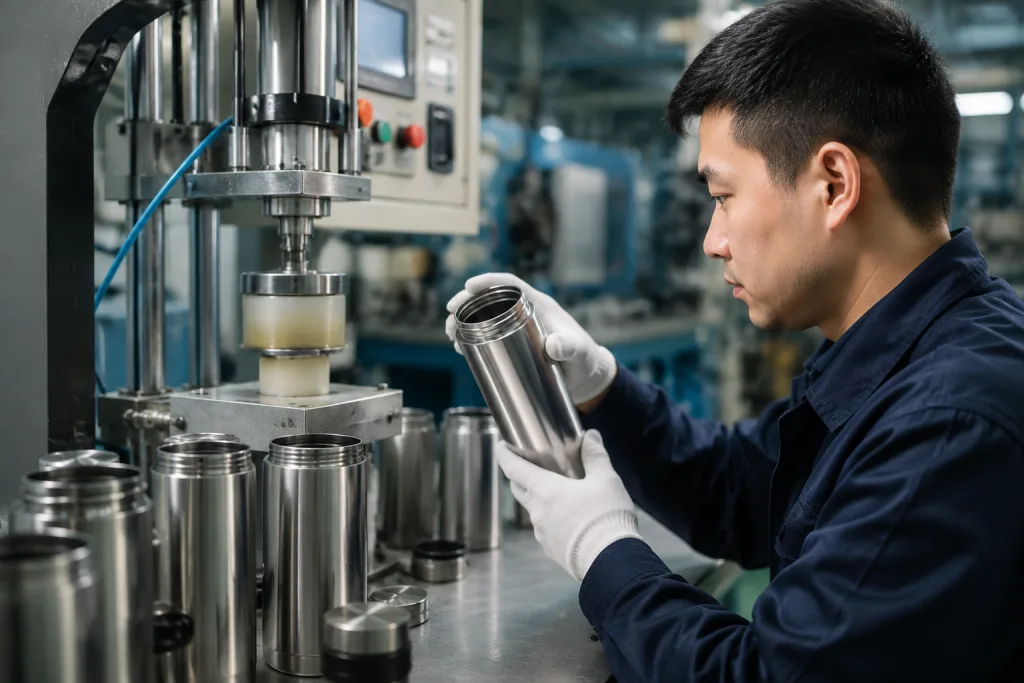
I’ll rewrite the section in-place, keep the HTML exactly as-is, and tighten the language so it reads like a factory-side sales engineer wrote it.Most complaints start at the lid. We’ve seen a custom thermos with a clean body fail because the gasket durometer was off by 5 Shore A, the thread pitch was rough, or the closing torque wandered from one worker to the next. Buyers chasing logo size usually miss the lid spec. That’s how a bulk thermos order shows up leaking in backpacks and courier bags.
For screw lids, ask for the gasket material, usually silicone, plus gasket diameter and compression range. For push-button or one-hand lids, the spring and seal geometry matter more than the outer shell. If you sell to outdoor retailers, require drop testing with the lid locked and with the lid open. One mode passing means nothing if the other fails on the line.
Leakage is rarely one problem. It is usually three small errors stacking up: seal tolerance, assembly torque, and shipping vibration.
This is where sample approval can fool you. The sample may be hand-built by a senior tech, while production runs on a different line with a 12 N·m torque setting and a fresh shift. A thermos distributor should ask for pilot-run samples from the actual lot. If you need a thermos customized with a special lid color or logo ring, inspect the seal again after decoration. Coating overspray near the thread is a classic fail, and we’ve seen the buyer flag it only after cartons reached QC.
Logo and coating wear
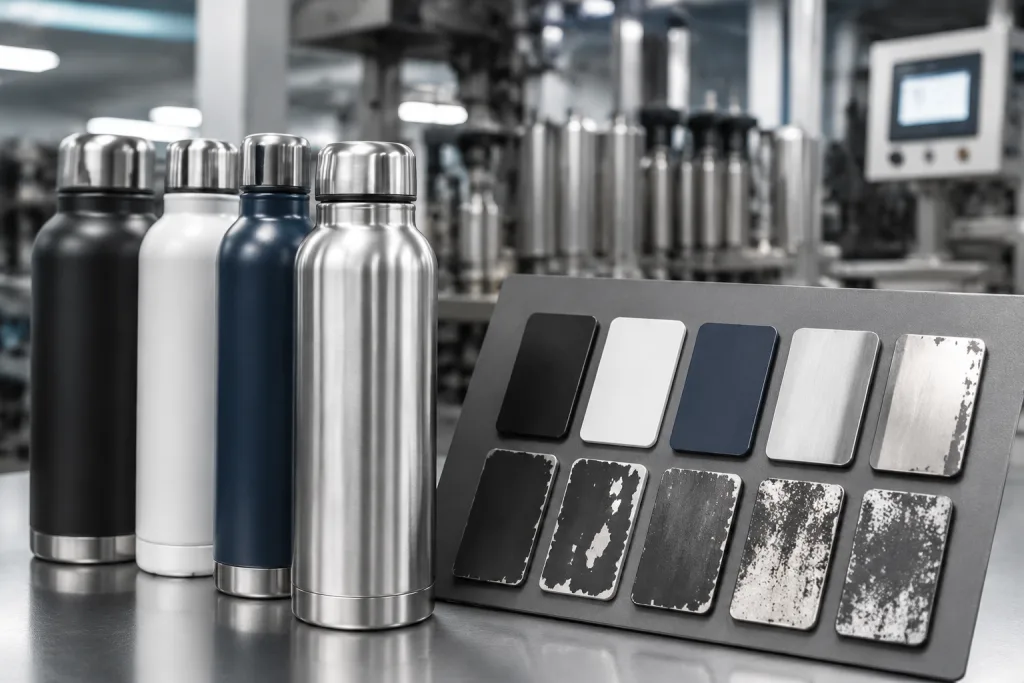
I’ll rewrite the section in-place, keeping the HTML tags and the heading structure unchanged, and tighten the copy so it reads like a factory-side sales note.A logo that looks crisp on day one can show its weak spot after one week in a carton or a warehouse bin. We see this a lot on promotional thermos runs: the buyer pushes for a low unit price and a 7-day lead time, then the line picks a decoration that cannot take abrasion. If the bottle ships through outdoor retail, e-commerce, or event giveaway channels, wear resistance is not a side issue.
Powder coating needs an adhesion check and a cure check. QC pulled the sample, ran tape adhesion, and the ink lifted on the edge after the second pull—bad news for a private label order. For silkscreen, ask if the print is single-pass or multi-pass and whether it passed tape testing. For laser engraving, wear is not the problem; contrast is. On matte black or anodized-style finishes, laser usually looks cleaner, while silkscreen suits bright brand colors better.
We quote decoration by method for a reason. The cheap option is seldom the durable one, and the math does not work if you reprint 5,000 pieces later. If the logo carries the sale, spend the extra USD 0.15–0.40 per unit on a stronger finish. We’ve seen buyer PO typos on logo size turn into a full rework, and that hurts more than the upgrade. For distributor thermos programs, the same bottle often gets resold under 2 or 3 channel brands, so the finish has to hold up before anyone checks insulation.
Packaging and transit damage
I’ll rewrite the section in a more grounded factory-sales voice, keep the HTML exactly as-is, and preserve the list structure and any existing technical numbers.A lot of thermos bulk damage happens after production. The bottle clears QC, then gets crushed in a weak inner box, a loose carton divider, or a pallet wrapped too thin. On ocean freight from China to Europe or North America, packaging is part of product quality, not a side note. We’ve seen a 304 stainless bottle pass inspection and still arrive with a dented shoulder because the carton spec was lazy. That is where a thermos factory in Zhejiang either protects your margin or hands you a claim.
Ask for carton drop test results, usually 1.0 m or higher depending on the pack layout, and check whether the shipper carton is 5-ply or 7-ply board. On the line, we run a simple shake check: if the bottle moves even 3 mm inside the box, the packing is too loose. For foam inserts, ask about compression recovery and whether the insert rebounds after pressure. A packed thermos should stay still. If it rattles, the outer shell will show dents by the time it reaches the distributor warehouse.
- Minimum checks: drop test, vibration test, carton compression, pallet wrap tension
- Best practice: ship a pre-production pack-out sample before mass loading
- Buyer warning: do not approve artwork before the actual packaging structure is confirmed
For Amazon or retail programs, packaging also affects labeling. FNSKU placement, barcode readability, and carton mark accuracy all need to line up with the pack-out. QC pulled the sample once and caught a PO typo on the carton mark, which would have turned into a warehouse refusal. A supplier who handles that cleanly is worth more than a $0.08 lower quote.
How to spec the order
I’ll keep the HTML exactly as-is and rewrite only the prose, tightening it into a more field-tested sales/spec style with concrete shop-floor details.To cut failures, write the order spec like a QC sheet. Do not just ask for a custom thermos with logo. State material grade, capacity, finish, lid type, thermal retention target, packaging spec, and inspection standard. A workable purchase sheet for a thermos bottle private label program should list body diameter, height, mouth opening, vacuum performance, and the cosmetic defects you will accept. If you leave those blank, the factory will fill them with its own guess. QC pulled the sample, and that is usually where the gap shows up.
A practical commercial spec can be simple: 500 ml capacity, 304 inner liner, 201 outer shell, 0.45 mm liner thickness, powder-coated body, one-color silkscreen logo, silicone gasket, 6-hour retention above 65°C, AQL 2.5 major, AQL 4.0 minor, and standard export carton. For a premium run, move to a 304 outer shell, laser logo, and lid torque testing above 0.35 N·m. This is the wrong question to ask if you only want the cheapest quote. The real job is turning a thermos manufacturer quote into a buying decision you can police.
When you compare suppliers thermos proposals, ask for three prices: entry, standard, and premium. A serious thermos supplier will show the delta line by line. A weak one says yes to everything and sorts it out later on the line. We have seen that go sideways on a PO typo for lid color, and the buyer flagged it only after 2,000 pcs were packed. In Zhejiang, the plants that scale are the ones that say no early, before the carton is printed and the math stops working.
Spec your thermos order before production starts
Send your target capacity, logo method, and market, and we’ll return a clear factory thermos quote with MOQ, lead time, and QC checkpoints.
Frequently asked questions
What MOQ should I expect for thermos bottle private label?
For a standard stainless thermos with one logo and one color finish, 3,000 pieces is a realistic MOQ from a Zhejiang factory. Some thermos suppliers will quote 1,000, but the unit cost usually rises 12-20% and decoration choices shrink. If you need multiple SKUs, expect the MOQ to be per color or per lid style. For promotional thermos projects, the factory may allow 500-1,000 units if the design is simple and the line is already set up, but the tooling and packing costs still need to be covered.
How do I check if a custom thermos is actually leakproof?
Do not rely on a visual sample. Ask for a 24-hour inverted leak test, a pressure or shake test, and a pilot run sample from the production line. For one-hand lids, test with the cap fully closed and in a partially abused condition, such as a 1 m drop onto a hard surface. A good thermos manufacturer should specify the gasket material, closure torque, and acceptable leakage threshold. If the supplier cannot describe the test method, the leak claim is weak.
What price range is normal for a bulk thermos order?
For a 500 ml stainless bulk thermos with basic powder coating and one-color print, FOB China pricing often lands around USD 4.20-7.80 depending on lid type, steel grade, and packaging. Premium models with 304 outer shell, better lids, and laser engraving can move into USD 8.50-12.00. The biggest cost drivers are material, vacuum performance, and decoration method. A cheap quote that skips these details usually creates a bigger landed cost later through claims or rework.
What certifications should I ask from a thermos supplier?
For Europe and North America, ask for REACH compliance, food-contact declaration, and if relevant, FDA contact material support. If the product is going into retail, ask for BSCI or equivalent social compliance documents from the factory. For quality control, request ISO 9001 evidence, AQL inspection records, and thermal retention test reports. A real thermos supplier should also provide material traceability for the stainless steel and silicone components. If you sell into multiple channels, keep copies of these files in your compliance folder.
Can I customize the lid, logo, and box together?
Yes, but that is where the risk rises. A thermos customizable program with a new lid, new print method, and custom carton should be piloted before mass production. The lid may change the fill line, the logo may affect coating cure, and the box may require a different insert. We usually recommend a 7-10 day sample confirmation window for combined changes, then a 20-30 day production lead time after approval. If you are buying through a thermos distributor or distributor thermos channel, lock all three elements before PO release.