Key Takeaways
- For bulk thermos programs, 304 stainless and a 12-24 hour insulation claim are the baseline; thin-wall 201 steel is usually a false economy.
- A typical custom thermos MOQ is 3,000 pcs, with lead time around 25-35 days after sample approval in Zhejiang production.
- FOB China pricing for a 500-750 ml stainless thermos often sits around USD 2.10-4.80 depending on lid, coating, and packaging.
- You should ask for AQL 2.5 inspection, leak testing, and REACH/RoHS documentation before you place a thermos custom order.
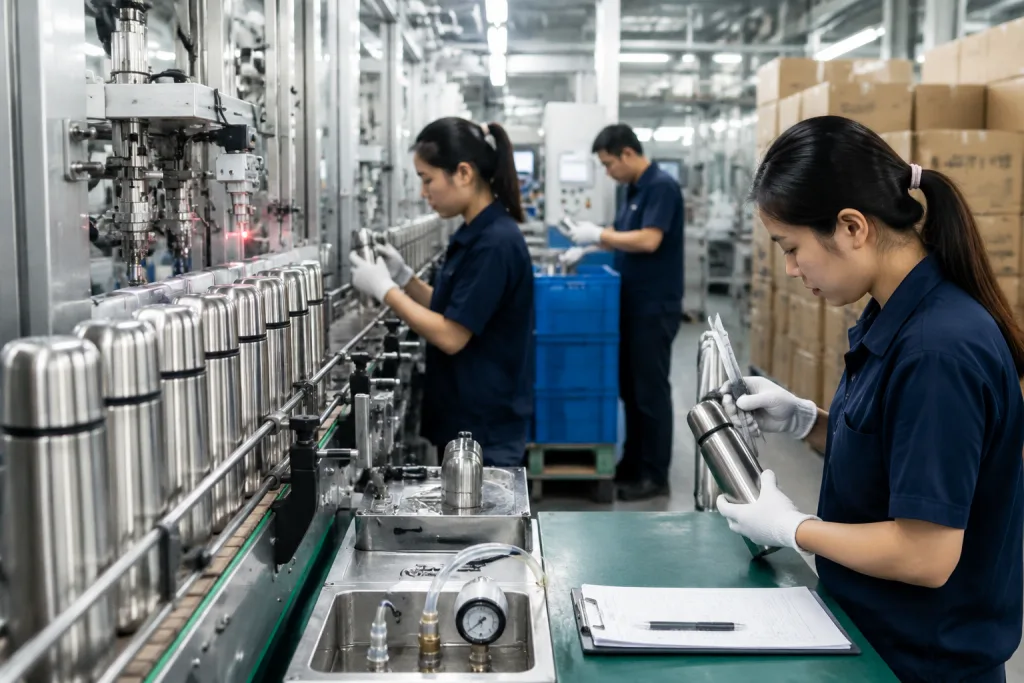
If you are buying for an outdoor retail line or a promo program, do not treat every stainless thermos as the same cylinder with a logo. It is not. The gap between a solid factory thermos and a return-heavy one usually shows up in four spots: steel grade, vacuum retention, lid seal, and how the line controls leakage and finish consistency. QC pulled a sample last week with a lid gap of 0.8 mm, and that bottle failed after one overnight tilt test.
As a thermos bottle OEM manufacturer in Zhejiang, China, we see the same pattern every week: the buyer asks for a custom thermos price first, then the PO lands with a typo on the wall thickness or a coating note that was never agreed. A 0.4 mm inner wall, a weak cap gasket, or a bad powder coat spec changes landed cost far more than a $0.30 decoration upgrade. This is the wrong question to ask: the real test is whether the supplier can hold spec on 5,000 to 50,000 pcs without the buyer flagging the same problem twice.
Start With the Use Case
I’ll rewrite the section in place, keep the HTML structure intact, and tighten the sales-engineer tone with more concrete sourcing detail.Before you talk artwork, lock the use case first. What sits on shelf is not always what runs in the field. Outdoor retailers usually want a rugged, reusable bottle with steady thermal numbers and a low defect rate. Promo buyers care more about logo placement, gift box size, and price holds across a 3-month campaign. Those are different briefs, and a thermos bottle OEM manufacturer should price them differently.
The split is clear. Retail buyers want repeatable quality and fewer warranty claims; promo buyers want the lowest decoration cost per unit and a clean MOQ. If the target is a 500 ml customized thermos for hiking sets, we run a double-wall vacuum body, powder coat, and a screw lid with a silicone gasket. If the order is 20,000 pieces of promotional thermos units for a trade show, a lighter lid and simpler printing can cut 8-15%. We have seen buyers push for one quote on both, and the math does not work.
Use these questions to define the job:
- Will the bottle travel in a backpack, a car cup holder, or a gift box?
- Do you need 6, 12, or 24 hours of heat retention?
- Will the buyer judge the product by feel, or only by logo exposure?
- Is the order for thermos bulk replenishment or a one-time campaign?
Answer them straight, and sourcing gets simpler. QC pulled a sample with a 0.8 mm lid gap once, and the buyer flagged it in one minute. A good supplier thermos quote starts with use case, not decoration.
Steel, Wall, and Vacuum Specs
I’ll rewrite this section in-place, keep the HTML structure unchanged, and make the wording sound like a factory-side sales engineer wrote it.For stainless thermos sourcing, the real decision is steel spec, not the print on the body. A solid manufacturer thermos should state the inner grade, outer grade, wall thickness, and vacuum method. We run 304 on food-contact parts as the default. If a thermos manufacturer pushes 201 on the inner wall for a drinking bottle, that is a cost-down move, and the buyer should check it against the target market before signing off. For retail outdoor lines, we often ship 304 inside and 201 or 304 outside, depending on the price band.
Wall thickness changes the whole job. A common build is 0.4 mm inner wall and 0.5 mm outer wall. Go thinner and the math stops working fast: more dent risk, more heat loss, and more weld variation on the line. Vacuum quality is the other part buyers miss. A proper thermos factory should explain the evacuation method and the insulation result by size, not hide behind “keeps hot long time.” QC pulled the sample on a 500 ml body last month, and the seam held fine, but the vacuum curve told the real story.
Ask for numbers: 12 hours hot retention at 60°C+ is a normal retail claim for a 500 ml flask, while premium formats may reach 24 hours under controlled test conditions. If the supplier thermos will not show test conditions, the claim is marketing, not engineering. We’ve seen this go sideways when the buyer accepted a warm sales deck and skipped the test report.
In Zhejiang, we usually see better consistency when buyers lock the body spec first and then choose the lid family second. Reversing that order often creates hidden cost.
If you compare thermos suppliers across China, check whether they can run the same shell with two or three lid SKUs. That is how you scale a thermos custom line without reopening tooling every time a customer changes packaging. The buyer flagged a PO typo on a 28 mm neck once, and that 2 mm mistake turned into a mold delay.
Lids, Seals, and Leak Risk
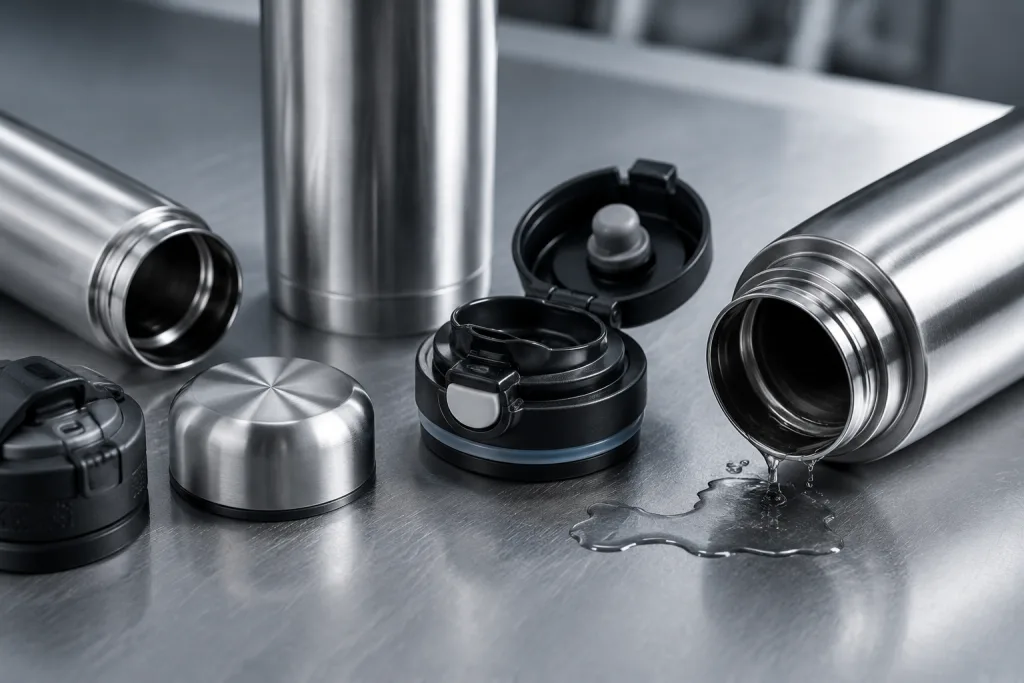
I’ll rewrite the section in-place, keep the HTML tags exactly, and tighten the sales-engineer tone with concrete factory-floor details.Most returns do not come from the steel cup; they come from the lid. We have seen a polished cap pass photos and fail a 1-meter drop test after one carton run. A thermos bottle OEM manufacturer should show the sealing stack, not just the render: silicone ring size, thread depth, vent path, and whether the lid body is PP, Tritan, or stainless-faced.
For outdoor retail, a screw cap with a dense silicone gasket beats a push button when the buyer wants fewer complaints. On the line, we run both styles, and the push-button unit always brings more parts and more chance for a bad spring seat. For promotional thermos orders, a simpler lid works if the bottle is not going into high-value retail. The math does not lie: more moving parts means more leak risk and lower yield.
We recommend a buyer check that matches factory reality:
- Fill test for 24 hours at room temperature
- Drop test from 80 cm on the lid and base
- Thread engagement check after 200 open-close cycles
- Dishwasher resistance if the market expects it
A thermos distributor selling into Europe or North America should ask for food-grade silicone proof and REACH paperwork for the lid parts. QC pulled the sample, and the first thing we check is the seal face and the vent hole, not the glossy finish. If the factory says yes but cannot send the file, the buyer flagged it for a reason.
Decoration That Survives Selling
I’ll keep the HTML structure intact and rewrite the prose to sound like a factory-side sales engineer. I’m checking the wording for the required concrete details, numbers, and a more natural export-sales voice.Logo work is where a lot of custom thermos orders get messy. We run the line by channel, not by theory. For a promo thermos order, screen printing is the cheapest route and holds up fine for a 1-color or 2-color logo. For retail, laser engraving or powder-coat masking gives a cleaner face and better rub resistance. If the buyer wants a gift line, full-wrap printing or a two-tone finish can work, but we reject decoration that scuffs in carton drop tests.
The right thermos customizable option comes down to who buys it and what they can pay. A distributor thermos program that moves through dealers usually needs plain branding plus a blank carton option for local rework. A DTC line can carry heavier artwork if the seller owns the photos and copy. QC pulled a sample with a 1.2 mm logo shift last month; the buyer flagged it, and they were right. Ask for print-area dimensions and color tolerance before the first run. Waiting until sample two is the wrong question to ask.
Typical decoration cost runs from USD 0.08 for a simple one-color print to USD 0.65 or more for laser, wrapped artwork, or multi-step coating. Sounds small. On thermos bulk orders of 10,000 pcs, that is USD 8,000 to USD 6,500 on the decoration line alone, and the math does not lie.
If you are comparing thermos distributors or thermos suppliers, ask if they can match printing on the bottle, lid, and carton. We ship a lot of mixed-SKU sets, and one PO typo on carton code can stall the whole pallet at packing. Consistency saves time when the same program goes into 12 stores or 3 campaign drops.
MOQ, Price, and Lead Time
I’ll rewrite the section in-place, keeping the HTML tags and structure intact while making the pricing, MOQ, and lead-time language sound like a factory-side sales engineer.For a thermos bottle OEM manufacturer, quote the unit price separately from the full program cost. A standard 500 ml stainless model with one-color print, a basic gift box, and FOB Ningbo or FOB Shanghai terms usually lands at USD 2.10-3.20 for 3,000 pcs. Add powder coating, laser logo, an upgraded lid, and an individual retail carton, and you are looking at USD 3.60-4.80. That is normal China factory pricing. We run these numbers every week on the line.
MOQ depends on the body, lid, and decoration method. For a simple customized thermos, 3,000 pcs is the usual ask. Some thermos factory lines will take 1,000 pcs, but the unit price often jumps 15-30% because the setup cost gets spread too thin. If you are a distributor testing a new market, that is often the wrong question to ask. The math does not work if you end up with dead stock. QC pulled a sample with the wrong lid color once because the buyer pushed for a 1,000 pcs trial and skipped the carton check.
Lead time in Zhejiang is usually 25-35 days after sample approval, assuming standard materials and no peak season pressure. If the order needs a new mold or a special lid, add 10-20 days. A factory with 300,000 units/month capacity can still miss the ship date if artwork approval comes in late, so ask for the production calendar, not a sales promise. We saw a PO typo on the print position once, and that one line cost us 4 days.
Budget rule: if a thermos custom quote comes in 20% below the rest, check steel grade, lid parts, carton quality, and compliance files before you get excited.
Compliance and Quality Control
I’ll rewrite the section in-place, keep the HTML tags unchanged, and tighten the language so it reads like a factory sales engineer wrote it.For Europe and North America, compliance is the gate. If the paperwork is weak, the cargo sits. A serious thermos manufacturer should support REACH, RoHS where relevant, LFGB or FDA-aligned food-contact documents, and batch traceability. If you sell into retail chains, ask for BSCI or a similar social audit too.
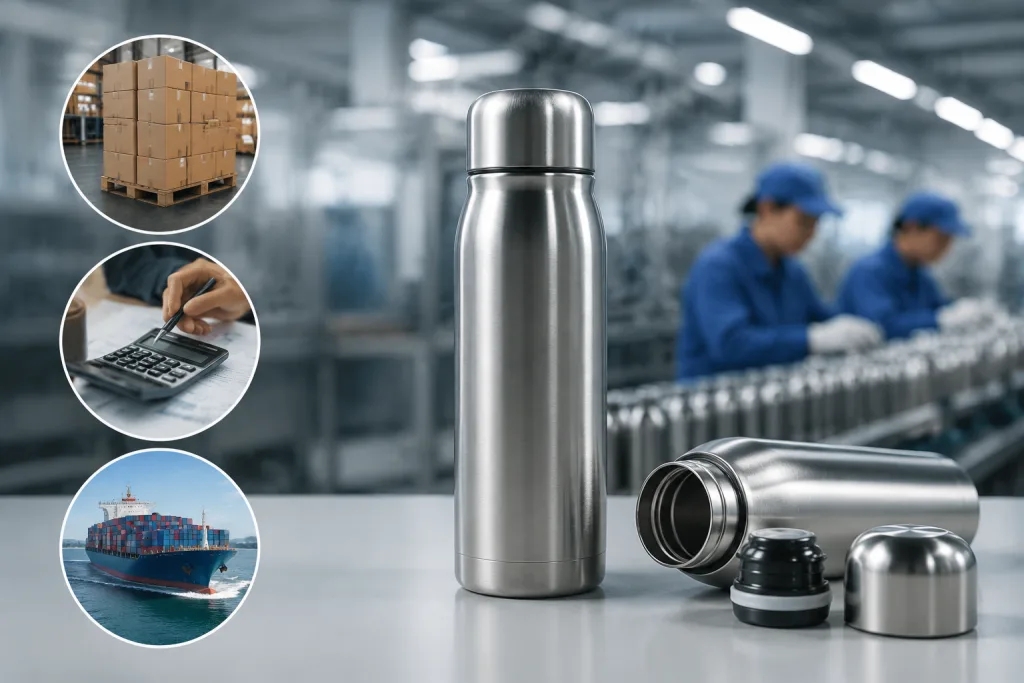
Quality control needs numbers, not adjectives. We run AQL 2.5 for major defects and AQL 4.0 for minor defects on large thermos bulk runs. Leak testing has to be written down. QC pulled the sample for print adhesion, coating thickness, and vacuum performance from the line, not just from the first article. For a promo order, carton compression and transit damage tests matter more, because those cartons pass through more hands and the buyer will flag it if the outer box looks tired on arrival.
Ask the thermos supplier for a pre-production sample, a sealed golden sample, and an inspection checklist before mass production. On a 50,000-piece run, we sign off the lid torque, 2 mm gasket fit, and logo position before the line starts. This is standard in Zhejiang when the order is real. If a supplier cannot show a control plan, the math doesn’t work; the risk just moves into your shipment.
Batch marking and traceability save time on warranty cases. A clean lot code on the carton and cup base can cut a review from 5 days to 1 day when one pallet needs checking and the rest can ship.
Send your thermos brief for a real quote
Share size, logo method, target market, and annual volume. We’ll turn it into a practical Zhejiang production plan, not a vague catalog answer.
Frequently asked questions
What is a normal MOQ for a custom stainless thermos?
For a standard thermos bottle OEM manufacturer in China, 3,000 pcs is a realistic MOQ for a custom thermos with print or coating. Simpler thermos customizable orders may go down to 1,000 pcs, but the unit price often rises 15-30%. If you need mixed SKUs, ask whether the factory can combine colors or lid styles under one body mold. That is common in Zhejiang and helps distributors thermos programs avoid overstretching inventory.
How much does a bulk thermos usually cost FOB China?
A basic 500 ml stainless thermos often costs around USD 2.10-3.20 FOB China at 3,000 pcs. Add powder coating, laser engraving, upgraded carton, or a premium lid, and the price can move to USD 3.60-4.80. The cheapest quote is not always best; check 304 steel, wall thickness, and leak testing first. A reliable thermos supplier should break the quote into body, lid, print, and packaging.
What insulation performance should I ask for?
For most retail and promotional thermos orders, ask for a controlled test result of 12 hours hot retention as a baseline. Premium bottle lines may reach 24 hours depending on volume and lid design. Always ask for the test method, starting temperature, fill ratio, and ambient temperature. Without those details, a hot-time claim from a thermos factory is just marketing. A good manufacturer thermos will give you the test conditions in writing.
What compliance documents do Europe and North America need?
At minimum, ask for food-contact documentation, REACH-related material declarations, and batch traceability. If you sell into retail chains, BSCI or equivalent audit support is useful. For a thermos distributor or thermos supplier handling multiple markets, keep a file with material specs, ink declarations, and carton info. Many buyers also request a sample test report showing leak performance, coating adhesion, and thermal data from the factory in Zhejiang or elsewhere in China.
Should I choose print, laser, or engraving for logos?
Choose by channel, not taste. Screen print is often the best promotional thermos option when you need a low-cost one- or two-color logo. Laser engraving is more durable and suits retail programs where abrasion resistance matters. For a premium custom thermos line, masked powder coat or wrap printing can deliver better shelf impact. On large thermos bulk orders, decoration differences can change pricing by USD 0.08 to USD 0.65 per unit.