Key Takeaways
- For outdoor retail, 18/8 stainless and 6-12 hour heat retention is usually safer than chasing the lowest FOB by $0.20
- For promotion, 500-1,000 ml custom thermos orders often start at 3,000-5,000 pcs MOQ with 25-35 day lead time
- A 0.38 mm inner wall and double-wall vacuum build is a better baseline than chasing a lighter shell under 0.30 mm
- China thermos suppliers in Zhejiang typically quote faster when you lock logo method, lid style, and packaging on day one
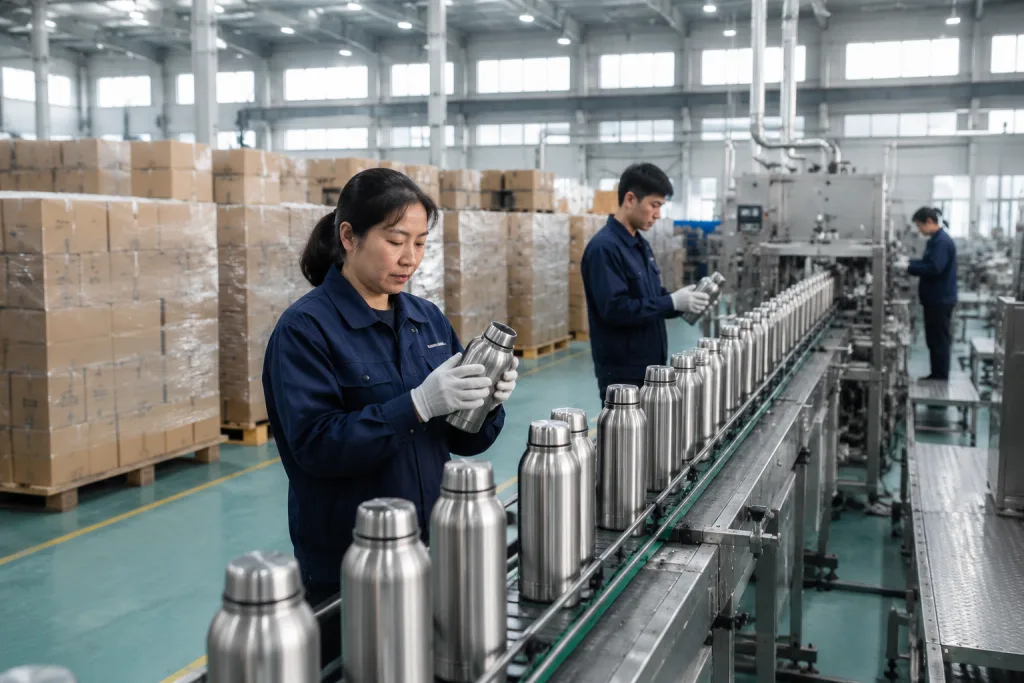
If you buy for outdoor retail or a promo program, the wrong stainless thermos turns into dead stock fast. We’ve seen a 500 ml bottle look clean on a spec sheet, then fail a backpack drop test, miss the silk screen area, or add $0.80 per unit after freight and packing. That is the wrong place to start. Serious thermos bottle manufacturers start with the use case, then work back to structure and price.
In Zhejiang and across China, the factories that stay in the game build repeatable lines: 304 or 316 inner walls, 0.35-0.45 mm stainless shells, vacuum holds checked against ASTM-style thermal claims, and MOQs that actually fit bulk thermos orders. QC pulled a sample from the line last week and the buyer flagged a 1.2 mm neck mismatch; that kind of miss kills a program. So the real question is not who lists the most options. It is which thermos factory can match your sales channel, decoration method, and margin target without creating avoidable risk.
Spec table first, not marketing
I’ll rewrite the prose in-place, keep the HTML structure and numbers intact, and tighten it so it sounds like a factory-side sales engineer wrote it.When you compare thermos bottle manufacturers, put a spec table in front first. No story, no pitch. A buyer can get a polished sample from a thermos distributor, but the factory thermos is what decides whether the line passes drop tests, survives dishwasher cycles, and keeps opening torque steady after 5,000 pulls. We run this check on the line with a torque meter and a drop rig. If you buy for outdoor retail, the bottle has to feel like a field product. If you buy for promotion, the math is print area, carton count, and freight per piece.
| Spec | Retail thermos fit | Promotional thermos fit |
|---|---|---|
| Capacity | 350-500 ml | 500-750 ml |
| Inner wall | 304 stainless, 0.38-0.45 mm | 304 stainless, 0.35-0.40 mm |
| Lid | Leakproof screw cap or cup lid | Push-button or simple screw lid |
| Decoration | Laser engraving or durable silk screen | One-color print or wrap label |
| MOQ | 3,000 pcs | 5,000 pcs+ |
| FOB target | $3.20-$5.80 | $2.10-$4.20 |
That table is not classroom theory. In Zhejiang, a solid thermos factory can hold these numbers because the line is built for repeat runs, not sample-room drama. QC pulled the sample on a 12-day run and flagged a lid fit issue before packing, which saved a rework lot. If a supplier quote leaves out wall thickness, lid tooling, or carton count, the buyer flagged it for a reason. You are not comparing real cost. You are comparing a promise on a PO with a typo.
Retail model versus promo model
I’ll rewrite the prose only, keep the HTML exactly as-is, and tighten the sales-engineer tone with concrete factory details and cleaner channel separation.The cleanest buying split is two lanes. Retail thermos products need a stronger value story: brushed finish, tighter vacuum numbers, and a lid that feels engineered on the line. Promotional thermos products need fast branding, locked-in cost, and packing that runs the same every time. Forcing one spec into both channels usually eats margin or kills sell-through.
Retail thermos works best when the buyer wants a custom thermos with a premium finish, because outdoor shoppers judge the bottle in hand. We’ve quoted a 500 ml thermos manufacturer price around $4.50 FOB and still made it work, but only when the surface treatment held up and the lid passed a 24-hour inversion test. Promo thermos can be lighter, though we don’t like going too thin. Under 0.30 mm on the shell, you save grams and lose stiffness. The math doesn’t work if your distributors thermos channel expects the bottle to survive catalog handling and transit.
- Outdoor retail: 350-500 ml, matte powder coat, laser logo, retail carton
- Corporate promo: 500-750 ml, one-color logo, bulk packed, lower-cost lid
- Distributor program: consistent carton count, FNSKU-ready labeling if needed
Thermos suppliers in China who know both lanes will quote two structures, not one lazy price. We had a buyer flag a promo sample because the carton count was off by 2 pcs, and QC pulled the sample straight off the packing table. That’s how you avoid a promotional thermos that looks cheap on shelf or a retailer-grade bottle that blows up your margin.
Stainless grades that matter
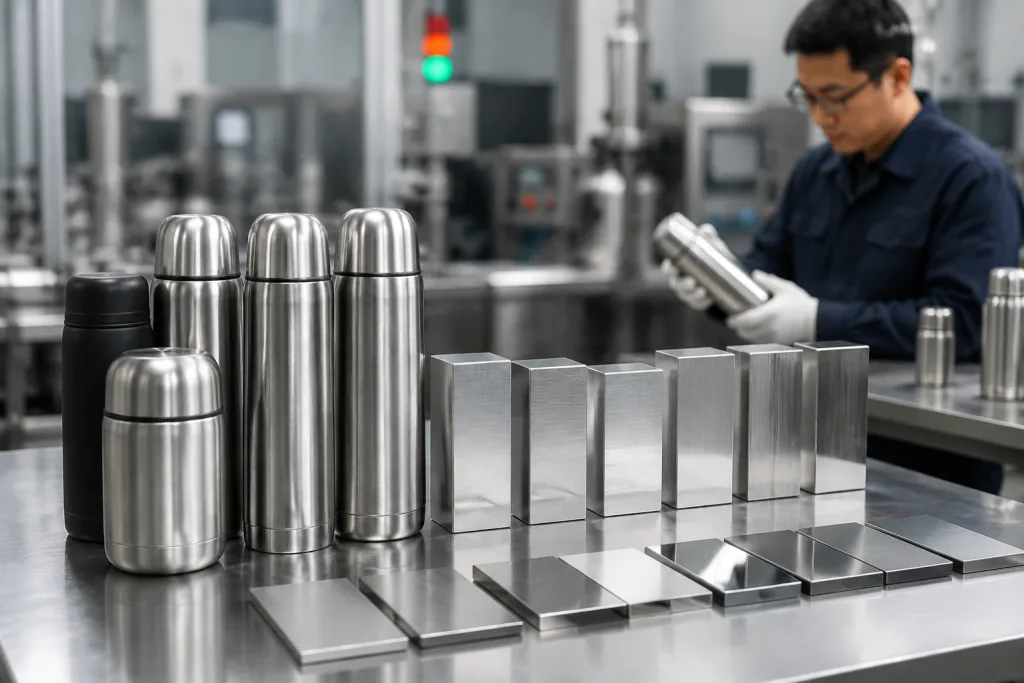
I’ll rewrite the section in-place, keep the HTML structure untouched, and make the copy sound like a factory-side sales engineer wrote it.Most buyers ask for stainless steel and stop there. That is too vague. For a custom thermos, the inner wall is usually 304 stainless if you want broad market acceptance. If the bottle will hold acidic drinks for 8–12 hours, or if your customer wants a higher-end spec, 316 inner steel is worth the extra cost. Outside shells can stay 304 in most programs. The job is matching the steel to the use case, not chasing labels.
A normal build on a competitive thermos factory line is 304 inner + 304 outer, 0.35-0.45 mm wall thickness, vacuum gap held for stable heat retention. If a quote skips wall thickness, ask again. We have seen the line pass samples that looked fine, then the buyer flagged denting after a 1.2 m drop test. A thinner shell can make a thermos customizable on paper, but it also creates complaints. For outdoor retail, dent resistance beats saving 12 grams. For promotional thermos orders, light weight only works if the cup still feels solid in hand.
Buyers in Zhejiang and other China export hubs know this rule: the lowest thermos manufacturer price is rarely the lowest landed cost once rejects, reprints, and replacement stock are counted.
Ask your supplier for material certificates, salt-spray data if coated, and a thermal test protocol. QC pulled the sample on one order because the mill report listed 304, but the finished parts were not marked and the batch traceability was weak. If they cannot explain test conditions, you are buying a story, not a thermos bottle.
Lids decide user complaints
I’ll rewrite the HTML in place, keep the tags and list structure intact, and tighten the copy so it reads like factory-side sales guidance.Most return claims start at the lid, not the steel body. We see a clean shell pass inspection and still fail because the gasket sits crooked or the thread pitch drifts by 0.2 mm. Retail buyers hate that. A thermos can ship fine from the line, then come back with leak complaints from backpacks and cup-lid spills in cars.
Pick the lid for the job. A screw-on cup lid fits a classic thermos bottle, but it adds parts, assembly time, and one more chance for a bad seat. A push-button lid feels easier for the user, yet QC pulled the sample after 500 cycles when the spring lost tension. If you are ordering thermos bulk for a giveaway, a simpler lid usually keeps the MOQ under control and cuts packing trouble. For a higher-end custom thermos, ask for at least 3,000 open-close cycles and check the gasket material yourself. Food-grade silicone with steady compression is the standard; anything softer is asking for a leak.
- Leakproof screw lid: best for field use and retail trust
- Push-button lid: best for convenience and office promotions
- Cup lid: best for classic styling, but adds complexity
Distributors often talk about appearance first. We run the assembly side, so we look at repeatability, torque, and the little typo on the PO that turns the wrong gasket into a delay. That is the part that keeps refund rates down.
Decoration choices change margin
I’ll rewrite the three paragraphs in-place, keep the HTML exactly as-is, and tune the copy to sound like a factory-side sales engineer with specific cost and line-detail cues.Your decoration choice decides whether the run stays clean on margin or turns into a headache. For a thermos custom order, laser engraving is usually the safest mark for the long haul because it stays on brushed steel and powder coat without peeling. We run it on a galvo machine, and on one 500-piece job the buyer flagged a scuff issue, so we pushed the engraving path. Silk screen still works for a one-color promotional thermos, but abrasion and curing need control. If the bottle goes through distributors thermos channels, durability beats a cheaper print quote.
Here is the working split. Laser engraving usually adds $0.12-$0.35 per unit, depending on mark size and cycle time. Silk screen can price lower on paper, but setup, plate cleaning, and rework wipe out the gain on a 300-piece order. Heat transfer or wrap labels fit seasonal promo programs, yet they are weak for outdoor retail. A customizable thermos should still read clearly after shipping, shelf rub, and three wash cycles. The math does not lie.
If you need a branded run from a China thermos supplier, lock the artwork early. A Zhejiang factory can turn samples fast, but every change after plate making adds days; we’ve seen a 2 mm logo shift delay shipment by 4 days. QC pulled the sample, the PO had a typo in the logo size, and the buyer paid for the reset. Get the placement signed off before the line starts.
MOQ, lead time, and landed cost
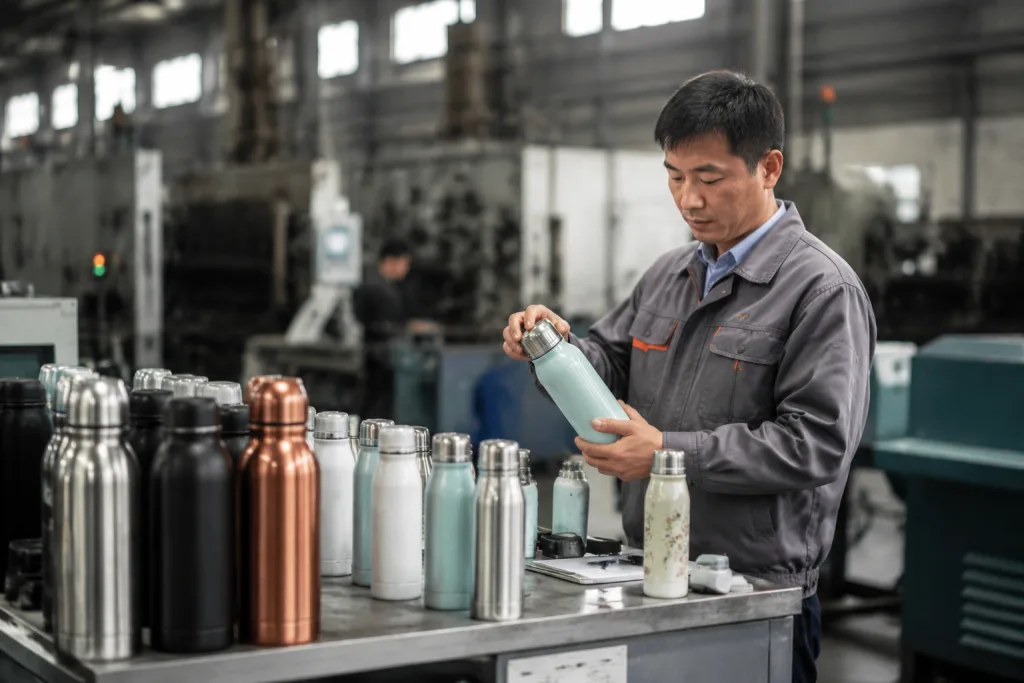
I’ll rewrite the three paragraphs with sharper factory-floor language, keep the HTML tags intact, and preserve all existing numbers and structure.MOQ is where buyer expectations usually crack. A thermos supplier quote can look clean until you see the minimum is 8,000 pcs and the lead time is 45 days. For a workable promo program, we usually run 3,000-5,000 pcs on standard shapes and 30-35 days after sample approval. Once you add custom molds, special lids, or two-tone coating, the schedule moves to 45-60 days. We’ve seen a buyer push back on 5,000 pcs, then come back after QC pulled the sample and checked the 0.3 mm wall thickness on the line.
For budgeting, a bulk thermos order might sit around $2.10-$3.60 FOB for simple promotional builds and $4.00-$6.50 FOB for retail-grade stainless thermos products with better finish and packaging. Add freight, duties, cartons, and local fulfillment, then compare it with your shelf price or campaign budget. That is the number that matters. A thermos distributor can throw out a low unit price, but if the carton count is poor, shipping eats the margin. We ask for pack-out detail, master carton dimensions, and drop-test standards up front; one PO typo on carton size can turn the math upside down.
If you need 10,000 pcs in under 30 days, ask whether the factory runs 300,000 units per month or more. In China, especially Zhejiang, that capacity gap separates a real thermos factory from a trading desk. Capacity is not everything, but it tells you whether the date is real. On our side, we check the press line schedule and the vacuum welding slot before we promise a ship date.
How to choose by channel
I’ll rewrite the section in-place, keep the HTML structure unchanged, and make the copy read like a factory-side sales engineer wrote it.Channel fit decides fast. Outdoor retail buyers usually want stronger shelf appeal, tougher coating, and packaging that survives a store rack, not just a lab test. Promo buyers push for lower landed cost, simple artwork, and delivery they can book on a calendar. If you source from thermos manufacturers or thermos suppliers in China, send the same 3 RFQ scenarios to each factory; otherwise the math does not work.
- Outdoor retail launch: 500 ml, 304/304 stainless, powder coat, laser logo, 3,000 pcs MOQ, retail carton
- Corporate gift program: 600 ml, simple screw lid, one-color print, 5,000 pcs MOQ, bulk pack
- Distributor replenishment: standard shape, repeat mold, stable carton count, 25-35 day production
If the channel is ecommerce, check whether the bottle takes FNSKU labels without lifting and still passes parcel drops. We run that test on the line with a 1 m drop, and the buyer flags it when the carton scuffs too easy. If the channel is wholesale, lock the carton pack count to the warehouse’s pallet plan. If the channel is event promotion, speed and print impact beat chasing thermal numbers. A good thermos factory will say where the trade-offs sit; a weak one will promise everything at the same unit price.
Send your thermos spec and target price
Get a practical quote from a Zhejiang thermos factory with MOQ, lead time, and decoration options matched to your channel.
Frequently asked questions
What MOQ should I expect from thermos bottle manufacturers?
For standard stainless thermos models, expect 3,000 pcs MOQ if the factory already has the mold and lid structure. For a custom thermos with a new lid or finish, 5,000 pcs is more realistic. If you want full thermos customizable packaging plus logo variation, some thermos suppliers in China will ask for 8,000-10,000 pcs. Zhejiang factories with higher monthly output can sometimes accept smaller trial runs, but the unit price usually rises by 8-15%. Always ask whether the MOQ applies per color, per logo, or per total order.
Is 304 stainless enough for a custom thermos?
Yes, 304 is the normal baseline for most custom thermos programs. It is suitable for water, coffee, tea, and general retail use. If your buyers expect a higher spec or you are targeting acidic beverages for longer hold times, 316 inner steel can be a better choice. The bigger issue is not the label but the actual wall thickness and finish. A 304 inner wall around 0.38-0.45 mm is a solid starting point for thermos bottle manufacturers focused on outdoor retail.
How do I compare FOB quotes from thermos suppliers?
Compare the same exact build: capacity, steel grade, wall thickness, lid type, finish, logo method, and carton pack count. A quote at $2.40 FOB with a thin shell and cheap lid may be more expensive than a $3.10 FOB bottle that ships fewer damaged units and needs no rework. Ask for sample photos, pack-out dimensions, and test standards. Good thermos manufacturers will give you enough detail to calculate landed cost, not just a pretty unit price.
What lead time is normal for thermos bulk orders?
For standard bulk thermos orders, 25-35 days after sample approval is normal if the factory has capacity and the artwork is locked. New molds, special coatings, or multiple logo positions can push that to 45-60 days. In Zhejiang, a large thermos factory may run 300,000 units per month or more, which helps with timing, but lead time still depends on raw material availability and finishing queue. Always confirm when the sample approval date starts the clock.
Which decoration method is best for promotional thermos orders?
For most promotional thermos campaigns, one-color silk screen is the lowest-cost option, especially on large runs. If you want better durability and a cleaner premium feel, laser engraving is usually the stronger choice, especially on brushed or coated steel. Wrap labels can work for short-term events, but they are weaker for long retail life. For distributor thermos programs, I usually recommend laser if the budget allows, because it reduces complaints about worn logos.