Key Takeaways
- For thermos bottle in bulk, 304 stainless steel is the normal baseline; 316 usually adds about 15% to 25% to material cost.
- A 0.45 mm to 0.6 mm inner wall is common for retail-grade stainless thermos bodies; thinner walls reduce cost but hurt dent resistance.
- Most custom thermos orders land at MOQ 3,000 pieces and 25 to 35 days lead time from a Zhejiang factory thermos line.
- A good vacuum-insulated thermos should hold 60°C+ after 12 hours and 45°C+ after 24 hours in controlled testing.
When you buy thermos bottle in bulk, the bad decisions are usually buried in the specs. We’ve seen a sample pass the desk test, then leak after 120 days in a warehouse, fail in transit, or miss the insulation target the buyer flagged on the PO. In Zhejiang and across China, the difference between a clean order and a headache is not the photo. It is the steel grade, wall thickness, vacuum level, lid structure, and how the factory holds each lot.
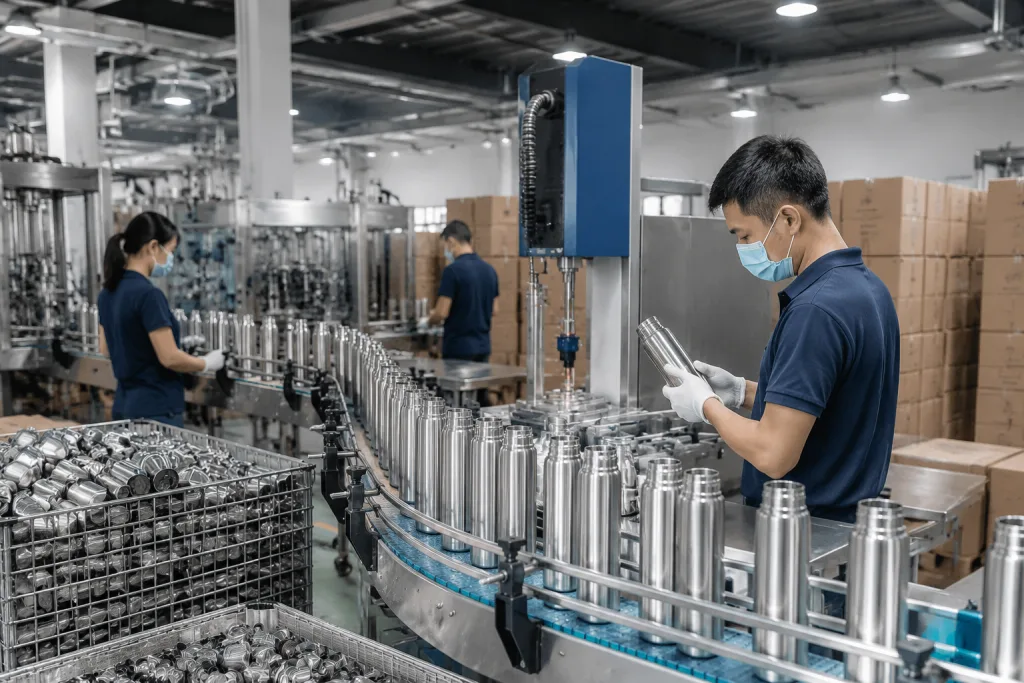
For outdoor retailers and promotional brands, a stainless thermos is not just a drink container; it is a reorder SKU. You need a custom thermos that survives drops, holds heat for 12 to 24 hours, and still leaves a clean logo panel. At BottleForge in Hangzhou, we run the thermos line at about 200,000 units per month with an MOQ of 3,000 pieces and a 25 to 35 day lead time, so the spec has to be locked before production starts. That is the part buyers miss. QC pulled the sample, and the math does not work if the details are loose.
Steel Grade Sets the Baseline
I’ll rewrite this section in a more field-tested sales tone, keep the HTML intact, and preserve the key specs and numbers.Start with the metal. Everything else sits on it. For a stainless thermos, the shell is usually 201 or 304 stainless steel, while the food-contact liner should be 304 if you want a commercial-grade product that holds up under export checks. If you are sourcing thermos bottle in bulk for North America or Europe, 304 is the safer default. Buyers there care about corrosion resistance and clean taste, and they ask for it by name.
Here is the buyer impact. 201 can cut a few cents off the unit price, but we have seen it show surface rust after a humid 45-day sea shipment and a week on coastal shelves. That turns into returns fast. For a manufacturer thermos program, we usually quote 304 inner and outer walls unless the customer is building a giveaway line. The material gap between 201 and 304 usually moves the landed unit by about 5% to 12%, depending on bottle shape and finish.
- 304 stainless: best balance of cost, corrosion resistance, and export acceptance.
- 316 stainless: premium option for salty, acidic, or high-end brand positioning.
- 201 stainless: budget use only; higher rust risk in real retail conditions.
If you are comparing thermos supplier quotes, ask for the exact steel spec on both liner and shell. “Stainless steel” is too loose. We’ve had a buyer flag a PO typo where the liner spec was missing, and QC pulled the sample before the line ran 500 pcs. That kind of gap is how low-grade material slips into a bulk thermos order.
Wall Thickness Changes Durability
I’ll keep the tags intact and rewrite only the prose, making it sound like a factory-side sales engineer. Next I’m checking the exact wording for the article section and then I’ll patch it directly.Wall thickness is the spec buyers skip until the first dented carton lands at the warehouse. On standard vacuum-flask bodies, inner wall thickness usually runs 0.45 mm to 0.6 mm, with the outer wall in the same band depending on diameter and tooling. Go thinner and you save stainless, but the bottle starts feeling soft, especially on 500 ml and 750 ml runs that outdoor chains move by the pallet. For a customized thermos, this is more important than the print file.
Here’s the trade-off in plain English: 0.45 mm works for price-led thermos promotional programs, while 0.6 mm usually gives better drop resistance and a cleaner hand feel. The cost jump is not huge, often USD 0.10 to USD 0.25 per unit on medium-volume orders, and we’ve seen it cut carton damage and shelf complaints fast. If you buy through a thermos distributor or straight from a thermos factory, ask for wall thickness by part, not just total bottle weight. QC pulled a sample last month and the buyer flagged a 0.08 mm gap between the body and base; that kind of mismatch is where the math stops working.
Weight alone is not a spec. A heavy bottle can still have poor geometry and weak seams.
For outdoor use, I want a body that feels firm in the hand and does not ring like a tin cup when tapped. That usually means the line is not shaving too much off the shell. One shop in Zhejiang sent us a PO with the wrong wall spec typed as 0.5 cm instead of 0.5 mm; we caught it before production, and that typo would have wrecked the run. The better factories will show you wall thickness tolerances and a caliper reading, not just a polished sample.
Vacuum Quality Drives Performance
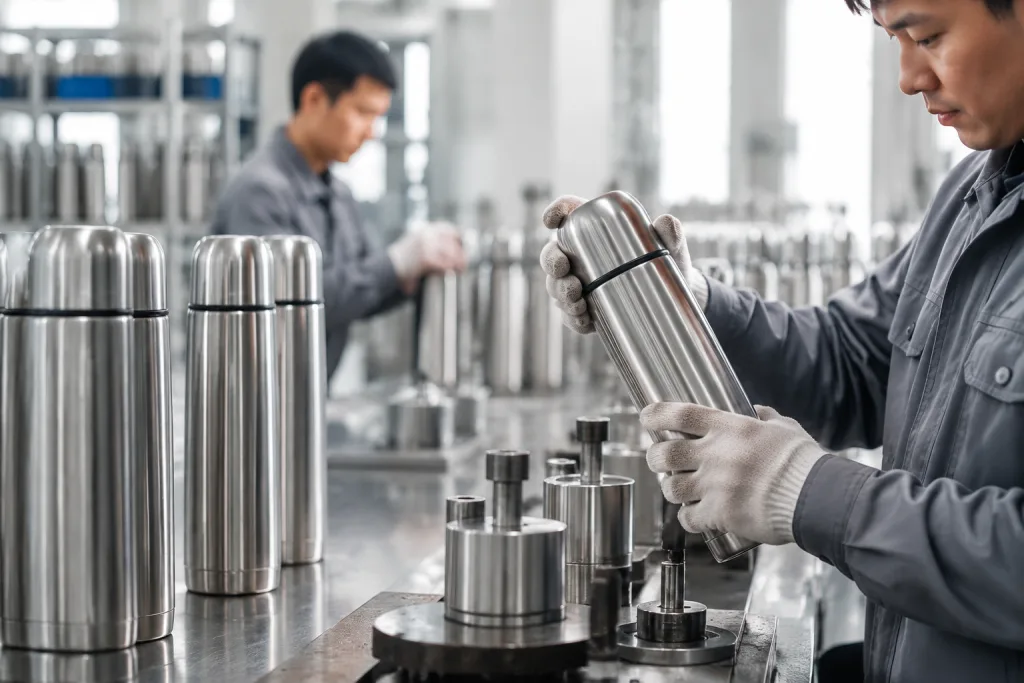
I’ll rewrite the section in place, keeping the HTML exactly as-is and tightening the language to sound like a buyer-facing factory note.Insulation is the whole point of a thermos, so this spec has to be real, not brochure talk. A proper vacuum-insulated stainless thermos uses double-wall construction, a sealed vacuum gap, and often a copper coating on the liner to slow heat loss. For a 500 ml bottle, we usually see hot retention above 60°C at 12 hours and around 45°C at 24 hours, tested from a 95°C fill at about 20°C room temperature.
Factories in China like to write “12-hour hot retention,” but the test setup decides whether that number means anything. Was the bottle preheated, did QC pull the sample after line start-up, and was the room 20°C or 25°C? Those details change the result. If you are buying thermos bottle in bulk for a brand program, ask for the written test method and ask for lot-to-lot data from production, not one clean sample report. A serious thermos manufacturer can show internal QC records in an ISO-style format, even if the form is their own.
Vacuum leaks are usually a process issue, not a design mystery. We see bad evacuation, weak neck sealing, and weld inconsistency on the line, then the buyer flags it after the first shipment. If a supplier cannot explain how they check vacuum hold, that is the wrong factory to work with.
Lid Design Decides Usability
I’ll rewrite the section in place, keep the HTML structure intact, and tighten the sales-engineer tone with a few concrete factory details.The lid decides whether the bottle works in the field or gets sent back. We see this on the line all the time: a thermos can pass insulation, then fail because the cap is slow to open, hard to grip with gloves, or starts weeping after a 1-meter drop. For bulk thermos orders, the main choices are screw lids, one-touch push buttons, cup lids, and twist caps. Each one changes how the buyer uses it and what the unit cost does.
For thermos custom orders, the lid also changes branding. A wide-mouth body gives you more room for print, and the lid top adds one more surface for a logo or color callout. That matters for customizable thermos programs sold through distributor thermos channels, where shelf recognition drives repeat orders. We usually spec a food-grade silicone gasket with a tight compression fit; the math does not work if you cut corners there. Our QC pulled a sample last month and held the bottle upside down for 30 minutes, then ran a 2-meter drop test, which is the right ask for this part.
- Screw lid: simple parts, solid seal, lower cost.
- Push-button lid: easier for commuters, more parts, more wear points.
- Cup lid: good for gifting and camping, but the cap stack gets bulkier.
When you compare thermos suppliers, ask for gasket material, spring cycle count, and spare seal availability. A good thermos vendor should swap wear parts without forcing a new mold. We’ve seen this go sideways when a buyer approved a nice-looking lid, then the PO typo changed the seal thickness from 2.0 mm to 1.0 mm.
Decoration Needs Space and Control
I’ll keep the tags intact and rewrite the prose in a more grounded factory-sales voice, with concrete production details and tighter phrasing. Then I’ll return only the HTML.Most buyers ask about logo size first and check coating control too late. That is backwards. Decoration only works when the blank zone is stable, and on a stainless thermos the line has to hold the coating edge within 1-2 mm or the logo starts drifting. Common finishes are powder coat, spray paint, brushed metal, and polished steel. Powder coat is the safest choice for custom thermos branding because it grips well and gives a wide color range. Brushed steel looks premium, but it shows scuffs fast on outdoor SKUs. If the order is for event giveaways, we care more about print life than a luxury look.
Decoration method changes the unit price. Screen printing usually works best for 1-2 colors; laser engraving costs more up front but gives a permanent mark, which fits premium thermos customized programs. Heat transfer and UV print sit in the middle, depending on shoulder shape and artwork detail. On normal bulk orders, logo decoration adds about USD 0.08 to USD 0.60 per piece, and setup fees run from USD 30 to USD 120 per design. QC pulled a sample last week with a 0.4 mm logo shift, and the buyer flagged it right away. That is why we push buyers to lock the art before sample approval.
For export orders, check rub resistance and ask for the coating to stay intact under cold-water condensation. We run cross-hatch adhesion on the line and do wear checks before mass production; if the tape pulls paint in the 100 mm grid test, the job goes back for rework. Retail programs need color control across at least three production lots. This is the wrong question to ask only after packing starts.
Packaging Protects Margin
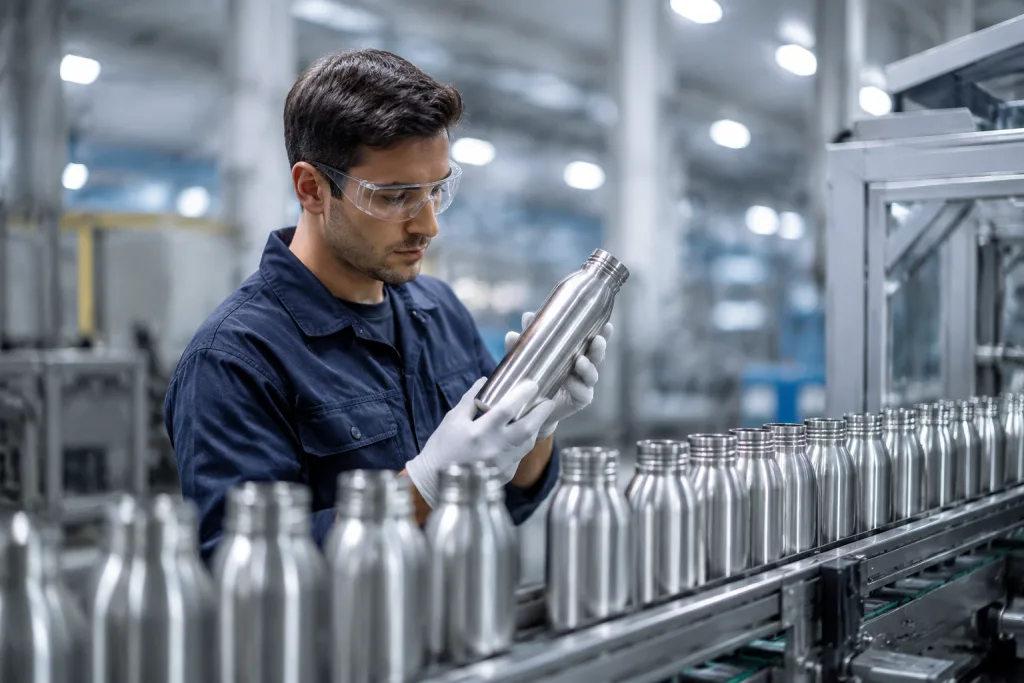
I’ll keep the HTML structure intact and rewrite only the prose, with a more field-tested sales-engineer tone and a few concrete factory details.Packaging is not a carton check-box; it sits in the margin math. A thermos bottle in bulk can miss target even when the bottle passes, because crushed cartons, weak inserts, and the wrong master-pack count burn money fast. On one outdoor retail order, we changed the pack after QC pulled the sample at 72 cm pallet height. White boxes, color boxes, brown mailer boxes, and gift sets with EVA or molded pulp inserts all work, but the right choice depends on the ship mode. If the goods go to Amazon or a 3PL, carton size and barcode position matter just as much as the bottle finish.
For a thermos distributor or promo brand, we set inner and outer box dimensions before sampling. That is the clean way to avoid a fight later over container loading and pallet height. The math works: a tighter pack can lift carton utilization by 8% to 15%, and ocean freight does not forgive waste. If you need FNSKU labels, keep one flat panel clear and confirm whether the factory can apply SKU stickers on the line. We do that for some buyers at MOQ 3,000, and it saves warehouse labor right away.
Do not ignore the moisture barrier. In a Hangzhou summer, a thin insert can pick up humidity, warp a few millimeters, and then the cartons rub in transit. We’ve seen that go sideways on export loads. A solid supplier thermos line in Zhejiang should know how to protect bottles for retail shelves and export cartons without stuffing extra material into the box.
Request a thermos spec quote today
Send your target size, finish, and order volume. We will match the right stainless build, pricing, and lead time for your bulk program.
Frequently asked questions
What MOQ should I expect for thermos bottle in bulk?
For most stainless thermos programs, a practical MOQ is 3,000 pieces per color or per model. If you need a deep custom mold or special lid tooling, the MOQ can rise to 5,000 or even 10,000 pieces. Smaller trial orders are possible, but the unit price usually jumps by 12% to 25% because the factory cannot spread setup, printing, and QC costs. At BottleForge in Zhejiang, our normal thermos line supports 200,000 units per month, so we can handle repeat programs and mixed SKUs if the packaging plan is clear.
How do I compare a cheap quote to a real quote?
Ask for the steel grade, wall thickness, vacuum test method, lid material, and decoration method line by line. A quote that says only “stainless thermos” is incomplete. For example, 201 steel instead of 304 can cut cost, but it changes corrosion risk and long-term appearance. Also check whether the quote includes export cartons, inner boxes, drop-test packaging, and logo setup. A fair bulk thermos price for a basic 500 ml stainless model often starts around USD 2.20 to USD 4.80 FOB, depending on finish and lid complexity.
Can you make a customizable thermos with our brand colors?
Yes. Most factories can do powder coating, painted shells, printed logos, laser engraving, and custom box art. Brand color control is best when you provide Pantone references and approve a physical sample. Keep in mind that matte powder coat hides fingerprints better than gloss, and it usually costs a little more. For a customized thermos order, expect the color-matching process to add 5 to 10 days if you want a precise retail finish. If the order is promotional, we can usually simplify the setup to keep lead time down.
What certifications matter for Europe and North America?
For stainless drinkware, buyers usually ask for food-contact compliance such as LFGB, REACH, and FDA-related material declarations. If the thermos includes silicone or plastic lids, those parts need their own compliance review. You may also want factory audit records like BSCI or ISO 9001 if you are supplying major retail chains. For a bulk thermos shipment, ask the thermos manufacturer for material traceability, test reports, and sample retention records. That saves time when your compliance team asks questions later.
How long does production usually take?
For standard stainless thermos orders, lead time is usually 25 to 35 days after sample approval and deposit. If you need new artwork, a custom finish, or special packaging, add 5 to 10 days. Peak season in China can push schedules longer, especially before Q4 retail shipments. A good thermos supplier in Zhejiang will confirm schedule based on actual line capacity, not just promise the earliest date. If you need split shipments, make that clear at PO stage so cartons and labels are prepared correctly.