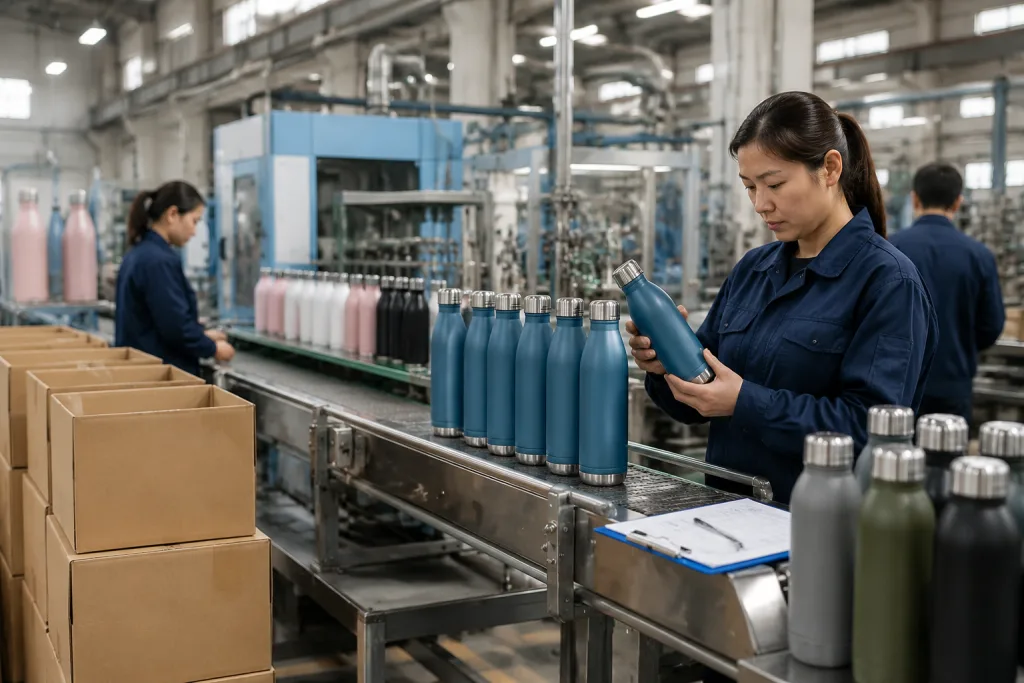
Key Takeaways
- Factory direct MOQ is usually 1,000-3,000 pcs per custom thermos model, depending on finish and logo method
- 304 stainless steel at 0.45-0.55 mm wall thickness is a practical baseline for retail thermos bulk orders
- Laser engraving is slower but more durable; screen print is cheaper for 1-color promotional thermos runs
- A realistic custom production lead time is 30-45 days after sample approval and deposit
If you are sourcing a stainless thermos for an outdoor retail line or a promo run, the hard part is not finding a thermos supplier. The hard part is checking whether the factory quote still matches the buyer brief when 5,000 units land in your warehouse.
Factory direct sourcing from China can cut 12-25% versus trading layers, but only if you compare the specs like a product engineer, not a catalog shopper. At BottleForge Industrial in Hangzhou, Zhejiang, we run export drinkware jobs with clear MOQ, repeatable decoration, and fewer ugly surprises on the line.
Factory Direct Versus Catalog Buying
I’ll rewrite the prose only, keep the HTML structure untouched, and make it sound like a factory-side sales engineer wrote it.A thermos bottle factory direct order is not just a cheaper catalog buy. You are buying line time, steel traceability, decoration setup, and the inspection terms from the source. Good deal if you know the spec. Dangerous if you only chase the FOB Ningbo number and skip the steel grade, vacuum hold, cap build, and packing method.
For outdoor retailers, the main win is spec control. We can run 304 inner and outer stainless steel, a copper-coated vacuum layer, a defined powder coat texture, and a cap that passes 24-hour inverted leak testing. For promo brands, logo control and repeatability matter more. We had one buyer flag a sample because the pad print looked fine, then the truck test knocked the ink edge in 10 days. That is a brand problem, not a product problem.
At our Zhejiang facility, monthly stainless drinkware capacity sits around 650,000 units across thermos bottles, travel tumblers, and sports bottles. Standard MOQ for a customized thermos is 1,000 pcs for laser engraving or screen print on an existing mold, and 3,000-5,000 pcs when you need a special lid color, private carton, or custom powder coat. New mold work starts higher, because tooling, fit checking, and pre-production sampling take real machine hours. QC pulled one cap set last week at 0.3 mm off center, and that kind of miss stops the line.
The trade-off is simple: factory direct gives you tighter control and lower landed cost, but your spec sheet has to carry more weight. If you want a vendor to “just handle it,” you may save a few emails. If you want a repeatable manufacturer thermos program with fewer hidden markups, direct is the better route. We’ve seen the math go sideways when a buyer left carton drop-test height out of the PO, then argued about damage later.
Spec Table For Buyer Decisions
I’ll rewrite the section in place, keep the HTML untouched, and tighten the copy so it reads like a factory-side buyer note with concrete spec language.Use the table below as a straight filter before you ask any thermos manufacturers for pricing. It keeps the talk off vague words like premium, heavy duty, or gift quality. We hear those terms all the time at the line. Numbers travel better across China, Germany, Canada, and the U.S.
| Spec choice | Outdoor retail fit | Promotional brand fit | Factory note |
|---|---|---|---|
| 500 ml bottle | Good for day hikes and commuter shelves | Good for event giveaways | Lowest freight per usable unit |
| 750 ml bottle | Best all-rounder for camping and work sites | Higher perceived value | Often the repeat seller; MOQ usually starts at 3,000 pcs |
| 1,000 ml bottle | Strong for outdoor and jobsite channels | Too large for some mailer kits | Higher carton CBM and freight cost |
| 304/304 stainless | Recommended baseline | Recommended for brand safety | Ask for the material certificate; QC pulls this on arrival |
| 201 outer, 304 inner | Only for price-sensitive programs | Possible for short campaigns | Lower corrosion resistance outside, and the math does not work for long runs |
| Powder coating | Best grip and shelf appearance | Good for color matching | Needs an adhesion test; we run cross-hatch before mass production |
| Laser logo | Durable, clean, retail friendly | Best for executive gifts | Higher unit cost than print, but it survives more abuse in transit |
| Silkscreen logo | Fine for simple marks | Best for 1-2 color bulk thermos runs | Needs rub and tape testing; the buyer flagged it when the logo peeled at 200 rubs |
For most thermos custom projects, I would start with a 750 ml 304/304 vacuum bottle, 0.50 mm outer wall, 0.45 mm inner wall, powder coating, and laser logo. Not the cheapest spec. We have seen cheaper builds go sideways fast. A 12-day production run on this spec is normal; the same order in thinner steel often turns into dent claims, rust complaints, weak decoration, and color drift between batches.
Outdoor Retail Bottle Fit
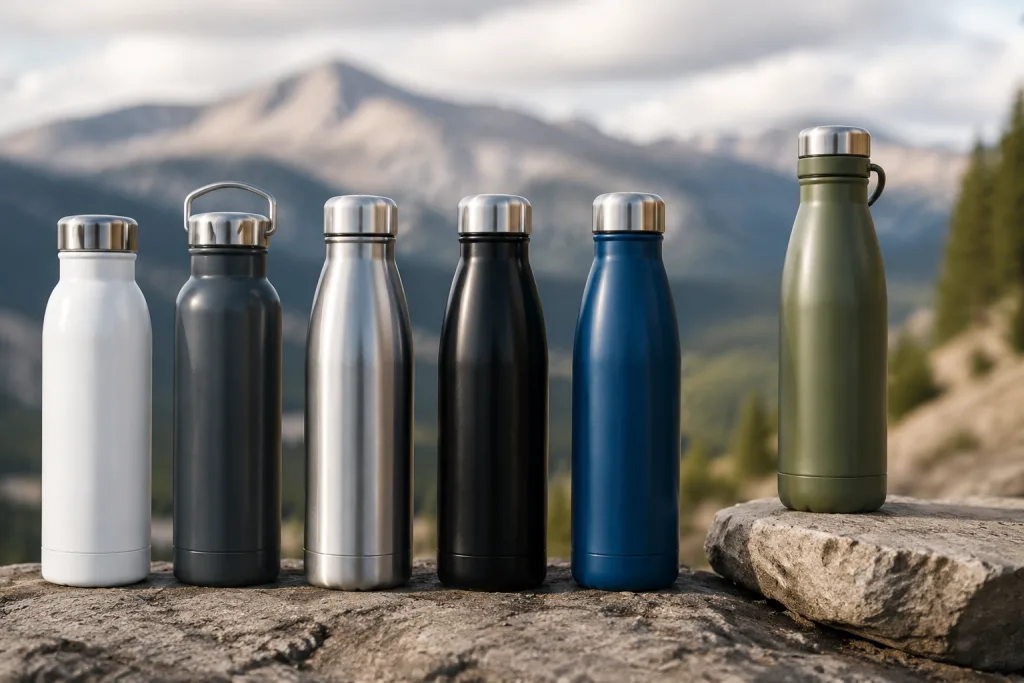
I’ll rewrite the section in place, keep the HTML tags untouched, and tighten the prose so it sounds like a factory sales engineer wrote it.Outdoor retailers should not source the same bottle a bank uses for a holiday giveaway. Your buyer wants a thermos that rides in a pack, sits in snow, bounces off a tailgate, and still holds heat on a cold morning. That means a tougher spec than the usual entry-level promotional quote. We see that argument on the line all the time.
For retail shelves, the clean comparison is 500 ml, 750 ml, and 1,000 ml. A 500 ml factory thermos is easy to carry and moves well near checkout or in commuter sets. A 750 ml model is the safest core SKU because hikers, anglers, school staff, truck drivers, and office buyers all take it. A 1,000 ml customized thermos is narrower, but the larger body sells the rugged look. The math works better than chasing a random size because the carton count and shelf depth stay predictable.
Insulation claims need hard numbers. Too many thermos quotes say “keeps hot 24 hours,” and that is the wrong question to ask if the test setup is fuzzy. Our factory test uses 95°C water, 20°C room temperature, and readings at 6, 12, and 24 hours. For a good 750 ml stainless vacuum bottle, expect about 72°C after 6 hours and 45-55°C after 24 hours, depending on mouth diameter and lid structure. QC pulled the sample on a 12 mm mouth once and the wide mouth dropped faster, but it washed easier and took ice cubes cleanly.
Retail packing matters too. Outdoor buyers usually ask for a printed color box, barcode, warning label, and sometimes REACH or LFGB statements for the EU. If you sell into North America, ask for FDA food-contact compliance and whether the coating passes a cross-hatch adhesion test before shipment. We’ve seen a buyer flag a PO typo on the carton mark and stall the whole booking, so this part is not paperwork fluff. A thermos manufacturer that dodges these points is not ready for real retail work.
Promotional Program Fit
I’ll rewrite the section in place, keeping the HTML intact and tightening the sales-engineer tone. Then I’ll do a quick pass for the requested anti-AI wording and concrete factory detail.Promotional thermos buying has different pressure points. Your client may care less about 24-hour heat retention and more about logo placement, gift-box look, delivery date, and whether 10,000 pieces match the approved sample. That does not mean weak construction is acceptable. It means you tune the spec to the campaign instead of paying for features nobody will see.
For a conference, employee gift, or loyalty program, a 500 ml or 600 ml customizable thermos is usually enough. It packs cleaner in cartons, costs less to air freight when the schedule slips, and leaves room in the budget for a better finish. On the line, we often see 600 ml stay under 0.42 kg gross weight with box, which helps when the buyer is trying to keep freight down. For a premium outdoor brand collaboration, move to 750 ml, laser logo, and a retail-style kraft or color box. The bottle feels more substantial without getting clumsy.
Decoration is where promotional buyers lose money. A one-color screen print can work at 3,000 pcs and above, often adding USD 0.08-0.18 per unit depending on logo size. Laser engraving may add USD 0.20-0.45 per unit, but it will not peel or scratch off like cheap ink. Full-wrap heat transfer looks strong, yet it needs larger MOQs, tighter artwork control, and more pre-production checking; QC pulled the sample last week because the white underbase was 1.5 mm off center.
If you are a thermos distributor serving agencies, build a small decision matrix before quoting: quantity, delivery date, logo colors, packaging, carton marking, and compliance market. For Amazon or e-commerce kits, add FNSKU labeling and drop-test packing. For corporate gifting, add individual polybag, insert card, and master carton marks. We’ve seen this go sideways when a buyer left the carton code off the PO, so put the details in writing before production starts. China factories can run these jobs efficiently, but only if the purchase order is clean.
Cost Drivers You Can Control
I’ll rewrite the section in-place, keep the HTML exactly as-is, and make the pricing language sound like a factory-side sales engineer wrote it.When one thermos factory quotes FOB USD 4.20 and another lands at USD 5.10, the lower number is not the better deal by default. We run stainless drinkware pricing off steel weight, forming difficulty, vacuum yield, coating, decoration, packaging, labor, QC, and overhead. On the line, a gap like that usually means one of those inputs changed.
Steel thickness is the first control point. A light 500 ml bottle may use 0.35-0.38 mm outer steel. It looks cheaper, and it dents easier on the carton drop test. A better manufacturer thermos for retail often uses 0.45-0.55 mm outer wall, depending on the shape. The math does not work if you cut steel too far: you save cents, then eat returns. For promo orders, 0.40-0.45 mm is workable if the bottle is not sold as rugged outdoor gear.
Finish is the next lever. Basic spray paint costs less, but it wears faster. Powder coating adds cost, usually USD 0.25-0.60 per unit depending on bottle size and color, and it gives better grip and a cleaner shelf look. We had a buyer flag a Pantone blue on a 500 ml run; QC pulled the sample and matched it against a sprayed metal chip, not the screen file. Plan for 3-5% color tolerance. That is the real factory number.
Packaging is the quiet cost driver. A white box may be USD 0.12-0.25. A printed color box can be USD 0.35-0.80. Molded pulp inserts, hang tags, and manual inserts push it up again. If you are comparing thermos suppliers, get the same packing method, same carton count, and same export marks on every quote. We once saw a PO with a typo on the outer carton size, and the carton room had to rework 800 sets. The FOB number was useless until that got fixed.
Our practical advice: do not chase the last USD 0.15 on a bulk thermos order if it strips out steel weight, coating quality, or QC time. We’ve seen that go sideways. The spreadsheet looks neat; the customer review does not.
Quality Checks Before Shipment
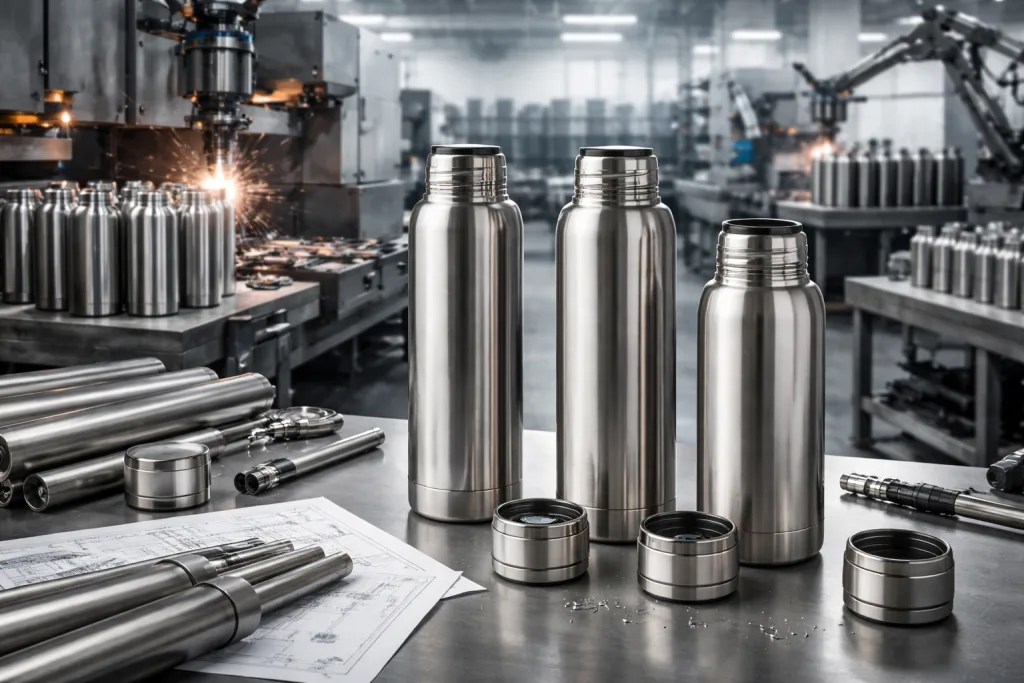
I’ll rewrite the section in-place, keep the HTML exactly as-is, and make the prose sound like a factory sales engineer wrote it.A stainless thermos looks simple on the shelf. Inside, it is unforgiving. If the vacuum fails, you just made a single-wall cup with a premium price tag. If the cap gasket is off by 0.2 mm, one leak can wreck a laptop bag. We run QC before the order goes out, not after the buyer flags a problem.
For factory direct orders from Zhejiang, we usually lock three checks. First, a pre-production sample with the final steel grade, finish, logo, and carton spec. Second, an inline check when the line hits 20-30%, because coating shade and print position drift fast. Third, a final random inspection under AQL. A lot of buyers ask for AQL 2.5 on major defects and 4.0 on minor defects; for a retail launch, that math can still be too soft.
Useful thermos customized inspection items include vacuum performance, leak testing, coating adhesion, logo rub resistance, lid thread fit, inner wall cleanliness, odor, carton drop test, barcode scan, and carton quantity. One batch we inspected had a barcode typo on the outer carton, and QC pulled the sample right away. For EU markets, add REACH documents for coatings and food-contact declarations. For U.S. children’s or youth-related programs, bring up CPSIA or ASTM early, especially if the bottle might land in a school bag.
Do not approve mass production from a glossy photo. Ask for a physical sample or a live video showing weight, dimensions, lid assembly, logo close-up, and packaging. A serious thermos manufacturer in China will not push back on that. The bad ones do. Good factories want clear standards because fuzzy standards turn into claims.
One practical rule: if the sample approval form does not mention steel grade, capacity, finish, logo method, packing, and test standard, it is not complete.
How To Brief The Factory
I’ll rewrite the section in-place, keep the HTML exactly as-is, and tighten the prose so it reads like a factory-side sales engineer wrote it.The fastest way to get a clean quote is to send a complete RFQ. A one-line note for “best price for custom thermos” gets you a guess, not a price. We see that go sideways when the buyer flags the PO later and the quote no longer matches the bottle on the line.
Put down capacity, bottle shape, steel grade, finish, logo method, logo size, packaging, target market, order quantity, delivery deadline, and Incoterm. If you need FOB Ningbo or Shanghai, say it. If you need DDP to a U.S. warehouse, say it too, but duty, freight, and last-mile charges move fast. For most outdoor retailers and promo brands, we quote FOB first because the math stays clean. On one order, the buyer wrote “logo size 30mm” on the brief and “30 cm” on the PO; QC pulled the sample, and we caught it before engraving.
Sample timing is usually 7-10 days for a logo sample on an existing bottle and 15-25 days for custom color or special components. Mass production is commonly 30-45 days after sample approval and deposit. Peak season before Q4 can add 7-14 days, especially for powder coating and gift box printing. A 2.0 mm coating spec sounds small on paper, but it is the sort of detail that saves a week later.
If you are checking thermos manufacturers or a new thermos vendor, ask straight questions: What is your monthly capacity? Which tests do you run as standard? Can you send BSCI or ISO 9001 files? What is your MOQ for Pantone coating? Who pays if final inspection fails? That tells you more than a polished PDF ever will. We ship enough to know the wrong question is “can you do it cheap?”—the better one is “can you hold the spec at 5,000 pcs?”
BottleForge Industrial is based in Hangzhou, Zhejiang, with production partners and finishing capacity built around export drinkware. We are not the right thermos option for every tiny run, but if you need 1,000-50,000 pcs of repeatable stainless thermos with real specs, factory direct is where the talk should start. One of our standard export cartons is 36 pcs per master case, and that kind of packing detail keeps freight disputes off the table.
Send your thermos brief for factory pricing
Share capacity, quantity, logo method, target market, and deadline. We will return a practical spec, MOQ, and FOB quote.
Frequently asked questions
What MOQ should I expect for thermos bottle factory direct orders?
For an existing stainless thermos mold, a realistic factory direct MOQ is 1,000 pcs for laser engraving or simple 1-color screen print. If you need a custom Pantone powder coat, private color lid, printed gift box, or multiple SKU colors, plan for 3,000 pcs per model or 1,000 pcs per color if the factory can combine production. New mold development usually starts around 5,000-10,000 pcs because tooling, trial production, and fit testing take time. Be careful with a thermos supplier offering 100 pcs factory custom pricing; it may be stock decoration, not true production customization.
How much does a custom stainless thermos cost from China?
For FOB China pricing, a 500 ml stainless custom thermos may land around USD 3.20-5.20 depending on steel thickness, lid, coating, and packaging. A 750 ml retail-grade bottle is often USD 4.50-7.20. A 1,000 ml model can run USD 6.00-9.50 before ocean freight, duty, and local delivery. Laser engraving, powder coating, color box packaging, and inspection add cost but also reduce brand risk. If two thermos suppliers quote more than 20% apart, compare steel grade, wall thickness, lid material, packing, and AQL terms before choosing the lower number.
Is laser engraving better than screen print for a promotional thermos?
Laser engraving is better for durability and a premium look because it removes the coating surface and exposes the metal beneath. It is a good fit for outdoor retail, executive gifts, and long-term employee programs. Screen print is better when you need a bright 1-color or 2-color logo at lower cost, especially above 3,000 pcs. Typical screen print add-on cost is USD 0.08-0.18 per unit, while laser is often USD 0.20-0.45 depending on logo size and position. For rough outdoor use, I would choose laser unless the brand color must be printed.
What testing should I require before shipping thermos bulk orders?
At minimum, require capacity check, vacuum insulation test, 24-hour leak test, coating adhesion test, logo rub test, lid torque or thread check, odor check, and carton drop test. For final inspection, many outdoor retailers use AQL 2.5 for major defects and 4.0 for minor defects. For EU sales, ask for food-contact documentation and REACH support for coatings. For North America, confirm FDA food-contact expectations and any retailer-specific packaging rules. A good thermos manufacturer should be able to document the tests with photos, records, and retained samples from the production batch.
How long does factory direct production usually take?
For an existing manufacturer thermos model, logo sampling usually takes 7-10 days after artwork confirmation. Custom color sampling may need 15-25 days because coating trials and color approval take longer. Mass production is normally 30-45 days after deposit and sample approval, assuming materials are available and packaging artwork is finished. Add 7-14 days during peak Q3 and Q4 production windows. Ocean freight to Europe or North America commonly adds 25-45 days port to port, depending on route. If your launch date is fixed, build the schedule backward before approving the order.