Key Takeaways
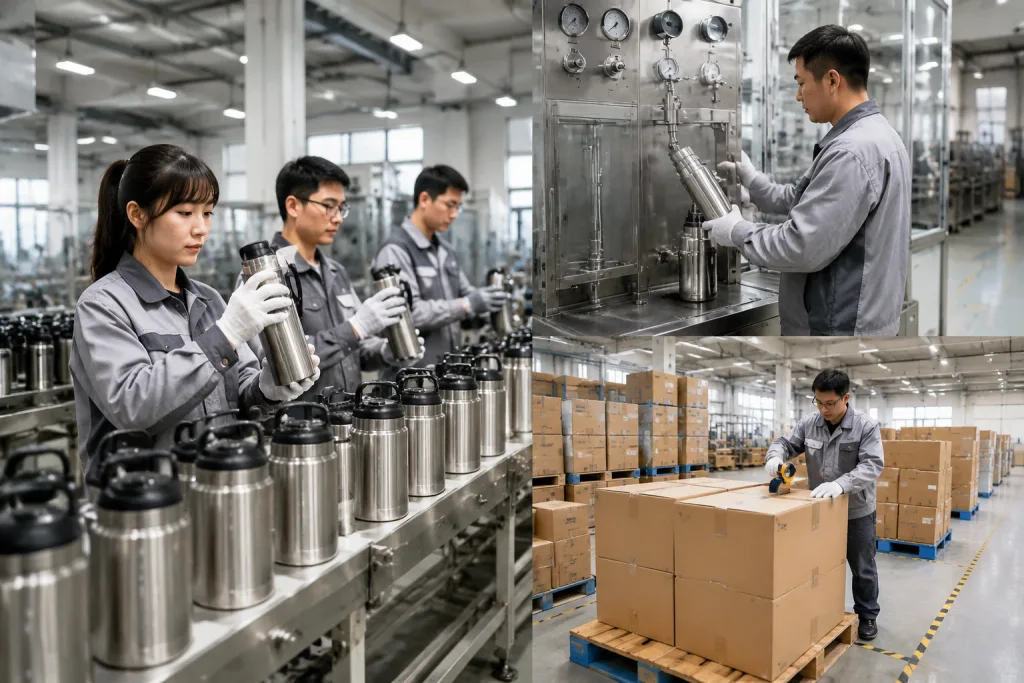
- A 0.35 mm liner wall and 0.40 mm outer wall are common for 304 stainless factory thermos builds.
- Typical MOQ for a thermos custom project is 1,000 units, with 35-45 day lead time after sample approval.
- Leak checks should be written as 100% air-pressure or inverted-water testing before carton packing.
- For export-ready promotional thermos orders, ask for AQL 2.5/4.0, REACH, and carton drop testing.
If you buy stainless thermos products for outdoor retail or promo runs, the sample is not where orders go bad. The trouble starts on the 20,000-unit line: one lot with weak vacuum, another with paint scuffing in transit, a third where lids pass hand-tight test but seep after 48 hours in a hot carton stack. We have seen distributors lose margin on that exact failure mode.
At BottleForge in Zhejiang, we run this pattern on China export jobs all the time. Buyers ask for a custom thermos, customizable thermos, or customized thermos, but the PO never pins down the weak spots, and QC pulls the sample too early to catch them. If you want bulk thermos supply that ships and stays off the returns pile, write the spec around the failure points, not around the brochure photo.
Where stainless thermos orders fail
I’ll rewrite the section in place, keeping the HTML structure and the listed specs intact, while making the prose sound like a factory-side sales engineer.The first fail point is plain: the buyer spec sounds complete, but it leaves the weak spots open. “Stainless steel, double wall, vacuum insulated, powder coat, logo, gift box” is not a control plan. We run orders like this all the time, and a 50,000-unit line still turns out rejects if nobody locks down the details that drive rework.
For a thermos bottle distributor, the usual trouble starts with dents at the shoulder, vacuum loss after welding, lid mismatch, coating chips at the mouth, and carton crush in export transit. QC pulled the sample on one 750 ml run and found the cap thread was off by 0.3 mm; the buyer flagged it before shipment, which saved a headache. Outdoor retail accounts catch the first two issues fast, while promo buyers only notice the last three when the giveaway stock lands looking cheap. This is the wrong question to ask: “what is the price?” The math does not work if the spec does not set shell thickness, weld finish, drop test height, leak test method, and print registration tolerance. If you are sourcing from a thermos supplier or thermos vendor in Zhejiang or elsewhere in China, ask for process controls first. Price comes second.
- Shell thickness: 0.35-0.45 mm for common 500-750 ml builds
- Vacuum hold: 24-hour check on first article samples
- Leak testing: 100% at assembly line, not random only
- Carton standard: at least 5-layer export carton for thermos bulk
Vacuum loss hides in welding
I’ll rewrite just the prose, keep every tag intact, and tighten it to sound like a factory-side sales engineer wrote it.Vacuum loss is the expensive failure because it slips past visual checks. The bottle can look clean, then the seam weld, shoulder weld, or base weld runs too hot and the insulation drops off. On a thermos line, the chamber can pass and still fail if the forming die drifts by 0.2 mm or the welding current walks off target.
Do not approve a thermos manufacturer on a hot-water retention claim alone. Ask for the test setup: start water temperature, room temperature, lid style, and test time. A proper manufacturer thermos report gives the numbers straight, like 6 hours above 68°C for a 500 ml bottle tested from 95°C in 20°C ambient. If they cannot write the conditions down, that number is sales copy, not QC. For thermos distributors running distributor thermos programs, this is the real point; buyers remember how the bottle performs after 8 hours in a truck, not the brochure line.
“If the vacuum is unstable, everything else becomes expensive decoration.”
For higher-value custom thermos orders, we ask for a 1% destructive sample check from the first lot and a full lot retention test on two cartons per shift. Sounds tight. On a 10,000-unit order, it still costs less than a 4% return rate, and QC pulled the sample from the same pallet every time.
Leakage starts with lids
I’ll rewrite the section in place, keep the HTML exactly as-is, and tighten the prose so it reads like a factory-side sales engineer wrote it.The lid is where a lot of promotional thermos orders go bad. Buyers want a thermos promotional item that still looks premium, and the lid is usually the first weak point. We’ve seen leaks come from the wrong gasket compound, sloppy thread pitch, or cap torque that drops after decoration. On one 5,000-piece run, QC pulled the sample at 22 N·m, then line workers were hitting 18 N·m in production. That gap is enough to fail a launch.
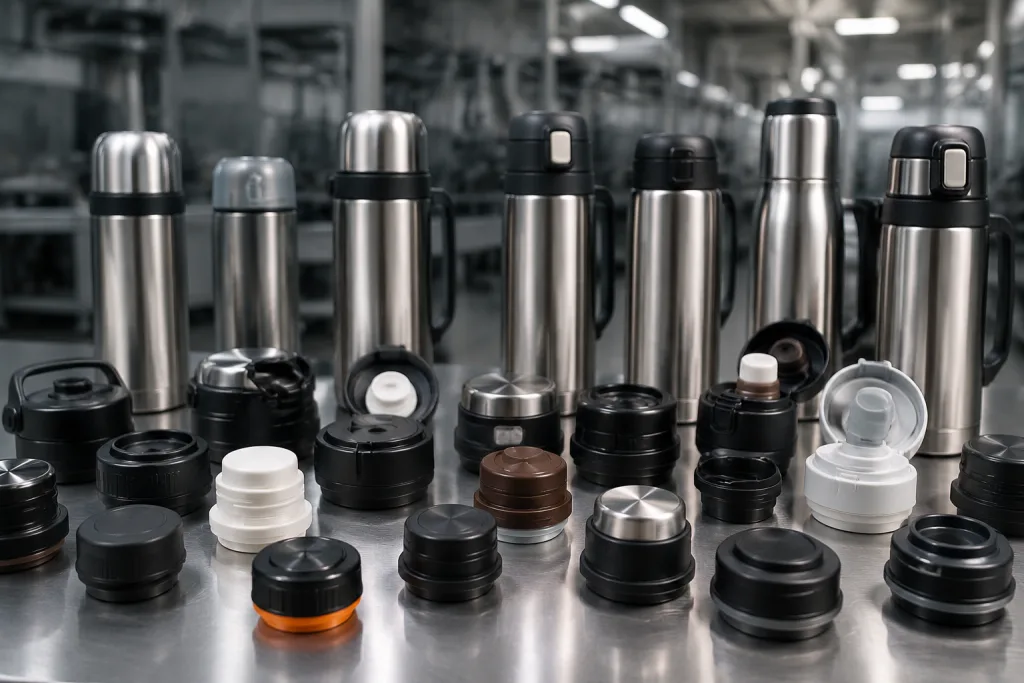
For a thermos bottle distributor, lock the lid stack before mass production: body, inner stopper or drinking lid, gasket, and torque standard. If the lid is PP, specify heat resistance and color stability. If there is stainless trim, check the exposed edge finish with a 10x loupe. The buyer flagged a hand-tightened sample once and said it was fine; it was not. Production runs loose when no one sets the number. Put the leak test in writing: invert for 30 minutes, shake for 20 cycles, then inspect the cap seam. That’s the right question to ask. For beverage retail, it keeps returns down. For giveaways, it stops complaints before they start.
- Specify gasket material and hardness
- Lock thread tolerance before mass production
- Test after logo printing and coating, not before
- Require torque targets for final assembly
Coating and print failures
I’ll rewrite the section in-place, keep the HTML structure intact, and sharpen the language so it reads like a factory-side sales note.Many buyers watch insulation and miss the surface. That is the first mistake. The outer finish is what the customer sees in hand and on the shelf. Powder coat can chip at the rim, pick up scratches in carton rub, or peel when pretreatment is weak. Silk-screen and laser logos behave differently on the line, so artwork approval has to match the actual thermos customizable method we run in production. Choose the wrong method and the bottle can pass thermal specs while failing at retail.
For outdoor retailers, abrasion matters more than a perfect gloss. For promo brands, the logo still has to read clean after 200 handling cycles. Ask your thermos supplier for cross-hatch adhesion results, tape pull results, and carton rub testing. On a China export run, we usually set up a sample board with the exact Pantone, gloss level, and logo location before production starts. If the job is thermos customized with gradient coating, soft-touch finish, or multiple imprints, get a signed pre-production sample. Digital renderings do not catch a 0.5 mm logo shift. QC pulled that sample before. The buyer flagged it. Good call.
China and Zhejiang factories can turn out strong finish quality, but only when the pretreatment line stays stable and the buyer stops changing artwork at the last minute. We run the line with a fixed schedule for a reason. A new file on day 3 can wreck a 5,000-piece order. That is the wrong question to ask if someone says finish is “just cosmetic.” It is where orders slip.
Packaging failure is part of product quality
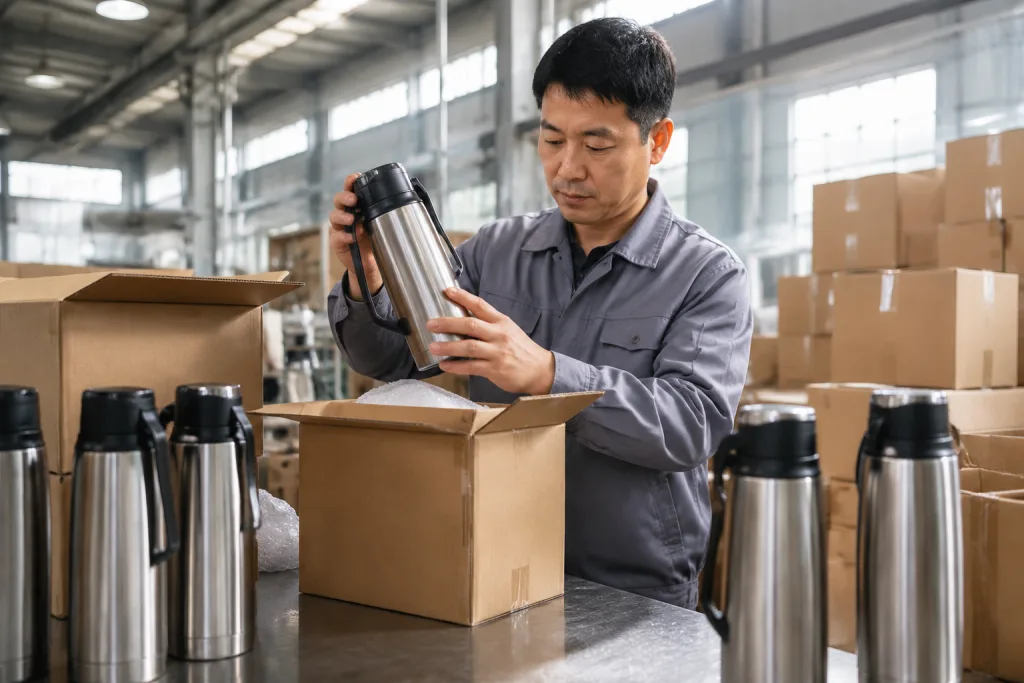
I’ll rewrite the HTML prose in a more lived-in sales-engineer voice, keep the tags exactly as-is, and make sure the packaging details stay concrete.Packaging is part of product quality. A dented thermos sitting in a broken inner tray is a failed product, full stop. We’ve seen bulk orders pass final QC, then get smashed in transit because the carton was 2 mm short, the divider was soft, or the insert had too much play. If you ship thermos bottles to North America or Europe, the pack has to survive consolidation, carton stacking, and rough handling at the warehouse.
Write the packing spec as a hard requirement: inner tray material, bottle direction, carton strength, drop height, and pallet pattern. For a 500 ml stainless thermos, we usually run 5-layer export cartons, 12-24 pcs per carton depending on bottle size, and a 1.5 m drop test on six faces for FBA or retail freight. One buyer once flagged a PO because the barcode was printed 8 mm too close to the seam; that kind of miss turns into a claim later. If you supply marketplaces, add FNSKU label position and scan check before sealing. A promotional thermos often goes in a gift box, but a gift box does not protect anything by default. If the outer carton flexes, the corners scuff and the complaint starts before the customer opens the lid.
Ask your thermos manufacturer for a shipping simulation on a pilot order. QC pulled the sample, shook the carton, and the loose insert showed up in 3 minutes. A proper packing test in China costs far less than replacing 500 crushed bottles at destination.
What to demand in QC paperwork
I’ll rewrite this section in-place, keep the HTML tags untouched, and make the prose read like a factory-side sales engineer wrote it.Good paperwork does not prove the bottles are fine, but bad paperwork wastes a week fast. A serious thermos factory should hand over a production control sheet, inspection report, material declaration, and test record with the lot number on every page. If you are buying from a thermos manufacturer or thermos suppliers in China, the documents must match the sample on the line: 304 or 316 stainless confirmation, a BPA-free statement for plastic parts, and a finish declaration for coating or printing. We’ve had buyers flag a PO typo where “316” was printed as “3016”; QC caught it before shipment, which saved a messy claim.
Use AQL the right way. For normal export lots, buyers often run AQL 2.5 for major defects and 4.0 for minor defects, but those numbers are useless if the defect list is vague. Call leaks, vacuum failure, lid mismatch, and coating peel major defects. Call light scuffing, small print shift, and carton marks minor defects. For a thermos bottle distributor, that split keeps the factory honest and keeps your customer from arguing over a lid that wobbles 1 mm. We run into this all the time: the buyer says “general appearance issue,” and the math doesn’t work until the defect is pinned down. Also ask for ISO 9001, BSCI if you need social compliance, and REACH for Europe. If your market is the US, add food-contact and material documents that match buyer demand.
One practical rule: if the factory cannot show a stamped lot sample and the matching inspection sheet within 10 minutes, they are not ready for bulk thermos export work. QC pulled the sample, checked the mark with a steel stamp, and the sheet matched in under 6 minutes on our last audit. That is the standard.
Spec your next thermos run before production
Send the target capacity, lid type, logo method, and carton plan. We will map the failure points and quote a practical bulk thermos solution.
Frequently asked questions
What MOQ should a thermos bottle distributor expect?
For a typical stainless thermos custom order, MOQ is usually 1,000 units per SKU and color. If you add multiple lid styles, the MOQ can rise to 3,000 units across variants or 1,500 per version. For simple logo-only promotional thermos runs, some factories will quote 500 units, but unit cost goes up fast. In Zhejiang, a well-run factory thermos line can still keep the lead time around 35-45 days after sample approval, provided artwork and packaging are frozen.
How do I check if a thermos actually holds vacuum?
Do not rely on the catalog claim. Ask for a hot retention test with stated conditions and a vacuum leak check. A practical factory method is a 24-hour water hold test plus inverted leak test on 100% of assembled units. For sample approval, request at least 6 pieces with different lid units. A solid thermos manufacturer will also show weld and seam consistency. If the bottle drops from 95°C fill water to under 68°C in 6 hours at room temperature, that tells you more than a marketing claim ever will.
What materials should I specify for stainless thermos bodies?
For most bulk thermos programs, 304 stainless on the inner liner is the standard choice, with 0.35 mm to 0.40 mm wall thickness commonly used. The outer shell often runs 0.35 mm to 0.45 mm depending on size and price point. If your market wants stronger corrosion resistance, 316 stainless can be used, but cost rises. Ask the thermos supplier for a material declaration on the steel grade and a clear statement on any plastic parts used in the lid.
What QC checks matter most for promotional thermos orders?
Focus on leaks, logo placement, surface scratch resistance, and carton damage. Promotional projects fail when the bottle looks fine in sample photos but arrives with chipped powder coat or a crooked logo. Use AQL 2.5 for major defects and 4.0 for minor defects, then define those defects clearly. For thermos promotional orders, also check barcode readability if the goods go through retail distribution or FBA. A clean carton is part of the product, not an extra.
Can you support Europe and North America compliance?
Yes, but the documents must match the market. For Europe, ask for REACH-related material declarations and confirm the coating and plastics used in the lid. For North America, buyers usually want food-contact confidence, BPA-free claims for plastic parts, and consistent lot traceability. A thermos distributor should also request production photos, inspection reports, and carton markings before shipment. If you need branded retail supply, we can prepare the product as a thermos customizable program with packaging labels and export cartons ready for your channel.