Key Takeaways
- A 500 ml thermos bottle customizable model usually lands at USD 2.80-5.20 FOB, with MOQ 1,000-3,000 pcs depending on print and lid.
- For outdoor retail, choose 0.35 mm inner wall, 304 stainless, and 6-8 hour hot retention at 20°C ambient.
- For promo programs, a 0.25-0.30 mm body and 1-color screen print keep thermos bulk pricing closer to USD 2.10-3.20.
- For serious branding, laser engraving lasts longer than screen print, and a good custom thermos should pass AQL 2.5 on appearance and leak tests.
If you are buying a thermos bottle customizable for outdoor retail or a promotional campaign, the wrong pick is easy. On paper, most stainless thermos models look the same: 18/8 body, vacuum insulation, powder coat, logo print. On the line, the details decide whether you keep margin or collect complaints. A 500 ml thermos with a 0.35 mm inner wall behaves differently from a 0.25 mm build once QC drops it, runs dishwash tests, or sends it through Amazon FBA cartons.
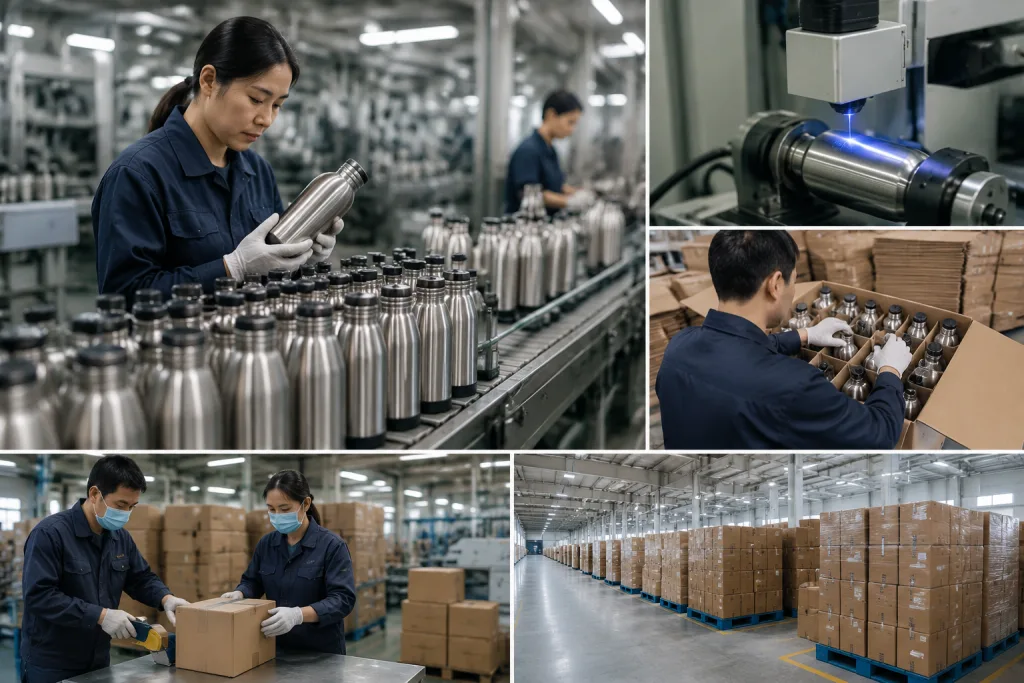
The better way to buy is spec first, not catalog photos. Match the use case, then match the decoration method. At our Zhejiang factory, we run more than 300,000 units a month across stainless drinkware, and most sourcing mistakes come from buyers mixing promo thermos orders with retail-grade custom thermos work. China has plenty of thermos suppliers; the real question is which factory thermos spec fits your channel, your target price, and your branding method.
Spec table: what changes the most
I’ll rewrite the prose in place, keep the HTML structure untouched, and make the wording sound like a factory-side sales engineer wrote it. Then I’ll return only the updated HTML.On a thermos bottle customizable line, the spec table tells you more than the catalog name. Two bottles can both be sold as a 500 ml stainless thermos, but one is built for thermos promotional giveaways and the other is meant to ride in a backpack for a full day. We run this split every week. Use the table below to separate brochure talk from a buying decision.
| Spec | Promo thermos | Retail thermos | What you should care about |
|---|---|---|---|
| Steel grade | 304 inside / 201 outside possible | 304 inside and outside | 304 is the safe baseline for a custom thermos |
| Wall thickness | 0.25-0.30 mm | 0.35-0.45 mm | Thicker walls improve feel and dent resistance |
| Capacity | 350-500 ml | 500-750 ml | Outdoor buyers usually want 500 ml or 750 ml |
| MOQ | 500-1,000 pcs | 1,000-3,000 pcs | Lower MOQ often means limited decoration choices |
| Lead time | 12-18 days | 20-30 days | Complex lids and color matching add days |
If you source from a thermos manufacturer in China, ask for measured wall thickness, not “thick body” claims. QC pulled the sample on the caliper at 0.28 mm, and that number tells the story. A true 0.35 mm inner liner usually weighs more and holds heat better than a thin promo bottle, but the math does not give you that upgrade for free. Buyers often get stuck on lid shape and miss the vacuum seam; that is the wrong question to ask. Clean welding and a steady polish finish matter more than one extra logo color.
Promo models versus retail models
I’ll keep the HTML structure intact and rewrite only the prose, with a more field-tested sales tone and a few concrete factory details.A side-by-side quote shows the real buying logic. A promo thermos is built for reach: lower unit price, faster logo work, simpler packing. A retail custom thermos is built for repeat use: stronger insulation, cleaner finish, and fewer dent or leak claims. If you are a distributor thermos buyer, pick the channel first. Don’t ask the line to do both jobs at once.
Where promo wins
- Budget campaigns need thermos bulk pricing under USD 3.00 FOB, and we can hold that if the MOQ stays tight.
- Screen print and pad print stay cheap and fast for 1-2 logos; QC can clear that on the first carton check if the artwork is clean.
- Carton packing stays simple for distributor thermos programs, which keeps labor down on the packing table.
Where retail wins
- Powder coat, laser engraving, and higher-grade lids lift shelf value; a 1.0 mm shell with a cleaner cap thread changes the feel fast.
- Hot retention is often 2-4 hours better on a tighter retail spec, and that is before the buyer starts comparing test cups.
- Returns drop when you use a better gasket and stricter vacuum checks; we have seen one loose seal turn into a whole PO dispute.
If your customer is paying under USD 8 retail, a clean promo thermos can work. If the shelf price is USD 14-24, buyers expect a better-feeling thermos customized for daily use, not a giveaway bottle with a logo.
Do not force one model to cover both channels. A thermos factory can quote the same body for promo and retail, but the finishing cost and failure rate move fast once you step up the spec. We’ve seen the math go sideways on a 500 pcs sample run when the buyer flagged a lid typo on the PO and expected retail looks on a promo budget. This is where a practical thermos supplier earns its fee: it says the spec is too thin for the channel.
Logos, surfaces, and durability
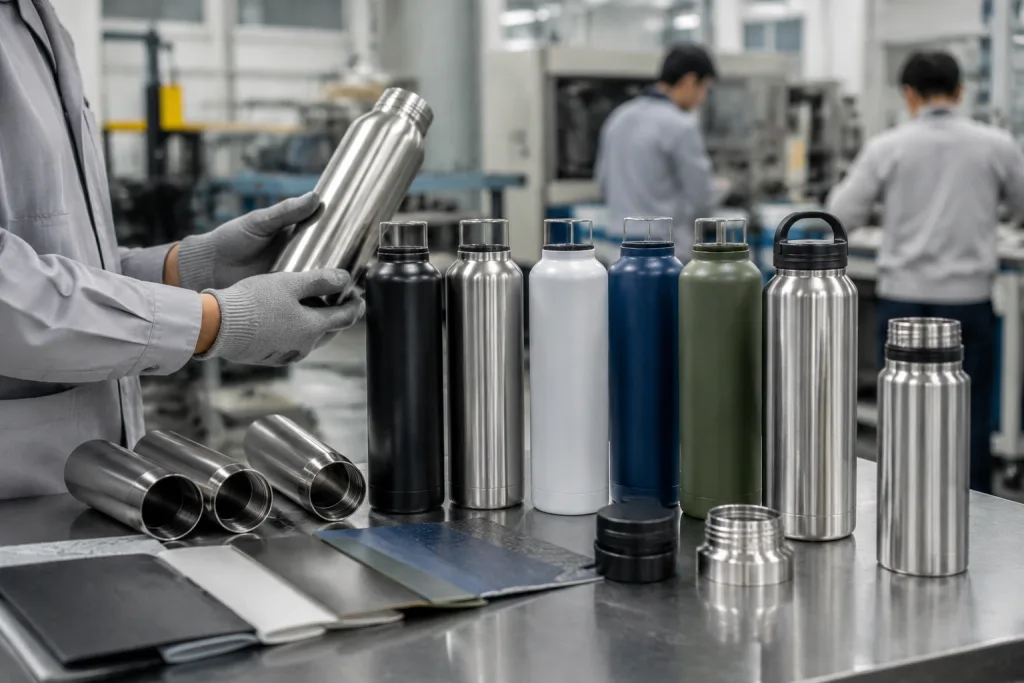
I’ll rewrite the section in-place, keep the HTML intact, and tune the prose to sound like a factory sales engineer with sharper specifics and fewer AI tells.Decoration is where a thermos bottle customizable order either looks sharp or looks cheap. The right method depends on use, not taste. A laser logo on brushed stainless holds up better in cartons, on pallet corners, and after a few drops on the line. Screen print still works for short runs, especially when the buyer wants low-cost thermos custom branding across 3,000 to 20,000 pcs.
- Laser engraving: best for long-life branding, usually USD 0.20-0.45 extra per unit.
- Screen print: best for bold color logos, usually USD 0.08-0.18 extra per color.
- Heat transfer: useful for full-wrap art, but more sensitive to wear.
- Debossed cap marks: good for subtle premium branding, often on larger custom thermos programs.
For outdoor retailers, laser engraving plus powder coat is the safer call. For promo brands, one-color screen print on a matte bottle keeps the cost under control and still looks like a proper promotional thermos. We run a 24-hour tape test and a 50-cycle rub test on decorated samples because “all decorations are possible” is the kind of promise that goes sideways fast. QC pulled the sample, the buyer flagged a logo edge issue, and we caught it before the PO moved.
If you have to choose between color and durability, pick durability. A decorated thermos customized badly looks tired after one season, and that hurts repeat orders more than a small FOB increase ever will. The math doesn’t work the other way. One faded logo and the buyer is back asking for a reprint.
Use-case fit for outdoor buyers
I’ll rewrite the section in-place, keep the HTML untouched, and make the prose sound like a factory-side sales engineer wrote it.Outdoor retailers should buy from use case backward. Hikers, anglers, campers, and field crews do not need the same bottle. A thermos bottle customizable for hiking should stay light, fit a cup holder, and take a few knocks in a pack. A thermos promotional piece for a branded event can stay plain if the job is reach, not daily carry.
| Use case | Best capacity | Best finish | Buyer note |
|---|---|---|---|
| Day hikes | 500 ml | Powder coat + laser | Light, compact, easy to clean |
| Camping | 750 ml | Matte paint + wide mouth | Hot beverage use and easier pouring |
| Travel retail | 350-500 ml | Gloss or satin | Fits bags and cup holders better |
| Promotional gifting | 350 ml | Screen print | Lowest landed cost |
For outdoor assortments, a manufacturer thermos with a wide mouth and a tight screw lid usually sells better than a decorative shape with weak grip. We run a leak test on every production lot; one sample check is not enough, and the buyer flagged it once after a 12-hour transit test in a 48-pack master carton. Our AQL 2.5 for appearance and leakage is standard for export work out of Zhejiang, and QC pulled the sample with a 0.8 mm lid gap on the line. If you ship into North America, match carton size and drop-test results to the freight plan, especially for Amazon FBA. The math does not work otherwise.
Outdoor buyers often ask for more colors than they need. That is the wrong question to ask. Start with black, white, and one brand color. Add a second color only after sell-through proves the setup change pays back, usually after 2 orders, not before.
Cost, MOQ, and lead time reality
I’ll rewrite the section in-place, keep the HTML exactly as-is, and make the pricing/MOQ/lead-time copy sound like a factory-side sales engineer.Buyers often ask for a custom thermos quote before they lock the spec. That slows everything down. Price moves with lid tooling, body finish, and decoration method. A basic 500 ml stainless thermos with one-color print usually lands at USD 2.10-3.20 FOB at 1,000 pcs. Add powder coating, laser marking, and a better cap, and the number shifts to USD 3.40-5.20. A unique lid or gift box pushes it higher. We’ve seen a PO typo on “500 ml” turn into a 470 ml sample fight, and that one line burned two days on the line.
Typical MOQ from a thermos supplier in Zhejiang looks like this:
- Stock shape with logo: 500-1,000 pcs
- Color change on stock shape: 1,000-3,000 pcs
- New lid or packaging: 3,000-5,000 pcs
Lead time is usually 12-18 days for a simple thermos custom order and 20-30 days when you add color matching, new tooling, or a retail box. If a supplier promises 7 days for a full custom build, ask what they are skipping. QC pulled the sample on a leak test at 48 hours, and that is where rushed jobs start to crack. We can move fast in China, but print curing, vacuum checking, and packing still take real hours. A good thermos manufacturer gives you a sampling date, mass production date, and inspection window. The math does not work any other way.
From a cost-control view, the smart move is to keep the body standard and change only the logo, lid color, or carton. That keeps thermos bulk orders profitable without dragging the job into a tooling mess. We run a 304 stainless line this way all the time, and it saves both sides grief.
What to ask before you place order
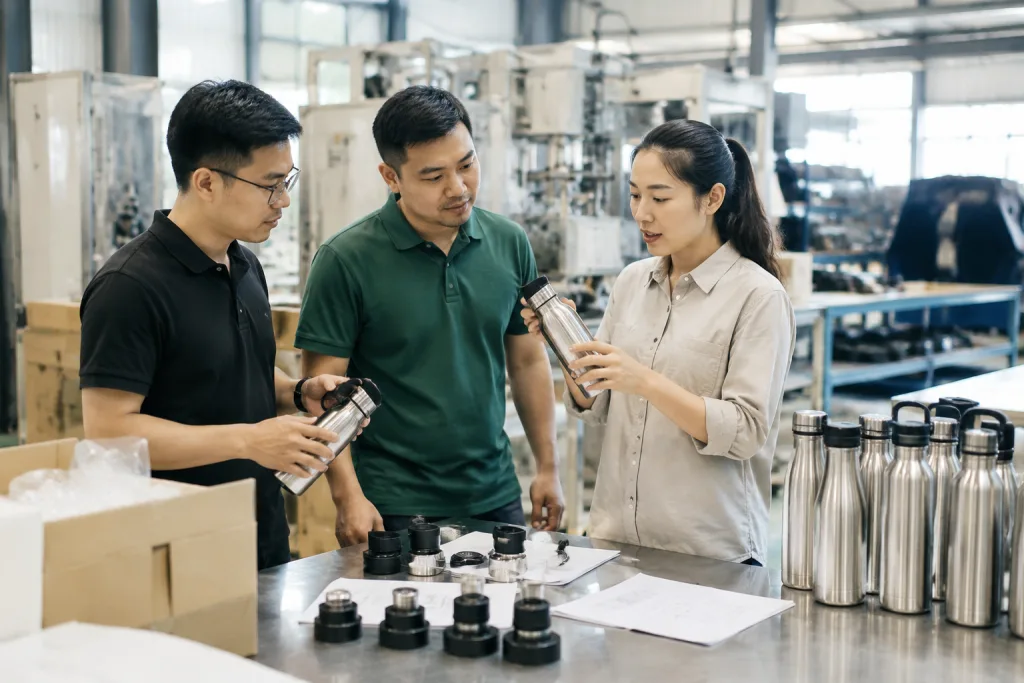
I’ll rewrite this section in-place, keep the HTML intact, and tighten the copy so it sounds like a factory-side sales engineer.If you want fewer surprises, ask direct questions before PO. Do not ask, “Can you customize it?” Every thermos factory in China will say yes. Ask the questions that show the real process behind the answer. We run this on the line every week, and the buyer who asks late pays for it.
- What is the exact stainless grade inside and outside?
- What is the measured wall thickness in mm?
- Can you share leak test, insulation test, and dishwasher guidance?
- Which decoration method fits my channel: promo or retail?
- What is your inspection standard: AQL 2.5 or stricter?
Ask for a sample with the final logo method, not a blank body. A laser sample and a screen print sample age in different ways, and QC pulled the sample to prove it. If you sell through distributors, ask whether cartons can be labeled for distributor thermos programs and whether inner packs can be barcoded. If you sell online, ask for FNSKU labeling and carton dimensions before the order is confirmed. We have seen a PO typo on carton size turn into a freight bill fight.
A serious supplier thermos partner will answer in numbers, not adjectives. Good answers sound like this: 304 stainless, 0.35 mm inner wall, 24-hour cold retention tested under set conditions, 1,000 pcs MOQ, and 15-20 day delivery for stocked components. Anything vaguer than that is a warning sign. The math does not work if they dodge the numbers.
Get a thermos quote built to your channel
Send your capacity, logo method, target price, and MOQ. We’ll match the right thermos bottle customizable spec from our Zhejiang line.
Frequently asked questions
What is the best thermos bottle customizable option for outdoor retail?
For outdoor retail, a 500 ml or 750 ml stainless thermos with 304 inner and outer walls, 0.35 mm thickness, powder coating, and laser logo is the safest choice. It usually sits around USD 3.40-5.20 FOB at 1,000 pcs, depending on lid and packing. That spec gives you a better hand feel, less denting, and more consistent insulation than a thin promo build. If you need a lower price, keep the same body and simplify the lid instead of cutting wall thickness.
How much does a custom thermos usually cost from China?
A basic custom thermos from China often starts around USD 2.10-3.20 FOB for 500 ml at 1,000 pcs with simple print. Once you add powder coating, laser engraving, better lid hardware, or retail packaging, you are usually at USD 3.40-5.50 FOB. Thermos bulk orders can be cheaper if you repeat the same body across multiple colors. Zhejiang factories can also quote faster when you use stock molds and standard packaging.
What MOQ should I expect from thermos manufacturers?
For stock-shape thermos custom orders, MOQ is often 500-1,000 pcs. For color changes or extra decoration, 1,000-3,000 pcs is more realistic. If you want a new lid, unique packaging, or a fully custom structure, thermos manufacturers usually ask for 3,000-5,000 pcs. In our Hangzhou, Zhejiang operation, standard lead time is 12-18 days for simple orders and 20-30 days for more complex builds.
Is laser engraving better than screen print on a promotional thermos?
For a promotional thermos, screen print is cheaper and works well for short campaigns or bold branding. Laser engraving costs more, usually USD 0.20-0.45 per unit extra, but it lasts longer and resists abrasion. If your product will sit in outdoor retail or get handled daily, laser is the safer choice. If you need the lowest landed cost and the run is purely for events, screen print is usually enough.
How do I check if a thermos supplier is reliable?
Ask for stainless grade proof, wall thickness, insulation test data, and an AQL inspection plan. A reliable thermos supplier will tell you whether the body is 304/304 or 304/201, what the exact lead time is, and whether they can support carton labeling or FNSKU stickers. You should also request samples with the final decoration method. A good supplier thermos partner gives numbers, not vague promises, and can support repeat orders from the same mold without quality drift.