Key Takeaways
- A practical thermos bottle custom made MOQ starts at 1,000 pcs per color for most stainless models
- 304 stainless inner wall, 201 or 304 outer wall, and 0.4-0.5 mm gauge are common commercial specs
- Normal custom thermos lead time is 30-45 days after artwork and pre-production sample approval
- Use AQL 2.5/4.0 inspection and verify vacuum performance, coating adhesion, and cap leakage before shipment
You are not buying a bottle. You are buying a line that has to survive freight, shelf handling, dishwasher arguments, logo approvals, and a customer who expects hot coffee after 6 hours on a trail. A thermos bottle custom made order looks simple until the quote sheet starts hiding steel grade, cap material, vacuum loss rate, carton drop tests, and logo setup fees. We run this kind of order every week, and the first sample usually tells the truth fast.
From our Hangzhou, Zhejiang factory, we see the same mistake with outdoor retailers and promo brands: buyers compare unit price before they compare specifications. That is the wrong order. A 20 oz custom thermos at USD 3.20 and one at USD 4.10 can be different products. China can make both. Your job is to lock the spec before you pay a deposit; otherwise QC pulls the sample, the buyer flags the lid fit, and the math stops working.
What are you really specifying?
I’ll rewrite the section in place, keeping the HTML tags and structure intact while making the copy sound like a factory-side sales engineer wrote it.When you ask for a thermos bottle custom made, the first thing we ask is not color or logo. It is use case. A hiking bottle for retail needs dent resistance, a lid you can open with gloves on, and a carton that still looks good after 12 days in transit. A promotional thermos for an insurance roadshow is a different job: clean print area, short lead time, and a hard price cap under USD 4.00 FOB China. We’ve seen buyers mix those two up, and the math does not work.
Start with capacity and shape. We ship a lot of 350 ml, 500 ml, 600 ml, 750 ml, and 1,000 ml bottles. For North America, 17 oz, 20 oz, 24 oz, and 32 oz sell cleanly because customers know the sizes. Europe usually wants metric on the box and the carton. A proper custom thermos brief should state capacity tolerance, mouth diameter, overall height, base diameter, and whether it has to fit a car cup holder. That last one sounds small, but QC pulled a sample that was 2 mm too wide last month, and the buyer flagged it fast.
Then lock down the build. For a mid-range manufacturer thermos, we normally quote 304 stainless steel inner wall, 201 stainless outer wall, double-wall vacuum insulation, food-grade PP cap, silicone seal ring, and powder coating or spray painting. For premium outdoor retail, 304 inner and 304 outer is cleaner, holds up better on corrosion checks, and is easier to sell through on the shelf. For budget bulk thermos programs, 201 outer can work if the coating line is stable and the wall thickness stays at spec; one PO typo on “0.45 mm” versus “0.35 mm” once caused a full re-approval, so this is the part to pin down early.
Checklist: capacity, steel grade, wall thickness, lid type, coating, logo method, packaging, compliance market, target FOB price, and launch date.
How low can MOQ go?
I’ll rewrite the section in-place, keep the HTML structure unchanged, and tighten the MOQ language so it reads like a factory-side sales note.Buyers ask this first: “Can you do 300 pcs?” Sometimes yes, but the math usually does not work at the price target. For a standard customizable thermos on an existing mold, 1,000 pcs per color is the clean MOQ. Laser engraving on stock bottles can run at 300-500 pcs. New powder coat color, PMS matching, retail box printing, or mixed cap colors usually start at 1,000 pcs. If you want a new mold, plan on 3,000-5,000 pcs and tooling from USD 1,500 to USD 6,000, depending on lid parts.
At BottleForge Industrial in Zhejiang, our stainless drinkware line runs about 650,000 units/month across thermos bottles, tumblers, and sports bottles. That number does not make every small order efficient. A thermos factory still has the same setup pain: the coating line needs a 20-minute purge, QC pulls first samples, logo fixtures get set, carton files get checked, and the packing table gets booked. We’ve seen a 500 pc order take almost the same pre-production time as 2,000 pcs.
For distributors, the smarter move is a shared base model. One distributor thermos body can carry different logos and sleeves without changing the core spec. If you are a thermos distributor or running distributors thermos programs, this keeps MOQ under control and avoids a weak generic bottle. Split 5,000 pcs into four logo versions if the coating color, cap, and carton stay the same. The buyer flagged it once on a PO typo, and we had to recheck every carton mark before shipping.
- Lowest friction: stock color plus laser logo, 300-500 pcs.
- Normal custom: PMS coating plus logo, 1,000 pcs per color.
- Retail program: custom box, barcode, inserts, 2,000-3,000 pcs.
- New shape: private mold, 3,000-5,000 pcs minimum.
Which logo method should you choose?
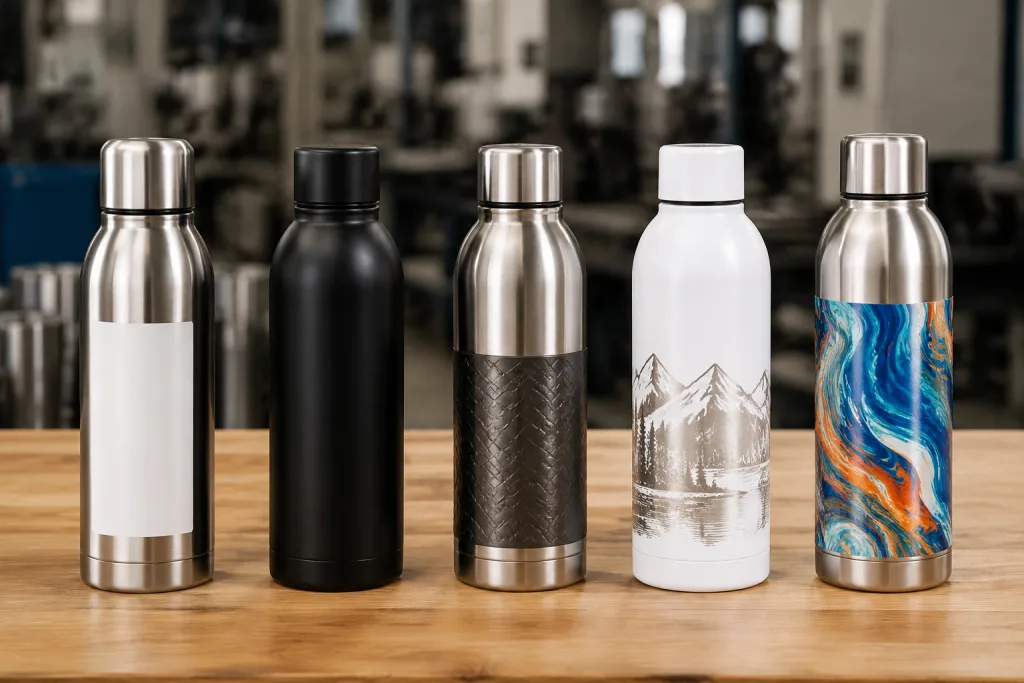
I’ll rewrite the section in-place, keeping the HTML structure and tightening the sales-engineer tone. Next I’m checking for any repo-specific instructions, then I’ll patch the prose only.Logo decoration is where a lot of thermos custom jobs go off track. Cheap is not the same as right. Laser engraving stays sharp on stainless steel and powder-coated bottles, and the line likes it because the mark does not peel. It burns through the top layer and shows the metal below, so outdoor brands usually pick it for a permanent mark. Setup runs about USD 30-80, and the unit cost is usually USD 0.08-0.25, depending on logo size.
Silkscreen printing works for one-color logos on smooth cylindrical areas. We ship plenty of thermos promotional orders that way, but the result depends on coating quality, ink, and curing temperature. For multi-color logos, heat transfer or UV printing can work, though QC pulled the sample and we had to reject a batch once because the gradient broke on the curve. If your brand has a strict Pantone target, ask for a physical sample, not a photo under factory lights. That is the wrong question to skip.
Embossed or debossed logos need tooling, so they only make sense on larger thermos customized orders. They look premium on silicone grips, metal badges, and lid inserts, but they add cost and lead time. Plan on 7-10 extra days for tooling and sample sign-off. A customized thermos for retail also needs logo position checked with the lid tightened; if the spout faces front and the logo turns 30 degrees sideways, the buyer will flag it and the pack shot looks sloppy. We have seen that go sideways more than once.
Logo checklist before approval
- Send vector artwork in AI, EPS, or PDF format.
- Define logo size in millimeters, not “medium size.”
- Confirm placement from bottom edge or top shoulder.
- Test adhesion with 3M tape and cross-hatch where applicable.
- Check barcode, FNSKU, or retail SKU labels separately from brand decoration.
What should the bottle cost?
I’ll keep the HTML exactly as-is and rewrite only the prose, with tighter sales-floor language and concrete cost details.A fair FOB China price comes down to size, steel grade, coating, cap structure, packaging, and order volume. For a 500 ml stainless supplier thermos with 304 inner and 201 outer, FOB often sits around USD 3.20-4.20 at 1,000-3,000 pcs. A 750 ml outdoor bottle with 304 inner and 304 outer, powder coating, carry handle cap, and retail box usually lands around USD 5.20-7.80. A 1,000 ml heavy-duty model can go above USD 8.50 if the lid has 4-6 parts or the coating needs harder abrasion resistance.
Watch quotes that come in 15-25% under market. We’ve seen that move before: thinner steel, lower vacuum pass rate, lighter cap, cheaper silicone, weak carton, or no real inspection. A thermos vendor can cut cost in clean ways, but you need to know what got cut. Switching from 304/304 to 304/201 construction may save USD 0.20-0.45. Dropping from an individual color box to a white box may save USD 0.12-0.35. Going from 0.5 mm wall thickness to 0.35 mm lowers the price, and QC will also flag more dent marks at the drop test table.
Ask your thermos supplier for a costed option table, not one take-it-or-leave-it number. Good thermos suppliers should quote the same spec across logo method, carton type, coating grade, lid upgrade, and inspection level. We run this comparison on the line with a simple sheet, because the math does not work if one factory is pricing AQL 2.5 and another is pricing a loose check. If you are comparing thermos manufacturers, make them quote the same drawing and the same packing list; otherwise you are comparing assumptions, not factories.
Practical rule: if the bottle must sit in outdoor retail at USD 24.99-34.99, do not build it like a USD 2.99 giveaway.
How do you verify quality?
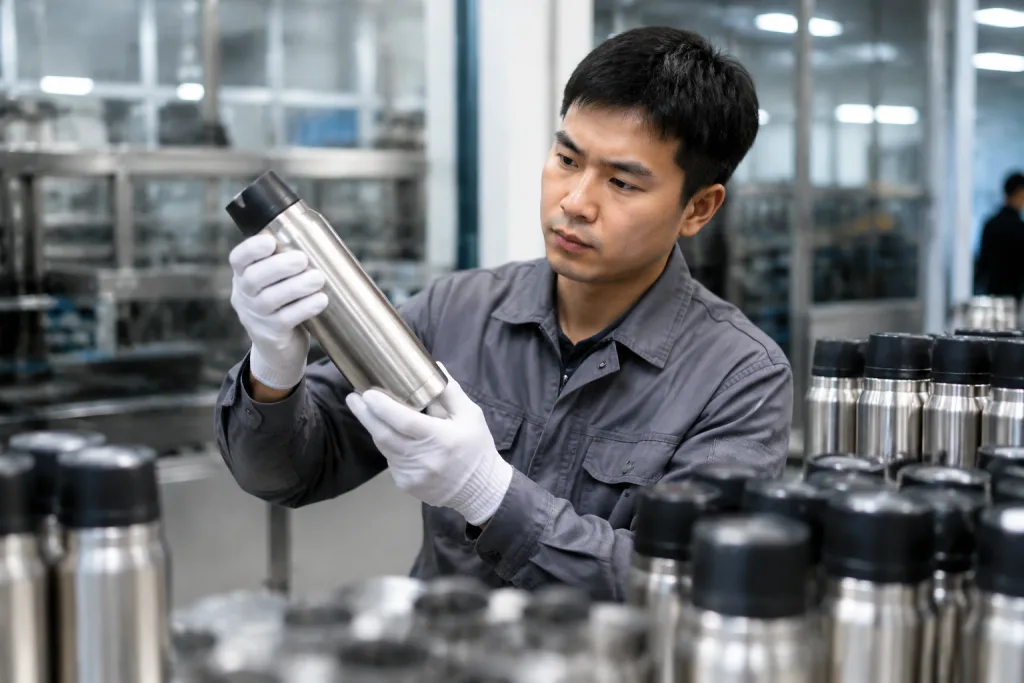
I’ll rewrite the section in-place, keep every tag and number intact, and make the prose read like a factory-side sales engineer wrote it.For a stainless manufacturers thermos order, quality control starts before mass production. We run the pre-production sample with the same steel grade, coating, cap material, logo process, and carton structure that will go into bulk production. Do not sign off on a “similar sample” and hope the line will magically match it. We lock one signed golden sample at the factory, then QC pulls it for line comparison.
For performance, ask for vacuum insulation testing. A standard check is 95°C water in the bottle, cap closed, then temperature recorded after 6, 12, or 24 hours at room temperature. The pass mark depends on bottle size and mouth opening, so put the number in writing. A 500 ml narrow-mouth bottle may need to stay above 60°C after 12 hours. Wide-mouth bottles dump heat faster. For cold retention, we also run ice water tests, and that is the cleaner way to support outdoor retail claims.
For safety and compliance, Europe normally asks for LFGB, REACH, and food-contact documents. North America may require FDA food-contact conformity, California Proposition 65 review, and sometimes ASTM or CPSIA checks if the bottle is sold as a kids item. Your factory thermos partner should know which papers are lab reports and which are supplier declarations. Mixing those up is how buyers lose a week on email. The math does not work.
Use third-party inspection when the order matters. AQL 2.5 for major defects and 4.0 for minor defects is common. Critical defects should stay at zero. Inspectors should check leakage, coating scratches, dents, logo position, cap threading, odor, carton drop condition, and quantity. We’ve seen a buyer flag a PO typo on carton count only after packing started. If you are buying thermos bulk for a fixed launch, that is already too late.
What timeline is realistic?
I’ll rewrite the section in-place, keep the HTML structure unchanged, and tighten the timeline language so it reads like a factory-side sales note.A standard thermos bottle custom made order needs 30-45 days after deposit and sample sign-off. That clock starts after the buyer approves the pre-production sample, not when the first email lands. If you want a September retail drop, late July is already tight unless you are taking stock bottles and booking air freight. We’ve seen this go sideways when the buyer flags the logo cure on day 28 and the line has to stop for rework. A serious thermos manufacturer will push back on a fantasy date because a bad coating bake leaves fingerprints, dust marks, and weak adhesion.
Here is the timeline we run. Quotation and spec check takes 2-4 working days if the brief is clean. Existing sample dispatch takes 3-7 days by courier. A custom pre-production sample usually takes 7-12 days for laser or silkscreen, and 12-18 days for PMS powder coating or new packaging. Mass production is usually 25-35 days for 1,000-10,000 pcs. Sea freight to the US West Coast is often 18-28 days port-to-port, while Europe usually runs 30-40 days depending on route and season. Add customs clearance, inland trucking, and warehouse receiving. QC pulled one sample at 2.1 mm neck finish once, and that kind of issue can add a week if it shows up late.
If you sell through marketplace or retail distribution, carton data has to be locked early. Confirm carton dimensions, gross weight, HS code, country of origin marking, barcode, FNSKU if needed, and pallet loading. A good thermos factory in Zhejiang can send carton specs before mass production, but the final packed weight still needs a check on the finished sample. The buyer flagged a 0.8 kg carton limit on one PO after the boxes were already printed; that is the wrong question to ask at the end. Do not wait until the container is booked to find out the master carton misses your warehouse limit.
- Fastest path: stock bottle, laser logo, neutral box, about 12-18 days.
- Standard path: custom color, logo, color box, about 30-45 days.
- Private mold: engineering, tooling, samples, production, about 75-120 days.
Send your thermos brief for a factory quote
Share capacity, quantity, logo, packaging, and target market. We will return a practical FOB China option with MOQ and lead time.
Frequently asked questions
Can I make a custom thermos with my own shape and lid?
Yes, but a new shape is a tooling project, not a normal logo order. For a custom body and lid, expect 3,000-5,000 pcs MOQ, tooling from about USD 1,500 to USD 6,000, and 75-120 days before mass production is ready. The lid is usually the harder part because it must pass leakage, torque, food-contact, and durability checks. If your launch budget is below USD 15,000, it is usually smarter to start with an existing mold and customize the color, finish, logo, and packaging.
Is 304 stainless steel necessary for a bulk thermos order?
For the inner wall, yes, 304 stainless steel is the practical standard for food contact and corrosion resistance. For the outer wall, 201 stainless steel can be acceptable on promotional or mid-range thermos bulk orders if the coating is good and the product is not positioned as premium outdoor gear. For retail outdoor bottles, 304 inner and 304 outer is safer. The price difference is often USD 0.20-0.60 per unit depending on size and steel market conditions, but it reduces complaints about rust spots and perceived quality.
What inspection standard should I use before shipment?
Use AQL inspection with zero tolerance for critical defects, AQL 2.5 for major defects, and AQL 4.0 for minor defects. For a 3,000 pc order, a third-party inspector may check around 200 units depending on the sampling plan. The checklist should include leakage, vacuum performance, coating scratches, logo accuracy, cap fit, odor, carton strength, barcode scanning, and quantity. If the order is for outdoor retailers, add carton drop testing and coating adhesion checks. Inspection usually costs USD 200-350 per man-day in China.
Can one order include several logo versions for distributors?
Usually yes, if the bottle color, cap, packaging structure, and production schedule stay consistent. For example, a 5,000 pc distributor thermos order may be split into five logo versions of 1,000 pcs each. If every distributor wants a different coating color and custom box, the factory will treat them more like separate orders. That affects MOQ, setup fees, and lead time. For thermos distributors, the cleanest model is one approved base product with variable laser engraving or printed sleeves.
What information should I send to get an accurate quote?
Send capacity, target market, order quantity, preferred steel grade, lid type, coating finish, logo method, packaging type, compliance needs, delivery country, and target launch date. If you have a target FOB price, say it directly. A useful RFQ might say: 20 oz, 304 inner/201 outer, powder coated black, laser logo 45 mm wide, color box, 2,000 pcs, REACH and FDA documents, FOB Ningbo. With that level of detail, a thermos supplier can quote in 24-48 hours instead of asking five follow-up questions.