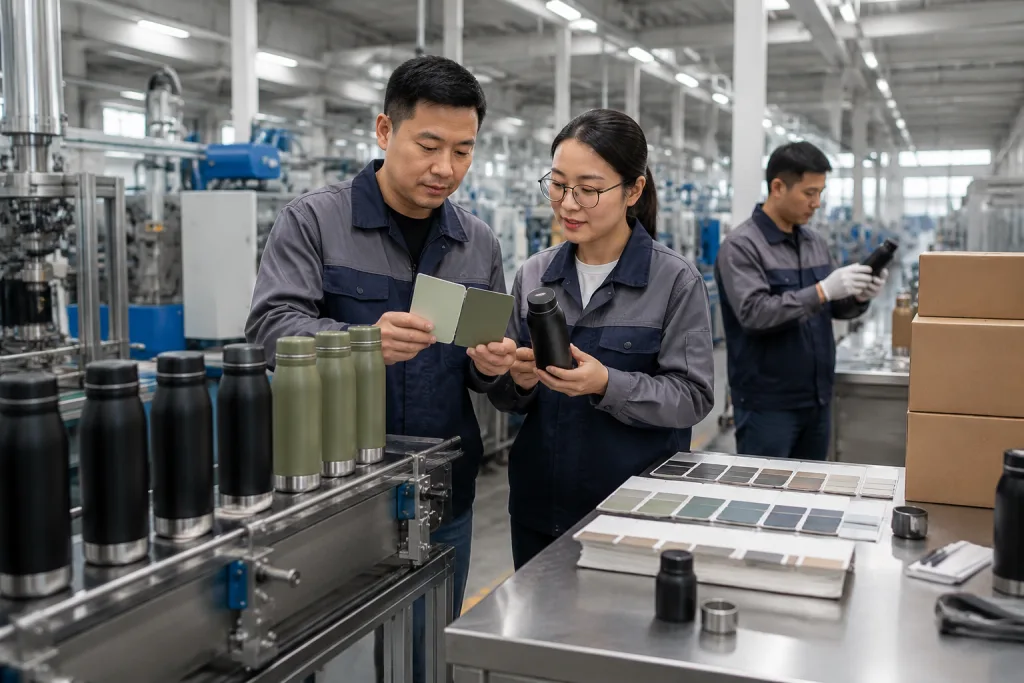
Key Takeaways
- Thermos bottle custom color orders usually need 500-1,000 pcs MOQ and 25-35 days lead time after sample sign-off.
- A Pantone target with a Delta E tolerance of 2.0 is more realistic than asking for an exact screen match on stainless steel.
- Powder coating is typically 60-90 microns; thin paint jobs under 40 microns chip faster in distributor thermos programs.
- For bulk thermos purchases, approve color on a pre-production sample, then inspect at AQL 2.5 before shipment.
You are not buying a color swatch. You are buying a production result that has to survive ocean freight, carton rub, and the customer twisting open the lid on day one. That is where thermos bottle custom color orders go wrong: the buyer treats it like an artwork brief, while the line is running powder coat, silk-screen, laser marking, and packing with different failure points at each station. One wrong call, and you get a pallet of mixed gloss or shade drift.
If you are sourcing for outdoor retail or a promo run, spec the thermos bottle custom color the same way we do on the shop floor: coating system, gloss level, Pantone tolerance, sample sign-off, and inspection checkpoints. In Zhejiang, we see this every week on a 300,000-unit/month thermos line, and the buyers who get clean results ask QC questions first, not marketing questions. The right question is not “can you match the color?” It is “what is the acceptable delta, and who checks it at 10 p.m. when the batch comes off the oven?”
Start With the Buyer Scenario
I’ll rewrite the section in-place, keeping the HTML tags and structure intact while tightening the copy to sound like a factory-side sales engineer.Picture a European promo buyer placing 8,000 stainless units for a spring outdoor campaign. They want a thermos bottle custom color in matte olive, a black lid, and a small laser logo. Sounds simple. On the line, it is three calls: body coating, lid resin color, and decoration method. If one call is fuzzy, QC ends up sorting mixed-good and mixed-bad cartons. That is how custom thermos jobs drift off spec.
The buyer should start with use case, not artwork. A retail line sitting next to hiking bottles needs a tougher finish than a one-time giveaway. A promo thermos can live with a lighter cosmetic spec, but a distributor program sold through three channels needs color repeatability from lot to lot. We run this every week in Zhejiang, and the factories that do it well ask for use environment, target shelf price, and reorder plan before they pull the shade card.
For the order sheet, lock down four items first: body material, color system, decoration, and packing. A clean spec reads like this: 304 stainless body, 500 ml, matte powder coat, Pantone 417 C target, lid in black PP, one-color logo, individual box, export carton of 24 pcs. That gives the thermos factory numbers to work with, not a loose brief. The buyer flagged it once on a PO because “olive green” had no code, and we had to hold the line until the shade was approved.
Choose the Right Color System
I’ll rewrite the section in-place, keeping the HTML structure and tightening the sales-engineer tone while preserving the key numbers and terms.Not every color request behaves the same on stainless. A glossy red promo thermos looks easy on a render, then the line shows every weak prep mark. Matte charcoal hides small shade drift, but fingerprints and rub marks show fast. Pick the coating system for how the bottle lives on shelf and in transit, not for the mockup.
- Powder coating: the workhorse for wear, usually 60-90 microns, and a solid fit for outdoor retail and thermos promotional orders.
- Wet paint: useful when the buyer wants a deeper gloss, but it needs tighter line control and cleaner dust handling.
- Metallic or pearlescent finishes: strong shelf impact, with cost usually 8-15% higher.
- Two-tone builds: body and lid often need separate color tolerances, so one approval sheet does not cover both.
If you want thermos bottle custom color to match on reorder, ask for a retained master sample and a written tolerance window. For most manufacturers thermos programs, Delta E under 2.0 is doable on stable runs. Push tighter only if you are ready to pay for extra sorting and slower line speed; the math does not work any other way. On our side, QC pulled the sample under a light box before release, and that check saves a lot of buyer complaints later.
Check whether coating happens before or after logo decoration. On many factory thermos lines, laser engraving goes after coating, while silk-screen sits on top of the finish. That changes scratch resistance and price. If the buyer wants a premium hand feel, matte powder is the safer call. If they want a high-sheen gift item, expect more rejects in transit. We’ve seen that go sideways on a 5,000 pcs PO when the lid color was typed wrong by one shade code.
Set the Spec Like a Factory
I’ll tighten the prose, keep every tag intact, and make it sound like a factory-side sales engineer wrote it. Then I’ll check that the spec details and structure stay unchanged.A thermos custom order lives or dies on the spec sheet. A bad one runs on chat screenshots. If you want a clean bulk thermos run, put every detail in one document and make the factory repeat it back before sampling starts. We’ve seen this go sideways: the buyer approves the wrong shade or misses the lid color, then flags it after the cartons are already packed.
The spec needs capacity, body diameter, finish, color code, logo method, carton count, and test standard. For stainless drinkware, ask for food-contact compliance papers tied to your market. For North America, that usually means FDA-related material declarations and ASTM-oriented test requests. For Europe, REACH and other substance checks matter more than decoration claims. If the order is promotional thermos only, you still need the same material traceability if you want fewer customs headaches. QC pulled a sample last week and found a 1.5 mm lid gap; that kind of miss starts with a vague spec.
One practical way to write it:
“500 ml stainless thermos, 304 inner and outer wall, matte powder coat Pantone 5535 C, lid black PP, laser logo 40 x 12 mm, leak test 100%, thermal retention target 12 hours hot / 24 hours cold, carton 24 pcs, AQL 2.5, pre-production sample approval required.”
That is the language a thermos manufacturer can run with. It also tells the line whether this goes on a standard run or needs a slower custom setup. If the buyer wants repeat color control, we keep a retained panel and a pigment lot record. The math does not work any other way. On a good line in Hangzhou, that record sits with the batch card; on a sloppy one, you end up chasing a PO typo for the rest of the job.
Sample Before You Commit
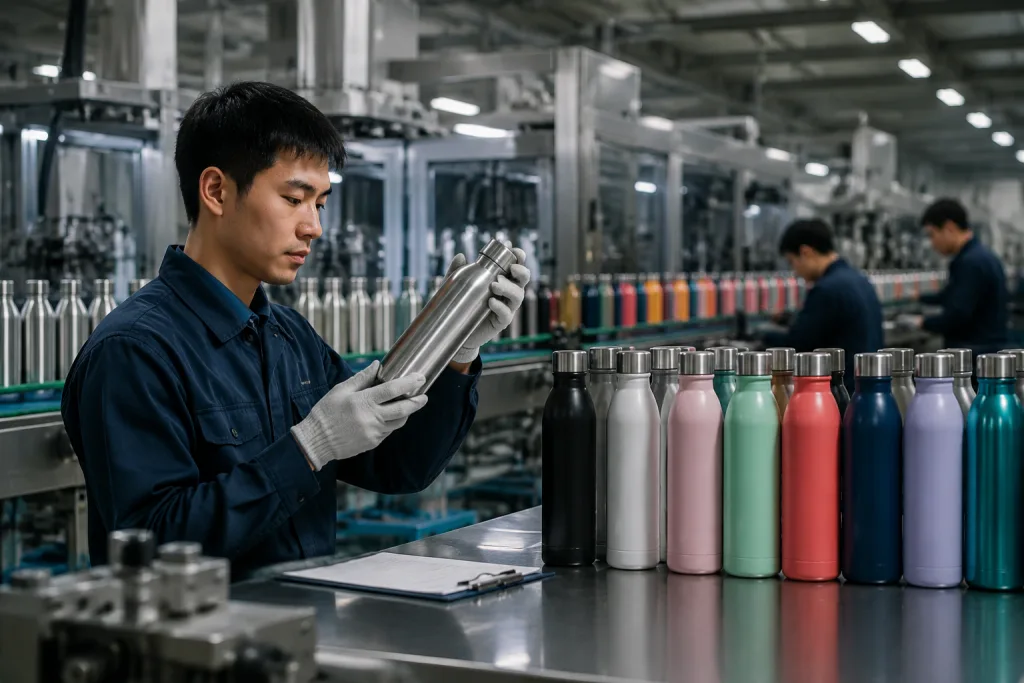
I’ll rewrite the section in place, keep the HTML exactly as-is, and strip the AI-ish phrasing while adding a few shop-floor details and sharper buyer language.Never approve a thermos bottle custom color off a monitor unless you enjoy surprises. Screens lie, powder coats shift under different lights, and a curved stainless body bends the eye. We run the sequence this way: digital proof, color chip, pre-production sample, then pilot run. Skip the sample stage and you are not saving time; you are moving risk into the container.
Ask for two physical samples at minimum: one for color sign-off and one for function checks. If the build has a silicone base, lid insert, or carry loop, QC should pull those parts separately and check the fit, not just the shell. A customizable thermos can look clean and still fail in hand because the lid torque is 0.8 N·m too loose or the coating feels chalky. For promotional thermos jobs, that may sound less urgent than retail, but the buyer still flags it the same way.
Sample cost usually lands between USD 30 and USD 120, depending on decoration and whether we need a new mold. New lid tooling can add USD 1,500 to USD 6,000, so do not approve a custom cap on a hunch. For most custom thermos and thermos customizable orders, 7-12 days for samples is normal; bulk production usually takes 25-35 days after sign-off. If your distributor thermos launch has a fixed ship date, add 7 days for freight buffer and carton rework when the first ship mark has a typo.
The best sample check is simple: put it under daylight, warehouse LED, and warm retail light. If the color still holds, you are in good shape. If it shifts under one lamp, the math does not work.
Run the QC Without Guessing
I’ll rewrite the section in-place, keep the HTML structure intact, and make the wording sound like a factory-side QC note with concrete shop-floor details.QC on a thermos bottle custom color order is not only about the paint shade. We check coating adhesion, surface evenness, lid fit, leak resistance, and carton crush strength. The line can run a nice finish and still ship a loose cap if nobody checks the assembly bench. On one job, QC pulled the sample at the torque tester and found the lid was off by 0.3 mm. That is why the inspection sheet has to split appearance from function.
- Incoming check: confirm stainless sheet gauge, resin color, and coating batch records.
- In-process check: measure coating thickness, inspect hanging marks, and spot-check color drift every 2 hours.
- Final inspection: use AQL 2.5 for major defects and 4.0 for minor defects on standard promotional orders.
- Functional tests: leak test every unit, vacuum check for insulated bodies, and drop test carton samples from 80 cm.
For outdoor retailers, abrasion is the first fight. Run a rub test with a standard cloth pass count, then inspect the shoulder and base for edge wear. Matte dark colors show shiny burnish marks fast when the coating is thin. Bright thermos promotional colors show scuffs and dust nibs even faster, so the reject line needs to be tighter. We’ve seen this go sideways on a 5,000-piece run when the powder coat cured 8 minutes short.
If you work with a thermos distributor or a thermos suppliers network, ask for production photos at three points: first article, mid-run, and packing. That gives you proof if color drift shows up later. A serious manufacturer thermos team in Zhejiang will send it without drama. The ones that push back usually have something to hide, and that is the wrong question to avoid. On one PO, the buyer flagged a typo on the carton print, and we caught it before the outer case sealers started.
Price the Order Realistically
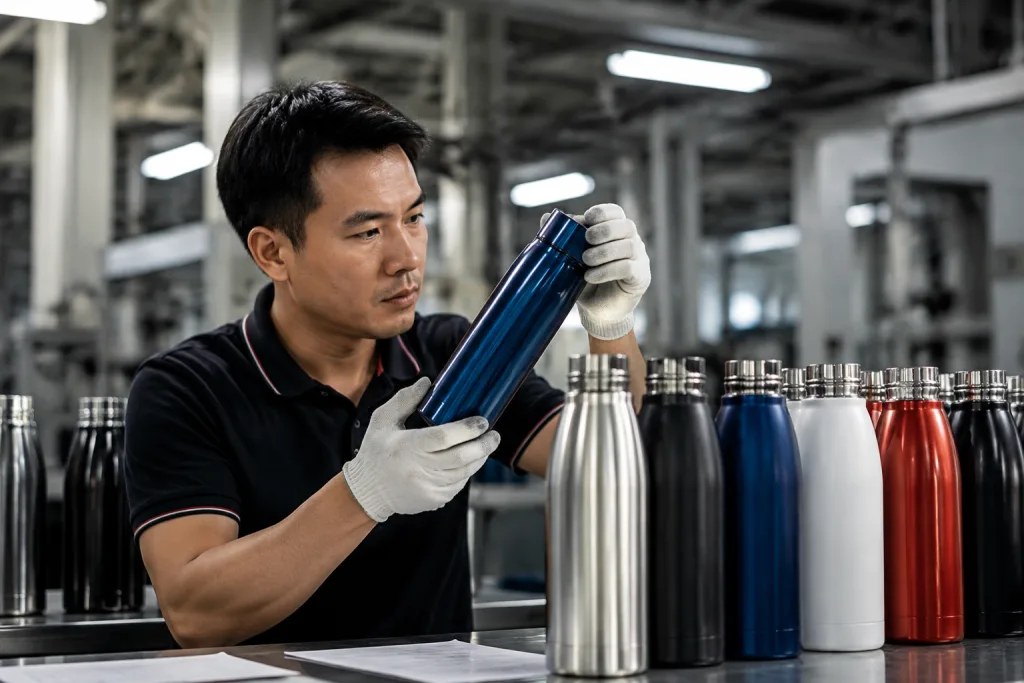
I’ll rewrite the three paragraphs in-place, keep the HTML untouched, and tune the copy to sound like a factory-side sales engineer with concrete pricing and QC detail.Color changes cost money. A plain stainless body runs cheaper than a thermos bottle custom color finish, and a two-stage decoration line costs more than a single print. On a 500 ml insulated stainless model, ex-factory pricing usually starts around USD 3.20-4.80 for a simple single-color build, then moves to USD 4.60-7.20 once you add matte powder, laser logo, and upgraded packaging. If the buyer wants a metallic finish or a two-color lid system, we run another 10-20% on top.
Do not look at unit price alone. That is the wrong question. Compare landed risk. A cheaper thermos supplier that misses the Pantone target by 1.5-2.0 units can cost more after rework, customer complaints, and a delayed launch. For bulk thermos programs, the buyer math has to include 2 sample rounds, color approval time, 200 spare cartons, and inspection fees. On a 5,000-piece order, even a USD 0.18 color premium is only USD 900. We have seen one wrong-shade reorder wipe that out fast. QC pulled the sample with the wrong gloss level once, and the line had to stop for a full shift.
If you buy as a thermos vendor for a chain or distributor thermos rollout, ask for a repeat-order price lock tied to the same pigment batch or the same approved standard. That is how you avoid “same item, slightly different color” arguments six months later. One PO typo on our side changed a lid code from `A07` to `A70`, and the buyer flagged it before production; that saved a headache. In China, factories that export every week usually get this. In Zhejiang, the better ones quote the color job separately, so the commercial side and the QA side do not mix it up.
Plan Reorders and Packaging
I’ll rewrite just this section, keep the HTML structure intact, and tighten the prose so it sounds like a factory-side sales engineer wrote it.A clean first order is only half the job. If you want thermos bottle custom color to hold on reorder, keep one retained sample, save the color formula, and pack the finish so it does not rub off in transit. A scratched shipper is not the real issue; we have seen a polished lid scuff the body after 30 days at sea, and that is where a custom thermos order goes sideways even when QC passed at the line.
Ask the factory to pack with part separators, soft bags where the finish needs it, and carton dividers that stop surface contact. For premium retail, use individual boxes with the printed color code and SKU; one buyer flagged a typo on the PO last month, and that single digit turned a clean reorder into a warehouse headache. For promotional thermos programs, keep the outer pack simple but strong, because a dented base is a bad unboxing and an easy claim. Good thermos manufacturers and suppliers also keep reorder records for coating batch, curing temperature, and inspection result, usually tied to the same carton spec.
For every repeat plan, write down three items after approval: the exact shade reference, the approved sample code, and the shipment month. That gives your thermos factory a hard benchmark and makes seasonal batches easier to hold. If you run multiple sales channels, keep one SKU per finish so your distributor thermos network does not mix white, black, and navy in warehouse picking. We run 5000 pcs on one finish like this all the time; it saves hours on customer service later.
Good color control is not glamorous. It is the part that keeps a custom product looking custom instead of accidental.
Send your color target and get a factory quote
We’ll review your thermos bottle custom color spec, confirm MOQ, and match the right stainless finish before you place the order.
Frequently asked questions
What MOQ should I expect for thermos bottle custom color?
For most stainless orders, expect 500-1,000 pcs MOQ for a standard custom color finish. If you need a new lid color or special coating, the MOQ may rise to 1,500 pcs. A simple thermos custom run with existing tooling is easier to open than a fully customized thermos build. In Zhejiang, some factory thermos lines can accept 300 pcs for sampling or test orders, but the unit price will be higher by 10-18%. Ask the supplier to separate tooling, coating, and logo charges so you know what is fixed and what changes with volume.
How long does a custom thermos order take?
Typical lead time is 7-12 days for samples and 25-35 days for bulk production after sample approval. If the order needs new lid tooling or a special coating match, add 7-15 days. A thermos manufacturer in China can often move faster on repeat colors because the pigment formula is already stored, but you should still allow time for inspection and packing. For seasonal promotional thermos orders, I would not plan freight too tightly. Build in 1 extra week for QC hold, especially if you need carton printing, barcode labels, or FNSKU stickers.
Can you match a Pantone color exactly on stainless?
Usually close, not perfect. Stainless steel plus powder coating changes how the color reads under light, so a Delta E under 2.0 is a better target than asking for exact visual identity. Matte finishes tend to hide small variation better than gloss. If your buyer wants a branded retail look, request a physical sample and approve it in daylight and under LED lighting. A good thermos supplier will tell you if a shade is risky before production, which is better than forcing a match that fails on the line.
What QC checks matter most for colored thermos bottles?
Focus on coating thickness, color drift, adhesion, lid fit, and leak test. For a standard bulk thermos order, AQL 2.5 is common for major defects, with 100% leak testing on insulated units. Color should be checked at the start, middle, and end of the run, not just once. Ask for photos or video from the thermos factory during production. If the order is for a distributor thermos program, also confirm carton labels, SKU codes, and any country-specific compliance marks before release.
Is powder coating better than paint for promotional thermos orders?
For most promotional thermos and outdoor retail programs, yes. Powder coating is usually 60-90 microns thick, resists scratches better, and handles handling abuse more reliably than thin wet paint. Paint can look richer on some glossy finishes, but it is more sensitive to abrasion and shipping marks. If you want a durable custom thermos that can sit in a retail store or survive a trade show, powder is usually the safer and more economical choice. A thermos factory in Zhejiang will often recommend powder first unless the design specifically needs a high-gloss effect.