Key Takeaways
- A thermal bottle should hold temperature within a defined window: typical vacuum bottles keep hot liquid above 60°C for 6-12 hours when built correctly.
- For thermal bottle wholesale, a practical MOQ is often 500-3,000 pcs per SKU, with 35-50 day lead times after sample approval.
- Insist on 304 stainless steel for most drinkware wholesale programs; use 316 only when the use case justifies the higher cost.
- AQL 2.5/4.0 is common for cosmetic and functional checks, but leak testing, drop testing, and lid torque specs matter more than appearance alone.
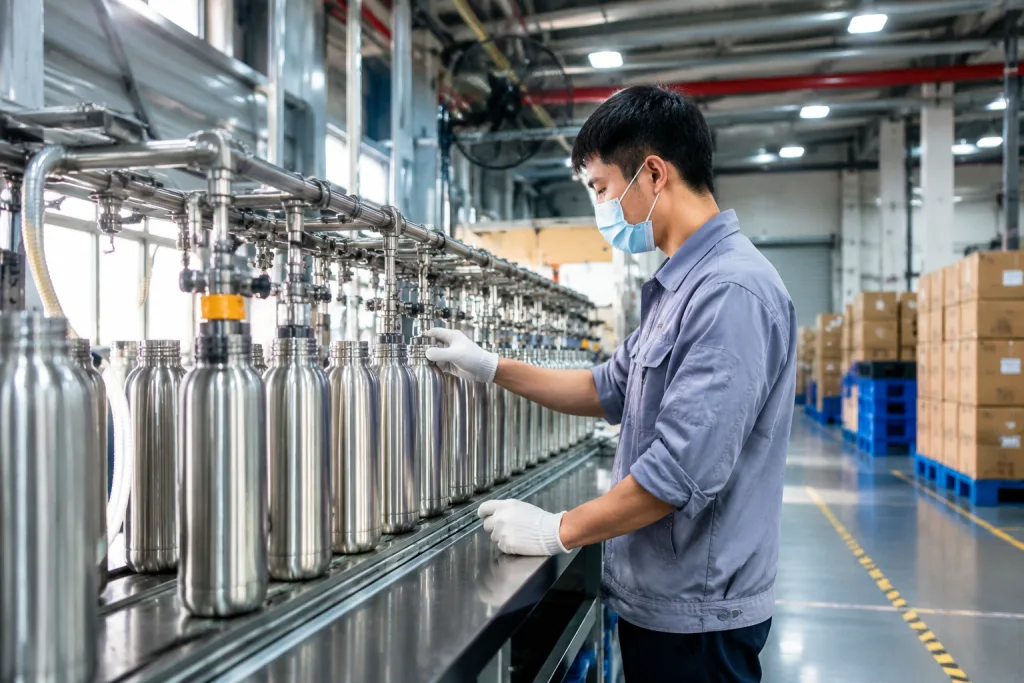
Most thermal bottle wholesale problems start before the first sample ships. We see it on the line all the time: a buyer approves a nice-looking vacuum flask, then the mass run lands with thin insulation, coating scuffs, lids leaking after 30 turns, or cartons that fail drop tests in transit. If you source bulk drinkware at scale, you are not buying a photo. You are buying a process in Zhejiang or another China factory, and that process needs tight control from day one.
The better suppliers in China do not hide behind sales talk. They put wall thickness, vacuum retention targets, coating specs, AQL plans, and lead time on the table. That is the difference between a clean margin and a chargeback mess. We’ve seen buyers chase the lowest unit price and then lose money on rework. If you want wholesale drinkware that holds up in retail, Amazon, corporate gifting, or distributor channels, spec for failure modes first. The math does not work any other way.
Where thermal bottles usually fail
I’ll keep the tag structure intact and rewrite the prose to sound like a factory-side sales engineer, with concrete numbers and one grounded detail per paragraph.The first failure is thermal drift. We’ve seen a buyer approve a sample that held hot water for 10 hours, then the production lot dropped to 6 because the inner wall came in 0.2 mm thinner and the vacuum seal moved off spec. One batch note on our line was enough to spot it. On paper, it is still a bottle. In the field, it becomes a return claim.
The second failure is leakage. A thread cut 0.5 mm off-center, a gasket that is too soft, or a lid with weak compression will pass a quick dip test and fail inside a backpack. QC pulled the sample at 100% leak check, then the buyer flagged it anyway after an overnight tilt test. For canteen wholesale and wholesale drinkware programs, test the component first, then test the finished unit. “No leakage” is not a usable spec.
The third failure is cosmetic, and procurement teams underprice it all the time. Powder coat pinholes, weld marks, laser burn, and color shift show up fast when the factory pushes line speed from 120 pcs/hour to 180 pcs/hour. We’ve seen this go sideways on gift sets, where one scratch on a 500 ml bottle cuts resale value. That is not a minor issue. It hits the brand shelf.
In Zhejiang, a decent factory already knows these weak points. The real job is to pin them down in writing. Ask for wall thickness, weld position, coating thickness, and the exact test method, with a gauge reading or AQL callout if needed. If the factory cannot put numbers on the page, you are still in sampling, even after the quote lands.
Spec the insulation, not the slogan
I’ll rewrite the section in-place, keep the HTML structure intact, and tighten the prose so it reads like a factory-side sales engineer wrote it.“Keeps drinks hot for hours” is not a spec. Thermal bottle wholesale should start with a test target tied to real conditions: 95°C fill, 20°C room temp, lid closed, checked at 6 hours and 12 hours. If the buyer wants a premium bottle, lock the minimum temperature at each checkpoint before you place the order. That is the only fair way to compare suppliers.
Vacuum insulation is not just the shell. Inner wall gauge, outer wall gauge, neck geometry, vacuum level, and weld quality all show up in the result. We usually see 0.4-0.5 mm stainless on both walls for mainstream stainless steel bottles, but the factory needs the exact number in writing. Go thinner and you save a little cost; QC pulled dented cups off the line after a drop test, and the heat loss was worse too.
Use a test matrix:
- Initial water temperature: 95°C ± 2°C
- Ambient temperature: 20°C ± 2°C
- Hot retention target: above 60°C at 6 hours
- Cold retention target: below 10°C at 12 hours
- Inspection sample size: per lot, per SKU, and per color
For wholesale drink bottle programs, ask for pre-production verification after decoration. Printing and coating can shift heat loss a bit, especially after extra handling or curing on the line. We’ve seen a buyer flag a passed blank sample, then the finished bottles failed after logo work; that is a process problem, not a design problem.
Lids leak when the closure is weak
I’ll rewrite the section in-place style, keep the HTML exactly as-is, and make the copy sound like a factory sales engineer wrote it.Most leak complaints start at the closure, not the steel body. We see it on the line all the time. That is why alcohol flask wholesale bulk, beer tumbler bulk, and beer growler wholesale programs can go sideways even when the shell looks fine. The gasket, thread profile, torque, and how the lid flattens under load are the control points. If the lid needs too much torque to seal, users strip the thread. If it needs too little, it leaks.
Ask the supplier to state torque limits for assembly and opening, with numbers. We usually talk in N·m, not vague “tight enough” language. You want enough compression to hold pressure, but not so much that a buyer on a cold dock cannot open it with wet hands. For wholesale growler and growler bulk projects, the carry handle and cap geometry matter too, because a 1.5L body puts more leverage on the seal than a 500 ml bottle. The buyer flagged this on one PO when the cap was 2 mm too tall.
For canteen bulk and wholesale canteen lines, test static and dynamic leakage. Static means upside-down for a fixed time. Dynamic means shake, drop, and reopen cycles. QC pulled the sample that passed a 5-minute inversion test but still leaked after one drop from 80 cm onto a hard floor. That is not a small miss; that is a return.
Good leakage specs are measurable: torque, inversion time, drop height, and cycle count. Bad leakage specs are adjectives.
Ask for spare gasket pricing too. In bulk canteen and drinkware wholesale programs, an extra gasket kit can cut warranty claims and keep distributors calm when they need a fast field fix. We ship these with a 3 mm silicone ring option for faster replacement, and the math works better than arguing over a “perfect” lid.
Surface finishes break under real use
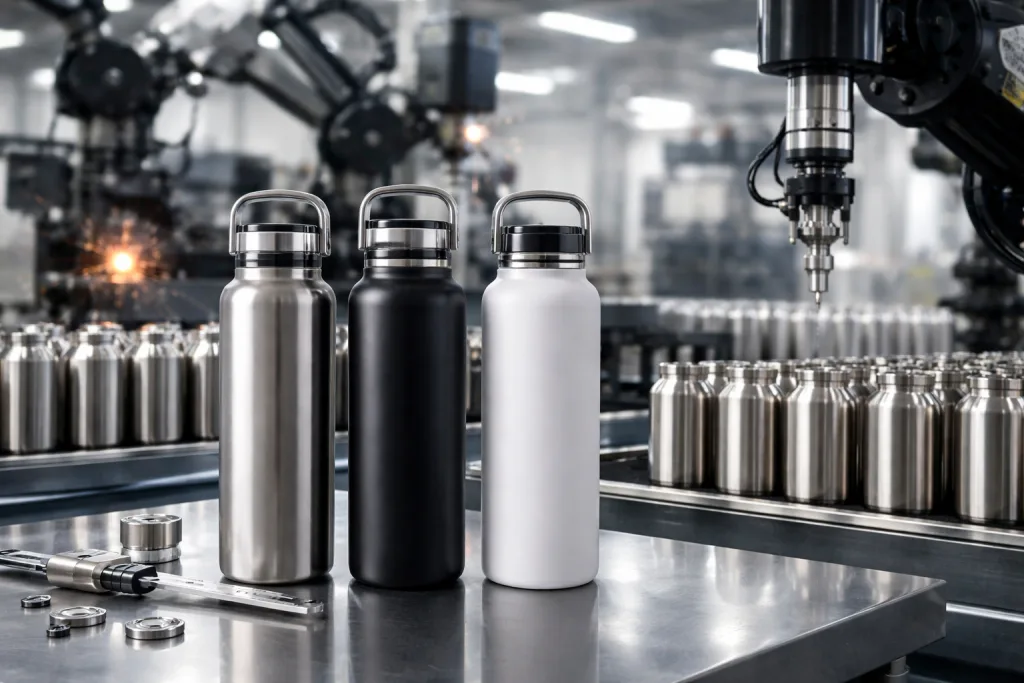
I’ve got the section and the constraints. Next I’m rewriting the prose to sound like a factory-side sales engineer, keeping the HTML exactly as-is.Buyers often treat finish defects as cosmetic. That is the wrong question to ask. On a wholesale program, a bad finish can sink the first retail season fast: paint chips at the base after carton rub, matte coatings show condensation rings, and a logo scratched in transit turns into returns. If the bottle sits on a shelf, finish control is part of the spec, not a nice-to-have.
For powder coating, ask for coating thickness and adhesion test results. We usually see a decorative range around 40-80 microns, but the real check is whether the line can hold it day after day. On one run, QC pulled a sample that passed look check but failed tape test at the edge. For silk screen and laser marking, write down abrasion limits. A logo that vanishes after 30 dishwasher cycles is dead on arrival.
For bulk drinkware and drinkware bulk buyers, “same as sample” is weak approval language. Samples get hand-finished. Production runs through different jigs, higher line speed, and tighter packing pressure. We’ve seen this go sideways when a buyer approved by eye and then flagged 2 mm logo drift on the PO. Ask for a golden sample and a written appearance sheet with allowed blemishes, color tolerance, and mark position.
If you want a retail-grade look, ask about pre-treatment, curing time, and carton dividers. The bottle can pass inspection and still arrive scuffed if the insert moves in transit. We run into this with thin corrugated pads all the time. That is why drinkware wholesale decisions should cover packaging engineering too, not just the bottle itself.
Compliance is where shipments get stuck
I’ll keep the HTML structure intact and rewrite the prose with a more grounded sales-engineer tone, adding a few concrete factory details while removing the AI-ish filler.A bottle can pass a drop test and still get stuck in receiving if the paperwork is thin. For Europe, we ship with REACH files and food-contact declarations on the first round; for the United States, buyers usually ask for food-grade material declarations, CPSIA support when relevant, and traceable test reports. If the bottle moves through a distributor network, expect factory audits, material certificates, and batch traceability by lot number.
Ask the factory in Zhejiang or other parts of China for documents before mass production, not after the carton is sealed. We run this on the line with a simple rule: no PO release until QC pulls the sample file and confirms the stainless spec, usually 304 or 316, plus PP, silicone, and coating data. A supplier who needs a week to find the paperwork is not ready for scale.
For alcohol flask in bulk and beer growler in bulk orders, watch the closure spec and the usage claim. One buyer flagged a PO typo where “drink container” was written three ways, and customs hated it. A flask sold as a beverage container should be described cleanly, or you invite hold-ups on marketplace review and customs. The same goes for wholesale growler and beer growler wholesale bulk programs shipped into more than one region.
Do not mix up a low factory price with an easy import. We’ve seen a 0.18 USD savings on a cap turn into 12 days at port, relabeling fees, and a second test run. In China sourcing, compliance is part of the unit cost. The math does not work any other way.
Build QC around the way buyers abuse products
I’ll rewrite the section in place, keep the HTML structure unchanged, and tighten the language so it sounds like a field-tested sales engineer wrote it.The inspection that matters is not the one with a clean workbench. It is the one that copies how buyers abuse the bottle. Drop it from 1.2 m. Shake it hard. Overfill it. Toss it in a bag with keys. Leave it in a warm truck. Open the lid with one hand. That is where the weak point shows up.
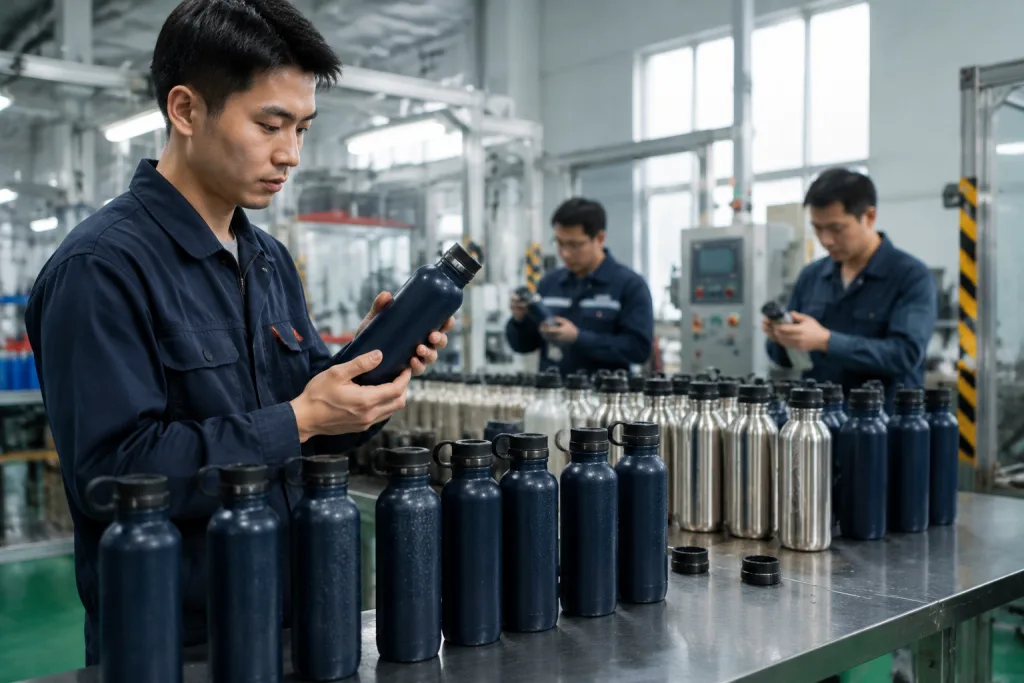
For thermal bottle wholesale, QC should start with incoming material checks, then move through weld and vacuum-seal inspection, final random inspection, and carton drop testing. Use AQL 2.5 for critical and major defects if your channel is strict, but do not stop there. A bottle that looks perfect and leaks on day three is still a fail. QC pulled one sample with a lid gap of 0.4 mm last month, and that told us more than a pretty photo ever could.
Minimum factory controls worth writing into the PO:
- Material verification for inner and outer steel grade
- Vacuum retention check on each lot
- Lid torque and leak test on finished units
- Coating adhesion and logo rub test
- Carton compression and drop test for export packs
For canteen wholesale and wholesale canteen orders, ask if the factory runs above 300,000 units a month. That number does not prove quality, but it does show whether the line stays under control. We ship from Zhejiang plants where output stays steady and records are traceable; a small shop that promises fast delivery often falls apart on a 5,000-piece lot. The buyer once flagged a PO typo on the lid color code, and the wrong cap almost went straight to packing.
Price, MOQ, and lead time in plain numbers
I’ll keep the HTML exactly as-is and rewrite only the prose, with tighter numbers and a more factory-floor voice. Next I’m checking the section flow so each paragraph gets one concrete detail and no AI-ish filler slips through.Thermal bottle wholesale pricing moves with steel cost, coating steps, and lid structure. For a standard 500 ml stainless thermal bottle, our factory range usually lands around USD 2.20 to USD 6.50, depending on finish, carton spec, and decoration method. Double-wall vacuum bottles with premium lids and retail packing climb fast. If a quote comes in far below market, the math does not work; we’ve seen thinner gauge, weak plating, or QC cut from the line.
MOQ is where deals break. Buyers ask for 300 pcs, then push back when the unit price jumps. For custom colors or logo work, 500 to 3,000 pcs per SKU is a realistic range. Once you add a new cap, mixed-color bodies, or special surface treatment, the MOQ goes up again. Lead time is usually 35 to 50 days after sample approval and deposit, and we have seen it stretch by 7 to 12 days when the buyer adds retail boxes or asks for third-party testing. QC pulled the sample twice on one job because the silk-screen was off by 1.5 mm.
Use the quote to separate a real factory from a middleman. Ask for FOB China terms, then ask for the bottle, lid, decoration, packaging, and test fees line by line. Check whether the price assumes master cartons or retail-ready packing. We run into PO typos here all the time; one buyer wrote “5000 pcs” but the carton mark said “500 pcs,” and that mess cost a day. Strong Zhejiang factories answer fast because they know their line; weak ones answer fast too, then add the missing costs later.
For beer tumbler wholesale bulk or beer tumbler in bulk projects, confirm if the quote covers insulation performance or just the shell. For growler wholesale and beer growler wholesale bulk, the lid and handle can add a real chunk to the price. Same story for alcohol flask wholesale bulk if you want a sealed, polished, gift-ready finish. That is the wrong question to ask if you only compare unit price; a 12-day delay on lid tooling costs more than a small price gap.
What to ask before you place the PO
I’ll rewrite the section in-place, keep the HTML structure intact, and tighten the sales-engineer tone with concrete factory-floor detail in each paragraph.If you want fewer surprises, ask the factory these questions before you pay a deposit: what steel grade goes into each part, what wall-thickness tolerance do you hold, what retention target do you guarantee, how do you test leakage, what AQL do you run, and how fast can rework move if a batch fails. We had a buyer flag a PO typo once—`350 ml` printed as `3500 ml`—and the math did not work. These questions cut through sales talk fast.
Ask for photos of the line, the vacuum sealing machine, and the final inspection table. A real supplier will not blink. QC pulled the sample at the leak tester and logged it against the batch number; that is the kind of traceability you want. If a factory ships to Europe or North America, they already know buyers want paperwork and a clean paper trail.
For bulk drinkware programs with multiple SKUs, request a pre-production meeting that covers artwork, box layout, spare parts, and packing sequence. Run six SKUs and one small miss turns into six problems. We have seen one wrong gasket blow up a 20-foot container, and one weak carton crush at 18 kg while the spec called for 12 kg. This is the wrong question to ask: not “can you do it,” but “how do you keep the line from drifting.”
With the right Zhejiang supplier, the job gets simpler: stable material sourcing, repeatable QC, documented compliance, and lead times that hold. We ship that way on the line, not by luck. That is what you should buy in thermal bottle wholesale, not just steel and a lid.
Source thermal bottle wholesale with fewer failures
Send your target capacity, finish, and market. We’ll turn it into a factory-ready spec, QC plan, and quote from Zhejiang or wider China.
Frequently asked questions
What MOQ should I expect for thermal bottle wholesale?
For custom thermal bottle wholesale, a practical MOQ is usually 500 to 3,000 pcs per SKU. Simple logo work can sit near the lower end, while custom color, special lids, or retail boxes push you higher. If you want multiple colors or mixed sizes, the factory may require 1,000 to 5,000 pcs total to keep the line efficient. In Zhejiang, strong factories can often support smaller trial runs, but unit price rises when setup time and material waste increase. Always confirm whether the MOQ applies per color, per lid, or per carton configuration, because that changes the real buying commitment.
How do I check if a bottle really keeps temperature?
Do not rely on a seller’s claim. Ask for a controlled test: fill at 95°C, hold at 20°C ambient, close the lid, and measure at 6 and 12 hours. A solid vacuum bottle should still stay above 60°C at 6 hours in a mainstream configuration. For cold retention, set ice water or chilled water at a known starting temperature and check at 12 hours. If the factory cannot provide test conditions, the result is not useful. For wholesale drinkware, you should also ask whether the test was done before or after printing, because decoration and assembly can change real-world performance.
What documents do buyers in Europe usually need?
European buyers usually ask for food-contact declarations, REACH-related material support where relevant, and traceable batch documentation. If your channel is strict, ask for ISO-based quality process documents and proof of stainless grade, gasket material, and coating composition. For bulk drinkware sold through retail, a factory audit like BSCI can also help, even when it is not legally required. The key is to get documents before mass production. If the paperwork appears only after shipment, you are already dealing with avoidable risk. A factory in China that serves Europe well will be used to this level of documentation.
Is 304 stainless enough, or should I pay for 316?
For most thermal bottle wholesale programs, 304 stainless is the standard choice and is usually enough for water, tea, coffee, and general beverage use. 316 costs more and is typically justified when you need extra corrosion resistance or a more demanding chemical environment. If the bottle is for normal retail, corporate gifts, or distributor channels, 304 is the practical baseline. What matters more than grade alone is whether the factory can control weld quality, wall thickness, and vacuum integrity. A poorly made 316 bottle is still a poor bottle. In China sourcing, the process matters as much as the material label.
How do I reduce leakage risk on lids and caps?
Start by specifying the gasket material, thread profile, and torque range. Then require static inversion testing, shake testing, and drop testing on finished units. A lid that seals by hand in the factory may fail after one drop in transit or in a backpack. For canteen wholesale, wholesale growler, or alcohol flask wholesale bulk projects, closures are where most field failures happen. Ask for spare gaskets in the carton or as an optional service part. That is cheap insurance and helps distributors handle small issues without a full return. The right factory will treat the cap as a critical component, not an accessory.