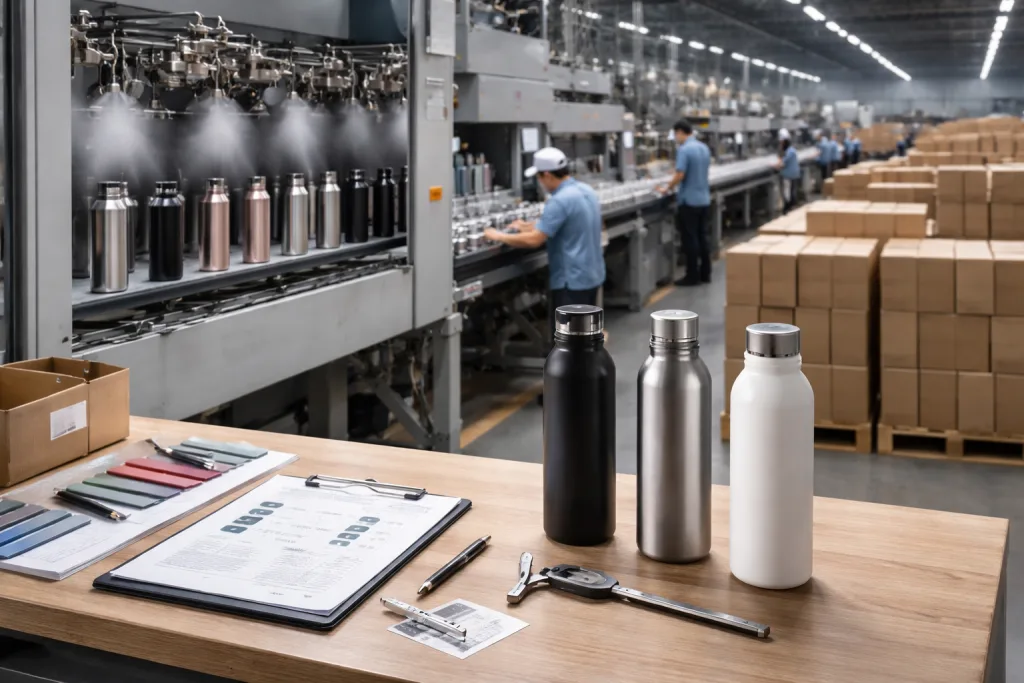
Key Takeaways
- A realistic 500 ml stainless thermal bottle FOB range is USD 3.20-6.50 at 3,000-10,000 pcs
- Custom logo MOQ usually starts at 1,000 pcs per color, but custom mold work is closer to 5,000-10,000 pcs
- Normal production lead time is 25-40 days after deposit and artwork approval
- AQL inspection, REACH/LFGB testing, and packaging upgrades can add USD 0.08-0.45 per unit
You are not buying “a bottle.” You are buying 304 stainless thickness, vacuum hold rate, logo reject risk, carton CBM, AQL 2.5 inspection time, and space in a 40HQ. That is why one supplier quotes USD 3.20 and another quotes USD 6.80 for a 500 ml thermal bottle that looks the same in a photo. On our line, QC pulled a 500 ml sample last month with a 0.18 mm body wall when the PO said 0.20 mm. Small number. Big cost gap.
At our Hangzhou, Zhejiang facility, we run stainless drinkware for brands and distributors that need repeat orders, not one lucky container. China still gives good value, but the wrong question is “what is your cheapest price?” Ask what is included. A proper thermal bottle wholesale price should show MOQ, steel grade, decoration method, packaging, testing standard, lead time, and FOB terms clearly. We ship better when the buyer confirms these points before tooling; we have seen orders go sideways over one missing line on a carton mark file.
What The Price Really Includes
I’ll rewrite the section in-place, keep every HTML tag and number intact, and trim the AI-ish phrasing while adding more factory-floor detail and a firmer sales tone.When you ask for a thermal bottle wholesale price, do not take a single number without a specification sheet. A proper quotation should list capacity, steel grade, wall thickness, lid material, coating, decoration, carton size, packing method, MOQ, payment terms, and Incoterm. If any one is missing, the price is still a guess.
For a common 500 ml double-wall vacuum bottle from China, the cost base usually starts with SUS304 inner steel and SUS201 or SUS304 outer steel. Wall thickness usually sits at 0.4-0.5 mm for mainstream wholesale drinkware. Go thinner and you may save USD 0.10-0.25, but dent claims go up and the product feels cheap in hand. For premium programs, full SUS304 construction looks cleaner for compliance and sales, but it can add USD 0.25-0.60 per unit depending on steel market pricing.
The vacuum process matters. A bottle that holds hot water for 6 hours is cheaper than one tested for 12-18 hours under controlled conditions. Better retention means tighter welding, cleaner inner surfaces, and more rejects on the line. QC pulled the sample on one run and the first leak check already showed why the cheap quote was cheap. You pay for those rejects whether the supplier says so or not.
At BottleForge Industrial in Zhejiang, our monthly drinkware capacity is about 450,000 units across thermal bottles, tumblers, canteens, growlers, and flasks. We run that volume with laser welders, but scale does not erase cost drivers. A low price with no defined AQL level, no carton drop test, and no stated steel grade is not a sourcing win. It is delayed trouble, and we have seen that go sideways after the buyer flagged a PO typo on the carton count.
MOQ Tiers Change The Math
I’ll rewrite the section in-place, keep the HTML structure intact, and tune the copy to sound like a factory-side sales engineer.MOQ is where first-time buyers miss the math on wholesale pricing. The factory is not just counting steel and lids. We run line setup, powder coating changeover, logo setup, jig prep, carton buying, and QC time. On the line, 500 pcs and 5,000 pcs are two different jobs.
For standard thermal bottles, use these working tiers:
- 500-999 pcs: sample market orders or distributor tests, usually USD 5.80-8.50 FOB for 500 ml with a simple logo.
- 1,000-2,999 pcs: practical custom logo MOQ, usually USD 4.30-6.80 FOB, depending on finish and packaging.
- 3,000-9,999 pcs: normal wholesale drinkware range, often USD 3.20-6.50 FOB.
- 10,000+ pcs: program pricing, custom color matching, tighter component control, and USD 0.20-0.70 savings per unit are realistic.
These tiers also show up in related bulk drinkware, but not on the same scale. A bulk canteen or wholesale canteen with a basic screw cap can price below a thermal bottle. A bulk growler or wholesale growler, especially a 64 oz beer growler bulk order, uses more steel and bigger cartons, so freight hits harder. Canteen bulk orders can start at 1,000 pcs; growler bulk projects usually make more sense at 2,000-3,000 pcs because carton volume eats the space. QC pulled the sample once and found a 3 mm carton gap, and the buyer flagged it right away.
If you are sourcing drinkware bulk for a retail chain, ask for tiered quotations at 1,000, 3,000, 5,000, and 10,000 pcs. This is the right question to ask. It shows where the supplier’s real production efficiency starts, and we have seen it go sideways when a buyer only asks for one flat price.
Materials, Lids, And Compliance Costs
I’ll rewrite just the HTML prose, keep the tags intact, and tighten the sales-engineer tone with concrete cost/detail cues.Material choice is the main reason wholesale prices split. SUS304 inner steel is the normal spec for drinking contact. SUS316 gives better corrosion resistance, but on standard thermal bottles it is usually overkill and can add USD 0.60-1.20 per unit. We run a lot of outdoor canteen orders on SUS304, and it holds up if the seam, coating, and cap seal are done right.
Lids are where quotes start drifting. A basic PP screw lid with a silicone gasket may cost USD 0.25-0.45. A push-button lid, straw lid, carry-loop lid, or leakproof sports cap can add USD 0.40-1.20. If the buyer wants two lids in one set, add another USD 0.50-1.50 and expect the carton to grow. For alcohol flask wholesale or alcohol flask bulk programs, threading tolerance and weld quality matter more than decoration; QC pulled the sample, shook it for 30 seconds, and any seepage was a red flag.
Compliance is not a line item you can trim away for Europe and North America. For EU orders, ask for LFGB, REACH, and food-contact declarations. For the US, FDA food-contact checks and, on kids’ products, CPSIA or ASTM-related testing may apply. Lab testing usually costs USD 180-600 per material set, depending on scope. At 5,000 units, the math works. At 500 units, it does not.
Coating also moves the price. Powder coating is common and durable, usually adding USD 0.35-0.90 versus bare stainless. Spray paint can come in cheaper, but abrasion claims show up fast on the line. Mirror polishing looks clean, then the buyer flags a scratch after one carton test. If your brand wants the best wholesale drink bottle for repeat orders, do not chase a saving that disappears the first time the bottle hits a desk.

Decoration And Packaging Price Adders
I’ll rewrite the section in-place, keeping every HTML tag and structure intact while making the prose sound like a factory-side sales engineer wrote it.Logo work looks small on a purchase order, but it drives both unit price and lead time. We run laser engraving on a fiber laser; it stays permanent and holds up on stainless or coated shells. It usually adds USD 0.08-0.25 per unit. One-color silkscreen usually lands at USD 0.06-0.18, while multi-color print needs extra screens, setup time, and register checks at the line. Heat transfer and full-wrap art can add USD 0.40-1.20 per unit, and if QC pulled the sample with pinholes, the scrap loss shows up fast.
For private-label wholesale drinkware, packaging often costs more than the buyer expects. A plain white box may be USD 0.12-0.25. A printed color box may be USD 0.25-0.60. Kraft gift tubes, molded inserts, barcode labels, retail hangtags, and instruction sheets can push packaging above USD 1.00. If you sell online, carton strength matters. A weak master carton saves USD 0.03 on paper cost and later triggers chargebacks. We’ve seen that go sideways on a 12 kg drop test.
Amazon-style prep, including FNSKU labeling, suffocation warning bags when needed, carton labels, and pallet rules, is another layer. We quote it separately because one buyer wants exact warehouse routing and another only needs export cartons. For a PO with 480 pcs and mixed SKUs, the buyer flagged a carton count typo, and that alone cost half a day. For drinkware wholesale into distributors, mixed-SKU carton packing can slow the line and add USD 0.05-0.15 per unit.
The same logic applies to beer tumbler wholesale, beer tumbler bulk, and beer tumbler in bulk programs. A tumbler may start cheaper than a thermal bottle, but a slide lid, straw set, powder coating, and retail box close the gap fast. Beer tumbler wholesale bulk orders should lock lid type and packing style before we price them; otherwise the math does not work. On one run, a 3 mm lid gasket spec changed after sample approval, and the rework wiped out the margin.
Lead Time From Artwork To FOB
I’ll rewrite the section in place, keep the HTML intact, and tighten the timeline with concrete shop-floor details and fewer generic phrases.A reliable timeline beats a hopeful promise. For most custom thermal bottle projects in China, count 25-40 days after deposit, confirmed artwork, and an approved pre-production sample. If the order needs a new mold, add 20-35 days. If the color must match Pantone, add 5-10 days for lab dips and sign-off.
A working timeline looks like this:
- Day 1-3: confirm spec, target price, MOQ, and quotation; the buyer flags a 12 oz typo here and we fix it before the line starts.
- Day 4-7: artwork layout, Pantone confirmation, and PI deposit; QC pulled the print file once because the logo sat 2 mm off center.
- Day 8-15: sample preparation for standard models, longer for new tooling; the laser welder queue decides the pace.
- Day 16-20: sample review, packaging proof, and production file lock; this is where one lid shade can hold the order.
- Day 21-50: material forming, welding, vacuuming, coating, printing, packing; the line runs in that sequence, and one missed check wastes a full shift.
- Day 51-55: AQL inspection, carton marking, booking, and FOB handover; we ship only after the carton drop test and pallet count pass.
Peak season changes the math. Before summer retail launches and Q4 gift programs, coating lines and carton suppliers fill up fast. In Zhejiang and nearby China supply clusters, a quoted 30 days can slide to 45 days if artwork lands late or the buyer changes lid colors after sample approval. We’ve seen that go sideways more than once.
For beer growler wholesale, beer growler in bulk, and beer growler wholesale bulk orders, expect extra handling because the unit is bulky and carton volume is high. A 64 oz stainless growler takes more pallet space, so freight booking needs to start earlier, especially for sea shipments to the US West Coast or Europe. Air freight works on paper, but the math doesn’t work unless the margin is strong.
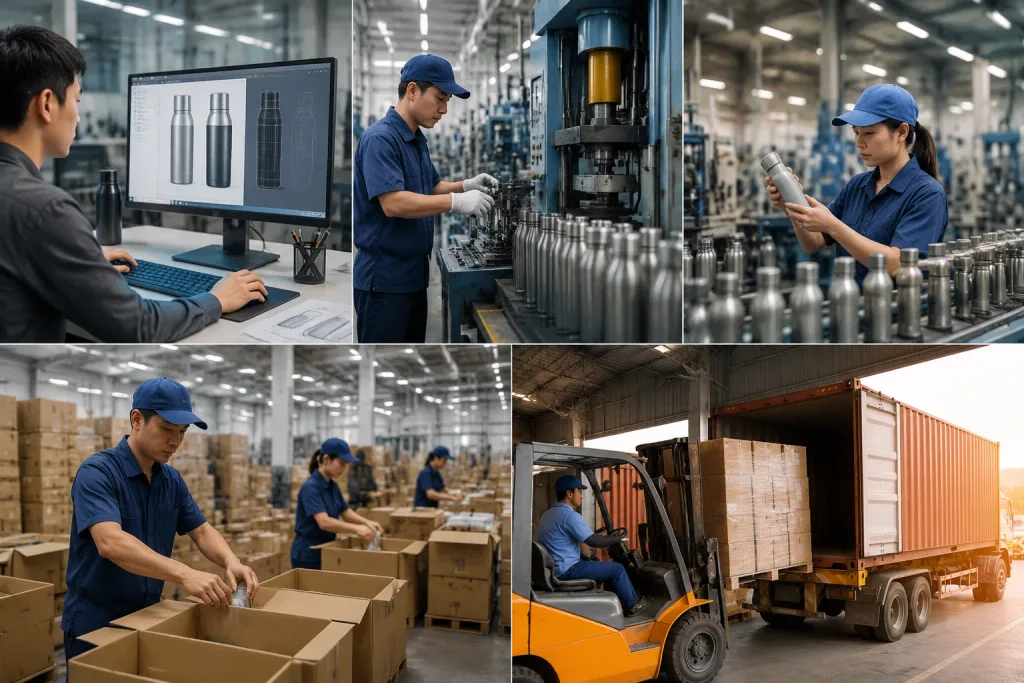
Freight, Incoterms, And Landed Cost
I’ll rewrite the section in-place, keep the HTML exactly as-is, and tighten the sourcing language so it sounds like a factory-side sales engineer.FOB price is not landed cost. A thermal bottle at USD 4.20 FOB Ningbo may land at USD 5.10 or USD 6.40 once you add carton volume, duty, inland trucking, inspection, and warehouse charges. We see this every week on the line. Drinkware often runs out of cube before it runs out of weight, especially with gift boxes or oversized growlers.
For a 500 ml bottle in individual box packing, a 40HQ container may hold about 45,000-60,000 pcs, depending on bottle shape and carton design. A 64 oz growler can cut that number hard. QC pulled the sample, checked the carton at 58 x 38 x 26 cm, and the cube told the story. That is why wholesale growler programs should be checked by CBM, not just unit price. The same logic applies to wholesale canteen orders with chunky carry handles or wide caps.
Ask your supplier for carton dimensions, gross weight, net weight, units per carton, and estimated CBM per 1,000 pcs. With those figures, your freight forwarder can price sea freight, rail, or truck delivery without guessing. We had a buyer flag a PO typo once—`1,0000` instead of `1,000`—and the freight quote blew up the math. If a supplier cannot send packing data before production, they are not ready for serious bulk drinkware sourcing.
Incoterms matter. FOB is common because you take control after the China port. EXW can look cheaper, but it pushes local trucking, export handling, and customs declaration risk onto you. DDP feels easy for small orders, but duty and compliance assumptions sit inside the price, and that is where deals go sideways. For procurement managers, FOB Ningbo or FOB Shanghai is usually the cleanest comparison basis when buying from Zhejiang factories.
How To Compare Supplier Quotes
I’ll rewrite the section in place, keeping the HTML tags and the existing structure, while stripping out the AI-sounding phrasing and adding a few concrete factory details.Do not compare two quotes by unit price alone. Use a simple quote matrix with 12 fields: capacity, steel grade, wall thickness, lid type, coating, decoration method, packaging, MOQ, sample fee, production lead time, AQL level, and Incoterm. If a supplier leaves three fields blank, that low price is not a real comparison. We see this on the line all the time.
For alcohol flask wholesale bulk, alcohol flask in bulk, and alcohol flask wholesale programs, add leak test method and cap material to the matrix. For beer growler wholesale bulk and beer tumbler in bulk, add carton CBM, because a 0.08 CBM box can change landed cost more than a $0.12 factory difference. For canteen bulk and wholesale canteen programs, add strap, carabiner, or handle material; we’ve had a 20 mm webbing strap fail in QC before the bottle body did.
Quality inspection has to go into the PO. A common inspection level is AQL 2.5 for major defects and AQL 4.0 for minor defects, though premium retail orders may use tighter limits. Define critical defects in plain terms: leakage, sharp edges, wrong material, failed vacuum, wrong logo, and severe coating damage. “Good quality” does not help when the cartons are sealed. The buyer flagged a typo once on the PO, and that one line saved a 3,000-piece rework.
A fair supplier will not always be the cheapest. They will tell you why the price changes when you adjust coating, MOQ, lid, or packaging, and the math should add up. That is the right question to ask a China manufacturing partner. If you want stable wholesale drinkware, ask for the assumption sheet, not a heroic discount. We run this way on our own quotes, and the buyers who push back on blank fields usually save money later.
Get a line-by-line bottle cost quote
Send your target model, quantity, logo, and market. We will return MOQ, FOB price, packing data, and lead time assumptions.
Frequently asked questions
What is a realistic thermal bottle wholesale price for 500 ml?
For a standard 500 ml double-wall stainless thermal bottle, a realistic FOB China range is USD 3.20-6.50 at 3,000-10,000 pcs. The low end usually means SUS304 inner with SUS201 outer, simple lid, no retail packaging, and one-color logo. The higher end may include full SUS304, powder coating, better lid construction, laser logo, color box, and tighter inspection. At 1,000 pcs, expect USD 4.30-6.80 because setup costs are spread over fewer units. Below 500 pcs, you are closer to sample-order pricing, not true wholesale.
Can I mix thermal bottles, canteens, growlers, and tumblers in one order?
Yes, but mixed bulk drinkware orders need planning. Factories usually calculate MOQ by model, color, and decoration method, not just total order quantity. You might order 1,000 thermal bottles, 1,000 wholesale canteen units, 1,000 beer tumbler wholesale units, and 500 bulk growler units, but each SKU still needs separate setup, artwork, packing, and inspection. Mixed orders can save on shipment consolidation, but they rarely get the same unit cost as 5,000 pcs of one model. For first orders, keep colors and lid types limited.
How long does production take after I approve the sample?
For standard models, production usually takes 25-40 days after deposit, artwork approval, and pre-production sample approval. Add 5-10 days for custom Pantone coating approval and 20-35 days for new mold tooling. Large programs above 20,000 pcs may need phased delivery, especially during peak season. AQL inspection normally takes 1 day on site, but booking, inspection reporting, and container loading can add 3-5 days. If your retail launch date is fixed, start sourcing at least 90 days before the required warehouse arrival.
Why is my growler or flask quote higher than bottle pricing?
A wholesale growler or alcohol flask wholesale order has different cost drivers. A 64 oz beer growler bulk product uses more steel, larger tooling, bigger cartons, and more container space than a 500 ml bottle. A hip flask may look smaller, but welding, polishing, cap threading, and leak testing are more sensitive. Beer growler in bulk and alcohol flask in bulk orders should always include leak test standards, cap material, and carton CBM. Otherwise, the FOB price may look fine while the landed cost or defect risk becomes the real problem.
What details should I send to get an accurate quote?
Send capacity, target FOB price, order quantity, delivery country, steel preference, lid type, coating color, logo method, packaging style, compliance market, and target ship date. If you have a reference sample, provide photos, dimensions, weight, and performance requirement such as 12 hours hot retention. For drinkware wholesale, also state whether you need barcodes, FNSKU labels, palletization, or distributor carton marks. With that information, a factory can quote within 24-48 hours. Without it, you will only receive a rough price that changes later.